
John 19:4
in John 19Once again Pilate came out and said to the Jews, “Look, I am bringing Him out to you to let you know that I find no basis for a charge against Him.”
BSB
The same verse in ASV and KJV ▾
ASV
And Pilate went out again, and saith unto them, Behold, I bring him out to you, that ye may know that I find no crime in him.
KJV
Pilate therefore went forth again, and saith unto them, Behold, I bring him forth to you, that ye may know that I find no fault in him.
⋯
This verse in John 19
Commentary
11 notes on this verseHe confesses the wrong he had done, and is not ashamed. For he admitted that he had scourged Him without a cause, and declares that he will show Him unto them, supposing that he would glut their savage passion by so pitiable a spectacle, and well-nigh accuses them henceforth, and that publicly, of putting Him to death unjustly, and of compelling him openly to be a law-breaker, who, if he transgressed his own laws, could not escape scot free.
This site's exposition
I find no basis for a charge against Him
on John 19:4-5
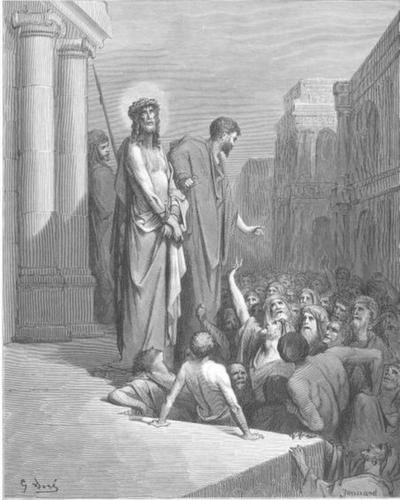
Pilate brings Jesus out beaten, the crown and the robe still on Him, and says again that he finds no basis for a charge. Here is the man, ecce homo in the Latin, is the line the church has carried ever since. Pilate's aim was political.
The record, by era
The Church Fathers1 voice
"Pilate went forth again, and saith unto them, Behold, I bring him forth, that ye may know that I find no fault in him. Then came Jesus forth, wearing the crown of thorns and the purple robe. And he saith unto them, Behold the man!" Hence it is apparent that these things were done by the soldiers not without Pilate's knowledge, whether it was that he ordered them or only permitted them, namely, for the reason we have stated above, that His enemies might all the more willingly drink in the sight of such derisive treatment, and cease to thirst further for His blood. Jesus goes forth to them wearing the crown of thorns and the purple robe, not resplendent in kingly power, but laden with reproach; and the words are addressed to them, Behold the man! If you hate your king, spare him now when you see him sunk so low; he has been scourged, crowned with thorns, clothed with the garments of derision, jeered at with the bitterest insults, struck with the open hand; his ignominy is at the boiling point, let your ill-will sink to zero. But there is no such cooling on the part of the latter, but rather a further increase of heat and vehemence.
The Medieval Church3 voices
Pilate is faint-hearted and unvindictive in relation to the Jews. He brings Jesus out, once again wishing to extinguish their fury.
Pilate went out again. Here is set forth the showing of Christ scourged and mocked, so that they might be moved to pity. And first indeed his innocence is reiterated: whence: He says: Behold, I bring him out to you. He adds the reason: That …
2379 Now the Evangelist treats of the crucifixion of Christ: first, the crucifixion itself; secondly, the death of Christ (v 28); and thirdly, his burial (v 38). As to the crucifixion, he first mentions the dispute Pilate had with the Jews; secondly, we have the …
The Puritans and the Awakening1 voice
Pilate therefore went forth again,....
4 more voices on this verse
The Puritans and the Awakening1 voice
It is common for those who think to keep themselves from greater sins by venturing upon less sins to run into both. That he had done that to him which would make him the less dangerous to them and to their government,
The Nineteenth Century3 voices
A commentator
J.C. Ryle1816–1900
Expository Thoughts on the Gospels: John (lightly modernized text, Grace Gems edition) (1869)
proposed
Pilate said to the Jewish religious leaders, "Look, here is your king!" Then they shouted out, "Away with him! Away with him! Crucify him!" Pilate asked, "Shall I crucify your king?" The high priests replied, "We have no king except Caesar!" Then Pilate handed him over to them to be crucified. These verses exhibit to our eyes a wonderful picture, a picture which ought to be deeply interesting to all who profess and call themselves Christians. Like every great historical picture, it contains special points on which we should fix our special attention.
A commentator
J.C. Ryle1816–1900
Expository Thoughts on the Gospels: John (lightly modernized text, Grace Gems edition) (1869)
proposed
Pilate said to the Jewish religious leaders, "Look, here is your king!" Then they shouted out, "Away with him! Away with him! Crucify him!" Pilate asked, "Shall I crucify your king?" The high priests replied, "We have no king except Caesar!" Then Pilate handed him over to them to be crucified. These verses exhibit to our eyes a wonderful picture, a picture which ought to be deeply interesting to all who profess and call themselves Christians. Like every great historical picture, it contains special points on which we should fix our special attention. Above all, it contains three life-like portraits, which we shall find it useful to examine in order. The first portrait in the picture is that of our Lord JESUS CHRIST himself. We see the Savior of mankind scourged, crowned with thorns, mocked, smitten, rejected by His own people, unjustly condemned by a judge who saw no fault in Him, and finally delivered up to a most painful death. Yet this was He who was the eternal Son of God, whom the Father's countless angels delighted to honor. This was He who came into the world to save sinners, and after living a blameless life for thirty years, spent the last three years of His time on earth in going about doing good, and preaching the Gospel. Surely the sun never shone on a more wondrous sight since the day of its creation! Let us admire that love of Christ which Paul declares, "passes knowledge," and let us see an endless depth of meaning in the expression. There is no earthly love with which it can be compared, and no standard by which to measure it. It is a love that stands alone. Never let us forget when we ponder this tale of suffering, that Jesus suffered for our sins, the Just for the unjust, that He was wounded for our transgressions and bruised for our iniquities, and that with His stripes we are healed.
A commentator
Albert Barnes1798–1870
Notes, Explanatory and Practical, on the Old and New Testaments (1832-1869)
proposed
Behold, I bring him forth ... - Pilate, after examining Jesus, had gone forth and declared to the Jews that he found no fault in him, Joh 18:38. At that time Jesus remained in the judgment hall. The Jews were not satisfied with that, but demanded still that he should be put to death, Joh 19:39-40. Pilate, disposed to gratify the Jews, returned to Jesus and ordered him to be scourged, as if preparatory to death, Joh 19:
The words behind it
22 Greek wordsEvery Greek word of this verse in the order it stands, with what it means and the door to its own study. The last column counts the times a word stands in the whole Bible: the rarer the word, the more the places it appears belong together.
| Greek | Sound | Meaning | Word study | In the Bible |
|---|---|---|---|---|
| Καὶ | kai | And | G2532 → | 9120 times |
| ἐξῆλθεν | exelthen | went forth | G1831 → | 216 times |
| πάλιν | palin | again | G3825 → | 139 times |
| ἔξω | exo | outside | G1854 → | 63 times |
| ὁ | ho | <the> | G3588 → | 19766 times |
| Πιλᾶτος | pilatos | Pilate | G4091 → | 55 times |
| καὶ | kai | and | G2532 → | 9120 times |
| λέγει | legei | he says | G3004 → | 1325 times |
| αὐτοῖς· | autois | to them; | G846 → | 5565 times |
| ἴδε | ide | Behold | G2396 → | 30 times |
| ἄγω | ago | I bring | G71 → | 68 times |
| ὑμῖν | humin | to you | G4771 → | 2973 times |
| αὐτὸν | auton | Him | G846 → | 5565 times |
| ἔξω, | exo | out, | G1854 → | 63 times |
| ἵνα | ina | so that | G2443 → | 668 times |
| γνῶτε | gnote | you may know | G1097 → | 221 times |
| ὅτι | hoti | that | G3754 → | 1292 times |
| οὐδεμίαν | oudemian | no [thing] | G3762 → | 232 times |
| αἰτίαν | aitian | guilt | G156 → | 20 times |
| εὑρίσκω | heurisko | I find | G2147 → | 175 times |
| ἐν | en | in | G1722 → | 2738 times |
| αὐτῷ.¶ | auto | Him. | G846 → | 5565 times |
ΚαὶAnd
kaiG2532 →9120 times
ἐξῆλθενwent forth
exelthenG1831 →216 times
πάλινagain
palinG3825 →139 times
ἔξωoutside
exoG1854 →63 times
ὁ<the>
hoG3588 →19766 times
ΠιλᾶτοςPilate
pilatosG4091 →55 times
καὶand
kaiG2532 →9120 times
λέγειhe says
legeiG3004 →1325 times
αὐτοῖς·to them;
autoisG846 →5565 times
ἴδεBehold
ideG2396 →30 times
ἄγωI bring
agoG71 →68 times
ὑμῖνto you
huminG4771 →2973 times
αὐτὸνHim
autonG846 →5565 times
ἔξω,out,
exoG1854 →63 times
ἵναso that
inaG2443 →668 times
γνῶτεyou may know
gnoteG1097 →221 times
ὅτιthat
hotiG3754 →1292 times
οὐδεμίανno [thing]
oudemianG3762 →232 times
αἰτίανguilt
aitianG156 →20 times
εὑρίσκωI find
heuriskoG2147 →175 times
ἐνin
enG1722 →2738 times
αὐτῷ.¶Him.
autoG846 →5565 times
A shaded row is a word that stands 400 times or fewer in the Bible.
The walk
8 stopsEach card is a verse this one points to, and under it the verses that one points to in turn. Where several paths arrive at the same place, that place is listed first: the text keeps returning to it.
Through
1 Peter 2:22“He committed no sin, and no deceit was found in His mouth.”
it leads to
- Isaiah 53:9
He was assigned a grave with the wicked, and with a rich man in His death, although He had done no violence, nor was any deceit in His mouth.
- Hebrews 4:15
For we do not have a high priest who is unable to sympathize with our weaknesses, but we have one who was tempted in every way that we are, yet was without sin.
- 2 Corinthians 5:21
God made Him who knew no sin to be sin on our behalf, so that in Him we might become the righteousness of God.
- 1 John 3:5
But you know that Christ appeared to take away sins, and in Him there is no sin.
- 1 John 2:1
My little children, I am writing these things to you so that you will not sin. But if anyone does sin, we have an advocate before the Father—Jesus Christ, the Righteous One.
- Isaiah 53:9
Through
John 18:38“What is truth?” Pilate asked. And having said this, he went out again to the Jews and told them, “I find no basis for a charge against Him.
it leads to
- Luke 23:4
Then Pilate said to the chief priests and the crowds, “I find no basis for a charge against this man.”
Reached by 2 separate paths from here.
- Luke 23:4
Through
Luke 23:47When the centurion saw what had happened, he gave glory to God, saying, “Surely this was a righteous man.”
it leads to
- Matthew 27:54
When the centurion and those with him who were guarding Jesus saw the earthquake and all that had happened, they were terrified and said, “Truly this was the Son of God.”
- Mark 15:39
When the centurion standing there in front of Jesus saw how He had breathed His last, he said, “Truly this man was the Son of God!”
- Matthew 27:54
Where this verse is studied
On this page
Studies25
On this verse
On this chapter
- Blue, Purple and Scarlet
- Hanged on a tree
- How Greek Works
- Irony in Scripture: More Than the Speaker Knows
- Mary Magdalene: the Witness at the Tomb
- Mary of Nazareth
Show the next 6 titles
About John
This page draws on 11 works. Open the list of works
This page draws on Albert Barnes, Notes, Explanatory and Practical, on the Old and New Testaments (1832-1869); Augustine, Tractates on the Gospel of John; Augustine of Hippo, Tractates on John 116; Bonaventure, Commentary on John, Chapter 19; Cyril of Alexandria, COMMENTARY ON THE GOSPEL OF JOHN 12; J. C. Ryle, Expository Thoughts on the Gospels, John; J.C. Ryle, Expository Thoughts on the Gospels: John (lightly modernized text, Grace Gems edition); John Gill, Exposition of the New Testament (1746-1748); Matthew Henry, Commentary on the Whole Bible; Theophylact of Ohrid, Commentary on John and Thomas Aquinas, Commentary on John.