
John 19:21
in John 19So the chief priests of the Jews said to Pilate, “Do not write, ‘The King of the Jews,’ but only that He said, ‘I am the King of the Jews.’”
BSB
The same verse in ASV and KJV ▾
ASV
The chief priests of the Jews therefore said to Pilate, Write not, The King of the Jews; but, that he said, I am King of the Jews.
KJV
Then said the chief priests of the Jews to Pilate, Write not, The King of the Jews; but that he said, I am King of the Jews.
⋯
This verse in John 19
Commentary
16 notes on this verseThe rulers of the Jews took ill the writing on the title, and, full of bitter hatred, once more denied the Kingship of Christ, and said in their great folly that He had never reigned in fact, nor been accepted as King, but had merely used this expression: not knowing that to lie is contrary to the nature of truth, and Christ is Truth. He was, then, King of the Jews, if He was proved to have given Himself this title, as they themselves also confirmed by their own words.
This site's exposition
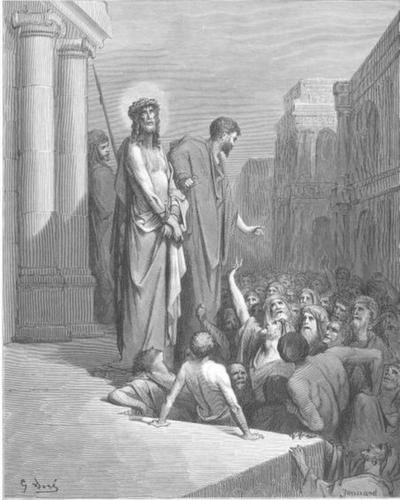
Pilate also had a notice posted on the cross
on John 19:19-22
The notice named Jesus of Nazareth King of the Jews, written in Hebrew, Latin and Greek. Pilate meant it against the nation that had forced his hand, and he refused the priests' correction with what I have written, I have written. Three languages carried the sentence to everyone who passed.
This site's exposition
Do not write, ‘The King of the Jews
The chief priests want the title turned into a claim. Cyril answers that the King was King whether they accepted Him or not. Augustine reads the exchange by Romans 11, the Gentile governor as the wild olive grafted in and the chief priests as the branches broken off.
The record, by era
The Church Fathers5 voices
The leaders of the Jews urged Pilate not to write without qualification that he is the king of the Jews, but that he himself said he was the king of the Jews, to which he replied, "What I have written, I have written." This had Pilate representing the wild olive to be grafted on, while the leaders of the Jews represented the broken-off branches. He was, you see, a man of the nations, writing for the nations their confession of faith, convicting the Jews of their denial of it, so that the Lord himself rightly said to them, "The kingdom shall be taken away from you and given to a nation that does justice." … Pilate, certainly, wrote "king of the Jews," not "king of the Greeks or the Latins," although Jesus was going to reign over the nations. And what he has written, he has written, and he did not change it at the urging of unbelievers, as had been foretold such a long time before in the psalm, "Do not corrupt the inscription of the title." All the nations believe in the king of the Jews. He reigns over all the nations but reigns nonetheless as the king of the Jews. Such was the worth and potency of that root that it could change the engrafted wild olive into itself, while the wild olive could not eliminate the name of the olive.
(Tract. cxviii) But was Christ the King of the Jews only? or of the Gentiles too? Of the Gentiles too, as we read in the Psalms, Yet have I set My King upon My holy hill of Sion; (Ps. 2:6) after which it follows, Demand of Me, and I will give Thee the heathen for Thine inheritance. So this title expresses a great mystery, viz. that the wild olive-tree was made partaker of the fatness of the olive-tree, not the olive-tree made partaker of the bitterness of the wild olive-tree. Christ then is King of the Jews according to the circumcision not of the flesh, but of the heart; not in the letter, but in the spirit. This title then read many of the Jews: for the place where Jesus was crucified was nigh to the city. (Tract. cxviii) These three were the languages most known there: the Hebrew, on account of being used in the worship of the Jews: the Greek, in consequence of the spread of Greek philosophy: the Latin, from the Roman empire being established every where. O ineffable working of Divine power even in the hearts of ignorant men! Did not some hidden voice sound from within, and, if we may say so, with clamorous silence, saying to Pilate in the prophetic words of the Psalm, Alter not the inscription of the titlea? But what say ye, ye mad priests: will the title be the less true, because Jesus said, I am the King of the Jews? If that which Pilate wrote cannot be altered, can that be altered which the Truth spoke? Pilate wrote what he wrote, bceause our Lord said what He said.
"Then said the chief priests of the Jews unto Pilate, Write not, The King of the Jews; but that he said, I am King of the Jews. Pilate answered, What I have written I have written." Oh the ineffable power of the working of God, even in the hearts of the ignorant! Was there not some hidden voice that sounded through Pilate's inner man with a kind, if one may so say, of loud-toned silence, the words that had been prophesied so long before in the very letter of the Psalms, "Corrupt not the inscription of the title"? Here, then, you see, he corrupted it not; what he has written he has written. But the high priests, who wished it to be corrupted, what did they say? "Write not, The King of the Jews; but that he said, I am King of the Jews." What is it, madmen, that you say? Why do you oppose the doing of that which you are utterly unable to alter? Will it by any such means become the less true that Jesus said, "I am King of the Jews"? If that cannot be tampered with which Pilate has written, can that be tampered with which the truth has uttered?
"And Pilate wrote a title." At the same time requiting the Jews, and making a defense for Christ. For since, they had given Him up as worthless, and attempted to confirm this sentence by making Him share the punishment of the robbers, in order that for the future it might be in no man's power to prefer evil charges against him, or to accuse him as a worthless and wicked person, to close moreover their mouths and the mouths of all who might desire to accuse Him, and to show that they had risen up against their own King, Pilate thus placed, as on a trophy, those letters, which utter a clear voice, and show forth His Victory, and proclaim His Kingdom, though not in its completeness. And this he made manifest not in a single tongue, but in three languages; for since it was likely that there would be a mixed multitude among the Jews on account of the Feast, in order that none might be ignorant of the defense, he publicly recorded the madness of the Jews, in all the languages. For they bore malice against Him even when crucified. "Yet what did this harm you? Nothing. For if He was a mortal and weak, and was about to become extinct, why did ye fear the letters asserting that He is the King of the Jews?" And what do they ask? "Say that 'he said.' For now it is an assertion, and a general sentence, but if 'he said' be added, the charge is shown to be one arising from his own rashness and arrogance." Still Pilate was not turned aside, but stood to his first decision. And it is no little thing that is dispensed even from this circumstance, but the whole matter. […]
But the Jews grudged our Lord this title: Then said the chief priests of the Jews to Pilate, Write not, The King of the Jews; but that He said, I am King of the Jews, For as Pilate wrote it, it was a plain and single declaration that He was King, but the addition of, that he said, made it a charge against Him of petulance and vain glory. But Pilate was firm: Pilate answered, What I have written I have written.
8 more voices on this verse
The Church Fathers1 voice
For after having done what they would, they endeavor also to injure His honor, fearing His resurrection. Therefore they say these things publicly, and crucified thieves with Him, and wishing to prove Him a deceiver, they say, "Thou that destroyest the temple, and buildest it in three days come down from the cross." For since on telling Pilate to remove the accusation (this was the writing, "The king of the Jews"), they prevailed not, but he persevered in saying, "What I have written, I have written," they then endeavor by their derision of Him to show that He is not a king.
The Medieval Church3 voices
The Jews envied Jesus even when He was crucified. For what do they say? Write that He Himself said it. For now the inscription appears as the common opinion of the Jews, but if it were added "He called Himself King," then the blame would …
The chief priests of the Jews therefore said to Pilate. Here is noted the contradiction of the Jews, by which they wanted to erase the title, since it was to their disgrace; whence they say: Do not write: King of the Jews, but that he …
2423 We now read that this title was not changed (v 21). First we see the Jews trying to have the title changed, The chief priests of the Jews then said to Pilate, Do not write, The King of the Jews, but, This man said, …
The Puritans and the Awakening1 voice
Then said the chief priests of the Jews to Pilate,....
The Nineteenth Century3 voices
A commentator
Jamieson, Fausset & Brown1802–1910
Commentary Critical and Explanatory on the Whole Bible (1871)
Pilate wrote a title, and put it on the cross . . . Jesus of Nazareth, the King of the Jews . . . and it was written in Hebrew--or Syro-Chaldaic, the language of the country. and Greek--the current language. and Latin--the official language.
A commentator
J.C. Ryle1816–1900
Expository Thoughts on the Gospels: John (lightly modernized text, Grace Gems edition) (1869)
proposed
He that can read a passage like this without a deep sense of man's debt to Christ, must have a very cold, or a very thoughtless heart. Great must be the love of the Lord Jesus to sinners, when He could voluntarily endure such sufferings for their salvation. Great must be the sinfulness of sin, when such an amount of vicarious suffering was needed in order to provide redemption. We should observe, first, in this passage, how our Lord had to bear His CROSS when He went forth from the city to Golgotha.
A commentator
J.C. Ryle1816–1900
Expository Thoughts on the Gospels: John (lightly modernized text, Grace Gems edition) (1869)
proposed
He that can read a passage like this without a deep sense of man's debt to Christ, must have a very cold, or a very thoughtless heart. Great must be the love of the Lord Jesus to sinners, when He could voluntarily endure such sufferings for their salvation. Great must be the sinfulness of sin, when such an amount of vicarious suffering was needed in order to provide redemption. We should observe, first, in this passage, how our Lord had to bear His CROSS when He went forth from the city to Golgotha. We need not doubt that there was a deep meaning in all this circumstance. For one thing, it was part of that depth of humiliation to which our Lord submitted as our substitute. One portion of the punishment imposed on the vilest criminals, was that they should carry their own cross when they went to execution; and this portion was laid upon our Lord. In the fullest sense He was reckoned a sinner, and counted a curse for our sakes. For another thing, it was a fulfillment of the great type of the sin-offering of the Mosaic law. It is written, that "The bull and goat given as sin offerings , whose blood Aaron brought into the Most Holy Place to make atonement for Israel, will be carried outside the camp to be burned." (Lev. 16:27.) Little did the blinded Jews imagine, when they madly hounded on the Romans to crucify Jesus outside the gates, that they were unconsciously perfecting the mightiest sin-offering that was ever seen. It is written, "So also Jesus suffered and died outside the city gates in order to make his people holy by shedding his own blood." (Heb. 13:12.) The practical lesson which all true Christians should gather from the fact before us, is one that should be kept in continual remembrance. Like our Master, we must be content to go forth "outside the camp," bearing His reproach.
The words behind it
22 Greek wordsEvery Greek word of this verse in the order it stands, with what it means and the door to its own study. The last column counts the times a word stands in the whole Bible: the rarer the word, the more the places it appears belong together.
| Greek | Sound | Meaning | Word study | In the Bible |
|---|---|---|---|---|
| ἔλεγον | elegon | Were saying | G3004 → | 1325 times |
| οὖν | oun | therefore | G3767 → | 497 times |
| τῷ | to | <the> | G3588 → | 19766 times |
| Πιλάτῳ | pilato | to Pilate | G4091 → | 55 times |
| οἱ | hoi | the | G3588 → | 19766 times |
| ἀρχιερεῖς | archiereis | chief priests | G749 → | 122 times |
| τῶν | ton | of the | G3588 → | 19766 times |
| Ἰουδαίων· | ioudaion | Jews; | G2453 → | 192 times |
| μὴ | me | Not | G3361 → | 1066 times |
| γράφε· | graphe | do write; | G1125 → | 189 times |
| ὁ | ho | The | G3588 → | 19766 times |
| βασιλεὺς | basileus | King | G935 → | 114 times |
| τῶν | ton | of the | G3588 → | 19766 times |
| Ἰουδαίων, | ioudaion | Jews, | G2453 → | 192 times |
| ἀλλ᾽ | all᾽ | but | G235 → | 635 times |
| ὅτι | hoti | for | G3754 → | 1292 times |
| ἐκεῖνος | ekeinos | He | G1565 → | 260 times |
| εἶπεν· | eipen | said; | G2036 → | 925 times |
| βασιλεύς | basileus | King | G935 → | 114 times |
| εἰμι | eimi | I am | G1510 → | 2333 times |
| τῶν | ton | of the | G3588 → | 19766 times |
| Ἰουδαίων. | ioudaion | Jews. | G2453 → | 192 times |
ἔλεγονWere saying
elegonG3004 →1325 times
οὖνtherefore
ounG3767 →497 times
τῷ<the>
toG3588 →19766 times
Πιλάτῳto Pilate
pilatoG4091 →55 times
οἱthe
hoiG3588 →19766 times
ἀρχιερεῖςchief priests
archiereisG749 →122 times
τῶνof the
tonG3588 →19766 times
Ἰουδαίων·Jews;
ioudaionG2453 →192 times
μὴNot
meG3361 →1066 times
γράφε·do write;
grapheG1125 →189 times
ὁThe
hoG3588 →19766 times
βασιλεὺςKing
basileusG935 →114 times
τῶνof the
tonG3588 →19766 times
Ἰουδαίων,Jews,
ioudaionG2453 →192 times
ἀλλ᾽but
all᾽G235 →635 times
ὅτιfor
hotiG3754 →1292 times
ἐκεῖνοςHe
ekeinosG1565 →260 times
εἶπεν·said;
eipenG2036 →925 times
βασιλεύςKing
basileusG935 →114 times
εἰμιI am
eimiG1510 →2333 times
τῶνof the
tonG3588 →19766 times
Ἰουδαίων.Jews.
ioudaionG2453 →192 times
A shaded row is a word that stands 400 times or fewer in the Bible.
The walk
8 stopsEach card is a verse this one points to, and under it the verses that one points to in turn. Where several paths arrive at the same place, that place is listed first: the text keeps returning to it.
Through
John 19:19Pilate also had a notice posted on the cross. It read: JESUS OF NAZARETH, THE KING OF THE JEWS.
it leads to
- Matthew 27:37
Above His head they posted the written charge against Him: THIS IS JESUS, THE KING OF THE JEWS.
- Luke 23:38
Above Him was posted an inscription: THIS IS THE KING OF THE JEWS.
- Mark 15:26
And the charge inscribed against Him read: THE KING OF THE JEWS.
- John 19:14
It was the day of Preparation for the Passover, about the sixth hour. And Pilate said to the Jews, “Here is your King!”
- Matthew 27:37
Through
John 19:14It was the day of Preparation for the Passover, about the sixth hour. And Pilate said to the Jews, “Here is your King!”
it leads to
- Matthew 27:62
The next day, the one after Preparation Day, the chief priests and Pharisees assembled before Pilate.
- John 19:5
When Jesus came out wearing the crown of thorns and the purple robe, Pilate said to them, “Here is the man!”
- Mark 15:25
It was the third hour when they crucified Him.
- John 19:42
And because it was the Jewish day of Preparation and the tomb was nearby, they placed Jesus there.
- Matthew 27:62
Where this verse is studied
On this page
Studies25
- Blue, Purple and Scarlet
- Hanged on a tree
- How Greek Works
- Irony in Scripture: More Than the Speaker Knows
- Mary Magdalene: the Witness at the Tomb
- Mary of Nazareth
Show the next 6 titles
- Messianic Prophecy
- The Messianic Psalms
- Nicodemus at Night. John 3
- Passover
- The Scarlet Thread
- Scribes and the Sanhedrin
Show the next 6 titles
About John
This page draws on 14 works. Open the list of works
This page draws on Augustine of Hippo, SERMON 218.7; Augustine of Hippo, Catena Aurea by Aquinas; Augustine of Hippo, Tractates on John 117; Bonaventure, Commentary on John, Chapter 19; Cyril of Alexandria, Commentary on the Gospel of John, Book 12; J.C. Ryle, Expository Thoughts on the Gospels: John (lightly modernized text, Grace Gems edition); Jamieson, Fausset & Brown, Commentary Critical and Explanatory on the Whole Bible; John Chrysostom, Homily on the Gospel of John 85; John Chrysostom, Catena Aurea by Aquinas; John Chrysostom, Homily on the Gospel of Matthew 87; John Gill, Exposition of the New Testament; John Gill, Exposition of the New Testament (1746-1748); Theophylact of Ohrid, Commentary on John and Thomas Aquinas, Commentary on John.