
John 19:13
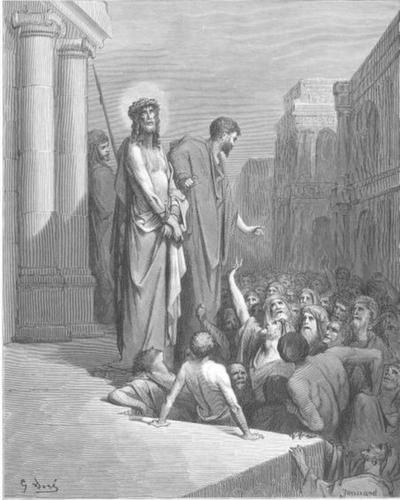
in John 19When Pilate heard these words, he brought Jesus out and sat on the judgment seat at a place called the Stone Pavement, which in Hebrew is Gabbatha.
BSB
The same verse in ASV and KJV ▾
ASV
When Pilate therefore heard these words, he brought Jesus out, and sat down on the judgment-seat at a place called The Pavement, but in Hebrew, Gabbatha.
KJV
When Pilate therefore heard that saying, he brought Jesus forth, and sat down in the judgment seat in a place that is called the Pavement, but in the Hebrew, Gabbatha.
⋯
This verse in John 19
Commentary
17 notes on this verseA commentator
Albert Barnes1798–1870
Notes, Explanatory and Practical, on the Old and New Testaments (1832-1869)
Judgment-seat - The tribunal or place of pronouncing sentence. He came here to deliver him, in due form of law, into the hands of the Jews. Pavement - This was an area or room of the judgment hall whose floor was made of small square stones of various colors. This was common in palaces and houses of wealth and splendor. See the notes at Mat 9:2. Gabbatha - This word is not elsewhere used. It comes from a word signifying to be elevated.
This site's exposition
you are no friend of Caesar
on John 19:12-13
Friend of Caesar was a real title under Tiberius, and the shout turns a religious case into a charge the governor cannot survive. Pilate sits on the judgment seat at the Stone Pavement, Gabbatha in Hebrew. John gives the local name, as a witness does.
The record, by era
The Church Fathers4 voices
(Tr. cxvi) Pilate was before afraid not of violating their law by sparing Him, but of killing the Son of God, in killing Him. But he could not treat his master Caesar with the same contempt with which he treated the law of a foreign nation: When Pilate therefore heard that saying, he brought Jesus forth, and sat down in the judgment seat in a place that is called the Pavement, but in the Hebrew, Gabbatha.
It was the day of preparation, that is, the sixth holy day of the week, and it was about the sixth hour. For those who think that the words of the Evangelists are in contradiction, as some say at the third hour, others at about …
After his public ministry, Jesus did not eat of the lamb, but he himself suffered as the true Lamb in the Paschal feast, as John, the divine and Evangelist teaches us in the Gospel written by him. "… And it was the preparation of the …
But O what shamelessness and ill-time cowardice! For Pilate, deeming that he should now incur some danger were he to overlook these words, comes forth as though to enquire into the matter, (for the "sitting down" showed this,) but without making any enquiry, he gave Him up to them, thinking to shame them. For to prove that he did it for this purpose, hear what he saith.
The Medieval Church1 voice
But how little courage there was in Pilate, when he considered it dangerous for himself to leave such an accusation without investigation! He goes out, as if with the intention of investigating the matter, for this is what the words "sat down on the judgment …
10 more voices on this verse
The Medieval Church4 voices
Pilate therefore, when he had heard. The perversity of the Jews has been shown in their malice of resisting the judgment of truth: here their perversity is shown in extorting a judgment of falsehood concerning the condemnation of Christ. The place is noted when he …
Lithostraton, i. e. laid with stone; the word signifies pavement. It was an elevated place.
The tribunal is the seat of the judge, as the throne is the seat of the king, and the chair the seat of the doctor.
2401 In treating the condemnation of Christ, the Evangelist mentions the place, secondly the time (v 14), and thirdly the manner of the condemnation (v 14b). 2402 In regard to the first, the Evangelist indicates the motive of Pilate when he says, When Pilate heard …
The Puritans and the Awakening2 voices
Paul might the better stand at Cæsar's judgment-seat when his Master had stood there before him. [2.] Notice is here taken of the place and time. First, The place where Christ was condemned: in a place called the Pavement, but in Hebrew, Gabbatha, probably the place where he used to sit to try causes or criminals.
When Pilate therefore heard that saying,....
The Nineteenth Century4 voices
A commentator
Jamieson, Fausset & Brown1802–1910
Commentary Critical and Explanatory on the Whole Bible (1871)
When Pilate . . . heard that, . . . he brought Jesus forth, and sat down in--"upon" the judgment seat--that he might pronounce sentence against the Prisoner, on this charge, the more solemnly. in a place called the Pavement--a tesselated pavement, much used by the Romans. in the Hebrew, Gabbatha--from its being raised.
A commentator
J.C. Ryle1816–1900
Expository Thoughts on the Gospels: John (lightly modernized text, Grace Gems edition) (1869)
proposed
Pilate said to the Jewish religious leaders, "Look, here is your king!" Then they shouted out, "Away with him! Away with him! Crucify him!" Pilate asked, "Shall I crucify your king?" The high priests replied, "We have no king except Caesar!" Then Pilate handed him over to them to be crucified. These verses exhibit to our eyes a wonderful picture, a picture which ought to be deeply interesting to all who profess and call themselves Christians. Like every great historical picture, it contains special points on which we should fix our special attention.
A commentator
J.C. Ryle1816–1900
Expository Thoughts on the Gospels: John (lightly modernized text, Grace Gems edition) (1869)
proposed
Pilate said to the Jewish religious leaders, "Look, here is your king!" Then they shouted out, "Away with him! Away with him! Crucify him!" Pilate asked, "Shall I crucify your king?" The high priests replied, "We have no king except Caesar!" Then Pilate handed him over to them to be crucified. These verses exhibit to our eyes a wonderful picture, a picture which ought to be deeply interesting to all who profess and call themselves Christians. Like every great historical picture, it contains special points on which we should fix our special attention. Above all, it contains three life-like portraits, which we shall find it useful to examine in order. The first portrait in the picture is that of our Lord JESUS CHRIST himself. We see the Savior of mankind scourged, crowned with thorns, mocked, smitten, rejected by His own people, unjustly condemned by a judge who saw no fault in Him, and finally delivered up to a most painful death. Yet this was He who was the eternal Son of God, whom the Father's countless angels delighted to honor. This was He who came into the world to save sinners, and after living a blameless life for thirty years, spent the last three years of His time on earth in going about doing good, and preaching the Gospel. Surely the sun never shone on a more wondrous sight since the day of its creation! Let us admire that love of Christ which Paul declares, "passes knowledge," and let us see an endless depth of meaning in the expression. There is no earthly love with which it can be compared, and no standard by which to measure it. It is a love that stands alone. Never let us forget when we ponder this tale of suffering, that Jesus suffered for our sins, the Just for the unjust, that He was wounded for our transgressions and bruised for our iniquities, and that with His stripes we are healed.
The Pavement - Λιθοστρωτον, literally, a stone pavement: probably it was that place in the open court where the chair of justice was set, for the prefects of provinces always held their courts of justice in the open air, and which was paved with stones of various colors, like that of Ahasuerus, Est 1:6, of red, blue, white, and black marble; what we still term Mosaic work, or something in imitation of it; such as the Roman pavements frequently dug up in this and other countries, where the Romans have had military stations. Gabbatha - That is, an elevated place; from גבה gabah, high, raised up; and it is very likely that the judgment seat was considerably elevated in the court, and that the governor went up to it by steps; and perhaps these very steps were what was called the Pavement. John does not say that Lithostroton, or the Pavement, is the meaning of the word Gabbatha; but that the place was called so in the Hebrew. The place was probably called Lithostroton, or the Pavement: the seat of judgment, Gabbatha, the raised or elevated place. In several MSS. and versions, the scribes not understanding the Hebrew word, wrote it variously, Gabbatha, Gabatha, Kapphatha, Kappata, Gennetha, Gennaesa, and Gennesar. Lightfoot conjectures that the pavement here means the room Gazith in the temple, in which the grand council, called the Sanhedrin, held their meetings.
The words behind it
22 Greek wordsEvery Greek word of this verse in the order it stands, with what it means and the door to its own study. The last column counts the times a word stands in the whole Bible: the rarer the word, the more the places it appears belong together.
| Greek | Sound | Meaning | Word study | In the Bible |
|---|---|---|---|---|
| Ὁ | ho | <the> | G3588 → | 19766 times |
| οὖν | oun | Therefore | G3767 → | 497 times |
| Πιλᾶτος | pilatos | Pilate | G4091 → | 55 times |
| ἀκούσας | akousas | having heard | G191 → | 425 times |
| τῶν | ton | <the> | G3588 → | 19766 times |
| λόγων | logon | words | G3056 → | 329 times |
| τούτων | touton | these | G3778 → | 1381 times |
| ἤγαγεν | egagen | brought | G71 → | 68 times |
| ἔξω | exo | out | G1854 → | 63 times |
| τὸν | ton | <the> | G3588 → | 19766 times |
| Ἰησοῦν | iesoun | Jesus | G2424 → | 908 times |
| καὶ | kai | and | G2532 → | 9120 times |
| ἐκάθισεν | ekathisen | sat down | G2523 → | |
| ἐπὶ | epi | upon | G1909 → | 883 times |
| βήματος | bematos | judgment seat | G968 → | |
| εἰς | eis | at | G1519 → | 1755 times |
| τόπον | topon | a place | G5117 → | 94 times |
| λεγόμενον | legomenon | being named | G3004 → | 1325 times |
| Λιθόστρωτον, | lithostroton | [the] Stone Pavement, | G3038 → | |
| Ἑβραϊστὶ | hebraisti | in Hebrew | G1447 → | 7 times |
| δὲ | de | now | G1161 → | 2765 times |
| Γαββαθα. | gabbatha | Gabbatha. | G1042 → |
Ὁ<the>
hoG3588 →19766 times
οὖνTherefore
ounG3767 →497 times
ΠιλᾶτοςPilate
pilatosG4091 →55 times
ἀκούσαςhaving heard
akousasG191 →425 times
τῶν<the>
tonG3588 →19766 times
λόγωνwords
logonG3056 →329 times
τούτωνthese
toutonG3778 →1381 times
ἤγαγενbrought
egagenG71 →68 times
ἔξωout
exoG1854 →63 times
τὸν<the>
tonG3588 →19766 times
ἸησοῦνJesus
iesounG2424 →908 times
καὶand
kaiG2532 →9120 times
ἐκάθισενsat down
ekathisenG2523 →
ἐπὶupon
epiG1909 →883 times
βήματοςjudgment seat
bematosG968 →
εἰςat
eisG1519 →1755 times
τόπονa place
toponG5117 →94 times
λεγόμενονbeing named
legomenonG3004 →1325 times
Λιθόστρωτον,[the] Stone Pavement,
lithostrotonG3038 →
Ἑβραϊστὶin Hebrew
hebraistiG1447 →7 times
δὲnow
deG1161 →2765 times
Γαββαθα.Gabbatha.
gabbathaG1042 →
A shaded row is a word that stands 400 times or fewer in the Bible.
The walk
8 stopsEach card is a verse this one points to, and under it the verses that one points to in turn. Where several paths arrive at the same place, that place is listed first: the text keeps returning to it.
Through
Ecclesiastes 5:8If you see the oppression of the poor and the denial of justice and righteousness in the province, do not be astonished at the matter; for one official is watched by a superior, and…
it leads to
- Psalms 12:5
“For the cause of the oppressed and for the groaning of the needy, I will now arise,” says the LORD. “I will bring safety to him who yearns.”
- Ecclesiastes 4:1
Again I looked, and I considered all the oppression taking place under the sun. I saw the tears of the oppressed, and they had no comforter; the power lay in the hands of their…
- Ecclesiastes 3:16
Furthermore, I saw under the sun that in the place of judgment there is wickedness, and in the place of righteousness there is wickedness.
- Psalms 12:5
Through
Amos 4:7“I also withheld the rain from you when the harvest was three months away. I sent rain on one city but withheld it from another. One field received rain; another without rain withered.
it leads to
- Exodus 9:26
The only place where it did not hail was in the land of Goshen, where the Israelites lived.
- Jeremiah 3:3
Therefore the showers have been withheld, and no spring rains have fallen. Yet you have the brazen look of a prostitute; you refuse to be ashamed.
- Exodus 9:26
Through
Matthew 27:19While Pilate was sitting on the judgment seat, his wife sent him this message: “Have nothing to do with that innocent man, for I have suffered terribly in a dream today because of Him.”
it leads to
- Zechariah 9:9
Rejoice greatly, O Daughter of Zion! Shout in triumph, O Daughter of Jerusalem! See, your King comes to you, righteous and victorious, humble and riding on a donkey, on a colt, the foal of…
- Proverbs 29:1
A man who remains stiff-necked after much reproof will suddenly be shattered beyond recovery.
- 1 Peter 2:22
“He committed no sin, and no deceit was found in His mouth.”
- Zechariah 9:9
Where this verse is studied
On this page
Studies12
- The Binding of Isaac (Genesis 22)
- Blue, Purple & Scarlet
- How Greek Works
- Irony in Scripture: More Than the Speaker Knows
- Mary Magdalene: the Witness at the Tomb
- Messianic Prophecy
- The Messianic Psalms
- Nicodemus at Night. John 3
- Passover
- Taw: The Mark of God
- The Lamb: the symbol, from Moriah to the throne
- The Sevens of Scripture
About John
This page draws on 16 works. Open the list of works
This page draws on Adam Clarke, Commentary on the Bible; Albert Barnes, Notes, Explanatory and Practical, on the Old and New Testaments (1832-1869); Augustine of Hippo, Catena Aurea by Aquinas; B. F. Westcott, The Gospel according to St. John; Bede, Catena Aurea by Aquinas; Bonaventure, Commentary on John, Chapter 19; Glossa Ordinaria, Catena Aurea by Aquinas; J.C. Ryle, Expository Thoughts on the Gospels: John (lightly modernized text, Grace Gems edition); Jamieson, Fausset & Brown, Commentary Critical and Explanatory on the Whole Bible; John Chrysostom, Homily on the Gospel of John 84; John Gill, Exposition of the New Testament (1746-1748); Matthew Henry, Commentary on the Whole Bible; Peter of Alexandria, FRAGMENT 1.7; Theodore of Mopsuestia, COMMENTARY ON JOHN 7.19.14; Theophylact of Ohrid, Commentary on John and Thomas Aquinas, Commentary on John.