
John 19:12
in John 19From then on, Pilate tried to release Him, but the Jews kept shouting, “If you release this man, you are no friend of Caesar. Anyone who declares himself a king is defying Caesar.”
BSB
The same verse in ASV and KJV ▾
ASV
Upon this Pilate sought to release him: but the Jews cried out, saying, If thou release this man, thou art not Cæsar’s friend: every one that maketh himself a king speaketh against Cæsar.
KJV
And from thenceforth Pilate sought to release him: but the Jews cried out, saying, If thou let this man go, thou art not Cesar’s friend: whosoever maketh himself a king speaketh against Cesar.
⋯
This verse in John 19
Commentary
20 notes on this verseThe exclamation of the Jews afflicts Pilate with panic, and sharpens the keenness of his caution, and makes him pause before putting Him to death. For they shouted out, that that very prisoner had made Himself the Son of God, Whom Pilate had been most anxious to release from all danger, and to acquit of every false accusation, having this fear at heart.
This site's exposition
you are no friend of Caesar
on John 19:12-13
Friend of Caesar was a real title under Tiberius, and the shout turns a religious case into a charge the governor cannot survive. Pilate sits on the judgment seat at the Stone Pavement, Gabbatha in Hebrew. John gives the local name, as a witness does.
The record, by era
The Church Fathers5 voices
This may very well agree with what Luke records in connection with the said accusation brought by the Jews. For after the words, "We found this fellow perverting our nation," he has added the clause, "And forbidding to give tribute to Caesar, and saying that he himself is Christ a king." This will also offer a solution for the difficulty previously referred to, namely, the occasion which might seem to be given for supposing John to have indicated that no specific charge was laid by the Jews against the Lord, when they answered and said unto him, "If he were not a malefactor, we would not have delivered him up unto thee."
(Tr. cxvi) The Jews thought they could alarm Pilate more by the mention of Caesar, than by telling him of their law, as they had done above; We have a law, and by that law He ought to die, because He made Himself the Son of God. So it follows, But the Jews cried out, saying, If thou let this Man go, thou art not Caesar's friend; whosoever maketh himself a king speaketh against Caesar.
(Tr. cxvi) Pilate had sought from the first to release: so we must understand, from thence, to mean from this cause, i. e. lest he should incur guilt by putting to death an innocent person.
"Hence Pilate sought to release Him." What is to be understood by the word here used, "hence," as if he had not been seeking to do so before? Read what precedes, and thou wilt find that he had already for some time been seeking to release Jesus. By the original word, therefore, we are to understand, on this account, that is, for this reason, that he might not contract sin by slaying an innocent man who had been delivered into his hands, even though his sin would be less than that of the Jews, who delivered Him to him to be put to death. "From thence," therefore, that is, for this reason, that he might not commit such a sin, "he sought" not now for the first time, but from the beginning, "to release Him."
"But the Jews cried out, saying, If thou let this man go, thou art not Caesar's friend: whosoever maketh himself a king, speaketh against Caesar." They thought to inspire Pilate with greater fear by terrifying him about Caesar, in order that he might put Christ to death, than formerly when they said, "We have the law, and by the law he ought to die, because he made himself the Son of God." It was not their law, indeed, that impelled him through fear to the deed of murder, but rather it was his fear of the Son of God that held him back from the crime. But now he could not set Caesar, who was the author of his own power, at nought, in the same way as the law of another nation.
13 more voices on this verse
The Church Fathers4 voices
A commentator
Romanos the MelodistKONTAKION ON THE PASSION OF CHRIST 36.16 · Written before 555.
proposed
"Crucify!" the murderer heard the impious crying out, And their will he fulfilled, Handing over, without being compelled to, The One whom he planned to have crucified. For having heard that he would be an enemy of Caesar, The coward was frightened. He would rather …
Accordingly, all the synagogue of Israel did slay Him, saying to Pilate, when he was desirous to dismiss Him, "His blood be upon us, and upon our children; " and, "If thou dismiss him, thou art not a friend of Caesar; " in order that all things might be fulfilled which had been written of Him.
And "the clouds were commanded not to rain a shower upon the vineyard of Sorek," -the clouds being celestial benefits, which were commanded not to be forthcoming to the house of Israel; for it "had borne thorns"-whereof that house of Israel had wrought a crown for Christ-and not "righteousness, but a clamour,"-the clamour whereby it had extorted His surrender to the cross. And thus, the former gifts of grace being withdrawn, "the law and the prophets were until John," and the fishpool of Bethsaida until the advent of Christ: thereafter it ceased curatively to remove from Israel infirmities of health; since, as the result of their perseverance in their frenzy, the name of the Lord was through them blasphemed, as it is written: "On your account the name of God is blasphemed among the Gentiles: " for it is from them that the infamy (attached to that name) began, and (was propagated during) the interval from Tiberius to Vespasian.
But they again cried out, saying, "If thou let this man go, thou art not Caesar's friend." For when they profited nothing by bringing charges drawn from their own law, they wickedly betook themselves to external laws, saying, "Every one that maketh himself a king speaketh against Caesar." And where hath this Man appeared as a tyrant? Whence can ye prove it? By the purple robe? By the diadem? By the dress? By the soldiers? Did not He ever walk unattended, save by His twelve disciples, following in every point a humble mode of living, both as to food, and clothing, and habitation?
The Medieval Church4 voices
He that delivered Me unto thee, i. e. Judas, or the multitude. When Jesus had boldly replied, that unless He gave Himself up, and the Father consented, Pilate could have had no power over Him, Pilate was the more anxious to release Him; And from thenceforth Pilate sought to release Him.
And from thenceforth Pilate sought to release him. Understanding that his power was established under the power of another, he was unwilling to condemn an innocent man: therefore he wished to release him. But the Jews cried out. Here the fourth point is set forth, …
2397 The effect of all this was that upon this Pilate sought to release him. As we saw before, Pilate tried to release Christ from the very beginning. Thus the upon this indicates he now sought it for another reason, that is, to escape from …
So, when the Lord frightened Pilate with these words, from that time on he sought all the more to release Him. The Jews, since they had been convicted of slander in claiming that He made Himself a king, and had not succeeded either in their …
The Puritans and the Awakening1 voice
And from thenceforth Pilate sought to release him,....
The Nineteenth Century4 voices
Pilate sought to release him - Pilate made five several attempts to release our Lord; as we may learn from Luk 23:4, Luk 23:15, Luk 23:20, Luk 23:22; Joh 19:4, Joh 19:12, Joh 19:13. Thou art not Caesar’s friend - Thou dost not act like a person who has the interest of the emperor at heart. Ambassadors, prefects, counsellors, etc., were generally termed the friends of the emperor. This insinuation determined Pilate to make no longer resistance: he was afraid of being accused, and he knew Tiberius was one of the most jealous and distrustful princes in the world.
A commentator
J.C. Ryle1816–1900
Expository Thoughts on the Gospels: John (lightly modernized text, Grace Gems edition) (1869)
proposed
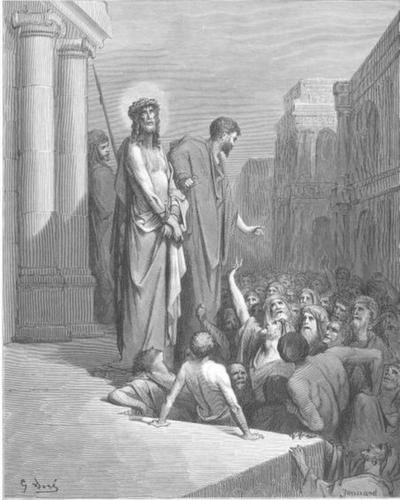
Pilate said to the Jewish religious leaders, "Look, here is your king!" Then they shouted out, "Away with him! Away with him! Crucify him!" Pilate asked, "Shall I crucify your king?" The high priests replied, "We have no king except Caesar!" Then Pilate handed him over to them to be crucified. These verses exhibit to our eyes a wonderful picture, a picture which ought to be deeply interesting to all who profess and call themselves Christians. Like every great historical picture, it contains special points on which we should fix our special attention. Above all, it contains three life-like portraits, which we shall find it useful to examine in order. The first portrait in the picture is that of our Lord JESUS CHRIST himself. We see the Savior of mankind scourged, crowned with thorns, mocked, smitten, rejected by His own people, unjustly condemned by a judge who saw no fault in Him, and finally delivered up to a most painful death. Yet this was He who was the eternal Son of God, whom the Father's countless angels delighted to honor. This was He who came into the world to save sinners, and after living a blameless life for thirty years, spent the last three years of His time on earth in going about doing good, and preaching the Gospel. Surely the sun never shone on a more wondrous sight since the day of its creation! Let us admire that love of Christ which Paul declares, "passes knowledge," and let us see an endless depth of meaning in the expression. There is no earthly love with which it can be compared, and no standard by which to measure it. It is a love that stands alone. Never let us forget when we ponder this tale of suffering, that Jesus suffered for our sins, the Just for the unjust, that He was wounded for our transgressions and bruised for our iniquities, and that with His stripes we are healed.
A commentator
J.C. Ryle1816–1900
Expository Thoughts on the Gospels: John (lightly modernized text, Grace Gems edition) (1869)
proposed
Pilate said to the Jewish religious leaders, "Look, here is your king!" Then they shouted out, "Away with him! Away with him! Crucify him!" Pilate asked, "Shall I crucify your king?" The high priests replied, "We have no king except Caesar!" Then Pilate handed him over to them to be crucified. These verses exhibit to our eyes a wonderful picture, a picture which ought to be deeply interesting to all who profess and call themselves Christians. Like every great historical picture, it contains special points on which we should fix our special attention.
A commentator
Albert Barnes1798–1870
Notes, Explanatory and Practical, on the Old and New Testaments (1832-1869)
proposed
Sought to release him - He was more and more convinced of his innocence, and more unwilling to yield him to mere malice and envy in the face of justice. But the Jews cried out ... - This moved Pilate to deliver Jesus into their hands. He feared that he would be accused of unfaithfulness to the interests of the Roman emperor if he did not condemn a man whom his own nation had accused of sedition. The Roman emperor then on the throne was exceedingly jealous and tyrannical, and the fear of losing his favor induced Pilate to deliver Jesus into their hands. Caesar’s friend - The friend of the Roman emperor. The name of the reigning emperor was Tiberius. After the time of Julius Caesar all the emperors were called Caesar, as all the kings of Egypt were called Pharaoh. This emperor was, during the latter part of his reign, the most cruel, jealous, and wicked that ever sat on the Roman throne.
The words behind it
28 Greek wordsEvery Greek word of this verse in the order it stands, with what it means and the door to its own study. The last column counts the times a word stands in the whole Bible: the rarer the word, the more the places it appears belong together.
| Greek | Sound | Meaning | Word study | In the Bible |
|---|---|---|---|---|
| ἐκ | ek | Out of | G1537 → | 911 times |
| τούτου | toutou | this | G3778 → | 1381 times |
| ὁ | ho | <the> | G3588 → | 19766 times |
| Πιλᾶτος | pilatos | Pilate | G4091 → | 55 times |
| ἐζήτει | ezetei | was seeking | G2212 → | 117 times |
| ἀπολῦσαι | apolusai | to release | G630 → | 63 times |
| αὐτόν.¶ | auton | Him. | G846 → | 5565 times |
| Οἱ | hoi | <the> | G3588 → | 19766 times |
| δὲ | de | but | G1161 → | 2765 times |
| Ἰουδαῖοι | ioudaioi | the Jews | G2453 → | 192 times |
| ἐκραύγασαν | ekraugasan | cried out | G2905 → | 9 times |
| λέγοντες· | legontes | saying; | G3004 → | 1325 times |
| ἐὰν | ean | If | G1437 → | 352 times |
| τοῦτον | touton | this [man] | G3778 → | 1381 times |
| ἀπολύσῃς, | apoluses | you shall release, | G630 → | 63 times |
| οὐκ | ouk | not | G3756 → | 1664 times |
| εἶ | ei | you are | G1510 → | 2333 times |
| φίλος | philos | a friend | G5384 → | 27 times |
| τοῦ | tou | <the> | G3588 → | 19766 times |
| Καίσαρος. | kaisaros | of Caesar. | G2541 → | 29 times |
| πᾶς | pas | Everyone | G3956 → | 1235 times |
| ὁ | ho | <the> | G3588 → | 19766 times |
| βασιλέα | basilea | a king | G935 → | 114 times |
| ἑαυτὸν | he'auton | himself | G1438 → | 322 times |
| ποιῶν | poion | making | G4160 → | 569 times |
| ἀντιλέγει | antilegei | speaks against | G483 → | |
| τῷ | to | <the> | G3588 → | 19766 times |
| Καίσαρι.¶ | kaisari | Caesar. | G2541 → | 29 times |
ἐκOut of
ekG1537 →911 times
τούτουthis
toutouG3778 →1381 times
ὁ<the>
hoG3588 →19766 times
ΠιλᾶτοςPilate
pilatosG4091 →55 times
ἐζήτειwas seeking
ezeteiG2212 →117 times
ἀπολῦσαιto release
apolusaiG630 →63 times
αὐτόν.¶Him.
autonG846 →5565 times
Οἱ<the>
hoiG3588 →19766 times
δὲbut
deG1161 →2765 times
Ἰουδαῖοιthe Jews
ioudaioiG2453 →192 times
ἐκραύγασανcried out
ekraugasanG2905 →9 times
λέγοντες·saying;
legontesG3004 →1325 times
ἐὰνIf
eanG1437 →352 times
τοῦτονthis [man]
toutonG3778 →1381 times
ἀπολύσῃς,you shall release,
apolusesG630 →63 times
οὐκnot
oukG3756 →1664 times
εἶyou are
eiG1510 →2333 times
φίλοςa friend
philosG5384 →27 times
τοῦ<the>
touG3588 →19766 times
Καίσαρος.of Caesar.
kaisarosG2541 →29 times
πᾶςEveryone
pasG3956 →1235 times
ὁ<the>
hoG3588 →19766 times
βασιλέαa king
basileaG935 →114 times
ἑαυτὸνhimself
he'autonG1438 →322 times
ποιῶνmaking
poionG4160 →569 times
ἀντιλέγειspeaks against
antilegeiG483 →
τῷ<the>
toG3588 →19766 times
Καίσαρι.¶Caesar.
kaisariG2541 →29 times
A shaded row is a word that stands 400 times or fewer in the Bible.
Where this verse is studied
On this page
Studies25
- Blue, Purple and Scarlet
- Hanged on a tree
- How Greek Works
- Irony in Scripture: More Than the Speaker Knows
- Mary Magdalene: the Witness at the Tomb
- Mary of Nazareth
Show the next 6 titles
- Messianic Prophecy
- The Messianic Psalms
- Nicodemus at Night. John 3
- Passover
- The Scarlet Thread
- Scribes and the Sanhedrin
Show the next 6 titles
About John
This page draws on 16 works. Open the list of works
This page draws on Adam Clarke, Commentary on the Bible; Albert Barnes, Notes, Explanatory and Practical, on the Old and New Testaments (1832-1869); Augustine of Hippo, The Harmony of the Gospels, Book 3; Augustine of Hippo, Catena Aurea by Aquinas; Augustine of Hippo, Tractates on John 116; B. F. Westcott, The Gospel according to St. John; Bonaventure, Commentary on John, Chapter 19; Cyril of Alexandria, Commentary on the Gospel of John, Book 12; J.C. Ryle, Expository Thoughts on the Gospels: John (lightly modernized text, Grace Gems edition); John Chrysostom, Homily on the Gospel of John 84; John Gill, Exposition of the New Testament (1746-1748); Romanos the Melodist, KONTAKION ON THE PASSION OF CHRIST 36.16; Tertullian, An Answer to the Jews; Theophylact of Ohrid, Catena Aurea by Aquinas; Theophylact of Ohrid, Commentary on John and Thomas Aquinas, Commentary on John.