
John 19:15
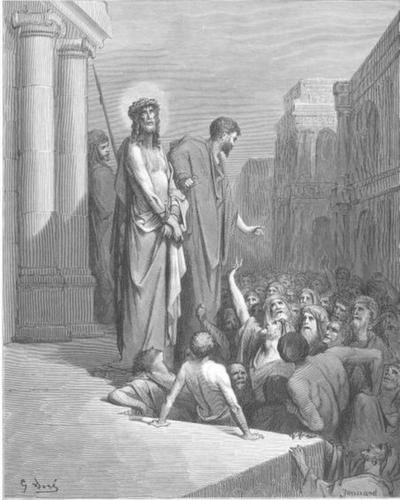
in John 19At this, they shouted, “Away with Him! Away with Him! Crucify Him!” “Shall I crucify your King?” Pilate asked. “We have no king but Caesar,” replied the chief priests.
BSB
The same verse in ASV and KJV ▾
ASV
They therefore cried out, Away with him, away with him, crucify him! Pilate saith unto them, Shall I crucify your King? The chief priests answered, We have no king but Cæsar.
KJV
But they cried out, Away with him, away with him, crucify him. Pilate saith unto them, Shall I crucify your King? The chief priests answered, We have no king but Cesar.
⋯
This verse in John 19
Commentary
20 notes on this verseAway with him - Αρον: probably this means, kill him. In Isa 57:1, it is said, και ανδρες, δικαιοι αιρονται, and just men are taken away; that is, according to some, by a violent death.
This site's exposition
about the sixth hour
on John 19:14-15
John fixes the day and the hour, the Passover Preparation at about the sixth hour. Here is your King mocks the crowd, and the chief priests answer that they have no king but Caesar. Rome burned their temple within forty years.
This site's exposition
Away with Him! Away with Him
The crowd calls for His death. Clarke takes Away with Him as a demand to kill, and sets it beside Isaiah 57:1 in the Septuagint, where the righteous are taken away. Augustine reads Shall I crucify your King as the last attempt of Pilate to shame the chief priests.
The record, by era
The Church Fathers5 voices
(Tr. cxvi. 8) Pilate still tries to overcome their apprehensions on Caesar's account; Pilate saith unto them, Shall I crucify your King? He tries to shame them into doing what he had not been able to soften them into by putting Christ to shame. The chief priests answered, We have no king but Caesar.
As yet, however, the evangelist proceeds to say: "But when Pilate heard these sayings, he brought Jesus forth, and sat down before the tribunal, in a place that is called the Pavement, but in the Hebrew, Gabbatha. And it was the preparation of the passover, and about the sixth hour." When Pilate, therefore, had sat down before the tribunal, "he saith unto the Jews, Behold your king! But they cried out, Away with him, away with him, crucify him. Pilate said unto them, Shall I crucify your king?" As yet he tries to overcome the terror with which they had inspired him about Caesar, by seeking to break them from their purpose on the ground of the ignominy it brought on themselves, with the words, "Shall I crucify your king?" when he failed to soften them on the ground of the ignominy done to Christ; but by and by he is overcome by fear.
For "the chief priests answered, We have no king but Caesar. Then delivered he Him therefore unto them to be crucified." For he would have every appearance of acting against Caesar if, on their declaration that they had no king but Caesar, he were wishing to impose on them another king by releasing without punishment one whom for these very attempts they had delivered unto him to be put to death. "Therefore he delivered Him unto them to be crucified." But was it, then, anything different that he had previously desired when he said, "Take ye him, and crucify him;" or even earlier still, "Take ye him, and judge him according to your law?" And why did they show so great reluctance, when they said, "It is not lawful for us to put any man to death," and were in every way urgent to have Him slain not by themselves, but by the governor, and therefore refused to receive Him for the purpose of putting Him to death, if now for the same purpose they actually do receive Him? Or if such be not the case, why was it said, "Then delivered he Him therefore unto them to be crucified?" Or is it of any importance? Plainly it is. For it was not said, "Then delivered he Him therefore unto them" that they might crucify Him, but "that He might be crucified," that is, that He might be crucified by the judicial sentence and power of the governor. But it is for this reason that the evangelist has said that He was delivered to them, that he might show that they were implicated in the crime from which they tried to hold themselves aloof; for Pilate would have done no such thing, save to implement what he perceived to be their fixed desire.
A commentator
Apostolic ConstitutionsConstitutions of the Holy Apostles Book 5 · Written before 380.
proposed
...the judge, who was a stranger, "washed his hands, and said, I am innocent of the blood of this just person: see ye to it. But Israel cried out, His blood be on us, and on our children." And when Pilate said, "Shall I crucify your king? they cried out, We have no king but Caesar: crucify Him, crucify Him; for every, one that maketh himself a king speaketh against Caesar." And, "If thou let this man go, thou art not Caesar's friend." And Pilate the governor and Herod the king commanded Him to be crucified...
[Daniel 13:60] "And the whole congregration (Vulgate: assembly) cried out with a great voice and blessed God, who saveth those who trust in Him..." If the whole congregation put them to death, the view which we mentioned earlier is apparently refuted, namely that these were the elders Ahab and Zedekiah, in conformity with Jeremiah's statement (Jeremiah 29:22). The only other possibility is that instead of taking the statement, "They killed them," literally, we interpret it as meaning that they gave them over to the king of Babylon to be put to death. That would be just like when we say that the Jews put the Savior to death; not that they smote Him themselves, but they gave Him over to be slain and cried out, "Crucify Him! Crucify Him!" (John 19:15).
12 more voices on this verse
The Church Fathers5 voices
A commentator
Cyril of AlexandriaCommentary on the Gospel of John, Book 12 · Written before 444.
proposed
The chief priests answered, We have no king but Caesar. Hereupon the well-beloved Israel spurned his God, and started aside from his allegiance, and, as Moses said, abandoned the God that was his Father, and remembered not the Lord his helper. For see how he turned his eyes upon an harlot, according to the Scripture, refused to be ashamed, disowned his own glory, and denied his Lord. Of this very charge God accused Israel of old, speaking by the mouth of Jeremiah: For pass over the isles of Chittim, and send unto Kedar, and see whether the nations change their gods, who are yet no gods; but My people have changed their glory. And again: The heavens were astonished thereat, and were horribly afraid, saith the Lord; for My people have committed two evils: they have forsaken Me the fountain of living waters, and have hewed them out cisterns, broken cisterns, that hold no water. For while other nations throughout the whole world clung fast to the deceitfulness of their idols, and steadfastly adhered to the gods whom they so deemed, and did not readily undergo a change of faith, nor easily alter their form of worship, the Israelites started aside, and joined themselves to the empire of Caesar, and cast off the rule of God. Therefore, very justly, were they given over into Caesar's hands, and, having at first welcomed his rule, afterwards brought themselves to grievous ruin, and underwent expulsion from their country, and the sufferings of war, and those irremediable calamities that befell them. Observe, too, here the minuteness of the writer. For he does not say that the people started the impious cry, but rather their rulers. For he says: the chief priests cried out, everywhere pointing out, that it was through their submissively following their leaders that the multitude was carried down the precipice, and fell into the abyss of perdition. […]
A commentator
Cyril of AlexandriaCommentary on the Gospel of John, Book 12 · Written before 444.
proposed
They reiterate their old cry with the same fury, and desisted not from their lust for blood, and were not softened at all by the insults He had endured, nor inclined to clemency by the outrages inflicted upon Him; but were rather goaded to a greater pitch of fury, and intreat that He Who had raised the dead in their midst, and shown Himself the worker of such marvels, should be crucified; at which Pilate was sore amazed, seeing that they declared with such vehemence, that He, Who had acquired such eminence among them as to be deemed the Son of God, and King, was not merely worthy of death, but that He deserved so cruel a fate, for crucifixion is the worst of deaths. The judge, therefore, makes their outcry a charge and reproach against them, that they should be desirous that He should be crucified, Who had excited so great admiration by deeds which were so pre-eminent as to transcend anything on earth. For what is there that is equal to what does not fall short of the Son of God, and King?
"Behold your king!" But when they said, "Crucify him," he added again, "Shall I crucify your king?" But they cried out, "We have no king but Caesar." Of their own will they subjected themselves to punishment; therefore also God gave them up, because they were the first to cast themselves out from His providence and superintendence; and since with one voice they rejected His sovereignty, He allowed them to fall by their own suffrages.
Still what had been said should have been sufficient to calm their passion, but they feared, lest, being let go, He should again draw the multitudes, and they did all they could to prevent this. For a dreadful thing is love of rule, dreadful and able to destroy the soul; it was on account of this that they had never heard Him. And yet Pilate, in consequence of a few words, desired to let Him go, but they pressed on, saying, "Crucify him." And why did they strive to kill Him in this manner? It was a shameful death. Fearing therefore lest there should afterwards be any remembrance of Him, they desired to bring Him to the accursed punishment, not knowing that truth is exalted by hindrances.
A commentator
Apostolic ConstitutionsConstitutions of the Holy Apostles Book 6 · Written before 380.
proposed
Because, indeed, they drew servitude upon themselves voluntarily, when they said, "We have no king but Caesar;" and, "If we do not slay Christ, all men will believe in Him, and the Romans will come and will take away both our place and nation." And so they prophesied unwittingly. For accordingly the nations believed on Him, and they themselves were deprived by the Romans of their power, and of their legal worship; and they have been forbidden to slay whom they please, and to sacrifice when they will.
The Medieval Church3 voices
And they say: "Away with Him, away with Him, crucify Him"; they insist upon and demand the cross, because they wish to give Christ an evil reputation. For such a death was the most shameful and accursed, as it is said: "Cursed is everyone who …
But they cried out: Away, away, crucify him. The doubling signifies the intensity of desire for Christ's death: Jeremiah twenty-six, "The priests and prophets spoke to the princes and to all the people, saying: The judgment of death is upon this man." And because the …
2408 This did not lessen the malice of the Jews. In inexhaustible hatred they cried out, doubling their already great malice by repeating the words, Away with him, away with him, crucify him! This shows that they could not stand the sight of him: "They …
The Puritans and the Awakening2 voices
Pilate sat down on the judgment seat - Which was then without the palace, in a place called, in Greek, the pavement, on account of a beautiful piece of Mosaic work, with which the floor was adorned: but in Hebrew, Gabbatha - Or the high place, because it stood on an eminence, so that the judge sitting on his throne might be seen and heard by a considerable number of people.
But they cried out, Away with him,....
The Nineteenth Century2 voices
A commentator
J.C. Ryle1816–1900
Expository Thoughts on the Gospels: John (lightly modernized text, Grace Gems edition) (1869)
proposed
Pilate said to the Jewish religious leaders, "Look, here is your king!" Then they shouted out, "Away with him! Away with him! Crucify him!" Pilate asked, "Shall I crucify your king?" The high priests replied, "We have no king except Caesar!" Then Pilate handed him over to them to be crucified. These verses exhibit to our eyes a wonderful picture, a picture which ought to be deeply interesting to all who profess and call themselves Christians. Like every great historical picture, it contains special points on which we should fix our special attention.
A commentator
J.C. Ryle1816–1900
Expository Thoughts on the Gospels: John (lightly modernized text, Grace Gems edition) (1869)
proposed
Pilate said to the Jewish religious leaders, "Look, here is your king!" Then they shouted out, "Away with him! Away with him! Crucify him!" Pilate asked, "Shall I crucify your king?" The high priests replied, "We have no king except Caesar!" Then Pilate handed him over to them to be crucified. These verses exhibit to our eyes a wonderful picture, a picture which ought to be deeply interesting to all who profess and call themselves Christians. Like every great historical picture, it contains special points on which we should fix our special attention. Above all, it contains three life-like portraits, which we shall find it useful to examine in order. The first portrait in the picture is that of our Lord JESUS CHRIST himself. We see the Savior of mankind scourged, crowned with thorns, mocked, smitten, rejected by His own people, unjustly condemned by a judge who saw no fault in Him, and finally delivered up to a most painful death. Yet this was He who was the eternal Son of God, whom the Father's countless angels delighted to honor. This was He who came into the world to save sinners, and after living a blameless life for thirty years, spent the last three years of His time on earth in going about doing good, and preaching the Gospel. Surely the sun never shone on a more wondrous sight since the day of its creation! Let us admire that love of Christ which Paul declares, "passes knowledge," and let us see an endless depth of meaning in the expression. There is no earthly love with which it can be compared, and no standard by which to measure it. It is a love that stands alone. Never let us forget when we ponder this tale of suffering, that Jesus suffered for our sins, the Just for the unjust, that He was wounded for our transgressions and bruised for our iniquities, and that with His stripes we are healed.
The words behind it
24 Greek wordsEvery Greek word of this verse in the order it stands, with what it means and the door to its own study. The last column counts the times a word stands in the whole Bible: the rarer the word, the more the places it appears belong together.
| Greek | Sound | Meaning | Word study | In the Bible |
|---|---|---|---|---|
| ἐκραύγασαν | ekraugasan | They cried out | G2905 → | 9 times |
| οὖν | oun | therefore | G3767 → | 497 times |
| ἐκεῖνοι· | ekeinoi | concerning Him: | G1565 → | 260 times |
| ἆρον | aron | away | G142 → | 100 times |
| ἆρον, | aron | away! | G142 → | 100 times |
| σταύρωσον | stauroson | do crucify | G4717 → | 46 times |
| αὐτόν. | auton | Him! | G846 → | 5565 times |
| λέγει | legei | Says | G3004 → | 1325 times |
| αὐτοῖς | autois | to them | G846 → | 5565 times |
| ὁ | ho | <the> | G3588 → | 19766 times |
| Πιλᾶτος· | pilatos | Pilate; | G4091 → | 55 times |
| τὸν | ton | The | G3588 → | 19766 times |
| βασιλέα | basilea | King | G935 → | 114 times |
| ὑμῶν | humon | of you | G4771 → | 2973 times |
| σταυρώσω;¶ | stauroso | shall I crucify? | G4717 → | 46 times |
| ἀπεκρίθησαν | apekrithesan | Answered | G611 → | 231 times |
| οἱ | hoi | the | G3588 → | 19766 times |
| ἀρχιερεῖς· | archiereis | chief priests; | G749 → | 122 times |
| οὐκ | ouk | Not | G3756 → | 1664 times |
| ἔχομεν | echomen | we have | G2192 → | 707 times |
| βασιλέα | basilea | a king | G935 → | 114 times |
| εἰ | ei | only | G1487 → | 508 times |
| μὴ | me | except | G3361 → | 1066 times |
| Καίσαρα.¶ | kaisara | Caesar. | G2541 → | 29 times |
ἐκραύγασανThey cried out
ekraugasanG2905 →9 times
οὖνtherefore
ounG3767 →497 times
ἐκεῖνοι·concerning Him:
ekeinoiG1565 →260 times
ἆρονaway
aronG142 →100 times
ἆρον,away!
aronG142 →100 times
σταύρωσονdo crucify
staurosonG4717 →46 times
αὐτόν.Him!
autonG846 →5565 times
λέγειSays
legeiG3004 →1325 times
αὐτοῖςto them
autoisG846 →5565 times
ὁ<the>
hoG3588 →19766 times
Πιλᾶτος·Pilate;
pilatosG4091 →55 times
τὸνThe
tonG3588 →19766 times
βασιλέαKing
basileaG935 →114 times
ὑμῶνof you
humonG4771 →2973 times
σταυρώσω;¶shall I crucify?
staurosoG4717 →46 times
ἀπεκρίθησανAnswered
apekrithesanG611 →231 times
οἱthe
hoiG3588 →19766 times
ἀρχιερεῖς·chief priests;
archiereisG749 →122 times
οὐκNot
oukG3756 →1664 times
ἔχομενwe have
echomenG2192 →707 times
βασιλέαa king
basileaG935 →114 times
εἰonly
eiG1487 →508 times
μὴexcept
meG3361 →1066 times
Καίσαρα.¶Caesar.
kaisaraG2541 →29 times
A shaded row is a word that stands 400 times or fewer in the Bible.
The walk
8 stopsEach card is a verse this one points to, and under it the verses that one points to in turn. Where several paths arrive at the same place, that place is listed first: the text keeps returning to it.
Through
Genesis 49:10The scepter will not depart from Judah, nor the staff from between his feet, until Shiloh comes and the allegiance of the nations is his.
it leads to
- Numbers 24:17
I see him, but not now; I behold him, but not near. A star will come forth from Jacob, and a scepter will arise from Israel. He will crush the skulls of Moab and…
- Luke 1:32–33
He will be great and will be called the Son of the Most High. The Lord God will give Him the throne of His father David,
- Psalms 60:7
Gilead is Mine, and Manasseh is Mine; Ephraim is My helmet, Judah is My scepter.
- Isaiah 9:6
For unto us a child is born, unto us a son is given, and the government will be upon His shoulders. And He will be called Wonderful Counselor, Mighty God, Everlasting Father, Prince of…
- Jeremiah 23:5–6
Behold, the days are coming, declares the LORD, when I will raise up for David a righteous Branch, and He will reign wisely as King and will administer justice and righteousness in the land.
- Numbers 24:17
Through
Acts 22:22The crowd listened to Paul until he made this statement. Then they lifted up their voices and shouted, “Rid the earth of him! He is not fit to live!”
it leads to
- Acts 21:36
For the crowd that followed him kept shouting, “Away with him!”
Reached by 2 separate paths from here.
- Acts 21:36
Through
Acts 21:36For the crowd that followed him kept shouting, “Away with him!”
it leads to
- Acts 22:22
The crowd listened to Paul until he made this statement. Then they lifted up their voices and shouted, “Rid the earth of him! He is not fit to live!”
Reached by 2 separate paths from here.
- Luke 23:18
But they all cried out in unison: “Away with this man! Release Barabbas to us!”
Reached by 2 separate paths from here.
- Acts 22:22
Where this verse is studied
On this page
Studies25
On this verse
On this chapter
- Blue, Purple and Scarlet
- Hanged on a tree
- How Greek Works
- Irony in Scripture: More Than the Speaker Knows
- Mary Magdalene: the Witness at the Tomb
- Mary of Nazareth
Show the next 6 titles
About John
This page draws on 16 works. Open the list of works
This page draws on Adam Clarke, Commentary on the Bible; Apostolic Constitutions, Constitutions of the Holy Apostles Book 5; Apostolic Constitutions, Constitutions of the Holy Apostles Book 6; Augustine of Hippo, Catena Aurea by Aquinas; Augustine of Hippo, Tractates on John 116; Bonaventure, Commentary on John, Chapter 19; Cyril of Alexandria, Commentary on the Gospel of John, Book 12; J.C. Ryle, Expository Thoughts on the Gospels: John (lightly modernized text, Grace Gems edition); Jerome, St. Jerome, Commentary on Daniel, CHAPTER THIRTEEN; John Chrysostom, Homily on the Gospel of John 84; John Gill, Exposition of the New Testament (1746-1748); John Lightfoot, Horae Hebraicae et Talmudicae on John; John Wesley, Explanatory Notes upon the New Testament; Matthew Henry, Commentary on the Whole Bible; Theophylact of Ohrid, Commentary on John and Thomas Aquinas, Commentary on John.