
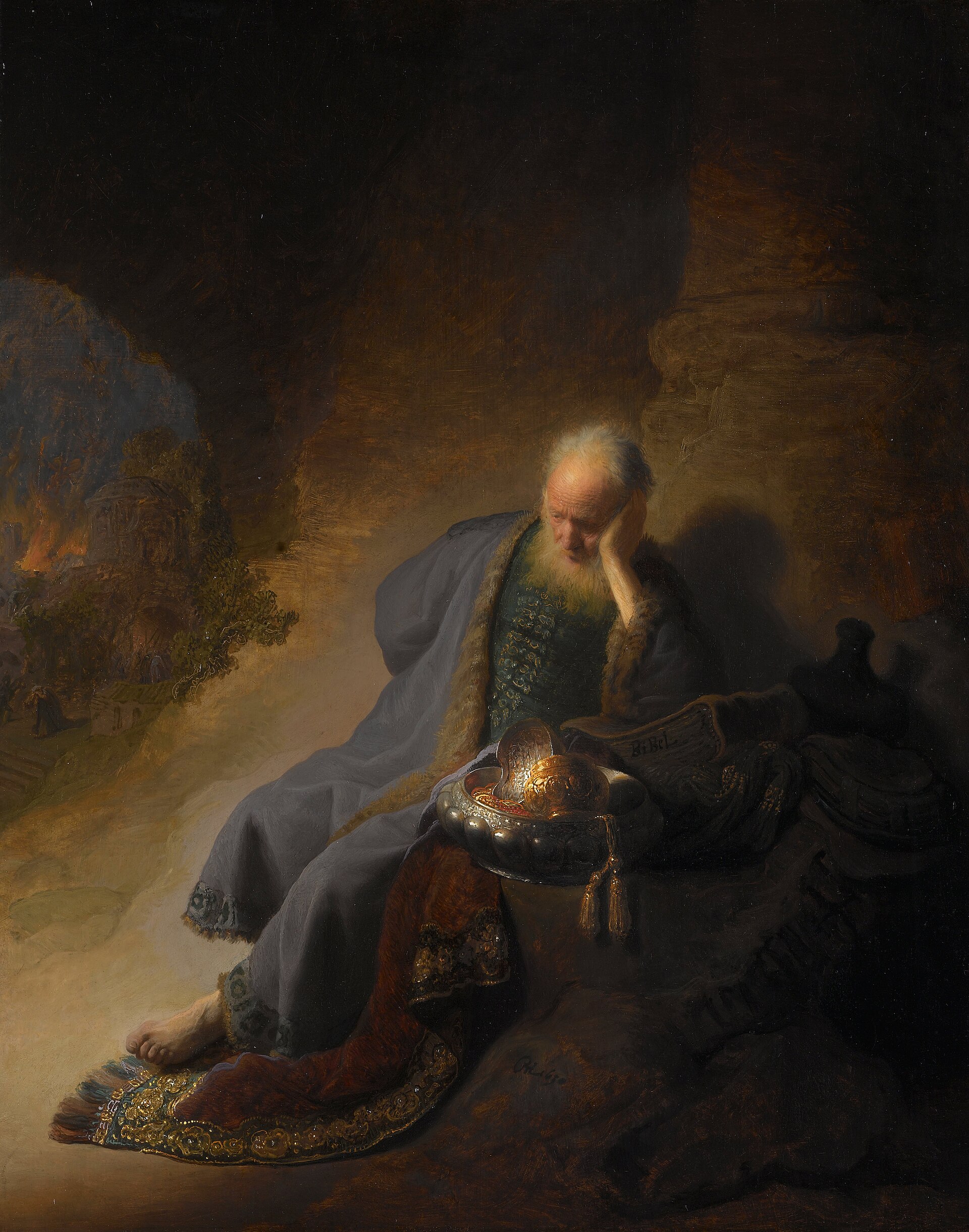
Jeremiahchapter 32
44 verses · Jeremiah, written by Baruch · 7th to 6th century BC · The Prophets
I signed and sealed the deed, called in witnesses, and weighed out the silver on the scales.
Introduction
Jeremiah, written by Baruch, The Prophets, Jeremiah Overview.
Jeremiah received this chapter as a prisoner of his own king, held in the palace guardhouse of a city under siege. Its first hearers were officials and citizens who expected the city to fall and the land to be lost. The chapter joins a legal purchase of family land to a long prayer and a longer answer from God. Listen for how carefully the purchase is witnessed and stored, and for the question the prophet puts to God when it is done. The chapter asks whether a promise can be trusted when every sign is against it.
Context
- Who
- Officials and witnesses watching a prisoner buy farmland in occupied territory
- What
- An account of Jeremiah buying his cousin's field at Anathoth during the siege, his prayer afterwards, and God's answer promising a return to the land.
- Where
- The court of the guard in the royal palace at Jerusalem, with Anathoth, the prophet's home town, a few miles north-east behind the Babylonian lines.
- When
- The tenth year of Zedekiah and the eighteenth of Nebuchadnezzar, about 588 to 587 BC, during the last siege of Jerusalem.
- Why
- To show the besieged city that God had set an end to its judgment, and that fields in Judah would be bought and sold again.
Historical context
The transaction is the message, and it is done by the book. Israelite law gave the nearest relative the first right to buy family land so it stayed in the clan, and Hanamel comes to his cousin Jeremiah with exactly that offer. Anathoth at this moment is behind Babylonian lines. The field is worthless.
Show the rest of the historical context, 3 more paragraphs
Everything about the sale is recorded because it had to be. Seventeen shekels of silver are weighed out on scales, there were no coins yet in that world, so payment meant weighing metal against stone weights, many of which have been dug up in Jerusalem inscribed with their values.
Then the paperwork. Two documents are made: a sealed copy and an open copy. That is real practice, the deed was written, the sheet rolled, tied with cord, and blobs of clay pressed over the cord and stamped with the parties' seals, with a second unsealed copy for consultation. Thousands of those clay seal blobs survive; the sealed original could only be opened by breaking them, in front of witnesses, if the open copy was ever disputed.
The deeds are given to Baruch and put in an earthenware jar so they will last a long time. Storing documents in sealed pottery is precisely how the Dead Sea Scrolls survived two thousand years in the caves above the same valley.
Significance
The first witnesses had just watched a condemned prophet spend real silver on land held by the enemy, and file the deed for long-term storage. He had been telling them the city would fall. Now he was betting his savings that houses and fields and vineyards would be bought again in this land.
Show the rest of the significance, 1 more paragraph
His prayer afterwards is honest about the strangeness of it, he asks God outright why he was told to buy a field while the siege ramps are going up. The answer is the sentence the whole chapter exists for: I am the LORD, the God of all flesh; is anything too hard for me.
This chapter in Jewish lifeWhat this chapter is in Jewish life and reading.
What is done
The site's own table in src/lib/hebraic/readings.ts sets this chapter in one prophetic reading of the annual cycle. It is read as the Haftarah of Behar, Jeremiah 32:6 to 32:27, in both rites, on the Sabbath of the portion Leviticus 25:1 to 26:2. A congregation keeping that cycle hears the verses of the reference read aloud after the Torah portion of its Sabbath. The portion sets out the law of the Jubilee and the redemption of land, and the Haftarah tells of Jeremiah buying the field of his cousin Hanamel at Anathoth.
The corpus joins the chapter to the weeks of the Torah portions through the works arranged by portion. Under the seventh verse it carries Bereshit Rabbati, Parashat Vayishlach 26. Under the thirty-sixth verse it carries Midrash Tanchuma, Ha'Azinu 1:1.
How it is read
Rashi is the one commentator on this chapter whose English the corpus carries, quoted here from The Judaica Press complete Tanach with Rashi, translated by A. J. Rosenberg, which Sefaria reports as CC-BY. Every quotation of it is held to fifty words or fewer because the translation is modern, and his headwords, which carry the verse in that translation's wording, are never quoted.
Rashi first sorts the order of the telling. Jeremiah's words in the sixth verse were never spoken to Zedekiah. "Scripture explained why he imprisoned him and then returned to its first statement" (Rashi on Jeremiah 32:6:1). The remembering of Zedekiah in the fifth verse is "The remembrance of all mankind. That is death" (Rashi on Jeremiah 32:5:1). Hanamel's coming in the seventh verse was "By Divine command" (Rashi on Jeremiah 32:7:1).
At the twelfth verse Rashi meets a difficulty and says so. Hanamel was called the son of Jeremiah's uncle, and here he is called his uncle. "Perhaps there were two. Otherwise, I do not know what it means." He reports a reading that makes one man both uncle and cousin by a marriage within the family. He turns it down: "This is, however, not the method of expression" (Rashi on Jeremiah 32:12:1).
The deeds put in a jar carry the point of the purchase. Rashi gives the sense of the fourteenth verse as "Do not say that I am concealing them for nothing since everyone is going into exile" (Rashi on Jeremiah 32:14:1). The fifteenth answers, "They will ultimately purchase houses" (Rashi on Jeremiah 32:15:1). The prophet's prayer he reads as a question. "You know that we are destined to be exiled, so why did You tell me to buy a field?" (Rashi on Jeremiah 32:17:1). It ends in the twenty-fifth verse with "Of what avail is the field to me?" (Rashi on Jeremiah 32:25:1).
Two notes stand on the prayer's middle. The iniquity of the fathers repaid to the children falls on those "who follow their ancestors in their evil way" (Rashi on Jeremiah 32:18:1). The signs among mankind in the twentieth verse he reads through the cloud at the sea, dark to Egypt and light to Israel. He takes it from a Midrash Aggadah whose source he leaves unknown (Rashi on Jeremiah 32:20:1).
The corpus carries ten further notes on this chapter without an English text. Each is marked linked because Sefaria holds no English version of the ref, so each is cited here and none is quoted. The notes of Radak are cited at Radak on Jeremiah 32:1:1, 32:4:1, 32:8:1, 32:9:1, 32:10:1, 32:19:1 and 32:21:1. The notes of Metzudat David are cited at Metzudat David on Jeremiah 32:3:1, 32:16:1 and 32:22:1.
What the rabbis say
The corpus carries forty rabbinic locators on this chapter and the text of none, so each is cited and linked here rather than quoted. On the first verse it holds Introductions to Amoraic Literature, Part II (Notes and Interpretations for Chapters of the Talmud), Baba Batra, Chapter III 72 and Midrash Lekach Tov on Esther, Introduction 2. On the seventh verse it holds Bereshit Rabbati, Parashat Vayishlach 26, Midrash Tanchuma, Behar 3:1 and Pesikta DeRav Kahana 13:14. On the eighth verse it holds Seder Olam Rabbah 26:1. On the eleventh verse it holds Bava Batra 160b:3, Bava Batra 160b:8 and Gittin 20b:17. On the fourteenth verse it holds Bava Batra 29a:1, Gittin 22b:4 and Megillah 26b:16.
On the sixteenth verse it holds Midrash Tehillim 90:1. On the seventeenth verse it holds Bereshit Rabbah 9:3 and Midrash Shmuel 5:5. On the eighteenth verse it holds Berakhot 5b:3, Ein Yaakov (Glick Edition), Berakhot 1:18 and Ein Yaakov, Berakhot 1:26. On the nineteenth verse it holds Aggadat Bereshit 21:1, Avodah Zarah 18a:5 and Ein Yaakov (Glick Edition), Avodah Zarah 1:23. On the twenty-first verse it holds Midrash Tehillim 90:6.
On the twenty-third verse it holds Jerusalem Talmud Chagigah 1:7:4. On the twenty-fourth verse it holds Pesikta DeRav Kahana 16:6. On the twenty-sixth verse it holds Jerusalem Talmud Moed Katan 3:7:8, Jerusalem Talmud Moed Katan 3:7:9 and Jerusalem Talmud Sanhedrin 7:8:7. On the twenty-seventh verse it holds Midrash Tannaim on Deuteronomy 17:8:2 and Yalkut Shimoni on Torah 357:1. On the twenty-ninth verse it holds Midrash Tehillim 53:2.
On the thirtieth verse it holds Sifrei Devarim 96:9. On the thirty-first verse it holds Bamidbar Rabbah 10:4 and Eikhah Rabbah 2:12. On the thirty-third verse it holds Midrash Tehillim 13:3. On the thirty-sixth verse it holds Midrash Tanchuma, Ha'Azinu 1:1. On the fortieth verse it holds Kohelet Rabbah 1:16:1.
On the forty-first verse it holds Bereshit Rabbati, Parashat Vayetze 3 and Pirkei DeRabbi Eliezer 42:16. On the forty-fourth verse it holds Bava Batra 160a:4 and Bava Batra 28b:13. What each of them teaches is a saying of the rabbis, and is reported as theirs wherever this site quotes one. The quotations wait on a fetch that carries the text.
Sources: Rashi, Rashi on Jeremiah 32:5:1 to 32:25:1, The Judaica Press complete Tanach with Rashi, translated by A. J. Rosenberg, reported CC-BY; Radak, Radak on Jeremiah 32:1:1, 32:4:1, 32:8:1, 32:9:1, 32:10:1, 32:19:1 and 32:21:1, cited by ref because the corpus carries no English text; Metzudat David, Metzudat David on Jeremiah 32:3:1, 32:16:1 and 32:22:1, cited by ref because the corpus carries no English text; The Sefaria corpus, scripts/data/sources/sefaria/jeremiah/32.json, the 40 Talmud and Midrash locators of this chapter; The site's own files, src/lib/hebraic/readings.ts, printing the Haftarah of Behar, Jeremiah 32:6 to 32:27, for this chapter.
The heads below are this chapter's scenes. The numbered points under each are its verses.
Buying a Field at Anathoth While the Siege Mounds Rise
Jeremiah 32:1-5
in the tenth year of Zedekiah king of Judah: The date is exact, “the tenth year of Zedekiah king of Judah, which was the eighteenth year of Nebuchadnezzar.” His offense is the message that the city will fall, and the king confines the messenger. The chapter's sign of hope takes place in this same prison yard.
Jeremiah 32:1
“The siege of Jerusalem began in Zedekiah’s ninth year Jer 39:1, but was temporarily raised upon the approach of an Egyptian army. See Jer. 37; 38.”
was besieging Jerusalem: Barnes places the courtyard of the guard inside the palace, where the royal guard had its quarters. Jamieson, Fausset and Brown trace the way Jeremiah came there. When an Egyptian army lifted the siege, he was put in a dungeon and later moved to this freer custody (Jeremiah 37:12-21).
Jeremiah 32:2
“Then the king of Babylon’s army besieged Jerusalem - The siege had commenced the year before, and continued a year after ending in the fifth month of the following year; consequently, the siege must have lasted about eighteen months and twenty-seven days. See 2Ki 25:18.”
Adam Clarke · Commentary on the Bible (1810-1826)evangelical
1 more voice on this verse
Jeremiah 32:2
“He was at that time put into free custody in the court of the prison. At the raising of the siege by Pharaoh-hophra, Jeremiah was on the point of repairing to Benjamin, when he was cast into "the dungeon," but obtained leave to be removed again to the court of the prison (Jer 37:12-21).”
Jamieson, Fausset & Brown · Commentary Critical and Explanatory on the Whole Bible (1871)reformed
Zedekiah king of Judah had imprisoned him: The words Zedekiah throws back at Jeremiah come from the oracle of Jeremiah 21:4-7 and 9, as Barnes notes. Matthew Henry observes that the king kept up his persecution even in the depth of the siege. Calvin adds that the word itself stayed unbound.
Jeremiah 32:3
“The Prophet here declares, that though he was shut up in prison, the Word of God was not bound, and that he himself was not less loose and free in his confinement than if he rambled through the whole city and visited all the lanes and the streets.”
John Calvin · Commentaries (1554)reformed
will not escape from the hands of the Chaldeans: Ezekiel 12:13 says the king will never see Babylon, while this verse says he will see its king eye to eye. Jamieson, Fausset and Brown join the two through Jeremiah 39:6-7. Zedekiah faced Nebuchadnezzar at Riblah and was blinded before he was taken to Babylon.
Jeremiah 32:4
“And shall speak with him mouth to mouth - He shall be reduced to a state of the most abject servitude. The slave was obliged to fix his eyes on every motion of the master whilst giving his orders, who often condescended to give them only by dumb signs.”
Adam Clarke · Commentary on the Bible (1810-1826)evangelical
until I attend to him: Readers divide over what this attending means. Wesley and Jamieson, Fausset and Brown take it as mercy, pointing to the peaceful death and burial promised at Jeremiah 34:4-5. Barnes takes it as punishment and cites Jeremiah 52:11, where the blinded king stays in prison until his death.
Jeremiah 32:5
“Until I visit him - Perhaps in mercy; it is certain Zedekiah was not put to death, only carried to Babylon, where some think he afterward found favour with the king of Babylon.”
John Wesley · Explanatory Notes upon the Old Testament (1765)evangelical
Jeremiah 32:6-10
Jeremiah replied, “The word of the: Hanamel's visit is foretold. When the cousin asks Jeremiah to use “the right of redemption” on a field, he knows “that this was the word of the LORD.” The sale is ordinary, “seventeen shekels of silver” for land he is unlikely to farm in territory the Chaldeans already hold.
Jeremiah 32:6
“And Jeremiah said, the word of the Lord came unto me, saying. Not that he said this to Zedekiah; but the prophet, after the above preface, returns to declare what the word of the Lord was, which came to him at the time before mentioned.”
the son of your uncle Shallum: Hanamel is Jeremiah's first cousin, as Barnes notes. Under Leviticus 25:25 the nearest relative had the first right to buy a poor man's land, which Clarke calls the right of the kinsman. Jamieson, Fausset and Brown add that Leviticus 25:34 forbade only selling such Levite fields outside the tribe.
Jeremiah 32:7
“The prohibition to sell these suburban fields (Le 25:34) applied merely to their alienating them from Levites to another tribe; so that this chapter does not contravene that prohibition. Besides, what is here meant is only the purchase of the use of the field till the year of jubilee.”
Jamieson, Fausset & Brown · Commentary Critical and Explanatory on the Whole Bible (1871)reformed
1 more voice on this verse
Jeremiah 32:7
“Hanameel was strictly the first-cousin of Jeremiah. In Hebrew all the terms of relationship are used in a more loose way than with us.”
my cousin Hanamel came to me: The visit came as the Lord had said, and only then does Jeremiah say he knew the word was from the Lord. Barnes infers that Hanamel was childless. Jamieson, Fausset and Brown cite Florus: while Hannibal besieged Rome, the ground under his camp found a buyer in the city.
Jeremiah 32:8
“This was the word of the Lord - It was by his appointment that I was to make this purchase. The whole was designed as a symbolical act, to show the people that there would be a return from Babylon, that each family should re-enter on its former possessions, and that a man might safely purchase on the certainty of this event.”
Adam Clarke · Commentary on the Bible (1810-1826)evangelical
2 more voices on this verse
Jeremiah 32:8
“It became him to fulfil all righteousness. It was land that lay within the suburbs of a priests' city, and, if he should refuse it, there was danger lest, in these times of disorder, it might be sold to one of another tribe, which was contrary to the law, to prevent which it was convenient for him to buy it.”
Matthew Henry · Commentary on the Whole Bible (1707-1721)puritan
Jeremiah 32:8
“The Roman historian, FLORUS (2.6), records a similar instance: During the days that Rome was being besieged by Hannibal, the very ground on which he was encamped was put up for sale at Rome, and found a purchaser; implying the calm confidence of the ultimate issue entertained by the Roman people.”
Jamieson, Fausset & Brown · Commentary Critical and Explanatory on the Whole Bible (1871)reformed
seventeen shekels of silver: Clarke notes that the silver was weighed, as Judah had no coined money before the exile. Barnes holds that Jeremiah bought only Hanamel's interest up to the year of Jubilee, in a siege where no life was worth much. The silver could have bought food.
Jeremiah 32:9
“Seventeen shekels of silver - literally, as in the margin, probably a legal formula. Jeremiah bought Hanameel’s life-interest up to the year of Jubilee, and no man’s life was worth much in a siege like that of Jerusalem. As Jeremiah had no children, at his death the land would devolve to the person who would have inherited it had Jeremiah not bought it. He therefore bought what never was and never could have been of the slightest use to him, and gave for it what in the growing urgency of the siege might have been very serviceable to himself.”
1 more voice on this verse
Jeremiah 32:9
“4d.., the whole would be under £2, a rather small sum, even taking into account the fact of the Chaldean occupation of the land, and the uncertainty of the time when it might come to Jeremiah or his heirs. Perhaps the "seven shekels," which in the Hebrew (see Margin) are distinguished from the "ten pieces of silver," were shekels of gold [MAURER].”
Jamieson, Fausset & Brown · Commentary Critical and Explanatory on the Whole Bible (1871)reformed
signed and sealed the deed: Barnes describes two documents: the sealed deed was closed up and kept, while the open copy served for common use. If the sale were challenged, a judge opened the sealed copy and compared the two. Clarke lists every step: offer, price, silver weighed, deed drawn up, witnesses at the signing.
Jeremiah 32:10
“I subscribed the evidence - We have here all the circumstances of this legal act: 1. An offer is made of the reversion of the ground, till the jubilee, to him who would then of right come into possession. 2. The price is agreed on, and the silver weighed in the balances. 3. A contract or deed of sale is drawn up, to which both parties agreeing, 4. Witnesses are brought forward to see it signed and sealed; for the contract was both subscribed and sealed.”
Adam Clarke · Commentary on the Bible (1810-1826)evangelical
Jeremiah 32:11-15
Then I took the deed of: Jeremiah hands both copies of the deed to Baruch before witnesses. The order to “put them in a clay jar to preserve them for a long time” looks past the coming destruction. The sign's meaning comes in one sentence: “Houses, fields, and vineyards will again be bought in this land.”
Jeremiah 32:11
“I took - It is probable, that upon such sales among the Jews, two instruments were made, the one sealed up, to be kept by the purchaser, the other open, to be shewed to the Judges, and by them ratified.”
John Wesley · Explanatory Notes upon the Old Testament (1765)evangelical
gave this deed to Baruch son of Neriah: Baruch son of Neriah is the scribe who later writes the words of the LORD from Jeremiah's mouth (Jeremiah 36:4). Jamieson, Fausset and Brown add that a purchase had to be made in the open. The Jews sitting in the courtyard were its witnesses.
Jeremiah 32:12
“Baruch - This Baruch (chap. xlvi, 4, 26,) was a scribe, and an attendant upon Jeremiah. Witnesses - He made this purchase with all the usual formalities; he signed and sealed it before witnesses, and delivered it to Baruch to keep, in the presence of all the Jews.”
John Wesley · Explanatory Notes upon the Old Testament (1765)evangelical
1 more voice on this verse
Jeremiah 32:12
“Baruch--Jeremiah's amanuensis and agent (Jer 36:4, &c.). before all--In sales everything clandestine was avoided; publicity was required. So here, in the court of prison, where Jeremiah was confined, there were soldiers and others, who had free access to him, present (Jer 38:1).”
Jamieson, Fausset & Brown · Commentary Critical and Explanatory on the Whole Bible (1871)reformed
In their sight I instructed Baruch: The charge to Baruch was given in public, before Hanamel, the witnesses and the Jews sitting in the court, as Gill notes. Everyone who saw the sale also heard what it meant. The explanation follows in verses 14 and 15.
put them in a clay jar: The deeds go into a clay jar to last a long time, so the purchase looks past the fall of the city. Spurgeon counts the cost. Jeremiah was a prisoner, food in the siege sold at great prices, and he paid for a field he could neither see nor reach.
Jeremiah 32:14
“THE discourse of this evening is suggested by the transaction of Jeremiah with his uncle's son in the purchase of a field at Anathoth which he conducted in a business-like and legal way. I will begin with just a few remarks upon the transaction itself. Jeremiah was called to forego the comforts of the present for the blessings of the future. He was a poor man and he was shut up in prison.”
Charles Spurgeon · written before 1892 · The Metropolitan Tabernacle Pulpit, Sermon No. 2297: “Sealed and Open Evidences” (lightly modernized text, CCEL edition)Particular Baptist
Houses, fields, and vineyards will again be bought: Clarke reads it as a sign the captivity would be short enough for the present owners or their children to return. A child under ten could live to come back. Jeremiah 29:10 had already set the exile at seventy years.
Jeremiah 32:15
“Houses and fields - shall be possessed again - That is, this is an evidence that the captivity shall not last long: houses, etc., shall here be possessed again, either by their present owners or immediate descendants. The young might return; at least, all under ten years of age: there was no natural impossibility that they should not live till they should be fourscore.”
Adam Clarke · Commentary on the Bible (1810-1826)evangelical
Ah, Lord GOD, There Is Nothing Too Hard for Thee
Jeremiah 32:16-25
After I had given the deed: Jeremiah's prayer opens with creation, then moves through the exodus and Israel's disobedience. That history ends in the present siege, where “the city has been given into the hands of the Chaldeans.” Verse 25 sets the LORD's command, “Buy for yourself the field with silver,” beside that fact.
Jeremiah 32:16
“Jeremiah, not comprehending how God's threat of destroying Judah could be reconciled with God's commanding him to purchase land in it as if in a free country, has recourse to his grand remedy against perplexities, prayer.”
Jamieson, Fausset & Brown · Commentary Critical and Explanatory on the Whole Bible (1871)reformed
1 more voice on this verse
Jeremiah 32:16
“Note, Prayer is a salve for every sore. Whatever is a burden to us, we may by prayer cast it upon the Lord and then be easy. In this prayer, or meditation, I.”
Matthew Henry · Commentary on the Whole Bible (1707-1721)puritan
Nothing is too difficult for You!: Jeremiah begins his prayer with creation, the largest proof of power he can name. Barnes gives the sense of too difficult as too wonderful. Jamieson, Fausset and Brown note the Lord answers in verse 27 with the prophet's words, the question put to Abraham over Sarah at Genesis 18:14.
Jeremiah 32:17
“AT the very time when the Chaldeans had cast up mounds round about the city of Jerusalem, and when the sword and famine and pestilence had desolated the whole land, Jeremiah, while in prison, was commanded by his God to purchase a field of Hanamel, his uncle's son at Anathoth. He was to subscribe the evidence of purchase by the usual witnesses, to seal the deed of transfer according to law and custom, and to do this publicly in the presence of all the Jews that sat in the court of the prison.”
lay the iniquity of the fathers into the laps: The words come from the Ten Commandments at Exodus 20:5-6, as Jamieson, Fausset and Brown note. Barnes explains the lap as the fold of a garment used as a pocket, where each one carries the reward of his deeds. Jerome weighs loving devotion to thousands against iniquity repaid.
Jeremiah 32:18
“His reprieves are not pardons, but if in mercy he spares the parents, that they may be led to repentance, yet such a hatred has he to sin, and such a displeasure against sinners, that he recompenses their iniquity into the bosom of their children, and yet does them no wrong; so hateful is the unrighteousness of man, and so jealous of its own honour is the righteousness of God.”
Matthew Henry · Commentary on the Whole Bible (1707-1721)puritan
2 more voices on this verse
Jeremiah 32:18
“Recompensest - The recompence is placed in the bosom, because, in the East, the garments are so arranged as to form a pocket there. Thus then, men must receive and carry with them God’s requital for their deeds.”
Jeremiah 32:18
“This is taken from the decalogue (Ex 20:5, 6). This is a second consideration to check hasty judgments as to God's ways: Thou art the gracious and righteous Judge of the world.”
Jamieson, Fausset & Brown · Commentary Critical and Explanatory on the Whole Bible (1871)reformed
great in counsel and mighty in deed: The prayer turns from God's great power to His eyes on all the ways of men. Matthew Henry pictures a judge who sees every step and gives each one the fruit of his deeds. Jerome adds that no man can hide his ways from God.
Jeremiah 32:19
“Thine eyes are open upon all the ways of - men - Thou art omniscient, and knowest all things; thou art omnipresent, and seest all things.”
Adam Clarke · Commentary on the Bible (1810-1826)evangelical
1 more voice on this verse
Jeremiah 32:19
“You, as a person, know any other person from the way he appears outside. You think the way you see. And you see as far only as your eyes do. But the Scripture says, "The eyes of the Lord are lofty," "People look at the outward appearance, but God looks at the heart," "The Lord sees and knows his own," and "the plant that my heavenly Father has not planted, he roots up," and "the first shall," as he shows, "be last," and he carries "his fan in his hand to purge his threshing floor."”
Tertullian · written before 220 · Prescriptions Against Heretics 3patristic
signs and wonders in the land of Egypt: Barnes reads the verse as a claim that the wonders begun in Egypt never stopped, still at work in Israel and among the nations. Jeremiah cites that record to steady himself. The God of the exodus is the God of the siege.
Jeremiah 32:20
“The sense is, who hast set, i. e., performed Exo 10:2 signs etc., and hast continued working them unto this day, both in lsrael and among men (i. e., the pagan).”
a strong hand and an outstretched arm: The strong hand and outstretched arm echo the exodus language of Deuteronomy 26:8. Matthew Henry reads them against Pharaoh: a hand too strong for the Egyptians and an arm long enough to reach their proud king. The same arm made the heavens in verse 17.
a land flowing with milk and honey: Gill names the fathers as Abraham, Isaac and Jacob, and reads the verse as Jeremiah's acknowledgment that God kept his oath. Jerome adds that Israel received the land for the fathers' sake. The next verse sets that kept promise against a broken obedience.
Jeremiah 32:22
“And hast given them this land, which thou didst swear to their fathers to give them,.... Abraham, Isaac, and Jacob; so that God was faithful to his word, kept his covenant and oath; and the faithfulness of God is observed and acknowledged by the prophet, along with other perfections of God before taken notice of.”
They came in and possessed it: Jerome finds no pause between possessing the land and disobeying the law: abundance bred security, and security bred contempt. Matthew Henry reads the verse as Jeremiah's confession that the LORD was right to bring this disaster. The disaster answers the broken law.
the siege ramps are mounted against the city: Clarke explains the ramps as great earthworks from which the besiegers threw darts and stones into the city. The city held out nearly a year longer. Matthew Henry notes that Jeremiah neither complains of God nor tells him what to do; he asks only that the Lord see it.
Jeremiah 32:24
“Behold the mounts - The huge terraces raised up to plant their engines on, that they might throw darts, stones, etc., into the city. Because of the sword, and of the famine, and of the pestilence - The city was now reduced to extreme necessity; and from the siege continuing nearly a year longer, we may conclude that the besieged made a noble defense.”
Adam Clarke · Commentary on the Bible (1810-1826)evangelical
Barnes observes that the command needs only to be set beside the state of Jerusalem to look contrary to all prudence. Jeremiah lays the two side by side. Matthew Henry takes the lesson that two words of God which seem at odds are both true and both kept.
Jeremiah 32:25
“Jeremiah knew not how to sing both of mercy and judgment, but God here teaches to sing unto him of both. When we know not how to reconcile one word of God with another we may yet be sure that both are true, both are pure, both shall be made good, and not one iota or tittle of either shall fall to the ground.”
Matthew Henry · Commentary on the Whole Bible (1707-1721)puritan
Behold, I Am the God of All Flesh
Jeremiah 32:26-35
Then the word of the LORD: The LORD answers with His question, “Is anything too difficult for Me?” The indictment names the places “of Baal in the Valley of Hinnom,” built to “make their sons and daughters pass through the fire to Molech.” This is the valley the closing verses of chapter 31 declare consecrated.
Jeremiah 32:26
“The answer is divided into two parts; (a) Jer 32:26-35, the sins of Judah are shown to be the cause of her punishment: (b) Jer 32:36-44, this punishment was not for Judah’s destruction, but for her amendment. Jer 32:28 I will give - Or, I am giving. Jer 32:30 From their youth - God’s mighty deeds for Israel began in Egypt Jer 32:20, and so did Israel’s sin. Jer 32:34, Jer 32:35 These verses are repeated from Jer 7:30-31, but with two important variations. Baal is put for Tophet, and to Molech instead of in the fire.”
the God of all flesh: The LORD turns Jeremiah's words of verse 17 into a question. Spurgeon explains why: a man can truly believe a thing and still fall short of believing it enough to act on it. Jerome notes that the God of all flesh is God of every living creature, man and beast.
Jeremiah 32:27
“A Truth of God may be sincerely believed by us and yet it may do us good to have it put in the form of a question. As I read the chapter, I called your attention to Jeremiah's confident declaration to God, "There is nothing too hard for You." Yet in our text, which is only a few verses further on in the chapter, the Lord says to this same Prophet, "Is there anything too hard for Me?" I think the explanation of this mystery is that we do not always thoroughly believe even all that we do truly believe.”
Charles Spurgeon · written before 1892 · The Metropolitan Tabernacle Pulpit, Sermon No. 2675: “Jehovah's Challenge” (lightly modernized text, CCEL edition)Particular Baptist
I am about to deliver this city: The answer to the prayer opens by confirming the worst. Gill notes that the fall of the city, foretold so often, was now about to happen. The field is bought, and Nebuchadnezzar will still take Jerusalem as Jeremiah had always said.
Jeremiah 32:28
“Therefore thus saith the Lord, behold, I will give this city into the hand of the Chaldeans,.... As he had foretold by the prophet, and was just now going to be fulfilled.”
burning incense to Baal on their rooftops: The punishment fits the sin: houses used to burn incense to Baal will be burned, a link Jamieson, Fausset and Brown trace to Jeremiah 19:13. Clarke thinks Baal was the sun, worshiped on flat roofs at sunrise. The fire of the offerings becomes the fire of the city.
Jeremiah 32:29
“They burnt incense to Baal, on the houses, so the houses shall be burnt (Jer 19:13). The god of fire was the object of their worship; so fire shall be the instrument of their punishment. to provoke me--indicating the design, not merely the event. They seemed to court God's "anger," and purposely to "provoke" Him.”
Jamieson, Fausset & Brown · Commentary Critical and Explanatory on the Whole Bible (1871)reformed
1 more voice on this verse
Jeremiah 32:29
“With the houses, upon whose roofs - As it is most probable that Baal was the sun, they might have chosen the tops of the houses, which were always flat, with battlements around, to offer incense and sacrifice to him at his rising, and while he was in sight above the horizon.”
Adam Clarke · Commentary on the Bible (1810-1826)evangelical
from their youth: Barnes links from their youth to verse 20. Israel's sin began in Egypt, where God's mighty deeds for them began. Clarke reads the work of their hands as the idols they made, and Israel in this verse as the ten northern tribes.
Jeremiah 32:30
“For the children of Israel and the children of Judah have only done evil - They have all been transgressors from their earliest history. For the children of Israel - The ten tribes. Have only provoked me to anger with the work of their hands - They have been sinners beyond all others, being excessive idolaters. Their hands have formed the objects of their worship.”
Adam Clarke · Commentary on the Bible (1810-1826)evangelical
from the day it was built until now: Jamieson, Fausset and Brown note the city was first built by idolatrous Canaanites, and Solomon was the first of its kings to turn to idols. Second Kings 23:27 records the same resolve to remove Jerusalem. The charge covers the whole life of the city.
Jeremiah 32:31
“In English Version the words, "that I should remove it," &c., stand independently, as the result of what precedes. The time is ripe for taking vengeance on them (2Ki 23:27). from the day that they built it--Solomon completed the building of the city; and it was he who, first of the Jewish kings, turned to idolatry. It was originally built by the idolatrous Canaanites.”
Jamieson, Fausset & Brown · Commentary Critical and Explanatory on the Whole Bible (1871)reformed
their kings, their officials, their priests and prophets: The list runs from the throne to the ordinary citizen and leaves no class outside the charge. Matthew Henry notes they knew their God was jealous over his worship and chose to provoke him there. Jeremiah 23:11 had already charged prophet and priest together.
turned their backs to Me: The people turned away, and the LORD kept teaching. Clarke took the early and repeated teaching as a sign that morning preaching was common in Judah. Matthew Henry compares them to children who walked away as they were called (Hosea 11).
Jeremiah 32:33
“Though I taught them, rising up early and teaching them - From the frequent reference to this, we may naturally conclude that morning preaching prevailed much in Judea.”
Adam Clarke · Commentary on the Bible (1810-1826)evangelical
placed their abominations in the house: Gill names Ahaz and Manasseh among the kings who set idols in the temple, and points back to the same charge at Jeremiah 7:30. Matthew Henry notes the idols stood in God's own house as well as on the high places. The Lord's house became the place of his dishonor.
Jeremiah 32:34
“But they set their abominations,.... Their idols, which were abominable to the Lord, and ought to have been so to them: these they placed in the house (which is called by my name), to defile it; in the temple; as by Ahaz, Manasseh, and others: see Jer 7:30.”
the high places of Baal in the Valley of Hinnom: Barnes notes these lines repeat Jeremiah 7:30-31, with Baal in place of Tophet and Molech named. Jamieson, Fausset and Brown explain Molech as meaning king, the god also called Milcom (1 Kings 11:33). The words never commanded remove any plea of good intention.
Jeremiah 32:35
“Molech--meaning "king"; the same as Milcom (1Ki 11:33). I commanded . . . not--This cuts off from the superstitious the plea of a good intention. All "will-worship" exposes to God's wrath (Col 2:18, 23).”
Jamieson, Fausset & Brown · Commentary Critical and Explanatory on the Whole Bible (1871)reformed
One Heart and One Way: Fields Bought Again in This Land
Jeremiah 32:36-41
Now therefore, about this city of: “Now therefore” turns the oracle from indictment to promise. The everlasting covenant gives “one heart and one way,” so obedience is a gift, as in the new covenant of chapter 31. Verse 41 names the LORD's gladness, in words rare in the book: “I will rejoice in doing them good.”
Jeremiah 32:36
“God's judgments came gradually upon them, but, they not meeting him by repentance in the way of his judgments, he proceeded in his controversy till all was laid waste, which was in the eleventh year of Zedekiah; now what is here recorded happened in the tenth.”
Matthew Henry · Commentary on the Whole Bible (1707-1721)puritan
I will surely gather My people: Gill points out that the scattering had not yet happened when this was spoken; the city still stood under siege. He reads the gathering as the return after seventy years, with a fuller one still to come for the Jews. Clarke links the promise to Jeremiah 29:14 and 31:8.
Jeremiah 32:37
“Behold, I will gather them out of all countries,.... At the end of the seventy years' captivity; and which will have a greater accomplishment in the latter day, when the Jews shall be converted, and gathered from their present dispersion all over the earth: whither I have driven them in mine anger, and in my fury, and in great wrath: or "whither I shall drive them", or "shall have driven them" (m); for as yet they were not thus driven and dispersed.”
1 more voice on this verse
Jeremiah 32:37
“Behold, I will gather them out of all countries - A promise often repeated. See Jer 29:14, and the notes on Jer 31:8 (note), etc.”
Adam Clarke · Commentary on the Bible (1810-1826)evangelical
They will be My people: This is the covenant formula of Jeremiah 31:33, and Gill calls it a summary of the covenant of grace. He sets it against the name Lo-ammi of Hosea 1:9, which declared Israel cut off. The name is given back.
Jeremiah 32:38
“And they shall be my people, and I will be their God. A comprehensive summary of the covenant of grace, which shall be made known to the Jews at the time of their conversion, and the blessings of it applied to them, and bestowed on them; though now a "loammi", Hos 1:9, is written upon them; see Jer 30:21.”
one heart and one way: Wesley reads one heart as agreement of mind and one way as common worship by the rule God gave. Spurgeon sets it against the divided heart, which the Hebrew calls a heart and a heart. The fear promised here serves the children too.
Jeremiah 32:39
“I will give them one heart - And that a clean one. And one way - And that a holy and safe one: and to have this clean heart, and to walk in this good way, will be for the good of them and their children after them. God’s blessing is a profitable inheritance. They shall have but one object of worship, and one way of salvation; and being saved from sin, idolatry, and destruction, they must necessarily be happy within and happy without.”
Adam Clarke · Commentary on the Bible (1810-1826)evangelical
1 more voice on this verse
Jeremiah 32:39
THOSE of you who were present last Lord's-Day morning will remember my sermon upon "Mongrel Religion," [Sermon #1622] in which I dealt with those who feared the Lord and served other gods. Their heart was divided and, therefore, they were found faulty. They had, as the Hebrew puts it, a heart and a heart—a heart that went this way and a heart that went the other way. And so, as a matter of fact, they became, as the Prophet says, as "a silly dove that has no heart."
I will make an everlasting covenant with them: The promise binds both sides: God will never turn from doing good, and his fear in their hearts will keep them from turning away. Augustine read it as the gift of perseverance. Jerome kept room for free will and called the fear a grace from the giver.
Jeremiah 32:40
“I will not turn away from them . . . good-- (Isa 30:21). Jehovah compares Himself to a sedulous preceptor following his pupils everywhere to direct their words, gestures. put my fear in . . . hearts . . . not depart from me--Both the conversion and perseverance of the saints are the work of God alone, by the operation of the Holy Spirit.”
Jamieson, Fausset & Brown · Commentary Critical and Explanatory on the Whole Bible (1871)reformed
2 more voices on this verse
Jeremiah 32:40
“And I will make an everlasting covenant with them,.... Which is made known and manifest at conversion; when the grace of it is applied; the blessings of it bestowed; and the promises of it made good; and therefore said to be made; for otherwise the covenant of grace here spoken of was made from all eternity with Christ, and his people in him; as appears from his being set up as the Mediator so early, and from the blessings and promises of it being of such a date.”
Jeremiah 32:40
“I will make - This promise manifestly relates to those Jews that should receive the Lord Jesus Christ, unless it be to be understood of a national conversion of the Jews, not yet effected.”
John Wesley · Explanatory Notes upon the Old Testament (1765)evangelical
I will rejoice in doing them good: The phrase with all the heart and soul, which Deuteronomy 6:5 asks of Israel, is here spoken by God of his own planting. Matthew Henry notes God punishes reluctantly and blesses with delight. Jerome compares the joy in heaven over one sinner who repents (Luke 15:10).
Jeremiah 32:41
“WE cannot help looking for the restoration of the scattered Israelites to the land which God has given to them by a covenant of salt—we also look for the time when they shall believe in the Messiah whom they have rejected, and shall rejoice in Jesus of Nazareth whom today they despise. There is great encouragement in prophecy to those who work among the seed of Israel. And it is greatly needed, for of all mission fields it has been commonly represented to be one of the most barren and upon the work the utmost ridicule has been poured.”
1 more voice on this verse
Jeremiah 32:41
“God will certainly do them good because he rejoices over them. They are dear to him; he makes his boast of them, and therefore will not only do them good, but will delight in doing them good. When he punishes them it is with reluctance.”
Matthew Henry · Commentary on the Whole Bible (1707-1721)puritan
Jeremiah 32:42-44
For this is what the LORD: “Just as I have brought all this great disaster on this people, so I will bring on them all the good I have promised them.” The desolation of verse 43 is answered district by district. The price paid for one field at Anathoth becomes a pledge for the whole land.
Jeremiah 32:42
“Will I bring upon them all the good that I have promised - God’s word cannot fail. The Jews have never yet received the good that God has promised. Nothing like the fulfillment of these promises took place after their return from Babylon; therefore there remaineth yet a rest for these ancient people of God; and it is under the Christian dispensation that they are to have it.”
Adam Clarke · Commentary on the Bible (1810-1826)evangelical
1 more voice on this verse
Jeremiah 32:42
“The restoration from Babylon was only a slight foretaste of the grace to be expected by Israel at last through Christ.”
Jamieson, Fausset & Brown · Commentary Critical and Explanatory on the Whole Bible (1871)reformed
fields will be bought in this land: The people's own words are quoted back: a desolation without man or beast, handed to the Chaldeans. Matthew Henry observes that those who felt secure before the siege now fell into despair. The one field of verse 9 becomes the pattern for many.
Jeremiah 32:43
“This is mentioned to reconcile Jeremiah to his new purchase. Though he had bought a piece of ground and could not go to see it, yet he must believe that this was the pledge of many a purchase, and those but faint resemblances of the purchased possessions in the heavenly Canaan, reserved for all those who have God's fear in their hearts and do not depart from him.”
Matthew Henry · Commentary on the Whole Bible (1707-1721)puritan
Fields will be purchased with silver: Every step of Jeremiah's own sale returns here. Jamieson, Fausset and Brown note that Benjamin heads the list because Anathoth, where the field lay, was in it. Clarke calls the purchase a sure sign of return to each family's own inheritance.
Jeremiah 32:44
“Men shall buy fields for money - This is a reference to the symbolical purchase mentioned at the beginning of the chapter; that may be considered by them as a sure sign of their restoration, not only to the same land, but to their respective inheritances in that land. This the power of God could alone perform.”
Adam Clarke · Commentary on the Bible (1810-1826)evangelical
1 more voice on this verse
Jeremiah 32:44
“Referring to the forms of contract (Jer 32:10-12): Benjamin--specified as Anathoth; Jeremiah's place of residence where the field lay (Jer 32:8), was in it.”
Jamieson, Fausset & Brown · Commentary Critical and Explanatory on the Whole Bible (1871)reformed
Keep studying
Studies6
Sources for this chapter
The summary
Jamieson, Fausset & Brown, Commentary Critical and Explanatory; John Calvin, Commentaries; John Wesley, Notes on the Old Testament and Matthew Henry, Complete Commentary.
The exposition
Adam Clarke, Commentary on the Bible; Albert Barnes; Augustine of Hippo, On the Gift of Perseverance 2:2, 7:14; Carl Friedrich Keil, The Prophecies of Jeremiah; Charles Spurgeon; Jamieson, Fausset & Brown, Commentary Critical and Explanatory on the Whole Bible; Jerome, Commentary on Jeremiah; John Calvin; John Gill; John Wesley, Explanatory Notes upon the Old Testament and Matthew Henry, Commentary on the Whole Bible.