
Genesischapter 27
46 verses · Moses, by tradition · 15th to 13th century BC · The Law
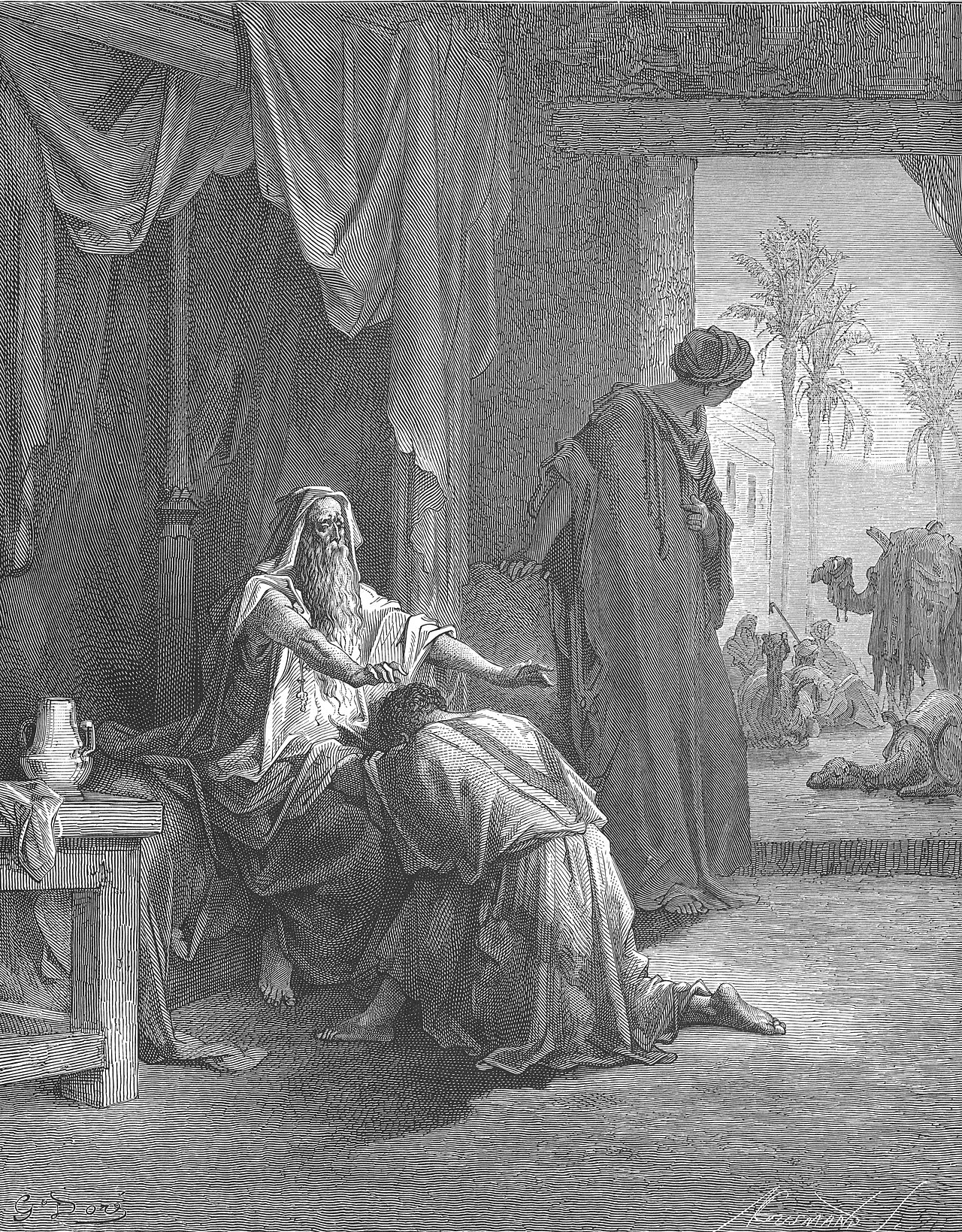
So Esau declared, “Is he not rightly named Jacob? For he has cheated me twice. He took my birthright, and now he has taken my blessing.” Then he asked, “Haven’t you saved a blessing for me?”
Introduction
Moses, by tradition, The Law, Genesis Overview.
Moses, by tradition, Narrative, The Law, The Isaac and Jacob cycle, Genesis Overview. Genesis was given to a nation that lived by a blessing spoken over it, and this chapter shows how that blessing first passed from father to son. It is set inside one household, and every member of it schemes. The first hearers knew that a father's last blessing, given before witnesses, was binding and could not be withdrawn. Listen for the blind man's tests by touch, taste and smell, for the two blessings and how they answer each other, and for the cry of the son who came too late. Read it with the word given to Rebekah before her sons were born.
Context
- Who
- Israel in the wilderness, a nation that lived by a blessing spoken over it
- What
- A narrative in which Jacob, disguised by his mother, receives the blessing Isaac meant for Esau, and Esau resolves to kill him.
- Where
- Isaac's tent in the Negev, with Esau out hunting in the open country.
- When
- The patriarchal age, about 1929 BC on the traditional dating from the ages Genesis gives, so the year is approximate.
- Why
- To show the promise reaching the son God named before birth, through a household that acted badly on every side.
Historical context
The chapter belongs to Isaac, who is old and whose eyes are too weak to see, and the blessing is his to give as head of the household. Genesis 35:28 records that he lived to a hundred and eighty, so he has many years left when he says he does not know the day of his death.
Show the rest of the historical context, 5 more paragraphs
The place is the family's own camp in the Negev, and the whole chapter happens between a tent and the open country a day's hunt away.
The occasion is a deathbed blessing, which in that world was a legal act rather than a fond wish. Records of the region treat a father's spoken disposition of his estate, made before witnesses, as binding, which is why Isaac cannot take it back when the fraud comes out.
A first hearer knew two things a reader today has to be told, and the first is that the blessing is agricultural and political at once, the dew of heaven, the richness of the earth, grain and new wine, and mastery over brothers, dew being a serious matter in that country because in the dry season it is what keeps vines and orchards alive.
He also knew how the disguise could work, because Isaac tests by touch, by taste, by a kiss and by smell, and the goatskins on Jacob's hands and Esau's own clothes carrying the smell of the field are all the evidence a blind man has. Adam Clarke takes the finest clothes to have been stored with aromatic herbs, which is how a wardrobe was kept, and he renders the Hebrew of verse 33 literally as trembling with a great trembling greatly.
Rebekah's plan is quick and complete, two young goats cooked to taste like game in the time it takes Esau to hunt, and she then has to send Jacob away for his life, and Genesis never records her seeing him again.
Significance
For Israel the chapter was a warning rather than a model. Every person in it schemes and every one of them pays, with a family split, a mother parted from the son she favoured, and a brother waiting for his father's funeral to kill.
Show the rest of the significance, 2 more paragraphs
What the nation also heard is that the blessing held. God's purpose ran through a household acting badly on every side, and the promise reached the son the oracle at Genesis 25:23 had named before either boy was born.
For a people who knew their own record, that was a hard comfort and they were meant to feel both halves of it.
This chapter in Jewish lifeWhat this chapter is in Jewish life and reading.
How it is read
The classical readers fill this chapter with motive, because the plain account gives so little of it. Rashi opens on the dimness of Isaac's eyes with three explanations set side by side and no ruling between them: the smoke of the idol offerings of Esau's wives, the tears of the ministering angels at the binding, and a dimness given so that the blessing would reach Jacob. The second is the one that has travelled: when Isaac was bound and his father was about to slay him, "the heavens opened, the ministering angels saw it and wept, and their tears flowed and fell upon Isaac's eyes which thus became dim" (Rashi on Genesis 27:1:1, the Pentateuch with Rashi's commentary by M. Rosenbaum and A. M. Silbermann, 1929 to 1934, public domain). On Isaac's not knowing the day of his death Rashi hands on the saying of R. Joshua the son of Korcha, that "When a person approaches the age at which his parents died he may well be anxious five years before and five years after", and does the arithmetic against Sarah's age. He reads Isaac's instruction to Esau as an instruction about ritual slaughter, that the knife be sharpened and the animal killed by the rules so that his father would not be given the flesh of a beast not ritually slaughtered (Rashi on Genesis 27:3:1). At the moment of the touch he takes Isaac's suspicion to rest on the name of God on the speaker's lips, and he sets the two brothers apart by their manner of speech, the voice of Jacob being the voice of one who speaks "because he speaks in an entreating strain" while Esau speaks harshly (Rashi on Genesis 27:21:1 and 27:22:1). Radak works the same chapter for its ordinary human sense. On the request for venison he denies any shortage in the house and explains the craving from age: "We observe that aged people progressively get tired of the food they are used to, and they crave something new to give them an incentive to eat and enjoy their food" (Radak on Genesis 27:4:1, translated by Eliyahu Munk, HaChut Hameshulash, CC-BY). On the questioning at the twentieth verse he reads Isaac as already alert, "because of the sound of Yaakov's voice his mind had been alerted so that he began to examine the person standing before him more closely". Ibn Ezra comments here at 27:13:1 and 27:25:1, Sforno at 27:23:1 and Radak again at 27:26:1, and the corpus holds no English of those four under a licence permitting quotation, so they stand as citations.
What the rabbis say
The corpus records forty rabbinic locators on this chapter, thirty-six of them Midrash and four Talmud, every one a locator without text. Bereshit Rabbah carries the weight of them, and the run through the scene is close to verse by verse: the sharpened knife at Bereshit Rabbah 65:13, the two kids of the goats at 65:14, the smooth man at 65:15, the costly garments at 65:16, the drawing near at 65:18, the questioning at 65:19, the touch and the blessing at 65:22, and Esau's cry and the trembling of his father at 67:4, 67:5 and 67:7. Aggadat Bereshit takes the chapter up at 40:1, 43:1, 43:3, 46:1, 49:5 and 82:1, Bereshit Rabbati at Parashat Toldot 28, 32 and 33 and Parashat Vayigash 3, and Midrash Aggadah at Genesis 27:4:1, 27:8:1, 27:13:1 and 27:14:1. The four Talmud locators stand at the twenty-seventh, thirty-third, thirty-sixth and thirty-eighth verses: Avot DeRabbi Natan, Recension B 43:12 and 47:6, Bava Batra 15a:12 and Berakhot 7b:7. Rashi himself hands on his sayings with their locators, and the ones he names here are Midrash Tanchuma, Toldot 8 and 11 and a series of passages of Genesis Rabbah at 65:8, 65:10, 65:12, 65:13, 65:14, 65:16 and 65:19.
Sources: Rashi, Rashi on Genesis 27:1:1, 27:2:1, 27:3:1, 27:5:1, 27:7:1, 27:9:1, 27:11:1, 27:12:1, 27:15:1, 27:19:1, 27:21:1, 27:22:1 and 27:24:1, the Pentateuch with Rashi's commentary by M. Rosenbaum and A. M. Silbermann, 1929 to 1934, public domain; Radak, Radak on Genesis 27:4:1, 27:6:1, 27:8:1, 27:16:1, 27:17:1, 27:18:1 and 27:20:1, translated by Eliyahu Munk, HaChut Hameshulash, CC-BY; Radak on Genesis 27:26:1, cited only; Ibn Ezra, Ibn Ezra on Genesis 27:13:1 and 27:25:1, cited only, no English version in the corpus under a licence permitting quotation; Sforno, Sforno on Genesis 27:23:1, cited only; Midrash, Bereshit Rabbah 44:3, 65:13, 65:14, 65:15, 65:18, 65:19, 65:22, 66:4, 66:5, 67:4, 67:5, 67:7, 67:12, 98:4 and 16:4; Aggadat Bereshit 40:1, 43:1, 43:3, 46:1, 49:5 and 82:1; Bereshit Rabbati, Parashat Toldot 28, 32 and 33 and Parashat Vayigash 3; Midrash Aggadah, Genesis 27:4:1, 27:8:1, 27:13:1 and 27:14:1; Midrash Lekach Tov, Genesis 27:17:1, 27:32:1 and 27:35:1; Bamidbar Rabbah 10:6, 20:13 and 20:19; Babylonian Talmud, Bava Batra 15a:12, Berakhot 7b:7; Avot DeRabbi Natan, Avot DeRabbi Natan, Recension B 43:12 and 47:6; Midrash Tanchuma, Midrash Tanchuma, Toldot 8 and 11, as Rashi cites them.
The heads below are this chapter's scenes. The numbered points under each are its verses.
Rebekah Plots for the Blessing
Genesis 27:1-2
his eyes were so weak: Isaac is old, and his eyes are too weak to see. He calls his older son Esau and tells him he does not know the day of his death. He asks for a tasty dish of the game Esau hunts, and says he will bless him before he dies. Isaac lives on many years, and 35:28 gives his age at death as a hundred and eighty.
Genesis 27:1
“Here is Isaac's design to declare Esau his heir. The promise of the Messiah and the land of Canaan was a great trust first committed to Abraham, inclusive and typical of spiritual and eternal blessings; this by divine direction he transmitted to Isaac.”
John Wesley · Explanatory Notes upon the Old Testament (1765)evangelical
1 more voice on this verseWhat preachers and commentators have said about this verse, in their own words.
Genesis 27:1
“For Esau, though married, had not yet removed; and, though he had greatly grieved his parents by his marriage, yet they had not expelled him, but it seems were pretty well reconciled to him, and made the best of it. Note, Parents that are justly offended at their children yet must not be implacable towards them.”
Matthew Henry · Commentary on the Whole Bible (1707-1721)puritan
the day of my death: Isaac is old and cannot see, and he does not know the day of his death, so he moves to bless his son now. Adam Clarke read this as a weak man settling his last duty. Albert Barnes counted forty-four more years of life for Isaac.
Genesis 27:2
“I know not the day of my death - From his present weakness he had reason to suppose that his death could not be at any great distance, and therefore would leave no act undone which he believed it his duty to perform. He who lives not in reference to eternity, lives not at all.”
Adam Clarke · Commentary on the Bible (1810-1826)evangelical
Genesis 27:3-4
hunt some game for me: Isaac ties the blessing to a meal he wants first. The narrator had already said at 25:28 that Isaac loved Esau for the game he brought home. Food had cost this family once before, when Esau sold his birthright for bread and lentil stew at 25:29 to 34. Hebrews 12:16 calls him godless for that sale.
Genesis 27:3
“Thy weapons - The original word כלי keley signifies vessels and instruments of any kind; and is probably used here for a hunting spear, javelin, sword, etc. Quiver - תלי teli, from תלה talah, to hang or suspend. Had not the Septuagint translated the word φαρετραν, and the Vulgate pharetram, a quiver, I should rather have supposed some kind of shield was meant; but either can be suspended on the arm or from the shoulder.”
Adam Clarke · Commentary on the Bible (1810-1826)evangelical
so that I may bless you: Jamieson, Fausset and Brown suggest that Isaac may not have known Esau had sold the birthright at 25:34. Adam Clarke took the meal as part of the ceremony. The Hebrew has Isaac's soul as the one who blesses, and John Wesley took that to mean a blessing from the heart.
Genesis 27:4
“Savory meat - מטעמים matammim, from טעם taam, to taste or relish; how dressed we know not, but its name declares its nature. That I may eat - The blessing which Isaac was to confer on his son was a species of Divine right, and must be communicated with appropriate ceremonies.”
Adam Clarke · Commentary on the Bible (1810-1826)evangelical
2 more voices on this verse
Genesis 27:4
“That my soul may bless thee before I die - Prayer is the work of the soul, and not of the lips only; as the soul must be employed in blessing God, Psalm ciii, 1, so it must be in blessing ourselves and others: the blessing will not go to the heart, if it do not come from the heart.”
John Wesley · Explanatory Notes upon the Old Testament (1765)evangelical
Genesis 27:4
“But natural affection, prevailing through age and infirmity, prompted him to entail the honors and powers of the birthright on his elder son; and perhaps he was not aware of what Esau had done (Ge 25:34).”
Jamieson, Fausset & Brown · Commentary Critical and Explanatory on the Whole Bible (1871)reformed
Genesis 27:5-7
Rebekah was listening to what Isaac told his son Esau: Rebekah listens while Isaac sends Esau out, then gives the errand to Jacob. Isaac had said he would bless his son before he died. In Rebekah's telling the blessing comes in the presence of the LORD. God's name is on the errand before the disguise is made.
Genesis 27:5
“And Rebekah heard - And was determined, if possible, to frustrate the design of Isaac, and procure the blessing for her favorite son. Some pretend that she received a Divine inspiration to the purpose; but if she had she needed not to have recourse to deceit, to help forward the accomplishment. Isaac, on being informed, would have had too much piety not to prefer the will of his Maker to his own partiality for his eldest son; but Rebekah had nothing of the kind to plead, and therefore had recourse to the most exceptionable means to accomplish her ends.”
Adam Clarke · Commentary on the Bible (1810-1826)evangelical
Rebekah said to her son Jacob: Rebekah knew the word given before the twins were born at 25:23, that the older would serve the younger. Jamieson, Fausset and Brown credit her with sincere faith and fault her method, acting as if the end made the means holy. Adam Clarke saw a mother working for her favourite son.
Genesis 27:6
“Rebekah spake unto Jacob--She prized the blessing as invaluable; she knew that God intended it for the younger son [Ge 25:23]; and in her anxiety to secure its being conferred on the right object--on one who cared for religion--she acted in the sincerity of faith; but in crooked policy--with unenlightened zeal; on the false principle that the end would sanctify the means.”
Jamieson, Fausset & Brown · Commentary Critical and Explanatory on the Whole Bible (1871)reformed
Rebekah's report leaves out Isaac's words about the dish he loves, which tied the blessing to his taste for Esau's game at verse 4. What she keeps is the tasty dish and the blessing before death. Jamieson, Fausset and Brown say she prized the blessing beyond price.
Genesis 27:8-10
listen to my voice and do exactly as I tell you: Rebekah tells Jacob to listen to her voice and do exactly as she says. She says it again at verse 13 and a third time at verse 43, when she sends him out of the land. God had told Isaac at 26:5 that Abraham obeyed His voice. Two goats from the flock start the disguise.
Genesis 27:8
“Now therefore, my son, obey my voice,.... Hearken to what I am about to say, and do according to that which I command thee, in every particular; she required of him filial obedience to all that she enjoined him; which, though not difficult to be performed, she was aware Jacob would make objections to, as he did; and therefore she is so pressing and peremptory in her injunctions, as well knowing it was respecting an affair of the greatest moment and importance.”
2 more voices on this verse
Genesis 27:8
“I will try to explain briefly how wonderful, great and full of mysteries according to the promises of God are the events that occurred in these two twins.”
Quodvultdeus · written before 450 · BOOK OF PROMISES AND PREDICTIONS OF GOD 1.21.28patristic
Genesis 27:8
“See a mother's affection, or rather God's designs: He it was who prompted her to make plans and also made sure all turned out well. Do you see the mother's excellent planning? See also Jacob's circumspection in showing his mildness of manner in his reply. "He replied to his mother, 'My brother Esau is hairy, whereas my skin is smooth. Perhaps my father may touch me, and I will appear ridiculous to him and bring on myself a curse, and not blessing' " Remarkable the child's dutifulness and his respect for his father: "I am afraid," he says.”
John Chrysostom · written before 407 · HOMILIES ON GENESIS 53.5patristic
two choice young goats: Rebekah plans to pass off meat from the home flock as game from the field. John Gill notes the dish was to be served as venison, as if Esau had brought it. The flock is near, so Isaac wonders at the speed.
Genesis 27:9
On the one hand, Rebekah, who bears the image of the church, already prefigures the future events that would be accomplished through her younger son. She says to him, "Go to the pasture of the sheep, and fetch me from there two small, tender and beautiful young goats."
Hippolytus of Rome · written before 235 · ON THE BLESSINGS OF ISAAC AND JACOB 4patristic
so that he may bless you: John Gill lists three grounds Rebekah had for thinking the blessing belonged to Jacob: the oracle at 25:23, the sale of the birthright at 25:33, and Esau's marriages at 26:34. He judged her right in her aim and wrong in her means. Her plan needs Isaac to bless Jacob unaware.
Genesis 27:10
“And thou shall bring it to thy father,.... For venison; and as if he was Esau that brought it: that he may eat, and that he may bless thee before his death; to whom she knew by the divine oracle the blessing belonged, Gen 25:23, as well as by virtue of the sale of the birthright to him by his brother, Gen 25:33, and through Esau's forfeiting of it by marrying with the Canaanites, Gen 26:34; in these her sentiments she was right, but wrong in the ways and means she took to get it for him.”
Genesis 27:11-13
my brother Esau is a hairy man: Jacob's objection is that his father may touch him and find him out. Jamieson, Fausset and Brown mark the scruple as fear of discovery. Rebekah answers by taking the curse on herself, Your curse be on me, my son. Jerome ties the word behind hairy to Seir, which becomes the name of Esau's country.
Genesis 27:11
“Jacob said, Esau my brother is a hairy man--It is remarkable that his scruples were founded, not on the evil of the act, but on the risk and consequences of deception.”
Jamieson, Fausset & Brown · Commentary Critical and Explanatory on the Whole Bible (1871)reformed
What if my father touches me?: Jacob fears being revealed as a deceiver and bringing a curse on himself. Adam Clarke heard more conscience in it than his mother showed, and linked it to the later law at Deuteronomy 27:18 against misleading the blind. Jamieson, Fausset and Brown heard only fear of being caught.
Genesis 27:12
“I shall bring a curse upon me - For even in those early times the spirit of that law was understood, Deu 27:18: Cursed is he that maketh the blind to wander out of the way; and Jacob seems to have possessed at this time a more tender conscience than his mother.”
Adam Clarke · Commentary on the Bible (1810-1826)evangelical
The Targum of Onkelos, as Adam Clarke reports it, turns her words into a prophecy that no curse would reach Jacob. Clarke himself saw a dreadful weight taken on by a mother. Matthew Henry heard in the words a picture of Christ, who bore the curse of the law for those who obey His voice.
Genesis 27:13
“Christ indeed, who is mighty to save, because mighty to bear, has said, Upon me be the curse, only obey my voice; he has borne the burden of the curse, the curse of the law, for all those that will take upon them the yoke of the command, the command of the gospel.”
Matthew Henry · Commentary on the Whole Bible (1707-1721)puritan
1 more voice on this verse
Genesis 27:13
“Upon me be thy curse, my son - Onkelos gives this a curious turn: It has been revealed to me by prophecy that the curses will not come upon thee, my son. What a dreadful responsibility did this woman take upon her at this time! The sacred writer states the facts as they were, and we may depend on the truth of the statement; but he nowhere says that God would have any man to copy this conduct. He often relates facts and sayings which he never recommends.”
Adam Clarke · Commentary on the Bible (1810-1826)evangelical
Genesis 27:14-17
made the tasty food his father loved: Rebekah dresses the deception in three pieces: the goat meat, Esau's finest clothes, and goatskins on Jacob's hands and neck. A garment and a young goat come back on Jacob twice. His sons dip Joseph's robe in goat blood and carry it to him at 37:31. Judah is taken in by a change of clothes and owes a young goat at 38:14 to 23.
Genesis 27:14
“And he went and fetched and brought them to his mother,.... Being satisfied with what his mother had said, he went to the field where the flock was, and took out of it two young kids, and brought them to his mother; and thus far he did right to obey her commands: and his mother made savoury meat, such as his father loved; by picking out proper pieces, and seasoning them well, it was as grateful to him as if it had really been venison, such as he loved.”
the finest clothes in the house: The clothes are kept in the house though Esau is a married man, and Adam Clarke, quoting Ainsworth, asked why. Ainsworth thought they might be robes the firstborn wore to minister, as priests later wore holy garments in Exodus 28. He notes the Septuagint uses the word robe in both places.
Genesis 27:15
“Goodly raiment - Mr. Ainsworth has a sensible note on this place. “The priest in the law had holy garments to minister in, Exo 28:2-4, which the Septuagint there and in this place term την στολην, The robe, and στολην ἁγιαν, the holy robe. Whether the first-born, before the law, had such to minister in is not certain, but it is probable by this example; for had they been common garments, why did not Esau himself, or his wives, keep them?”
Adam Clarke · Commentary on the Bible (1810-1826)evangelical
the skins of the young goats: Goatskin passes for a man's arm because Isaac's senses are failing. Adam Clarke drew that conclusion at verse 23: a father who could not tell a kid's skin from his son's flesh was in no state to judge. The hair Esau was born with at 25:25 is now used against him.
Genesis 27:16
“Esau was rough indeed when nothing less than these would serve to make Jacob like him. Those that affect to seem rough and rugged in their carriage put the beast upon the man, and really shame themselves, by thus disguising themselves.”
Matthew Henry · Commentary on the Whole Bible (1707-1721)puritan
the tasty food and bread she had made: Rebekah has done every part so far: she heard, planned, cooked and dressed her son, and now she puts the food and bread in his hands. From here Jacob acts alone. Adam Clarke held that she used the most exceptionable means to gain her end.
Genesis 27:17
“And she gave the savoury meat,.... Seasoned and dressed in such a manner as might be taken for venison: and the bread which she had prepared to eat with it: into the hand of her son Jacob; the dish of meat in one hand, and the bread in the other.”
1 more voice on this verse
Genesis 27:17
“Jacob's dominion over Esau was to be only typical of this, ch. xlix. Secondly, That from him should come the church, which should be particularly owned and favoured by Heaven. It was part of the blessing of Abraham, when he was first called to be the father of the faithful ch. xii.”
Matthew Henry · Commentary on the Whole Bible (1707-1721)puritan
The Voice of Jacob, Hands of Esau
Genesis 27:18-20
Isaac asks which son is in front of him. Jacob answers with three false statements: the name Esau, the place of the firstborn, and the claim that he hunted the meat. Pressed on the speed of the hunt, he puts the LORD behind it. Adam Clarke marks that answer as the worst of them, a lie that borrows God's name.
Genesis 27:18
“And he came unto his father,.... Into the tent and apartment where he was: and said, my father; to try whether he was awake, and to let him know that he was come, since he could not see him: and he said, here am I; what hast thou to say to me? who art thou, my son? for, from the voice and the quick dispatch made, he suspected it was not his son Esau.”
Jacob gives his father his brother's name and the title firstborn, which he had bought at 25:33. John Gill, at verse 32, says Esau was the firstborn son by nature and no longer by right. Adam Clarke still called the answer a plain lie.
Genesis 27:19
“I am Esau thy first-born - Here are many palpable falsehoods, and such as should neither be imitated nor excused. “Jacob,” says Calmet, “imposes on his father in three different ways. 1. By his words: I am thy first-born Esau. 2. By his actions; he gives him kids’ flesh for venison, and says he had executed his orders, and got it by hunting. 3. By his clothing; he puts on Esau’s garments, and the kids’ skins upon his hands and the smooth of his neck.”
Adam Clarke · Commentary on the Bible (1810-1826)evangelical
Jacob calls Him the LORD your God, his father's God. The first time he calls the LORD his own is his vow at Bethel, at 28:21, and even there it hangs on a condition. Adam Clarke counted this answer among the palpable falsehoods of the scene.
Genesis 27:20
“Now, certainly more is comprised in this blessing than appears at first; it must amount to an entail of the promise of the Messiah: that was in the patriarchal dialect the blessing; something spiritual doubtless is included in it. First, That from him should come the Messiah, that should have a sovereign dominion on earth.”
John Wesley · Explanatory Notes upon the Old Testament (1765)evangelical
1 more voice on this verse
Genesis 27:20
“It is certainly written, not for our imitation, but for our admonition. Let him that thinks he stands take heed lest he fall. Good men have sometimes failed in the exercise of those graces for which they have been most eminent.”
Matthew Henry · Commentary on the Whole Bible (1707-1721)puritan
Genesis 27:21-23
come closer so I can touch you: Isaac hears Jacob and feels Esau, and he decides by touch. The goatskins hold, and the hands are the hands of Esau. His hands were hairy like his brother's, so Isaac did not recognize him and blessed him. Matthew Henry read the line as the mark of a hypocrite, a man who talks one way and works another.
Genesis 27:21
“And Isaac said unto Jacob, come near, I pray thee, that I may feel thee, my son,.... Still suspecting some fraud in the case; and whereas he knew that Esau was a hairy man, and Jacob smooth, he thought by feeling he could discover the imposture, if there was any: whether thou be my very son Esau, or not; which he still pretty much questioned.”
Isaac says the name Jacob aloud and still goes on. His ear gives the truth, and his hands overrule it. John Gill, at verse 24, notes that the doubt raised by the voice stayed with him.
Genesis 27:22
“This may be alluded to to illustrate the character of a hypocrite. His voice is Jacob's voice, but his hands are Esau's. He speaks the language of a saint, but does the works of a sinner; but the judgment will be, as here, by the hands.”
Matthew Henry · Commentary on the Whole Bible (1707-1721)puritan
so he blessed him: The goatskins pass for his brother Esau's hairy hands, and so Isaac blessed him. Matthew Henry found one point in favour of Rebekah and Jacob: the blessing was about to go to the wrong son. He called it a small excuse for the fraud.
Genesis 27:23
“And he discerned him not, because his hands were hairy - From this circumstance we may learn that Isaac’s sense of feeling was much impaired by his present malady. When he could not discern the skin of a kid from the flesh of his son, we see that he was, through his infirmity, in a fit state to be imposed on by the deceit of his wife, and the cunning of his younger son.”
Adam Clarke · Commentary on the Bible (1810-1826)evangelical
1 more voice on this verse
Genesis 27:23
“That which in some small degree extenuates the crime of Rebekah and Jacob is that the fraud was intended, not so much to hasten the fulfilling, as to prevent the thwarting, of the oracle of God: the blessing was just going to be put upon the wrong head, and they thought it was time to bestir themselves.”
Matthew Henry · Commentary on the Whole Bible (1707-1721)puritan
Genesis 27:24-25
Isaac asks a second time whether this is really his son Esau. He replied, I am. Gill records an old attempt to soften those two words into something short of a lie, and rejects it outright. The father then eats the goat and drinks the wine, and the blessing is one verse away.
Genesis 27:24
“And said, art thou my very son Esau?.... Still having some doubt on his mind whether he really was so or not, because of his voice: and he said, I am; as for the observation of Jarchi upon this, in order to excuse Jacob from lying, that he does not say, "I am Esau", only "I", it will not do, since it is an answer to Isaac's question, with a design to deceive him; and he intended by it that he should understand him as he did, that he was really Esau.”
Isaac eats before he blesses, the order he set at verse 4. Adam Clarke took the meal as one of the ceremonies proper to a solemn blessing. The wine appears here for the first time.
Genesis 27:26-27
come near and kiss me: The last test is smell, and the borrowed clothes pass it. Clarke takes the finest clothes to have been stored with aromatic herbs, the way a wardrobe was kept. Isaac smells the open country on his son and blesses him. He names it the smell of a field the LORD has blessed.
Genesis 27:26
“And thus, as well as by their baptism, to do what they can to preserve and perpetuate the entail of the covenant in their families. But this was an extraordinary blessing; and Providence so ordered it that Isaac should bestow it upon Jacob ignorantly and by mistake, that it might appear he was beholden to God for it, and not to Isaac.”
Matthew Henry · Commentary on the Whole Bible (1707-1721)puritan
the smell of a field: The smell Isaac praises is the smell of a field, and 25:27 had called Esau a man of the field. The blessing opens on the son Isaac thinks is there. Matthew Henry held that in the patriarchal speech of the time the blessing carried the promise itself, with something spiritual in it.
Genesis 27:27
“The smell of my son is as the smell of a field - The smell of these garments, the goodly raiment which had been laid up in the house, was probably occasioned by some aromatic herbs, which we may naturally suppose were laid up with the clothes; a custom which prevails in many countries to the present day. Thyme, lavender, etc., are often deposited in wardrobes, to communicate an agreeable scent, and under the supposition that the moths are thereby prevented from fretting the garments.”
Adam Clarke · Commentary on the Bible (1810-1826)evangelical
Genesis 27:28-29
the dew of heaven: What Isaac speaks is the Abrahamic covenant: dew, grain and new wine, nations bowing, and a curse on those who curse him. The last clause came to Abram at 12:3. Isaac repeats the blessing knowingly at 28:3 and 4, and names it the blessing of Abraham. At 33:3 Jacob bows to the ground seven times in front of Esau.
Genesis 27:28
“God give thee of the dew of heaven - Bp. Newton’s view of these predictions is so correct and appropriate, as to leave no wish for any thing farther on the subject. “It is here foretold, and in Gen 27:39, of these two brethren, that as to situation, and other temporal advantages, they should be much alike.”
Adam Clarke · Commentary on the Bible (1810-1826)evangelical
1 more voice on this verse
Genesis 27:28
“The copious fall of dew is indispensable to the fruitfulness of lands, which would be otherwise arid and sterile through the violent heat; and it abounds most in hilly regions, such as Canaan, hence called the "fat land" (Ne 9:25, 35). plenty of corn and wine--Palestine was famous for vineyards, and it produced varieties of corn, namely, wheat, barley, oats, and rye.”
Jamieson, Fausset & Brown · Commentary Critical and Explanatory on the Whole Bible (1871)reformed
May peoples serve you: Readers differ on who the peoples and nations are. Jamieson, Fausset and Brown saw the words fulfilled in Israel's power over the tribes around it. Matthew Henry and Cyril of Alexandria saw the Messiah, the master whom peoples serve and to whom nations bow down.
Genesis 27:29
“Let people serve thee - “However alike their temporal advantages were to each other,” says Bp. Newton, “in all spiritual gifts and graces the younger brother was to have the superiority, was to be the happy instrument of conveying the blessing to all nations: In thee and in thy seed shall all the families of the earth be blessed; and to this are to be referred, in their full force, those expressions: Let people serve thee, and nations bow down to thee. Cursed be every one that curseth thee, and blessed be he that blesseth thee.”
Adam Clarke · Commentary on the Bible (1810-1826)evangelical
3 more voices on this verse
Genesis 27:29
“Afterward the power of blessing is transferred again to the Immanuel himself. "And let nations serve you, and princes bow down to you, and be lord of your brother." The Immanuel was called "the firstborn" when he became so with reference to us, "among many brothers." But for this reason we must not forget that he is God and the Lord of the universe. We worship him as God, and he has reigned as God over those who are called from the brothers through grace.”
Cyril of Alexandria · written before 444 · GLAPHYRA ON GENESIS, 3.173B-Cpatristic
Genesis 27:29
“It must amount to an entail of the promise of the Messiah, and of the church; this was, in the patriarchal dialect, the blessing: something spiritual, doubtless, is included in it. First, That from him should come the Messiah, who should have a sovereign dominion on earth. It was that top-branch of his family which people should serve and nations bow down to.”
Matthew Henry · Commentary on the Whole Bible (1707-1721)puritan
Genesis 27:29
“Let people serve thee--fulfilled in the discomfiture of the hostile tribes that opposed the Israelites in the wilderness; and in the pre-eminence and power they attained after their national establishment in the promised land.”
Jamieson, Fausset & Brown · Commentary Critical and Explanatory on the Whole Bible (1871)reformed
Esau's Bitter and Desperate Cry
Genesis 27:30-31
As soon as Isaac had finished blessing him: Jacob leaves his father's presence and Esau walks in from the hunt. The text puts the two of them within a minute of each other. Esau brings the same dish and asks for the same blessing, in nearly his brother's words. Genesis reports the timing and draws nothing from it.
Genesis 27:30
“The other one, you see, comes along in the evening, and brings what his father ordered, and finds his brother has been blessed instead of himself and is not blessed with a second blessing. Because those two men were two peoples. One blessing signifies the unity of the church. But they are two peoples.… But the two peoples who belong to Jacob are represented in other ways. You see, our Lord Jesus Christ, who had come to Jews and Gentiles, was repudiated by the Jews, who belonged to the elder son.”
Augustine of Hippo · written before 430 · SERMON 4.17patristic
1 more voice on this verse
Genesis 27:30
“But a moment's reflection convinced the aged patriarch that the transfer of the blessing was "of the Lord," and now irrevocable. The importunities of Esau, however, overpowered him; and as the prophetic afflatus was upon the patriarch, he added what was probably as pleasing to a man of Esau's character as the other would have been.”
Jamieson, Fausset & Brown · Commentary Critical and Explanatory on the Whole Bible (1871)reformed
He too made some tasty food: Esau's meal is the honest one, real game from a real hunt, and it comes too late. He too asks his father to sit up and eat. John Gill notes that Isaac at once heard a voice more like Esau's than the one before.
Genesis 27:31
“The dishes of Esau signify the cult of the people under the law. Since they are inflated with pride and are certain of being justified by circumcision, they offer the pagan converts as nourishment, whereas they themselves need nourishment because they cannot touch the heavenly bread.”
Hippolytus of Rome · written before 235 · ON THE BLESSINGS OF ISAAC AND JACOB 8patristic
Genesis 27:32-33
Isaac begins to tremble violently, the heaviest phrase of its kind in Genesis. Adam Clarke renders the Hebrew literally as trembled with a great trembling greatly. Isaac could have revoked a blessing got by fraud, and he confirms it instead: indeed, he will be blessed. Hebrews 11:20 calls it faith about things to come.
Genesis 27:32
“And Isaac his father said unto him, who art thou?.... Hearing another voice more like Esau's than what he had heard before surprised him, and therefore in haste puts this question: and he said, I am thy son, thy firstborn Esau; all which was true in a sense; he was his son, and he was Esau, and he was his firstborn by nature, but not by right, for he had sold his birthright.”
John Wesley read these words as Isaac seeing at last that he had meant the blessing for the wrong son. Matthew Henry heard Romans 9 here, where God's mercy decides. Hippolytus of Rome took the trembling as awe at the Gentiles to be blessed through the younger son.
Genesis 27:33
“What had actually occurred from the action of Jacob was a mystery of the [divine] economy in view of the Christ prefigured [by Jacob], [of the Christ] who, blessed by the Father, has been blessed forever after his [temporal] birth.The words of Scripture, "Besides himself, Isaac was seized with great amazement," have the same meaning as "Isaac was filled with admiration" for what had happened, because he foresaw that the Gentiles, according to the will of God, had to be blessed and take part in the covenant of the promise made to the fathers through the younger son.”
Hippolytus of Rome · written before 235 · ON THE BLESSINGS OF THE ISAAC AND JACOB 8patristic
3 more voices on this verse
Genesis 27:33
“And Isaac trembled - The marginal reading is very literal and proper, And Isaac trembled with a great trembling greatly. And this shows the deep concern he felt for his own deception, and the iniquity of the means by which it had been brought about.”
Adam Clarke · Commentary on the Bible (1810-1826)evangelical
Genesis 27:33
“But he soon recovers himself, and ratifies the blessing he had given to Jacob, I have blessed him, and he shall be blessed - He might have recalled it, but now at last he is sensible he was in an error when he designed it for Esau.”
John Wesley · Explanatory Notes upon the Old Testament (1765)evangelical
Genesis 27:33
“We, by this instance, are taught, [1.] That it is not of him that willeth, nor of him that runneth, but of God that showeth mercy, Rom. ix. The apostle seems to allude to this story.”
Matthew Henry · Commentary on the Whole Bible (1707-1721)puritan
Genesis 27:34-35
a loud and bitter cry: Esau's cry is the loudest sound in the chapter. Hebrews 12:17 sends the reader back to it, saying he found no ground for repentance though he sought the blessing with tears. Readers divide over what he failed to find, his father's mind or a change in himself. Isaac names the method plainly: your brother came deceitfully and took the blessing.
Genesis 27:34
“And Esau cried out and wailed bitterly, not because he lost his spiritual blessings but because he was now deprived of the bountiful produce of the blessed earth.”
Ephrem the Syrian · written before 373 · COMMENTARY ON GENESIS 25:3patristic
Isaac calls it your blessing, still Esau's by his own intention. Adam Clarke separated the blessing from the birthright and found two parts in it: rule over the family, and descent to the Messiah. Hippolytus of Rome read the deceit as a figure of the Word taking the form of a slave, unknown in His generation.
Genesis 27:35
“The fact that he says to him, "Your brother came by trickery and took away your blessing" means, in a way that implies a mystery, that the Word of God, after his incarnation, had to take the form of a slave. [Thus] thanks to him who was unknown in his generation, he might receive the blessing of the Father and transmit it to us, who believe in him.”
Hippolytus of Rome · written before 235 · ON THE BLESSINGS OF ISAAC AND JACOB 8patristic
1 more voice on this verse
Genesis 27:35
“Hath taken away thy blessing - This blessing, which was a different thing from the birthright, seems to consist of two parts: 1. The dominion, generally and finally, over the other part of the family; and, 2. Being the progenitor of the Messiah. But the former is more explicitly declared than the latter. See note on Gen 25:31.”
Adam Clarke · Commentary on the Bible (1810-1826)evangelical
Genesis 27:36-37
Esau turns the name into the charge, and Jerome ties Jacob back to the hand on the heel at 25:26. He counts two thefts, the birthright and the blessing, though he sold the birthright himself at 25:33. The name he throws at his brother is taken away at 32:28. There Jacob is called Israel.
Genesis 27:36
“Is not he rightly named Jacob? - See note on Gen 25:26. He took away my birthright - So he might say with considerable propriety; for though he sold it to Jacob, yet as Jacob had taken advantage of his perishing situation, he considered the act as a species of robbery.”
Adam Clarke · Commentary on the Bible (1810-1826)evangelical
I have made him your master: Isaac treats the spoken blessing as done and beyond recall, and lists what it has already given away: mastery, servants, grain and new wine. John Gill, at verse 39, says he then gave Esau what he could without breaking in on the grant to Jacob. What is left for Esau lies outside those terms.
Genesis 27:37
“I have made him thy lord - See note on Gen 27:28.”
Adam Clarke · Commentary on the Bible (1810-1826)evangelical
Genesis 27:38-40
Esau's portion lies away from the richness of the land and the dew of heaven. The Hebrew preposition at verse 39 can carry a share in a thing or a distance from it, and the Berean reads distance. Wesley notes that nothing in this word reaches toward Christ or the promise. Esau lives by the sword and later breaks his brother's yoke.
Genesis 27:38
“Note, The day is coming when those that now make light of the blessings of the covenant, and sell their title to them for a thing of nought, will in vain be importunate for them. Those that will not so much as ask and seek now will knock shortly, and cry, Lord, Lord. Slighters of Christ will then be humble suitors to him.”
Matthew Henry · Commentary on the Whole Bible (1707-1721)puritan
your dwelling place shall be away: John Gill read the line as a lesser share of the same goods, the richness and the dew in reverse order, with the grain and new wine left out. He judged Edom less fruitful than Canaan. The Berean takes the other reading, a dwelling away from the richness of the land.
Genesis 27:39
“And Isaac his father answered and said unto him,.... Being willing to bestow what he could upon him, without lessening or breaking in upon the grant made to Jacob: behold, thy dwelling shall be the fatness of the earth, and of the dew of heaven from above: this agrees with part of the blessing of Jacob, only the clauses are inverted, and no mention made of corn and wine; the land of Edom not being so fat and fruitful as the land of Canaan.”
1 more voice on this verse
Genesis 27:39
“But the great difference is, that there is nothing in Esau's blessing that points at Christ, nothing that brings either him or his into the church, and without that the fatness of the earth, and the plunder of the field, will stand him in little stead. Thus Isaac by faith blessed them both, according as their lot should be.”
John Wesley · Explanatory Notes upon the Old Testament (1765)evangelical
You shall live by the sword: Jerome read the verse as history told in advance: Esau's people would serve his brother's people and later tear the yoke from their neck. David made Edom serve him at 2 Samuel 8:14, and Edom rebels against Judah at 2 Kings 8:20. Adam Clarke took living by the sword as a warlike temper.
Genesis 27:40
“By thy sword shalt thou live - This does not absolutely mean that the Edomites should have constant wars; but that they should be of a fierce and warlike disposition, gaining their sustenance by hunting, and by predatory excursions upon the possessions of others. Bishop Newton speaks on this subject with his usual good sense and judgment: “The elder branch, it is here foretold, should delight more in war and violence, but yet should be subdued by the younger. By thy sword shalt thou live, and shalt serve thy brother.”
Adam Clarke · Commentary on the Bible (1810-1826)evangelical
Jacob Must Flee for His Life
Esau held a grudge against Jacob: Esau holds the grudge and fixes a time, the days of mourning for his father. Genesis has been here before, at 4:8, where a brother killed a brother in a field. The plan stops at the intent. At 33:4 Esau runs to meet Jacob and weeps on his neck, and at 35:29 the two bury Isaac together.
Genesis 27:41
“The days of mourning for my father are at hand - Such was the state of Isaac’s health at that time, though he lived more than forty years afterwards, that his death was expected by all; and Esau thought that would be a favorable time for him to avenge himself on his brother Jacob, as, according to the custom of the times, the sons were always present at the burial of the father.”
Adam Clarke · Commentary on the Bible (1810-1826)evangelical
2 more voices on this verse
Genesis 27:41
“But we shouldn't leave his parents without excuse for having preferred their younger son to the elder. At the same time we must take care so that no one, in turning to their example, would make an unfair judgment between his sons or suppose that he should love the one and esteem the other less. From this line of conduct fraternal hatreds are aroused and the crime of fratricide is contrived to gain a worthless sum of money. Let children be nurtured with an equal measure of devotion.”
Ambrose of Milan · written before 397 · On Jacob and the Blessed Life, Book 2, Chapter 2, Sections 5-6patristic
Genesis 27:41
“Esau hated Jacob--It is scarcely to be wondered at that Esau resented the conduct of Jacob and vowed revenge. The days of mourning for my father are at hand--a common Oriental phrase for the death of a parent.”
Jamieson, Fausset & Brown · Commentary Critical and Explanatory on the Whole Bible (1871)reformed
Genesis 27:42-43
the words of her older son Esau: Rebekah tells Jacob a third time to obey her voice, and this time it puts him on the road out of the land. The road runs to Haran and to Laban her brother, the road Abraham's servant took at 24:10. It ends the same way, at a well where a woman comes to draw water. Jacob meets Rachel there at 29:9 and 10.
Genesis 27:42
“Doth comfort himself, purposing to kill thee - מתנחם לך mithnachem lecha, which Houbigant renders cogitat super te, he thinks or meditates to kill thee. This sense is natural enough here, but it does not appear to be the meaning of the original; nor does Houbigant himself give it this sense, in his Racines Hebraiques. There is no doubt that Esau, in his hatred to his brother, felt himself pleased with the thought that he should soon have the opportunity of avenging his wrongs.”
Adam Clarke · Commentary on the Bible (1810-1826)evangelical
flee at once to my brother Laban: Rebekah tells her son to flee at once to her brother Laban in Haran, and at 32:10 Jacob recalls crossing the Jordan with only his staff. Adam Clarke thought it likely the mother never saw her son again. Rabbis he cites say she died before Jacob returned.
Genesis 27:43
“Now therefore, my son, obey my voice,.... Hearken to what I say, and do according to it, as he had already in many instances, and particularly in a late one, in which he succeeded, and therefore had good reason to attend to her advice and direction, see Gen 27:13, and arise, flee thou to Laban my brother, to Haran; where Laban her brother, dwelt.”
1 more voice on this verse
Genesis 27:43
“But if needs be, let us learn from Rebekah how to make provision so that enmity does not provoke wrath and wrath rush headlong into fratricide. Let Rebekah come—that is, let us put on patience, the good guardian of blamelessness—and let her persuade us not to give in to our anger. Let us withdraw somewhat further, until our anger is softened by time and we are taken by surprise at having forgotten the wrong done us.”
Ambrose of Milan · written before 397 · On Jacob and the Blessed Life, Book 2, Chapter 4, Section 14patristic
Genesis 27:44-45
Stay with him for a while: A while runs out to twenty years, and Jacob counts them to Laban's face at 31:41. The house he is sent to is where the substitution comes back on him, when Laban puts the older daughter in the younger's place at 29:23 to 26. Rebekah asks why she should lose both sons in one day. Jacob names her burial place in the cave at 49:31.
Genesis 27:44
“Tarry with him a few days - It was probably forty years before he returned, and it is likely Rebekah saw him no more; for it is the general opinion of the Jewish rabbins that she died before Jacob’s return from Padan-aram, whether the period of his stay be considered twenty or forty years. See note on Gen 31:55, etc.”
Adam Clarke · Commentary on the Bible (1810-1826)evangelical
Why should I lose both of you: Adam Clarke explains the both: if Esau killed Jacob, the nearest kinsman would avenge the blood under the law of 9:6, and Esau would die too. Both deaths could fall in one day. Clarke adds that those who try to sanctify the means by the end live in perplexity and distress.
Genesis 27:45
“Why should I be deprived also of you both - If Esau should kill Jacob, then the nearest akin to Jacob, who was by the patriarchal law, Gen 9:6, the avenger of blood, would kill Esau; and both these deaths might possibly take place in the same day. This appears to be the meaning of Rebekah. Those who are ever endeavoring to sanctify the means by the end, are full of perplexity and distress. God will not give his blessing to even a Divine service, if not done in his own way, on principles of truth and righteousness.”
Adam Clarke · Commentary on the Bible (1810-1826)evangelical
weary of my life because of these Hittite women: Rebekah brings Isaac a grievance he already shares, the Hittite wives who were a grief to him and to her at 26:35. Isaac acts on it at once, sending Jacob to Paddan-aram for a wife at 28:1 and 2. Abraham had bound his servant by oath to the same rule at 24:3. The house law carries Jacob out of Canaan.
Genesis 27:46
“I am weary of my life - It is very likely that Rebekah kept many of the circumstances related above from the knowledge of Isaac; but as Jacob could not go to Padan-aram without his knowledge, she appears here quite in her own character, framing an excuse for his departure, and concealing the true cause. Abraham had been solicitous to get a wife for his son Isaac from a branch of his own family; hence she was brought from Syria.”
Adam Clarke · Commentary on the Bible (1810-1826)evangelical
How this psalm is built
The form: A narrative of the stolen blessing, told as a sequence of tests Isaac puts to the son in front of him, as Henry classes it.
The patterns in this chapter
| Device | What it does | Where to see it |
|---|---|---|
| The voice against the hands | Isaac hears one son and feels another in the same verse, and he decides by touch. Matthew Henry read the line as the mark of a man whose words and works run in opposite directions. The chapter turns on the father trusting the sense that can be faked over the sense that cannot.Matthew Henry, Commentary on the Whole Bible, 1710, on Genesis 27:21 to 23. | Genesis 27:22, Genesis 27:23 |
| Listen to my voice, said three times | Rebekah tells Jacob to obey her voice when the plan is made, again when he objects, and a third time when she sends him out of the land. The same words set the deception going and then carry him away from its result.Matthew Henry, Commentary on the Whole Bible, 1710, on Genesis 27:8 to 10. | Genesis 27:8, Genesis 27:13, Genesis 27:43 |
| The senses tested one at a time | Isaac questions the son in front of him, then touches him, then eats what he has brought, then kisses him and smells his clothes. Four tests are run in seven verses and the disguise passes all four. Adam Clarke takes the finest clothes to have been stored with aromatic herbs, which is why the last test fails the father.Adam Clarke, Commentary on the Bible, 1832, on Genesis 27:26 and 27. | Genesis 27:21, Genesis 27:22, Genesis 27:25, Genesis 27:27 |
| The name turned into the accusation | Esau asks whether his brother is not rightly named Jacob, and counts two thefts. Jerome ties the name back to the hand on the heel at Genesis 25:26. The same name is taken off him at Genesis 32:28, where he is called Israel.Jerome, Hebrew Questions on Genesis, c. 390, on Genesis 27:36. | Genesis 27:36 |
The historical value
11 more paragraphs on the patterns
The chapter turns on a deathbed blessing treated as binding once spoken, and Isaac is held to his own words even after the fraud is proved. He could have revoked a blessing obtained that way, and Adam Clarke renders the Hebrew of verse 33 literally as trembling with a great trembling greatly. What Isaac says instead is that the man he blessed will be blessed.
The second fact the chapter records is the bride rule. Abraham had bound his servant by oath at Genesis 24:3 to take no wife for Isaac from the Canaanites, and Isaac lays the same rule on Jacob at Genesis 28:1. Rebekah's grievance at verse 46 is the Hittite wives Esau had taken at Genesis 26:34 and 35.
The debated concept
Verse 39 is the chapter's translation question. The Hebrew preposition can carry a share in a thing or a distance from it, so Esau's portion is either away from the richness of the land and the dew of heaven, which is how the Berean Standard Bible reads it, or made up of that richness, which is how the King James renders it. The Berean reads distance, and John Wesley notes that nothing in the word given to Esau reaches toward Christ.
Hebrews 12:17 is the chapter's other debated point. It says Esau could find no ground for repentance though he sought the blessing with tears, and readers divide over what he failed to find. One reading takes it as his father's mind, which Isaac would not change. The other takes it as a change in Esau himself, so the tears were for the lost inheritance rather than for the sale. Both readings hold Hebrews 12:16, which calls him godless for the single meal.
The New Testament's use
Hebrews 11:20 says that by faith Isaac blessed Jacob and Esau concerning the future, which reads the confirmation at verse 33 as faith rather than as a father cornered.
Hebrews 12:16 and 17 send the reader to Esau's loud and bitter cry at verse 34, and reads the sale of the birthright at Genesis 25 as the thing the tears came too late for.
Romans 9:12 and 13 quotes the oracle that the older will serve the younger, given to Rebekah before the twins were born, and sets Malachi 1:2 and 3 beside it. Paul takes the two sons as his case that the choice did not rest on works.
The divine connection
The text says what the family did and does not approve of it. Rebekah plans the deception, Jacob lies three times and takes God's name into the third lie at verse 20, and Genesis records the whole of it without a word of defence. What the chapter reports alongside that is that the blessing stood and the promise went where the oracle of Genesis 25:23 had said it would go. At the Evidence Standard the claim is this and no more: the narrative states the wrong plainly and states the outcome plainly, and Romans 9:12 reads the outcome as God's choice rather than as the family's achievement. Jacob pays for the method inside two chapters, when Laban puts the older daughter in the younger's place at Genesis 29:23 to 26.
Keep studying
Studies6
Places1
Sources for this chapter
The summary
Jamieson, Fausset & Brown, Commentary Critical and Explanatory; John Calvin, Commentaries; John Wesley, Notes on the Old Testament and Matthew Henry, Complete Commentary.
The context
John Calvin, Commentary on Genesis and Matthew Henry, Commentary on the Whole Bible.
The form and classifications
Adam Clarke, Commentary on the Bible, 1832, on Genesis 27:20; Jerome, Hebrew Questions on Genesis, c. 390, on Genesis 27:36; John Calvin, Commentary on Genesis, 1554, on Genesis 27 and Matthew Henry, Commentary on the Whole Bible, 1710, on Genesis 27.
The exposition
Adam Clarke, Commentary on the Bible; Albert Barnes, Notes, Explanatory and Practical, on the Old and New Testaments (1832-1869); Cyril of Alexandria, GLAPHYRA ON GENESIS, 3.173B-C; Hippolytus of Rome; Jamieson, Fausset & Brown, Commentary Critical and Explanatory on the Whole Bible; Jerome, Hebrew Questions on Genesis; John Calvin, Commentary on Genesis; John Gill, Exposition of the Old Testament; John Wesley, Explanatory Notes upon the Old Testament and Matthew Henry, Commentary on the Whole Bible.