
Genesis 27:12
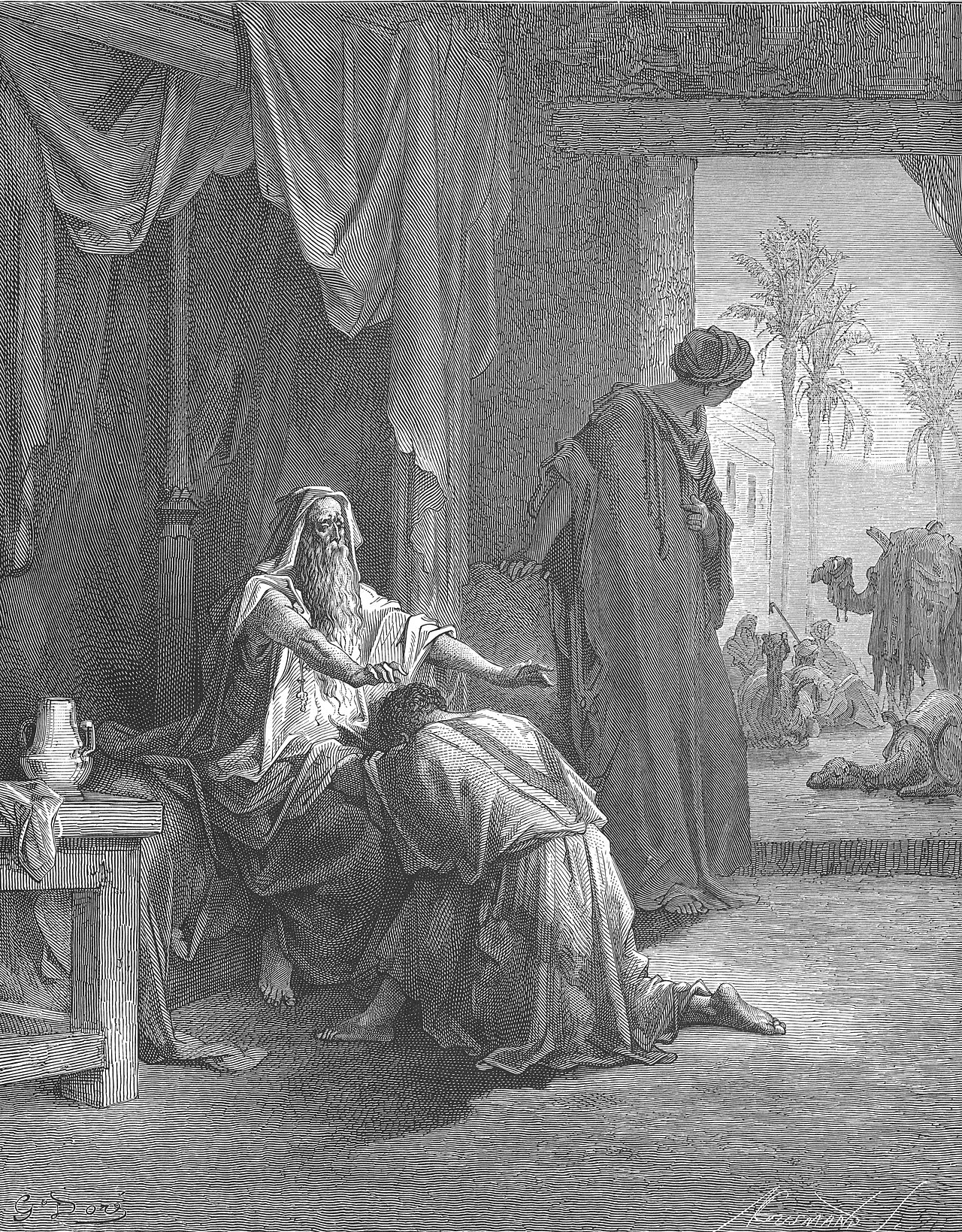
in Genesis 27What if my father touches me? Then I would be revealed to him as a deceiver, and I would bring upon myself a curse rather than a blessing.”
BSB
The same verse in ASV and KJV ▾
ASV
My father peradventure will feel me, and I shall seem to him as a deceiver; and I shall bring a curse upon me, and not a blessing.
KJV
My father peradventure will feel me, and I shall seem to him as a deceiver; and I shall bring a curse upon me, and not a blessing.
⋯
This verse in Genesis 27
Commentary
4 notes on this verseI shall bring a curse upon me - For even in those early times the spirit of that law was understood, Deu 27:18: Cursed is he that maketh the blind to wander out of the way; and Jacob seems to have possessed at this time a more tender conscience than his mother.
This site's exposition
my brother Esau is a hairy man
on Genesis 27:11-13
Jacob's objection is that his father may touch him and find him out, and Jamieson, Fausset and Brown mark the scruple as fear of discovery. Rebekah answers by taking the curse on herself, Your curse be on me, my son. Jerome ties the word behind hairy to Seir, Esau's country.
The record, by era
The Puritans and the Awakening2 voices
My father peradventure will feel me,....
16 , With him are strength and wisdom, the deceived and the deceiver are his. Isaac had lost the sense of seeing, which, in this case, could not have been imposed upon, Providence having so admirably well ordered the difference of features that no two faces are exactly alike: conversation and commerce could scarcely be maintained if there were not such a variety.
How the passage was read
What the Jewish commentators add
The reason that Isaac will feel him is not for the purpose of recognition.
1 more on this passage, in their own words ▾
Don’t be afraid that your father might curse you. If he does, the curse will be upon me, not on you.
This section is reception history: how the passage was read and kept in the Jewish tradition. Where a reading parts from an essential of the Christian faith, the section says so at that point.
Texts and citation data: Sefaria; each excerpt follows its version’s licence. 3 further sources are cited on this chapter that carry no English text this site may quote or only restate the verse.
The words behind it
11 Hebrew wordsEvery Hebrew word of this verse in the order it stands, with what it means and the door to its own study. The last column counts the times a word stands in the whole Bible: the rarer the word, the more the places it appears belong together.
| Hebrew | Sound | Meaning | Word study | In the Bible |
|---|---|---|---|---|
| אוּלַ֤י | ʾulai | perhaps | H194 → | 45 times |
| יְמֻשֵּׁ֙נִי֙ | yemusheni | he will feel me | H4959 → | 9 times |
| אָבִ֔י | ʾavi | father my | H1 → | 1212 times |
| וְהָיִ֥יתִי | vehayiti | and I will be | H1961 → | 3559 times |
| בְעֵינָ֖יו | veeinav | in view his | H5869 → | 887 times |
| כִּמְתַעְתֵּ֑עַ | kimta'tea' | like a mocker | H8591 → | |
| וְהֵבֵאתִ֥י | veheveti | and I will bring | H935 → | 2568 times |
| עָלַ֛י | ʾalai | on myself | H5921 → | 5755 times |
| קְלָלָ֖ה | kelalah | a curse | H7045 → | |
| וְלֹ֥א | velo' | and not | H3808 → | 5168 times |
| בְרָכָֽה׃ | verakhah | a blessing | H1293 → | 69 times |
אוּלַ֤יperhaps
ʾulaiH194 →45 times
יְמֻשֵּׁ֙נִי֙he will feel me
yemusheniH4959 →9 times
אָבִ֔יfather my
ʾaviH1 →1212 times
וְהָיִ֥יתִיand I will be
vehayitiH1961 →3559 times
בְעֵינָ֖יוin view his
veeinavH5869 →887 times
כִּמְתַעְתֵּ֑עַlike a mocker
kimta'tea'H8591 →
וְהֵבֵאתִ֥יand I will bring
vehevetiH935 →2568 times
עָלַ֛יon myself
ʾalaiH5921 →5755 times
קְלָלָ֖הa curse
kelalahH7045 →
וְלֹ֥אand not
velo'H3808 →5168 times
בְרָכָֽה׃a blessing
verakhahH1293 →69 times
A shaded row is a word that stands 400 times or fewer in the Bible.
The walk
8 stopsEach card is a verse this one points to, and under it the verses that one points to in turn. Where several paths arrive at the same place, that place is listed first: the text keeps returning to it.
Through
Malachi 1:14“But cursed is the deceiver who has an acceptable male in his flock and vows to give it, but sacrifices a defective animal to the Lord. For I am a great King,” says the…
it leads to
- Acts 5:1–10
Now a man named Ananias, together with his wife Sapphira, also sold a piece of property.
- 2 Corinthians 8:12
For if the eagerness is there, the gift is acceptable according to what one has, not according to what he does not have.
- Ecclesiastes 5:4–5
When you make a vow to God, do not delay in fulfilling it, because He takes no pleasure in fools. Fulfill your vow.
- Acts 5:1–10
Through
Genesis 25:27When the boys grew up, Esau became a skillful hunter, a man of the field, while Jacob was a quiet man who stayed at home.
it leads to
- Hebrews 11:9
By faith he dwelt in the promised land as a stranger in a foreign country. He lived in tents, as did Isaac and Jacob, who were heirs with him of the same promise.
- Genesis 21:20
And God was with the boy, and he grew up and settled in the wilderness and became a great archer.
- Genesis 6:9
This is the account of Noah. Noah was a righteous man, blameless in his generation; Noah walked with God.
- Genesis 10:9
He was a mighty hunter before the LORD; so it is said, “Like Nimrod, a mighty hunter before the LORD.”
- Hebrews 11:9
Through
2 Corinthians 6:8through glory and dishonor, slander and praise; viewed as imposters, yet genuine;
it leads to
- Matthew 27:63
“Sir,” they said, “we remember that while He was alive that deceiver said, ‘After three days I will rise again.’
- Matthew 27:63
Where this verse is studied
About Genesis
This page draws on Adam Clarke, Commentary on the Bible; Jamieson, Fausset & Brown, Commentary Critical and Explanatory on the Whole Bible; Jerome, Hebrew Questions on Genesis; John Gill, Exposition of the Old Testament (1748-1763) and Matthew Henry, Commentary on the Whole Bible.