
Genesis 27:35
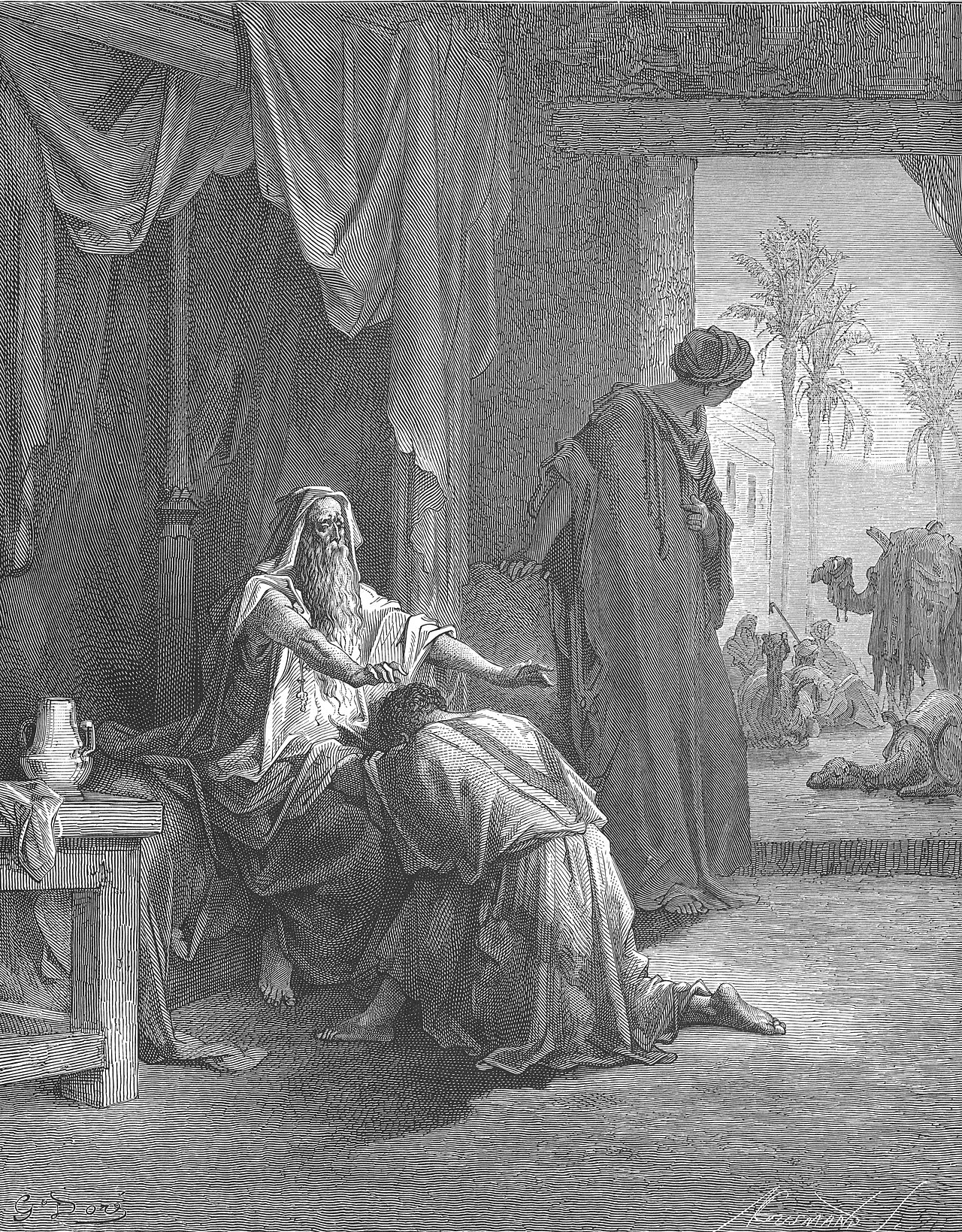
in Genesis 27But Isaac replied, “Your brother came deceitfully and took your blessing.”
BSB
The same verse in ASV and KJV ▾
ASV
And he said, Thy brother came with guile, and hath taken away thy blessing.
KJV
And he said, Thy brother came with subtilty, and hath taken away thy blessing.
⋯
This verse in Genesis 27
Commentary
9 notes on this verseThe fact that he says to him, "Your brother came by trickery and took away your blessing" means, in a way that implies a mystery, that the Word of God, after his incarnation, had to take the form of a slave. [Thus] thanks to him who was unknown in his generation, he might receive the blessing of the Father and transmit it to us, who believe in him.
This site's exposition
a loud and bitter cry
on Genesis 27:34-35
Hebrews 12:17 sends the reader back to Esau's loud and bitter cry, saying he found no ground for repentance though he sought the blessing with tears. Readers divide over what he failed to find, his father's mind or a change in himself. Isaac names the method: your brother came deceitfully.
The record, by era
The Church Fathers2 voices
So what can it mean when it says, "Your brother came with guile and stole the blessing"?… So what can it mean when it says, "He came along with guile and stole the blessing"?First of all, let us note what guile means, and so see what Jacob ought to do. He is bearing the sins of others, and he is bearing them patiently although they are other people's. That is what it means to have the skins of the kids on him; he is bearing the sins of others, not clinging to his own. In this way all those who put up with the sins of others for the sake of unity in the church are imitating Jacob. Because Jacob too is in Christ, inasmuch as Christ is in the seed of Abraham; as it was said, "In your seed shall all the nations be blessed." So our Lord Jesus Christ, who committed no sin, bore the sins of others. And will those whose sins have been forgiven disdain to bear the sins of others? So if Jacob turns into Christ, he bears the sins of others—that, is the skins of the kids. And where is the guile in that?
What then is guile? Guile is when one thing is done and another pretended. When there is one thing in intention and another in deeds, it is called guile. So guile in the proper sense is reprehensible, just like rock in the proper sense. If you said Christ was a rock in the proper sense, it would be a blasphemy, just as if you said Christ was a calf in the proper sense it would be blasphemy. In the proper sense a calf is a beast; in the figurative sense it is a victim in a sacrifice. In the proper sense a stone is compacted earth; in the figurative sense it is firmness. Guile in the proper sense is deceit; in the figurative sense.… Every figurative and allegorical text or utterance seems to mean one thing materially and to suggest another thing spiritually. So he called this figurative sense by the name of guile. At long last then, what does it mean, "He came with guile and stole your blessing"? The reason it says "He came with guile" is that what was being done had a figurative sense. Isaac, after all, would not have confirmed the blessing on a guileful, deceitful man who more justly would deserve a curse. So it wasn't a case of real guile, especially since he did not in fact lie when he said, "I am your elder son Esau." For that one had already made a bargain with his brother and sold him his rights as firstborn. So he told his father that he had what he had bought from his brother; what that one had lost had passed to this one. The title of firstborn had not been eliminated from Isaac's household. The title of firstborn was still here—but not with the one who had sold it. Where else was it but with the younger brother? Because he knew the symbolic mystery in all this, Isaac confirmed the blessing and said to this other son, "What am I to do for you?" He answered, "Bless me too, father; you do not only have one blessing." But Isaac knew only of one.
The Puritans and the Awakening1 voice
And he said, thy brother came with subtilty,....
The Nineteenth Century2 voices
Hath taken away thy blessing - This blessing, which was a different thing from the birthright, seems to consist of two parts: 1. The dominion, generally and finally, over the other part of the family; and, 2. Being the progenitor of the Messiah. But the former is more explicitly declared than the latter. See note on Gen 25:31.
A commentator
Jamieson, Fausset & Brown1802–1910
Commentary Critical and Explanatory on the Whole Bible (1871)
proposed
But a moment's reflection convinced the aged patriarch that the transfer of the blessing was "of the Lord," and now irrevocable. The importunities of Esau, however, overpowered him; and as the prophetic afflatus was upon the patriarch, he added what was probably as pleasing to a man of Esau's character as the other would have been.
2 more voices on this verse
The Nineteenth Century2 voices
A commentator
Charles Spurgeon1834–1892
The Metropolitan Tabernacle Pulpit, Sermon No. 3473: “Household Sin and Sorrow” (lightly modernized text, CCEL edition) · Written before 1892.
proposed
THERE are some households where all are saved—how happy they should be! Where every son and every daughter, father and mother are all Believers—a Church in the house, a Church of which the whole of the house is comprised. It is such an unspeakable blessing that those who enjoy it ought never cease to praise God for it day and night. And there are very many other households that have a share of this blessing, but the blessing is not complete. Like Noah with his household in the ark—Shem, Japheth, and perhaps some of the rest, their wives, Believers and saved, but Ham profane and wicked! And here was the family of Isaac, not a very large one—but two boys—and here were father and mother and one son, but there was also one unregenerate, one of the flesh, one carnal-minded and minding earthly things. And in this case this son, Esau, appears to have been a bold, manly, outspoken fellow who did not keep his irreligion to himself and made no sort of pretense about it. He despised the birthright. The great blessing which God had promised to the seed of Abraham he thought to be—well, a matter that did not concern him. For he received his pottage and enjoyed it. He was satisfied, for he could put on his goodly garments and disport himself as men of his time did—he was perfectly satisfied. He had not any particular concern about spiritual things—did not need them. And on one occasion he was so profane that he showed the little esteem he had for what his father, and mother, and brother valued beyond life, itself, by offering to sell this birthright that they thought so much of, for just a savory meal! He was a profane person, so the Apostle tells us, and I suppose that action to have been one piece of his profanity. He did it out of profane bravado as well as out of a careless disregard for it.
A commentator
Charles Spurgeon1834–1892
The Metropolitan Tabernacle Pulpit, Sermon No. 3473: “Household Sin and Sorrow” (lightly modernized text, CCEL edition) · Written before 1892.
proposed
THERE are some households where all are saved—how happy they should be! Where every son and every daughter, father and mother are all Believers—a Church in the house, a Church of which the whole of the house is comprised. It is such an unspeakable blessing that those who enjoy it ought never cease to praise God for it day and night. And there are very many other households that have a share of this blessing, but the blessing is not complete.
The words behind it
6 Hebrew wordsEvery Hebrew word of this verse in the order it stands, with what it means and the door to its own study. The last column counts the times a word stands in the whole Bible: the rarer the word, the more the places it appears belong together.
| Hebrew | Sound | Meaning | Word study | In the Bible |
|---|---|---|---|---|
| וַיֹּ֕אמֶר | vaiyomer | and he said | H559 → | 5305 times |
| בָּ֥א | ba' | he came | H935 → | 2568 times |
| אָחִ֖יךָ | ʾachikha | brother your | H251 → | 630 times |
| בְּמִרְמָ֑ה | bemirmah | with deceit | H4820 → | |
| וַיִּקַּ֖ח | vaiyikach | and he took | H3947 → | 966 times |
| בִּרְכָתֶֽךָ׃ | birkhatekha | blessing your | H1293 → | 69 times |
וַיֹּ֕אמֶרand he said
vaiyomerH559 →5305 times
בָּ֥אhe came
ba'H935 →2568 times
אָחִ֖יךָbrother your
ʾachikhaH251 →630 times
בְּמִרְמָ֑הwith deceit
bemirmahH4820 →
וַיִּקַּ֖חand he took
vaiyikachH3947 →966 times
בִּרְכָתֶֽךָ׃blessing your
birkhatekhaH1293 →69 times
A shaded row is a word that stands 400 times or fewer in the Bible.
The walk
8 stopsEach card is a verse this one points to, and under it the verses that one points to in turn. Where several paths arrive at the same place, that place is listed first: the text keeps returning to it.
Through
Malachi 2:10Do we not all have one Father? Did not one God create us? Why then do we break faith with one another so as to profane the covenant of our fathers?
it leads to
- Psalms 100:3
Know that the LORD is God. It is He who made us, and we are His; we are His people, and the sheep of His pasture.
- Malachi 2:11
Judah has broken faith; an abomination has been committed in Israel and in Jerusalem. For Judah has profaned the LORD’s beloved sanctuary by marrying the daughter of a foreign god.
- 1 Corinthians 8:6
yet for us there is but one God, the Father, from whom all things came and for whom we exist. And there is but one Lord, Jesus Christ, through whom all things came and…
- Ephesians 4:6
one God and Father of all, who is over all and through all and in all.
- Isaiah 63:16
Yet You are our Father, though Abraham does not know us and Israel does not acknowledge us. You, O LORD, are our Father; our Redeemer from Everlasting is Your name.
- Psalms 100:3
Through
1 Thessalonians 4:6and no one should ever violate or exploit his brother in this regard, because the Lord will avenge all such acts, as we have already told you and solemnly warned you.
it leads to
- Hebrews 13:4
Marriage should be honored by all and the marriage bed kept undefiled, for God will judge the sexually immoral and adulterers.
- Exodus 20:17
You shall not covet your neighbor’s house. You shall not covet your neighbor’s wife, or his manservant or maidservant, or his ox or donkey, or anything that belongs to your neighbor.”
- Exodus 20:15
You shall not steal.
- Hebrews 13:4
Where this verse is studied
About Genesis
Who and where
1 name in this verse with a page on the site.
This page draws on Adam Clarke, Commentary on the Bible; Augustine of Hippo, SERMON 4.15-16; Augustine of Hippo, SERMON 4.23; Charles Spurgeon, The Metropolitan Tabernacle Pulpit, Sermon No. 3473: “Household Sin and Sorrow” (lightly modernized text, CCEL edition); Hippolytus of Rome, ON THE BLESSINGS OF ISAAC AND JACOB 8; Jamieson, Fausset & Brown, Commentary Critical and Explanatory on the Whole Bible; John Gill, Exposition of the Old Testament (1748-1763) and Matthew Henry, Commentary on the Whole Bible.