
Genesis 27:28
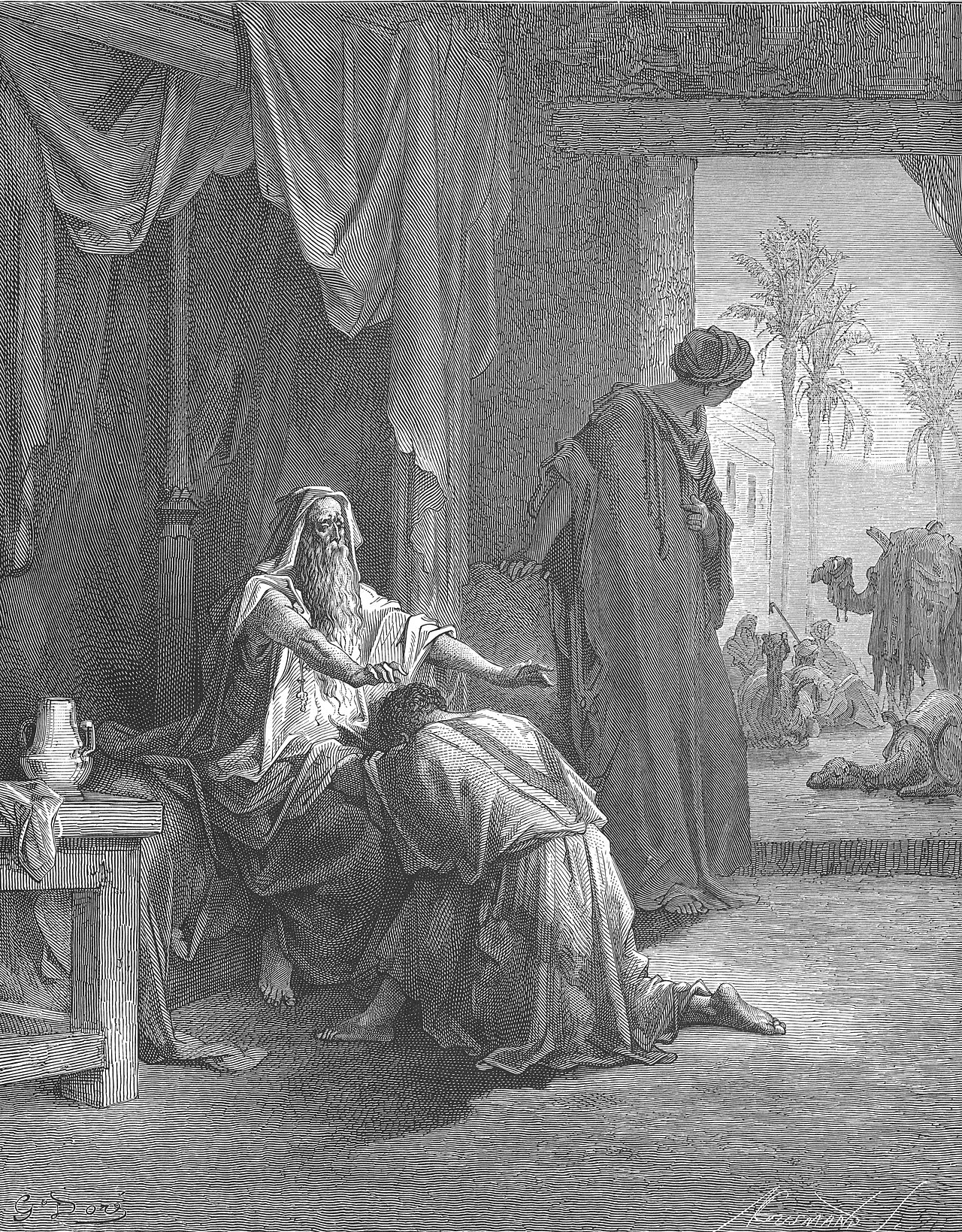
in Genesis 27May God give to you the dew of heaven and the richness of the earth—an abundance of grain and new wine.
BSB
The same verse in ASV and KJV ▾
ASV
And God give thee of the dew of heaven, And of the fatness of the earth, And plenty of grain and new wine:
KJV
Therefore God give thee of the dew of heaven, and the fatness of the earth, and plenty of corn and wine:
⋯
This verse in Genesis 27
Commentary
9 notes on this verseGod give thee of the dew of heaven - Bp. Newton’s view of these predictions is so correct and appropriate, as to leave no wish for any thing farther on the subject. “It is here foretold, and in Gen 27:39, of these two brethren, that as to situation, and other temporal advantages, they should be much alike.
This site's exposition
the dew of heaven
on Genesis 27:28-29
What Isaac speaks is the Abrahamic covenant: dew, grain and new wine, nations bowing, and a curse on those who curse him. The last clause came to Abram at 12:3. Isaac repeats the blessing knowingly at 28:3 and 4, and names it the blessing of Abraham. At 33:3 Jacob bows to the ground seven times in front of Esau.
The record, by era
The Church Fathers2 voices
If one believes that this blessing was accomplished in Jacob, he is mistaken. Nothing of this ever happened to Jacob. First we find him in Mesopotamia at the service of Laban for twenty years; then he prostrates himself before his brother Esau and tries to make himself pleasing to him by offering presents; after this he goes down to Egypt to avoid starvation with his children. In whom then have the words "Ah, the smell of the clothes of my son is like the smell of a fruitful field that the Lord has blessed" been accomplished? In nobody else but Christ, Son of God. In fact, the field is the world, and the smell of his clothes are all those who believe in him, according to what the apostle says: "We are the aroma of Christ to God among those who are being saved and among those who are perishing; to the one a fragrance from death to death, to the other a fragrance from life to life."The words "May God give you of the dew of heaven, and of the fatness of the earth, and plenty of grain and wine" signify clearly the Word, who came down from heaven like dew. The earth is the flesh that he has assumed from the Virgin. Through the words "plenty of grain and wine," the prophet signifies the saints, who are gathered together like the grain in a barn and are justified by the Spirit as by wine.
These things therefore fit with Christ and also fit quite reasonably with the new people: "May God give you of the dew of heaven and of the fatness of the earth and plenty of grain and wine." The dew of heaven and the fatness of the earth, that is, the Word, was given to us by the Father, together with the participation through the Spirit, and therefore we were made participants in the divine nature through him. And we also received plenty of grain and wine, that is, strength and happiness.
The Medieval Church1 voice
A commentator
BonaventureCollations on the Hexaemeron, Collation 14 · Written in the 13th century.
proposed
This dew is the influence of the Holy Spirit's grace which visits the Scriptures and in which it is sweetly found. Hence, in Genesis: "The fragrance of my son is like the fragrance of a field which the Lord has blessed!
The Puritans and the Awakening2 voices
Therefore God give thee of the dew of heaven,....
And thus, as well as by their baptism, to do what they can to preserve and perpetuate the entail of the covenant in their families. But this was an extraordinary blessing; and Providence so ordered it that Isaac should bestow it upon Jacob ignorantly and by mistake, that it might appear he was beholden to God for it, and not to Isaac.
2 more voices on this verse
The Puritans and the Awakening1 voice
But the great difference in that there is nothing in Esau's blessing that points at Christ, nothing that brings him or his into the church and covenant of God, without which the fatness of the earth, and the plunder of the field, will stand him in little stead. Thus Isaac by faith blessed them both according as their lot should be.
The Nineteenth Century1 voice
A commentator
Jamieson, Fausset & Brown1802–1910
Commentary Critical and Explanatory on the Whole Bible (1871)
The copious fall of dew is indispensable to the fruitfulness of lands, which would be otherwise arid and sterile through the violent heat; and it abounds most in hilly regions, such as Canaan, hence called the "fat land" (Ne 9:25, 35). plenty of corn and wine--Palestine was famous for vineyards, and it produced varieties of corn, namely, wheat, barley, oats, and rye.
The words behind it
10 Hebrew wordsEvery Hebrew word of this verse in the order it stands, with what it means and the door to its own study. The last column counts the times a word stands in the whole Bible: the rarer the word, the more the places it appears belong together.
| Hebrew | Sound | Meaning | Word study | In the Bible |
|---|---|---|---|---|
| וְיִֽתֶּן־ | veyiten- | and may he give | H5414 → | 2011 times |
| לְךָ֙ | lekha | to <the> you | ||
| הָאֱלֹהִ֔ים | haelohim | <the> God | H430 → | 2601 times |
| מִטַּל֙ | mital | some of [the] dew of | H2919 → | |
| הַשָּׁמַ֔יִם | hashamayim | the heavens | H8064 → | 421 times |
| וּמִשְׁמַנֵּ֖י | umishmanei | and some of [the] fatness<es> of | H4924 → | |
| הָאָ֑רֶץ | haaretz | the earth | H776 → | 2504 times |
| וְרֹ֥ב | vero | and abundance of | H7230 → | 149 times |
| דָּגָ֖ן | dagan | grain | H1715 → | |
| וְתִירֹֽשׁ׃ | vetirosh | and new wine | H8492 → |
וְיִֽתֶּן־and may he give
veyiten-H5414 →2011 times
לְךָ֙to <the> you
lekha
הָאֱלֹהִ֔ים<the> God
haelohimH430 →2601 times
מִטַּל֙some of [the] dew of
mitalH2919 →
הַשָּׁמַ֔יִםthe heavens
hashamayimH8064 →421 times
וּמִשְׁמַנֵּ֖יand some of [the] fatness<es> of
umishmaneiH4924 →
הָאָ֑רֶץthe earth
haaretzH776 →2504 times
וְרֹ֥בand abundance of
veroH7230 →149 times
דָּגָ֖ןgrain
daganH1715 →
וְתִירֹֽשׁ׃and new wine
vetiroshH8492 →
A shaded row is a word that stands 400 times or fewer in the Bible.
The walk
8 stopsEach card is a verse this one points to, and under it the verses that one points to in turn. Where several paths arrive at the same place, that place is listed first: the text keeps returning to it.
Through
Psalms 133:3It is like the dew of Hermon falling on the mountains of Zion. For there the LORD has bestowed the blessing of life forevermore.
it leads to
- Deuteronomy 28:8
The LORD will decree a blessing on your barns and on everything to which you put your hand; the LORD your God will bless you in the land He is giving you.
- Leviticus 25:21
But I will send My blessing upon you in the sixth year, so that the land will yield a crop sufficient for three years.
- Psalms 42:8
The LORD decrees His loving devotion by day, and at night His song is with me as a prayer to the God of my life.
- Deuteronomy 4:48
extending from Aroer on the rim of the Arnon Valley as far as Mount Siyon (that is, Hermon),
- 1 John 5:11
And this is that testimony: God has given us eternal life, and this life is in His Son.
- Deuteronomy 28:8
Through
Deuteronomy 7:13He will love you and bless you and multiply you. He will bless the fruit of your womb and the produce of your land—your grain, new wine, and oil, the young of your herds…
it leads to
- John 14:21
Whoever has My commandments and keeps them is the one who loves Me. The one who loves Me will be loved by My Father, and I will love him and reveal Myself to him.”
- John 15:10
If you keep My commandments, you will remain in My love, just as I have kept My Father’s commandments and remain in His love.
- John 14:21
Through
Deuteronomy 33:28So Israel dwells securely; the fountain of Jacob lives untroubled in a land of grain and new wine, where even the heavens drip with dew.
it leads to
- Numbers 23:9
For I see them from atop the rocky cliffs, and I watch them from the hills. Behold, a people dwelling apart, not reckoning themselves among the nations.
- Numbers 23:9
Where this verse is studied
About Genesis
This page draws on Adam Clarke, Commentary on the Bible; Bonaventure, Collations on the Hexaemeron, Collation 14; Cyril of Alexandria, GLAPHYRA ON GENESIS, 3.5; Hippolytus of Rome, ON THE BLESSINGS OF ISAAC AND JACOB 7; Jamieson, Fausset & Brown, Commentary Critical and Explanatory on the Whole Bible; John Gill, Exposition of the Old Testament (1748-1763) and Matthew Henry, Commentary on the Whole Bible.