
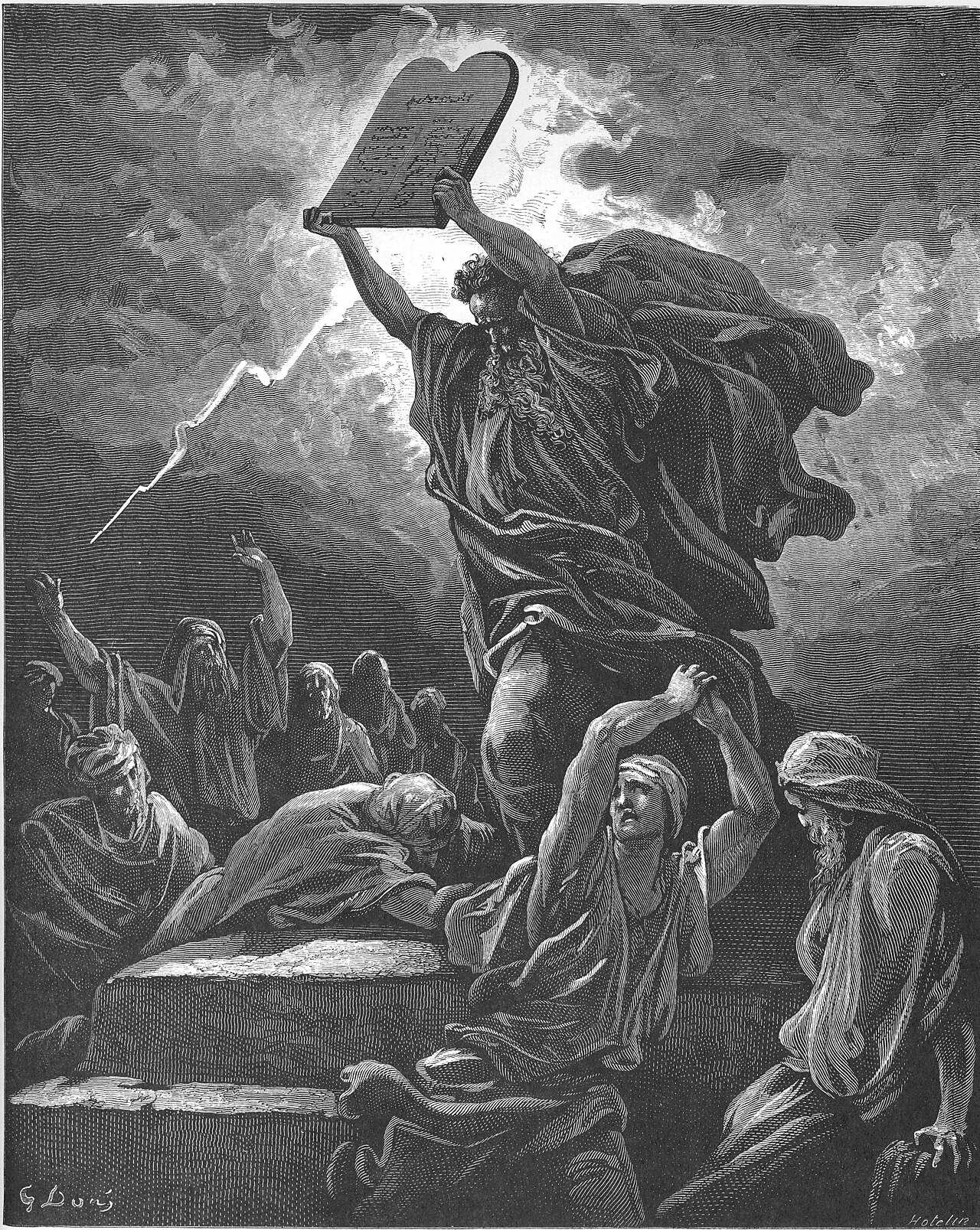
Exoduschapter 32
35 verses · Moses, by tradition · 15th or 13th century BC · The Law
The tablets were the work of God, and the writing was the writing of God, engraved on the tablets.
Introduction
Moses, by tradition, The Law, Exodus Overview.
This chapter takes place at the foot of Sinai while Moses is still on the mountain receiving the pattern for God's dwelling. The covenant had been sealed with a meal only weeks before, and the people had promised aloud to keep every word of it. Israel told this day to its children for centuries as the worst in its memory. Listen for two scenes running at once, one in the camp and one on the mountain. Watch how each leader answers for the people in his charge. The chapter asks what a mediator is worth when a nation has no defence left.
Context
- Who
- Israel in the wilderness, hearing the account of the worst day in their national memory
- What
- The account of the golden calf, the breaking of the tablets, the judgment in the camp and Moses' intercession for the people.
- Where
- The camp at the foot of Mount Sinai and the mountain above it.
- When
- About 1446 BC on the traditional early date, with a thirteenth-century date also held, during the forty days Moses spent on the mountain.
- Why
- To show how quickly a redeemed people can fall, and how one man stood between them and the judgment they had earned.
Historical context
The book is ascribed to Moses in the tradition the site follows, and this chapter turns on him as mediator. He is on the mountain receiving the pattern of the tabernacle while the events below take place. The chapter falls during the forty days of Exodus 24:18, in the first year after the exodus. The place is the camp at the foot of Mount Sinai, in the wilderness of the Sinai peninsula.
Show the rest of the historical context, 2 more paragraphs
The occasion is a wait that ran longer than the people expected, after they had agreed at 24:3 and 24:7 to everything the LORD had spoken.
A first hearer knew what a young bull stood for. In Egypt the Apis bull was worshipped at Memphis and the Mnevis bull at Heliopolis. In Canaan the bull was the standing image of strength, associated with El and later with Baal, and small bronze bull figurines have been recovered in the region. A first hearer also knew that Aaron kept the name of Israel's God, since he built an altar and proclaimed a feast to the LORD, so what changed was the form. Making an offender consume the ground remains of his own offence has parallels in the practice of that world, and nothing of the calf was left.
Significance
Forty days is how long the covenant lasted between the meal that ratified it and the calf. Israel was never allowed to forget the number, and Psalm 106:19 to 23 still tells the story centuries later.
Show the rest of the significance, 1 more paragraph
The other half of the chapter is a man standing between God and a guilty people. Moses offers to be blotted out of God's book in their place, and the intercession is the reason there was still a nation to hear the account.
This chapter in Jewish lifeWhat this chapter is in Jewish life and reading.
How it is read
The golden calf is the chapter the classical commentators work hardest, and Rashi begins with the clock. Moses had told the people he would return within the first six hours of the fortieth day, and they counted the day of his ascent among the forty (Rashi on Exodus 32:1:1). Aaron asked for the ornaments of the wives and children in the hope that the delay would save the day, and the men tore off their own instead (Rashi on Exodus 32:2:1). On the making of the calf Rashi gives two readings of the same words, one taking them of gold tied in a cloth and the other of a goldsmith's engraving tool (Rashi on Exodus 32:4:1). Sforno reads God's complaint about the speed of the fall as a gift cut short. "I have not even been able to complete the gift of the Torah I had wanted to give to you" (Sforno on Exodus 32:8:1, from Eliyahu Munk, HaChut Hameshulash, CC-BY). Rashi reads the words let me alone as an opening rather than a refusal. They told Moses that prayer would hold the sentence back (Rashi on Exodus 32:10:1, citing Shemot Rabbah 42:9 and Berakhot 32a). The plea itself he fills out from the Midrash. Israel had broken ten commandments, and Abraham had stood ten trials whose reward was still owed. Moses asked that the one be set against the other (Rashi on Exodus 32:13:1, citing Midrash Tanchuma, Ki Tisa 24 and Shemot Rabbah 44:4). The writing on the tablets could be read from both sides, which he calls a miraculous piece of work (Rashi on Exodus 32:15:1, citing Shabbat 104a). The breaking of the tablets he explains by a rule of law. Moses reasoned that a stranger may not eat the Passover, and that the people had put themselves outside the whole Torah (Rashi on Exodus 32:19:1, citing Shabbat 87a). Rashi is quoted from the Rosenbaum and Silbermann edition of 1929 to 1934, public domain. Ibn Ezra comments at Exodus 32:14:1 and Malbim at Exodus 32:23:1, both cited by reference.
What the rabbis say
The corpus records forty places where the Midrash and the Talmud draw on this chapter, cited here by reference. Bamidbar Rabbah reads the calf and its aftermath at 1:12, 1:13, 4:8 and 12:4. It reads it again at 13:8, 15:21, 18:6, 20:14, 20:20, 20:23 and 21:10. Aggadat Bereshit carries the chapter at 5:3, 10:2, 32:1, 51:1 and 63:1. The prayer of Moses is read in Berakhot at 32a:14 and 32a:20, and in Arakhin at 15b:18. The breaking and the burning are read at Avodah Zarah 44a:2 and 53b:10, and at Megillah 25b:12. The Jerusalem Talmud takes up the chapter at Nazir 6:1:4, Shekalim 1:1:6, Terumot 10:2:2 and Megillah 4:11:3. Midrash Aggadah reads it at Exodus 32:22:1 and 32:29:1, and at Deuteronomy 9:15:1 and 9:20:1. Midrash Lekach Tov reads it at Exodus 32:23:1, 32:28:1 and 32:33:1. Devarim Rabbah 9:2 reads the plea, and Eikhah Rabbah 1:28 the noise in the camp.
Sources: Rashi, Rashi on Exodus 32:1 to 32:24, the Pentateuch with Rashi's commentary by M. Rosenbaum and A. M. Silbermann, 1929 to 1934, public domain, 1040 to 1105; Sforno, Sforno on Exodus 32:8:1, Eliyahu Munk, HaChut Hameshulash, CC-BY, 1475 to 1550; Ibn Ezra, Ibn Ezra on Exodus 32:14:1, cited by reference, CC-BY-NC, 1089 to 1164; Malbim, Malbim on Exodus 32:23:1, cited by reference, no English version in the corpus; Shemot Rabbah, 42:9 and 44:4, as Rashi cites them; Midrash Tanchuma, Ki Tisa 24, as Rashi cites it; Babylonian Talmud, Berakhot 32a, Shabbat 87a and 104a, as Rashi cites them, and Avodah Zarah 44a:2 and Megillah 25b:12, cited by reference; Bamidbar Rabbah, 1:12, 1:13, 4:8, 12:4, 13:8 and 15:21, cited by reference; The Sefaria corpus, scripts/data/sources/sefaria/exodus/32.json, fetched 2026-09-19, 2026; MannaFest, the commentators and their dates, src/app/featured/the-jewish-writings/page.tsx, 2026.
The heads below are this chapter's scenes. The numbered points under each are its verses.
The Golden Calf
Forty days earlier the people had answered at 24:3 and 24:7 that all the LORD had spoken they would do, and 24:18 says Moses was in the mount forty days and forty nights. What they ask for is something to go before them, which is what the pillar had done since 13:21. They also hand the deliverance to Moses, calling him the man that brought us up out of the land of Egypt, and verse 7 puts that same phrase back in God's mouth.
Exodus 32:1
“The image made was single, and therefore it would be imputing to the Israelites a greater sin than they were guilty of, to charge them with renouncing the worship of the true God for idols.”
Jamieson, Fausset & Brown · Commentary Critical and Explanatory on the Whole Bible (1871)reformed
Cross references
Exodus 32:1
- Quoted inActs 7:40“They said to Aaron, ‘Make us gods who will go before us! As for this Moses who led us out of the land of Egypt, we do not know what has happened to him.’”
'Make us gods to go before us' (golden calf)
Exodus 32:2-3
Aaron asks for the gold hanging on the wives, the sons and the daughters, and the people bring it without an argument. The same free giving of gold is recorded at 35:22, where earrings and rings are brought for the tabernacle, so the material is identical and the use is the difference. Jamieson, Fausset and Brown read the detail about the sons' earrings as pointing to the mixed multitude of 12:38, since Egyptian young men did not wear them.
Exodus 32:2
“Golden ear-rings - Both men and women wore these ornaments, and we may suppose that these were a part of the spoils which they brought out of Egypt. How strange, that the very things which were granted them by an especial influence and providence of God, should be now abused to the basest idolatrous purposes! But it is frequently the case that the gifts of God become desecrated by being employed in the service of sin; I will curse your blessings, saith the Lord, Mal 2:2.”
Adam Clarke · Commentary on the Bible (1810-1826)evangelical
took off their gold earrings and brought them to Aaron: John Gill cites the Targum of Jonathan, where the wives refuse to hand over their ornaments and the men break off their own. Gill reads all the people as the greater part, since 1 Corinthians 10:7 says some of them were idolaters. Adam Clarke takes the earrings as spoil from Egypt, 12:35.
Exodus 32:3
“Thus they changed their glory into the similitude of an ox ( Ps. cvi. 20 ), and proclaimed their own folly, beyond that of other idolaters, who worshipped the host of heaven. Having made the calf in Horeb, they worshipped the graven image, Ps. cvi.”
Matthew Henry · Commentary on the Whole Bible (1707-1721)puritan
The word molten occurs here for the first time in Scripture. They credit the exodus to a thing made that week, saying these be thy gods, O Israel, which brought thee up out of the land of Egypt, and Jeroboam uses almost the same sentence over two calves at 1 Kings 12:28. Jamieson, Fausset and Brown identify the figure with the Egyptian bull Apis of Memphis, while other readers have named Hathor or taken the calf as a pedestal for an unseen god, and Exodus itself names none of them.
Exodus 32:4
“Fashioned it with a graving tool - There has been much controversy about the meaning of the word חרט cheret in the text: some make it a mould, others a garment, cloth, or apron; some a purse or bag, and others a graver. It is likely that some mould was made on this occasion, that the gold when fused was cast into it, and that afterwards it was brought into form and symmetry by the action of the chisel and graver. These be thy gods, O Israel - The whole of this is a most strange and unaccountable transaction.”
Adam Clarke · Commentary on the Bible (1810-1826)evangelical
1 more voice on this verse
Exodus 32:4
“This idol seems to have been the god Apis, the chief deity of the Egyptians, worshipped at Memphis under the form of a live ox, three years old. It was distinguished by a triangular white spot on its forehead and other peculiar marks.”
Jamieson, Fausset & Brown · Commentary Critical and Explanatory on the Whole Bible (1871)reformed
Exodus 32:5-6
Aaron does not rename the God of Israel. He builds an altar and proclaims a feast to the LORD, so the name is kept and the form is changed, which is what the second commandment at 20:4 had addressed twelve chapters earlier. Paul quotes verse 6 word for word at 1 Corinthians 10:7 and applies it to a church, and 1 Corinthians 10:11 says these things were written for our admonition.
Exodus 32:5
To-morrow is a feast to the Lord - In Bengal the officiating Brahmin, or an appointed person proclaims, “To-morrow, or on - day of - , such a ceremony will be performed!”
Adam Clarke · Commentary on the Bible (1810-1826)evangelical
1 more voice on this verse
Exodus 32:5
“And when Aaron saw it,.... In what form it was, and what a figure it made, and how acceptable it was to the Israelites.”
the people sat down to eat and drink: The burnt offerings were burned whole on the altar, and the peace offerings gave the people their meal, as Adam Clarke explains. Aaron had proclaimed a feast to the LORD in verse 5. Gregory the Great saw the revelry follow the eating and drinking.
Exodus 32:6
“The people sat down to eat and to drink - The burnt-offerings were wholly consumed; the peace-offerings, when the blood bad been poured out, became the food of the priests, etc. When therefore the strictly religious part of these ceremonies was finished, the people sat down to eat of the peace-offerings, and this they did merely as the idolaters, eating and drinking to excess.”
Adam Clarke · Commentary on the Bible (1810-1826)evangelical
Cross references
Exodus 32:6
- Quoted in1 Corinthians 10:7Do not be idolaters, as some of them were. As it is written: “The people sat down to eat and to drink, and got up to indulge in revelry.”
'The people sat down to eat... and rose up to play' (golden-calf warning, 'as it is written')
Moses Stands in the Breach
Exodus 32:7-8
God calls them thy people, which thou broughtest out of the land of Egypt, handing them to Moses in the same words the people had used of Moses in verse 1. They have turned aside quickly out of the way, and the way was given at 20:4 and agreed to at 24:7. What God reports to Moses is what the narrator has already shown the reader in verses 4 through 6, told back in the same sentence the people shouted.
Exodus 32:7
Thy people - have corrupted themselves - They had not only got into the spirit of idolatry, but they had become abominable in their conduct, so that God disowns them to be his: Thy people have broken the covenant, and are no longer entitled to my protection and love. This is one pretense that the Roman Catholics have for the idolatry in their image worship. Their high priest, the pope, collects the ornaments of the people, and makes an image, a crucifix, a madonna, etc.
Adam Clarke · Commentary on the Bible (1810-1826)evangelical
2 more voices on this verse
Exodus 32:7
“Therefore just as the people are God's when they do not sin but are no longer said to be his when they sin, so also the feats are the feats of sinners when they are hated by the Lord's soul, but when they are ordained by the Lord, they are called the Lord's.”
Origen of Alexandria · written before 253 · COMMENTARY ON THE GOSPEL OF JOHN 10.80patristic
Exodus 32:7
“To fall into sin quickly after we have renewed our covenants with God, or received special mercy from him, is very provoking. He tells him particularly what they had done: They have made a calf, and worshipped it. Note, Those sins which are concealed from our governors are naked and open before God.”
Matthew Henry · Commentary on the Whole Bible (1707-1721)puritan
How quickly they have turned aside: The three acts the LORD names, making a molten calf, bowing down to it and sacrificing to it, each break a command already given. At 20:5 the LORD forbade bowing down to an image, and 22:20 set apart for destruction whoever sacrificed to other gods. Matthew Henry notes that the LORD saw what Moses could not.
Exodus 32:9-10
The word stiffnecked occurs here for the first time in Scripture, and it returns at 33:3, 33:5, 34:9 and Deuteronomy 9:6. Let me alone is an odd thing to say to a man who has said nothing, and Matthew Henry reads it as leaving the door open for the intercession that follows. The offer to make of Moses a great nation is the promise given to Abram at Genesis 12:2, and it is offered a second time after the spies at Numbers 14:12.
Exodus 32:9
“A stiff-necked people - Probably an allusion to the stiff-necked ox, the object of their worship.”
Adam Clarke · Commentary on the Bible (1810-1826)evangelical
1 more voice on this verse
Exodus 32:9
“Note, Sin exposes us to the wrath of God; and that wrath, if it be not allayed by divine mercy, will burn us up as stubble. It were just with God to let the law have its course against sinners, and to cut them off immediately in the very act of sin; and, if he should do so, it would be neither loss nor dishonour to him.”
Matthew Henry · Commentary on the Whole Bible (1707-1721)puritan
Now leave Me alone: Jerome read Leave Me alone as God showing that the prayers of His servant could hold back His hand. Adam Clarke sets the scene beside Abraham's pleading for Sodom at Genesis 18:23 to 33. Augustine notes that Moses refused and stayed with the sinners.
Exodus 32:10
“Moses resisted God and prevented him from destroying his people when God said to him: "Let me alone, that I may strike this people." Just see the power of Moses! What does God say to him? Let me alone; you are compelling me, your prayers, as it were, restrain me; your prayers hold back my hand. I shoot an arrow; I hurl a javelin; and your prayers are the shield of the people. Let me alone that I might strike down this people. Along with this, consider the compassionate kindness of God.”
Jerome · written before 420 · HOMILIES ON THE PSALMS 26patristic
1 more voice on this verse
Exodus 32:10
“Now therefore let me alone - Moses had already begun to plead with God in the behalf of this rebellious and ungrateful people; and so powerful was his intercession that even the Omnipotent represents himself as incapable of doing any thing in the way of judgment, unless his creature desisted from praying for mercy! See an instance of the prevalence of fervent intercession in the case of Abraham, Gen 18:23-33, from the model of which the intercession of Moses seems to have been formed.”
Adam Clarke · Commentary on the Bible (1810-1826)evangelical
Exodus 32:11-12
Moses hands the people straight back, calling them thy people, which thou hast brought forth out of the land of Egypt, and reversing the pronoun of verse 7. He argues from what Egypt would say rather than from anything Israel has earned. Psalm 106:23 looks back on this moment and says Moses his chosen stood before him in the breach, to turn away his wrath.
Exodus 32:11
“Now Moses is standing in the gap to turn away the wrath of God, Ps. cvi. He wisely took the hint which God gave him when he said, Let me alone, which, though it seemed to forbid his interceding, did really encourage it, by showing what power the prayer of faith has with God.”
Matthew Henry · Commentary on the Whole Bible (1707-1721)puritan
Why should the Egyptians declare: Moses asks what the Egyptians would declare, and in verse 13 he calls on the LORD to remember Abraham, Isaac and Israel. He pleads the same way at Numbers 14:13 to 16, after the spies return. Matthew Henry puts the LORD’s glory before Israel in his heart.
Exodus 32:12
"Let mercy rejoice against judgment; repent of this evil; change the sentence of destruction into that of correction." 2. He fills his mouth with arguments, not to move God, but to express his own faith and to excite his own fervency in prayer.
Matthew Henry · Commentary on the Whole Bible (1707-1721)puritan
Exodus 32:13-14
Moses' last argument is the oath God swore by his own self at Genesis 22:16, and he asks nothing on the ground of what the people deserve. The text then says the LORD repented of the evil which he thought to do unto his people, while Numbers 23:19 says God is not a man that he should repent. Readers have long divided here, some taking the language as spoken after the manner of men, which is how Charles Spurgeon takes it in his sermon on the mediation of Moses, and others reading a real turn made in answer to prayer.
Exodus 32:13
“God's promises are to be our pleas in prayer; for what he has promised he is able to perform, and the honour of this truth is engaged for the performance of it. "Lord, if Israel be cut off, what will become of the promise?”
Matthew Henry · Commentary on the Whole Bible (1707-1721)puritan
So the LORD relented: Augustine applies such language to human expectation and the order of natural causes, and he holds the decisions of God fixed. Moses had asked the LORD to turn from His fierce anger and relent in verse 12. Jonah 3:10 says the same of God and Nineveh.
Exodus 32:14
“I SUPPOSE that I need not say that this verse speaks after the manner of men. I do not know after what other manner we can speak. To speak of God after the manner of God is reserved for God, Himself, and mortal men could not comprehend such speech. In this sense, the Lord often speaks, not according to literal fact, but according to the appearance of things to us, in order that we may understand so far as the human can comprehend the Divine. The Lord's purposes never really change.”
Charles Spurgeon · written before 1892 · The Metropolitan Tabernacle Pulpit, Sermon No. 2398: “Mediation of Moses” (lightly modernized text, CCEL edition)Particular Baptist
Tablets Broken at the Mountain's Foot
Exodus 32:15-16
The tables are called the work of God and the writing the writing of God, and 31:18 says they were written with the finger of God. That phrase entered Scripture at 8:19 in the mouth of Egypt's magicians, who used it of the one plague they could not copy. Moses wrote at 24:4 and God writes here, and the first thing broken after the covenant is made is the covenant document itself.
Exodus 32:15
“Moses turned, and went down from the mount--The plain, Er-Raheh, is not visible from the top of Jebel Musa, nor can the mount be descended on the side towards that valley; hence Moses and his companion, who on duty had patiently waited his return in the hollow of the mountain's brow, heard the shouting some time before they actually saw the camp.”
Jamieson, Fausset & Brown · Commentary Critical and Explanatory on the Whole Bible (1871)reformed
1 more voice on this verse
Exodus 32:15
“The tables were written on both their sides - If we take this literally, it was certainly a very unusual thing; for in ancient times the two sides of the same substance were never written over. However, some rabbins suppose that by the writing on both sides is meant the letters were cut through the tables, so that they might be read on both sides, though on one side they would appear reversed.”
Adam Clarke · Commentary on the Bible (1810-1826)evangelical
the writing was the writing of God: The tablets and the writing were both the work of God, and in verse 19 Moses throws them down and shatters them at the base of the mountain. At 34:1 Moses chisels out the second pair himself, and God writes on them the words of the first. Adam Clarke looks to Jeremiah 31:33, the law on the heart.
Exodus 32:16
“And the tables were the work of God,.... And not of angels or men; the stones were made and formed by God into the shape they were: and the writing was the writing of God, graven upon the tables; the letters in which the law was written were of his framing, devising, and engraving; and this was to show that this law was his own, and contained his mind and will; and to give the greater dignity and authority to it, and to deter men from breaking it.”
1 more voice on this verse
Exodus 32:16
“The tables were the work of God - Because such a law could proceed from none but himself; God alone is the fountain and author of Law, of what is right, just, holy, and good. See the meaning of the word Law, Exo 12:49 (note). The writing was the writing of God - For as he is the sole author of law and justice, so he alone can write them on the heart of man.”
Adam Clarke · Commentary on the Bible (1810-1826)evangelical
Exodus 32:17-18
Joshua hears a camp under attack and Moses hears singing, and the two men are listening to the same sound. Singing entered Scripture at 15:1 with the song at the sea, which was sung after a deliverance and to the God who gave it. Moses corrects Joshua before either of them can see anything, because he already knows from verse 7 what he is walking down into.
Exodus 32:17
“Joshua - said - There is a noise of war in the camp - How natural was this thought to the mind of a military man! Hearing a confused noise he supposed that the Israelitish camp had been attacked by some of the neighboring tribes.”
Adam Clarke · Commentary on the Bible (1810-1826)evangelical
Jamieson, Fausset and Brown place the camp on the plain of Er-Raheh, which cannot be seen from the top of Jebel Musa. Matthew Henry has Joshua waiting on the mountain through all forty days until Moses came down. Adam Clarke calls Joshua's reading the natural thought of a soldier.
Exodus 32:18
“And he said - That is, Moses returned this answer to the observations of Joshua.”
Adam Clarke · Commentary on the Bible (1810-1826)evangelical
Moses' anger waxed hot, which is the phrase the chapter used of God's anger at verse 10 and that Moses himself used at verse 11. He breaks the tables at the foot of the mountain where the people can see it, and Deuteronomy 9:17 says he brake them before your eyes. Whether the act is temper or a public declaration that the covenant is already broken has been read both ways, and the text records the act without giving a reason.
Exodus 32:19
“Moses was the meekest man on the earth, and yet when he saw the calf, and the dancing, his anger waxed hot. Note, It is no breach of the law of meekness to show our displeasure at the wickedness of the wicked. Those are angry and sin not that are angry at sin only, not as against themselves, but as against God.”
Matthew Henry · Commentary on the Whole Bible (1707-1721)puritan
The calf is burnt, ground to powder, scattered on water and made a drink, so the thing they made ends up inside them. Deuteronomy 9:21 recounts the same act and adds that Moses cast the dust into the brook that descended out of the mount. Numbers 5:24 later puts a similar act into the law, where a woman suspected of unfaithfulness drinks water carrying dust from the floor of the tabernacle.
Exodus 32:20
“He took the calf - and burnt - and ground it to powder, etc. - How truly contemptible must the object of their idolatry appear when they were obliged to drink their god, reduced to powder and strewed on the water! “But,” says an objector, “how could gold, the most ductile of all metals, and the most ponderous, be stamped into dust and strewed on water?” In Deu 9:21, this matter is fully explained.”
Adam Clarke · Commentary on the Bible (1810-1826)evangelical
Exodus 32:21-22
Moses puts the question to Aaron as a matter of what the people did to him, which offers Aaron the position of a man acted upon. Aaron takes it, saying the people are set on mischief, and Adam Clarke reads the reply as an excuse rather than an account. Deuteronomy 9:20 supplies what this chapter leaves out, that the LORD was angry with Aaron enough to destroy him and that Moses prayed for Aaron also.
Exodus 32:21
“What did this people unto thee - It seems if Aaron had been firm, this evil might have been prevented.”
Adam Clarke · Commentary on the Bible (1810-1826)evangelical
the people are intent on evil: Aaron answers Moses by blaming the people, as Adam and Eve each passed the blame at Genesis 3:12 and 13, Matthew Henry notes. Jamieson, Fausset and Brown find in Aaron more dread of the anger of Moses than of the LORD. He was the elder brother, by 7:7.
Exodus 32:22
“And Aaron said, Let not the anger of my lord wax hot--Aaron cuts a poor figure, making a shuffling excuse and betraying more dread of the anger of Moses than of the Lord (compare De 9:20).”
Jamieson, Fausset & Brown · Commentary Critical and Explanatory on the Whole Bible (1871)reformed
Exodus 32:23-24
Aaron repeats the people's demand from verse 1 almost word for word, and then his account of the making parts from the narrator's. Verse 4 says he received the gold, fashioned it with a graving tool and made a molten calf, while Aaron says he threw the gold in and the calf came out. The text sets both accounts down and says nothing whatever about the difference, and Adam Clarke calls the second a subterfuge.
Aaron tells Moses that he threw the gold in the fire, and out came this calf. Verse 4 says he fashioned it with an engraving tool. Matthew Henry reads the answer by Proverbs 28:13, where hidden sin does not prosper.
Exodus 32:24
“I cast it into the fire and there came out this calf - What a silly and ridiculous subterfuge! He seems to insinuate that he only threw the metal into the fire, and that the calf came unexpectedly out by mere accident.”
Adam Clarke · Commentary on the Bible (1810-1826)evangelical
Who Is on the Lord's Side?
Exodus 32:25-26
The word rendered naked carries the sense of loosed or broken away, and Adam Clarke points to the same verb at 2 Chronicles 28:19 for Judah made naked under Ahaz. Moses stands in the gate and asks who is on the LORD's side, which requires every man in a camp of thousands to walk somewhere and be counted. The sons of Levi gather to him, and Genesis 49:5 through 7 had cursed the sword of Levi and scattered the tribe in Israel.
Exodus 32:25
“Moses saw that the people were naked - They were stripped, says the Targum, of the holy crown that was upon their heads, on which the great and precious name Jehovah was engraved. But it is more likely that the word פרע parua implies that they were reduced to the most helpless and wretched state, being abandoned by God in the midst of their enemies. This is exactly similar to that expression, 2Ch 28:19: For the Lord brought Judah low, because of Ahaz king of Israel: for he made Judah Naked, הפריע hiphria, and transgressed sore against the Lord.”
Adam Clarke · Commentary on the Bible (1810-1826)evangelical
Adam Clarke reads the call as a summons to everyone free of the idolatry, and takes the Levites as having no part in it. Matthew Henry says the case admits no neutral ground. Moses and Aaron were themselves of Levi, by the line of 6:16 to 20.
Exodus 32:26
“Moses stood in the gate of the camp, and said--The camp is supposed to have been protected by a rampart after the attack of the Amalekites. Who is on the Lord's side? let him come unto me--The zeal and courage of Moses was astonishing, considering he opposed an intoxicated mob.”
Jamieson, Fausset & Brown · Commentary Critical and Explanatory on the Whole Bible (1871)reformed
1 more voice on this verse
Exodus 32:26
“The interest of sin and wickedness is the devil's interest, and all wicked people side with that interest; the interest of truth and holiness is God's interest, with which all godly people side; and it is a case that will not admit a neutrality.”
Matthew Henry · Commentary on the Whole Bible (1707-1721)puritan
Exodus 32:27-28
The order is to kill inside the camp and inside families, brother, companion and neighbour, and three thousand fall that day. Deuteronomy 33:9 blesses Levi in the language of exactly this scene, that he said unto his father and to his mother, I have not seen him, and the blessing goes on to give Levi the law and the incense. Adam Clarke holds that the three thousand were the chief transgressors rather than a number taken at random, since the nation as a whole had been spared through Moses' prayer.
Exodus 32:27
“Let them hear how Moses, when he saw that God was angry with His people, and commanded swords to be taken for executing vengeance, declared those to be on God's side who should smite the crimes of the offenders without delay, saying, If any man is the Lord's, let him join himself to me; put every man his sword upon his thigh; go in and out from gate to gate through the midst of the camp, and slay every man his brother and friend and neighbour.”
Gregory the Dialogist · written before 604 · The Book of Pastoral Rule, Part 3, Chapter 25patristic
1 more voice on this verse
Exodus 32:27
“From gate to gate - It is probable that there was an enclosed or entrenched camp, in which the chief rulers and heads of the people were, and that this camp had two gates or outlets; and the Levites were commanded to pass from one to the other, slaying as many of the transgressors as they could find.”
Adam Clarke · Commentary on the Bible (1810-1826)evangelical
about three thousand of the people fell dead: Caesarius of Arles set these few deaths against the six hundred thousand who were saved, the count of men given at 12:37. Acts 2:41 counts about three thousand added at Pentecost.
Exodus 32:28
“There fell about three thousand men - These were no doubt the chief transgressors; having broken the covenant by having other gods besides Jehovah, they lost the Divine protection, and then the justice of God laid hold on and slew them. Moses doubtless had positive orders from God for this act of justice, (see Exo 32:27); for though, through his intercession, the people were spared so as not to be exterminated as a nation, yet the principal transgressors, those who were set on mischief, Exo 32:22, were to be put to death.”
Adam Clarke · Commentary on the Bible (1810-1826)evangelical
Consecrate yourselves renders a Hebrew phrase that reads fill your hands, and it is the phrase used of the ordination of the priests at 28:41 and 29:9. What Genesis 49:7 scattered becomes at Deuteronomy 33:10 the tribe that teaches Jacob God's judgments, and the turn is dated to this day. Levi's standing in Israel rests on the one day the tribe drew a sword inside the camp.
Exodus 32:29
“It is therefore to be well weighed, when there is rest from chiding, how culpably peace is kept with the worst of men, if so great a prophet offered this as a sacrifice to God, that he excited the enmities of the wicked against himself for the Lord. Hence it is that the tribe of Levi, when they took their swords and passed through the midst of the camp because they would not spare the sinners who were to be smitten, are said to have consecrated their hands to God.”
Gregory the Dialogist · written before 604 · The Book of Pastoral Rule, Part 3, Chapter 22patristic
1 more voice on this verse
Exodus 32:29
“For Moses had said, Consecrate yourselves - Fill your hands to the Lord. See the reason of this form of speech in the note on Exo 29:19 (note).”
Adam Clarke · Commentary on the Bible (1810-1826)evangelical
Exodus 32:30-31
Moses goes back up with no promise that anything will come of it, saying peradventure I shall make an atonement for your sin. The word atonement had entered Scripture at 29:33 with the consecration of the priests, seventeen chapters after the passover, so in Exodus it arrives with the priesthood rather than with the lamb. He states the case to God as this people have sinned a great sin, and he softens nothing before he asks.
Exodus 32:30
“By a threefold confession Peter blotted out his threefold denial. If Aaron committed sacrilege by fashioning molten gold into the head of a calf, his brother's prayers made amends for his transgressions. If holy David, meekest of men, committed the double sin of murder and adultery, he atoned for it by a fast of seven days.”
Jerome · written before 420 · LETTER 77.4patristic
They have made gods of gold for themselves: Gods of gold is the very thing 20:23 had forbidden, gods of silver or gold made alongside the LORD. John Gill notes that the people had called the single calf Elohim, gods. Adam Clarke notes that Moses now knows the whole sin.
Exodus 32:31
“And Moses returned unto the Lord,.... On the mount where he was in the cloud: and said, oh, this people have sinned a great sin; which to following words explain; he confesses the same to God he had charged the people with in Exo 32:30, and have made them gods of gold; the golden calf, which they themselves called "Elohim", gods.”
1 more voice on this verse
Exodus 32:31
“Moses returned unto the Lord - Before he went down from the mountain God had acquainted him with the general defection of the people, whereupon he immediately, without knowing the extent of their crime, began to make intercession for them; and God, having given him a general assurance that they should not be cut off, hastened him to go down, and bring them off from their idolatry.”
Adam Clarke · Commentary on the Bible (1810-1826)evangelical
Exodus 32:32-33
Moses offers to be blotted out of God's book in place of the people, and the Hebrew sentence breaks off before the alternative is finished, which the King James prints with a dash. Paul says something of the same shape at Romans 9:3, wishing himself accursed from Christ for his brethren, and the two may be set beside each other without claiming that Paul is quoting. The answer refuses the exchange, that whosoever hath sinned against me, him will I blot out of my book, which is the rule Ezekiel 18:4 later states as law.
Exodus 32:32
“What reproaches Moses had to bear from his people! But when the Lord would have avenged him on those who reviled him, he often used to offer himself for the people that he might save them from the divine anger. What gentle words he used to address the people, even after he was wronged! He comforted them in their labors, consoled them by his prophetic declarations of the future and encouraged them by his works. And though he often spoke with God, yet he was inclined to address men gently and pleasantly.”
Ambrose of Milan · written before 397 · On the Duties of the Clergy 2.7.31patristic
1 more voice on this verse
Exodus 32:32
“What warmth of affection did he evince for his brethren! How fully was he animated with the true spirit of a patriot, when he professed his willingness to die for them. But Christ actually died for His people (Ro 5:8).”
Jamieson, Fausset & Brown · Commentary Critical and Explanatory on the Whole Bible (1871)reformed
I will blot out of My book: Adam Clarke takes the book as the register of the tribes and families that Moses had ordered on the mountain, and blotting out as losing a place in the promised land. Revelation 3:5 uses the same image for the book of life.
Exodus 32:33
“Whosoever hath sinned against me, him will I blot out - As if the Divine Being had said: “All my conduct is regulated by infinite justice and righteousness: in no case shall the innocent ever suffer for the guilty. That no man may transgress through ignorance, I have given you my law, and thus published my covenant; the people themselves have acknowledged its justice and equity, and have voluntarily ratified it.”
Adam Clarke · Commentary on the Bible (1810-1826)evangelical
Exodus 32:34-35
God sends an angel before them, which is what verse 1 had demanded when the people asked for gods to go before us, and Moses refuses the substitute at 33:12 through 16 and asks for the presence itself. The visitation is deferred rather than cancelled, since in the day when I visit I will visit their sin upon them. The chapter's last words put the calf on Aaron, because they made the calf, which Aaron made, and Aaron is still the man who wears the ephod in chapter 39.
Exodus 32:34
“Lead the people unto the place - The word place is not in the text, and is with great propriety omitted. For Moses never led this people into that place, they all died in the wilderness except Joshua and Caleb; but Moses led them towards the place, and thus the particle אל el here should be understood, unless we suppose that God designed to lead them to the borders of the land, but not to take them into it. I will visit their sin - I will not destroy them, but they shall not enter into the promised land.”
Adam Clarke · Commentary on the Bible (1810-1826)evangelical
1 more voice on this verse
Exodus 32:34
“My angel shall go before them - Some created angel that was employed in the common services of his kingdom, which intimated that they were not to expect any thing for the future to be done for them out of the common road of providence. When I visit - Hereafter he shall see cause to punish them for other sins, I will visit for this among the rest.”
John Wesley · Explanatory Notes upon the Old Testament (1765)evangelical
the LORD sent a plague on the people: The plague fell on the people for the calf that Aaron had made, after Moses had pleaded for their sin in verses 31 and 32. Verse 34 had said the LORD would punish their sin. Adam Clarke cites a Jewish saying that every later affliction of Israel carries some dust of the golden calf.
Exodus 32:35
“The Lord plagued the people - Every time they transgressed afterwards Divine justice seems to have remembered this transgression against them. The Jews have a metaphorical saying, apparently founded on this text: “No affliction has ever happened to Israel in which there was not some particle of the dust of the golden calf.” 1. The attentive reader has seen enough in this chapter to induce him to exclaim, How soon a clear sky may be overcast! How soon may the brightest prospects be obscured!”
Adam Clarke · Commentary on the Bible (1810-1826)evangelical
How this psalm is built
The form: Narrative, the account of Israel's first breach of the covenant it had sworn seven chapters earlier, as site classes it.
The patterns in this chapter
| Device | What it does | Where to see it |
|---|---|---|
| The sentence the people shout, said back three times | The crowd credits the exodus to the thing made that week at verse 4. God repeats the same sentence to Moses at verse 8, and Aaron repeats the demand behind it at verse 23. The chapter never argues with the sentence and simply lets it be said again by each party in turn. | Exodus 32:4, Exodus 32:8, Exodus 32:23 |
| Whose people they are, handed back and forth | At verse 1 the people call Moses the man who brought them up out of Egypt. At verse 7 God uses that same description of Moses and calls them your people. At verse 11 Moses gives them straight back, calling them Your people whom You brought out of Egypt. The argument of the chapter is carried by a pronoun. | Exodus 32:1, Exodus 32:7, Exodus 32:11 |
| The same gold, given twice | The people strip off gold earrings and hand them to Aaron at verses 2 and 3. The same free giving of the same metal is recorded at 35:22, where earrings and rings are brought for the tabernacle. Exodus sets the two collections down three chapters apart and lets the reader hold them together. | Exodus 32:2, Exodus 32:3, Exodus 35:22 |
| Anger that burns in three places | The chapter uses one figure of burning anger for God at verse 10, for the argument Moses puts to God at verse 11, and for Moses himself at verse 19. The man who talks God out of consuming the camp comes down the mountain and breaks the tablets. The text reports the act and gives no reason for it. | Exodus 32:10, Exodus 32:11, Exodus 32:19 |
The chapter is placed where it does the most work. Seven chapters of instruction for a dwelling place stand before it, and six chapters of building stand after it, and the breach falls in between. Exodus 35 then opens the building with the same free giving of the same gold, and the book makes no comment on the distance between the two collections.
10 more paragraphs on the patterns
The vocabulary of the chapter enters Scripture here. The word rendered molten occurs for the first time at verse 4, and it returns in the renewed covenant at 34:17, which is the one commandment the renewal repeats on its own. The word stiff-necked occurs for the first time at verse 9. Counted in the Berean text of Exodus in this store, it stands four times in the book, here and twice in chapter 33 and once at 34:9. Each time it is the ground of a decision about whether God will travel with the camp.
The New Testament's use
Paul quotes verse 6 word for word at 1 Corinthians 10:7 and applies it to a church, and 1 Corinthians 10:11 says these things were written for our admonition. Stephen takes the chapter up at Acts 7:39 to 41, in the speech that costs him his life. Psalm 106:19 to 23 had already read it as the generation's defining act. It says that Moses stood before God in the breach to turn away His wrath. The offer to make Moses a great nation at verse 10 repeats the promise given to Abram at Genesis 12:2, and it is made a second time after the spies at Numbers 14:12.
The debated points
Three readings divide teachers the site cites, and Exodus settles none of them in its own words.
What the calf was meant to be. Jamieson, Fausset and Brown identify the figure with the Egyptian bull Apis of Memphis, which is a reading available to a people three months out of Egypt. Other readers have named the goddess Hathor. Others again take the calf as a pedestal for an unseen God rather than as an image of Him, which would fit Aaron proclaiming a feast to the LORD at verse 5. Exodus names no Egyptian god at all, and Jeroboam uses almost the sentence of verse 4 over two calves at 1 Kings 12:28.
Whether God turned. Verse 14 says the LORD relented from the calamity He had threatened, and Numbers 23:19 says God is not a man that He should change His mind. Charles Spurgeon takes the language of verse 14 as spoken after the manner of men, in his sermon on the mediation of Moses. Other readers hold that a real turn was made in answer to prayer. Matthew Henry reads the offer at verse 10 to be left alone as the opening for it.
Why Moses broke the tablets. Deuteronomy 9:17 says he broke them before the people's eyes, which supports reading the act as a public declaration that the covenant was already void. The chapter itself uses the same figure of burning anger for Moses at verse 19 that it used of God at verse 10, which supports reading it as temper. The text records the act and gives no reason, and both readings are held by teachers the site cites.
Where to go deeper
The calf itself is set out at the golden calf. The covenant the chapter breaks stands at the Mosaic covenant, and the ten words it breaks at the Ten Commandments. The deliverance the people credit to the calf is set out at the exodus.
Keep studying
Studies6
Places1
Words12
Trails1
Sources for this chapter
The summary
Jamieson, Fausset & Brown, Commentary Critical and Explanatory; John Calvin, Commentaries; John Wesley, Notes on the Old Testament and Matthew Henry, Complete Commentary.
The form and classifications
Charles Spurgeon and This site, the Study page standard, the form read from the chapter's own shape; Exodus stands in the law group at src/lib/bible/book-sections.ts.
The exposition
Adam Clarke, Commentary on the Bible; Augustine of Hippo; Caesarius of Arles, SERMON 40.1; Charles Spurgeon, The Metropolitan Tabernacle Pulpit, Sermon 2398, Mediation of Moses; Gregory the Dialogist, Forty Gospel Homilies, Homily 40; Jamieson, Fausset & Brown, Commentary Critical and Explanatory on the Whole Bible; Jerome, LETTER 128.4; John Calvin, Commentary on the Four Last Books of Moses Arranged in the Form of a Harmony; John Gill; Keil and Delitzsch, Biblical Commentary on the Old Testament: The Pentateuch and Matthew Henry, Commentary on the Whole Bible.