
Exodus 32:15
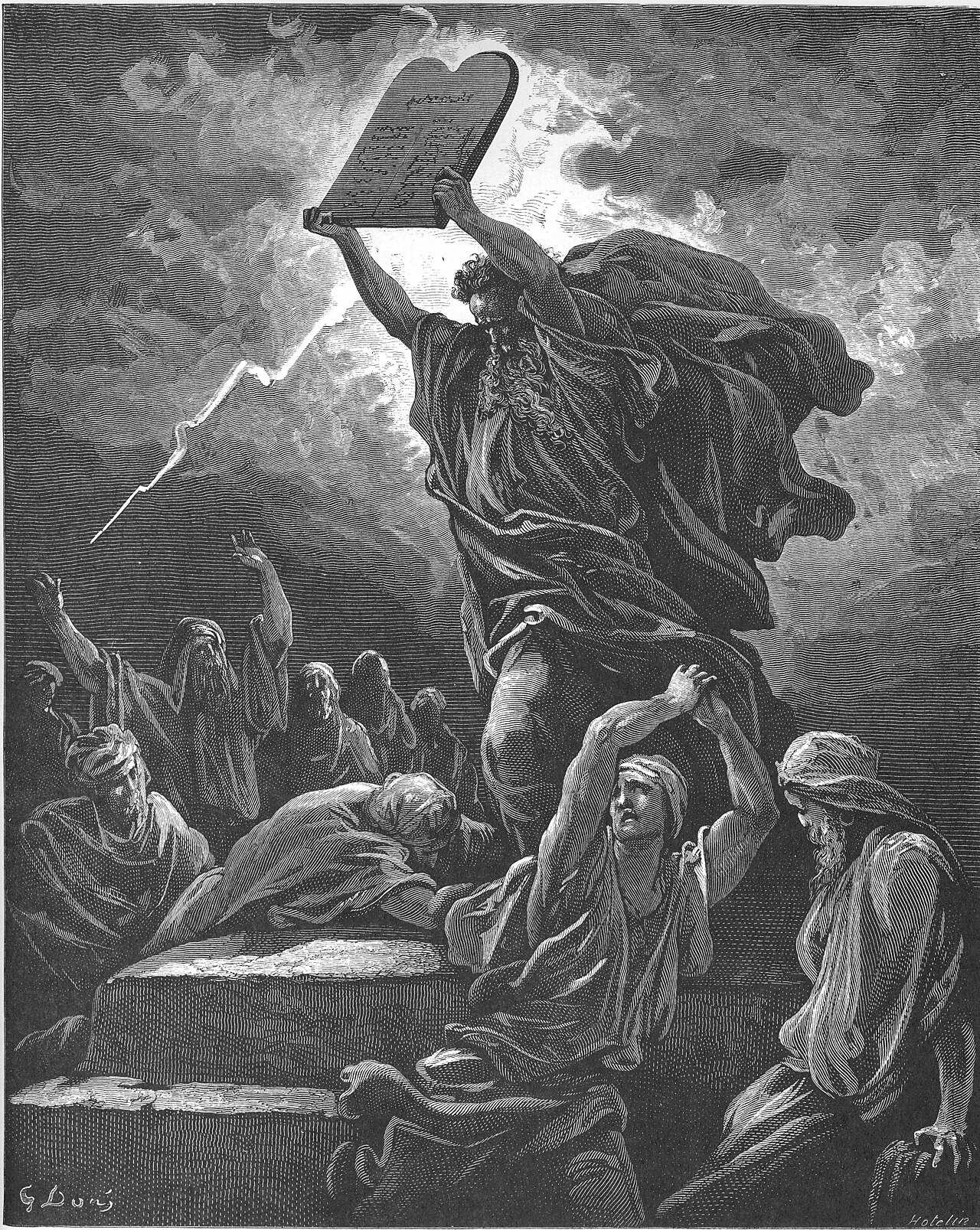
in Exodus 32Then Moses turned and went down the mountain with the two tablets of the Testimony in his hands. They were inscribed on both sides, front and back.
BSB
The same verse in ASV and KJV ▾
ASV
And Moses turned, and went down from the mount, with the two tables of the testimony in his hand; tables that were written on both their sides; on the one side and on the other were they written.
KJV
And Moses turned, and went down from the mount, and the two tables of the testimony were in his hand: the tables were written on both their sides; on the one side and on the other were they written.
⋯
This verse in Exodus 32
Commentary
6 notes on this verseThe tables were written on both their sides - If we take this literally, it was certainly a very unusual thing; for in ancient times the two sides of the same substance were never written over. However, some rabbins suppose that by the writing on both sides is meant the letters were cut through the tables, so that they might be read on both sides, though on one side they would appear reversed.
This site's exposition
the two tables of the testimony were in his hand
on Exodus 32:15-16
The tables are called the work of God and the writing the writing of God, and 31:18 says they were written with the finger of God. That phrase entered Scripture at 8:19 in the mouth of Egypt's magicians, who used it of the one plague they could not copy. Moses wrote at 24:4 and God writes here, and the first thing broken after the covenant is made is the covenant document itself.
The record, by era
The Church Fathers1 voice
A commentator
Augustine of HippoTRACTATE ON THE GOSPEL OF JOHN 122.8 · Written in the 5th century.
proposed
For if we should designate a number which signifies the law, what will it be except ten? For indeed we hold it as most certain that the Decalogue of the law, that is, those very well known ten commandments, were first written by the finger of God on two stone tablets. But the law, when grace gives no aid, makes transgressors and exists only in the letter. For because of this especially the apostle says, "The letter kills, but the spirit gives life." Therefore let the spirit be added to the letter so that the letter may not kill him to whom the spirit does not give life, but that we may practice the commandments, not by our own strength but by the gift of the Savior.
The Puritans and the Awakening2 voices
And Moses turned, and went down from the mount,....
While Moses was in the cloud, as in the presence-chamber, Joshua continued as near as he might, in the anti-chamber (as it were), waiting till Moses came out, that he might be ready to attend him; and though he was all alone for forty days (fed, it is likely, with manna), yet he was not weary of waiting, as the people were, but when Moses came down he came with him, and not till then.
The Nineteenth Century1 voice
A commentator
Jamieson, Fausset & Brown1802–1910
Commentary Critical and Explanatory on the Whole Bible (1871)
Moses turned, and went down from the mount--The plain, Er-Raheh, is not visible from the top of Jebel Musa, nor can the mount be descended on the side towards that valley; hence Moses and his companion, who on duty had patiently waited his return in the hollow of the mountain's brow, heard the shouting some time before they actually saw the camp.
How the passage was read
What the Jewish commentators add
On the verses either side of this one
Heaven forbid for the Lord to repent. 63 To change His mind. Medieval Jewish philosophers taught that God is unchanging.
This section is reception history: how the passage was read and kept in the Jewish tradition. Where a reading parts from an essential of the Christian faith, the section says so at that point.
Texts and citation data: Sefaria; each excerpt follows its version’s licence. 4 further sources are cited on this chapter that carry no English text this site may quote or only restate the verse.
The words behind it
17 Hebrew wordsEvery Hebrew word of this verse in the order it stands, with what it means and the door to its own study. The last column counts the times a word stands in the whole Bible: the rarer the word, the more the places it appears belong together.
| Hebrew | Sound | Meaning | Word study | In the Bible |
|---|---|---|---|---|
| וַיִּ֜פֶן | vaiyifen | and he turned | H6437 → | 135 times |
| וַיֵּ֤רֶד | vaiyered | and he went down | H3381 → | 381 times |
| מֹשֶׁה֙ | mosheh | Moses | H4872 → | 765 times |
| מִן־ | min- | from | H4480 → | 1188 times |
| הָהָ֔ר | hahar | the mountain | H2022 → | 546 times |
| וּשְׁנֵ֛י | ushenei | and [the] two | H8147 → | 768 times |
| לֻחֹ֥ת | luchot | [the] tablets of | H3871 → | 43 times |
| הָעֵדֻ֖ת | haedut | the testimony | H5715 → | 59 times |
| בְּיָד֑וֹ | beyado | [were] in hand his | H3027 → | 1618 times |
| לֻחֹ֗ת | luchot | tablets | H3871 → | 43 times |
| כְּתֻבִים֙ | ketuvim | written | H3789 → | 224 times |
| מִשְּׁנֵ֣י | mishenei | from [the] two | H8147 → | 768 times |
| עֶבְרֵיהֶ֔ם | ʾevreihem | sides their | H5676 → | 90 times |
| מִזֶּ֥ה | mizeh | from this | H2088 → | 1180 times |
| וּמִזֶּ֖ה | umizeh | and from this | H2088 → | 1180 times |
| הֵ֥ם | hem | they | H1992 → | 553 times |
| כְּתֻבִֽים׃ | ketuvim | [were] written | H3789 → | 224 times |
וַיִּ֜פֶןand he turned
vaiyifenH6437 →135 times
וַיֵּ֤רֶדand he went down
vaiyeredH3381 →381 times
מֹשֶׁה֙Moses
moshehH4872 →765 times
מִן־from
min-H4480 →1188 times
הָהָ֔רthe mountain
haharH2022 →546 times
וּשְׁנֵ֛יand [the] two
usheneiH8147 →768 times
לֻחֹ֥ת[the] tablets of
luchotH3871 →43 times
הָעֵדֻ֖תthe testimony
haedutH5715 →59 times
בְּיָד֑וֹ[were] in hand his
beyadoH3027 →1618 times
לֻחֹ֗תtablets
luchotH3871 →43 times
כְּתֻבִים֙written
ketuvimH3789 →224 times
מִשְּׁנֵ֣יfrom [the] two
misheneiH8147 →768 times
עֶבְרֵיהֶ֔םsides their
ʾevreihemH5676 →90 times
מִזֶּ֥הfrom this
mizehH2088 →1180 times
וּמִזֶּ֖הand from this
umizehH2088 →1180 times
הֵ֥םthey
hemH1992 →553 times
כְּתֻבִֽים׃[were] written
ketuvimH3789 →224 times
A shaded row is a word that stands 400 times or fewer in the Bible.
The walk
8 stopsEach card is a verse this one points to, and under it the verses that one points to in turn. Where several paths arrive at the same place, that place is listed first: the text keeps returning to it.
Through
Exodus 16:34And Aaron placed it in front of the Testimony, to be preserved just as the LORD had commanded Moses.
it leads to
- Exodus 25:21
Set the mercy seat atop the ark, and put the Testimony that I will give you into the ark.
- Exodus 25:16
And place inside the ark the Testimony, which I will give you.
- Exodus 27:21
In the Tent of Meeting, outside the veil that is in front of the Testimony, Aaron and his sons are to tend the lamps before the LORD from evening until morning. This is to…
- Exodus 25:21
Through
Exodus 24:18Moses entered the cloud as he went up on the mountain, and he remained on the mountain forty days and forty nights.
it leads to
- Deuteronomy 9:9
When I went up on the mountain to receive the tablets of stone, the tablets of the covenant that the LORD made with you, I stayed on the mountain forty days and forty nights.…
- Deuteronomy 10:10
I stayed on the mountain forty days and forty nights, like the first time, and that time the LORD again listened to me and agreed not to destroy you.
- Deuteronomy 9:9
Through
Deuteronomy 5:22The LORD spoke these commandments in a loud voice to your whole assembly out of the fire, the cloud, and the deep darkness on the mountain; He added nothing more. And He wrote them…
it leads to
- Exodus 31:18
When the LORD had finished speaking with Moses on Mount Sinai, He gave him the two tablets of the Testimony, tablets of stone inscribed by the finger of God.
- Exodus 24:12
Then the LORD said to Moses, “Come up to Me on the mountain and stay here, so that I may give you the tablets of stone, with the law and commandments I have written…
- Exodus 31:18
Through
Deuteronomy 9:15So I went back down the mountain while it was blazing with fire, with the two tablets of the covenant in my hands.
it leads to
- Exodus 19:18
Mount Sinai was completely enveloped in smoke, because the LORD had descended on it in fire. And the smoke rose like the smoke of a furnace, and the whole mountain quaked violently.
- Exodus 19:18
Where this verse is studied
About Exodus
Who and where
1 name in this verse with a page on the site.
This page draws on Adam Clarke, Commentary on the Bible; Augustine of Hippo, TRACTATE ON THE GOSPEL OF JOHN 122.8; Jamieson, Fausset & Brown, Commentary Critical and Explanatory on the Whole Bible; John Gill, Exposition of the Old Testament; John Gill, Exposition of the Old Testament (1748-1763) and Matthew Henry, Commentary on the Whole Bible.