
Exodus 32:26
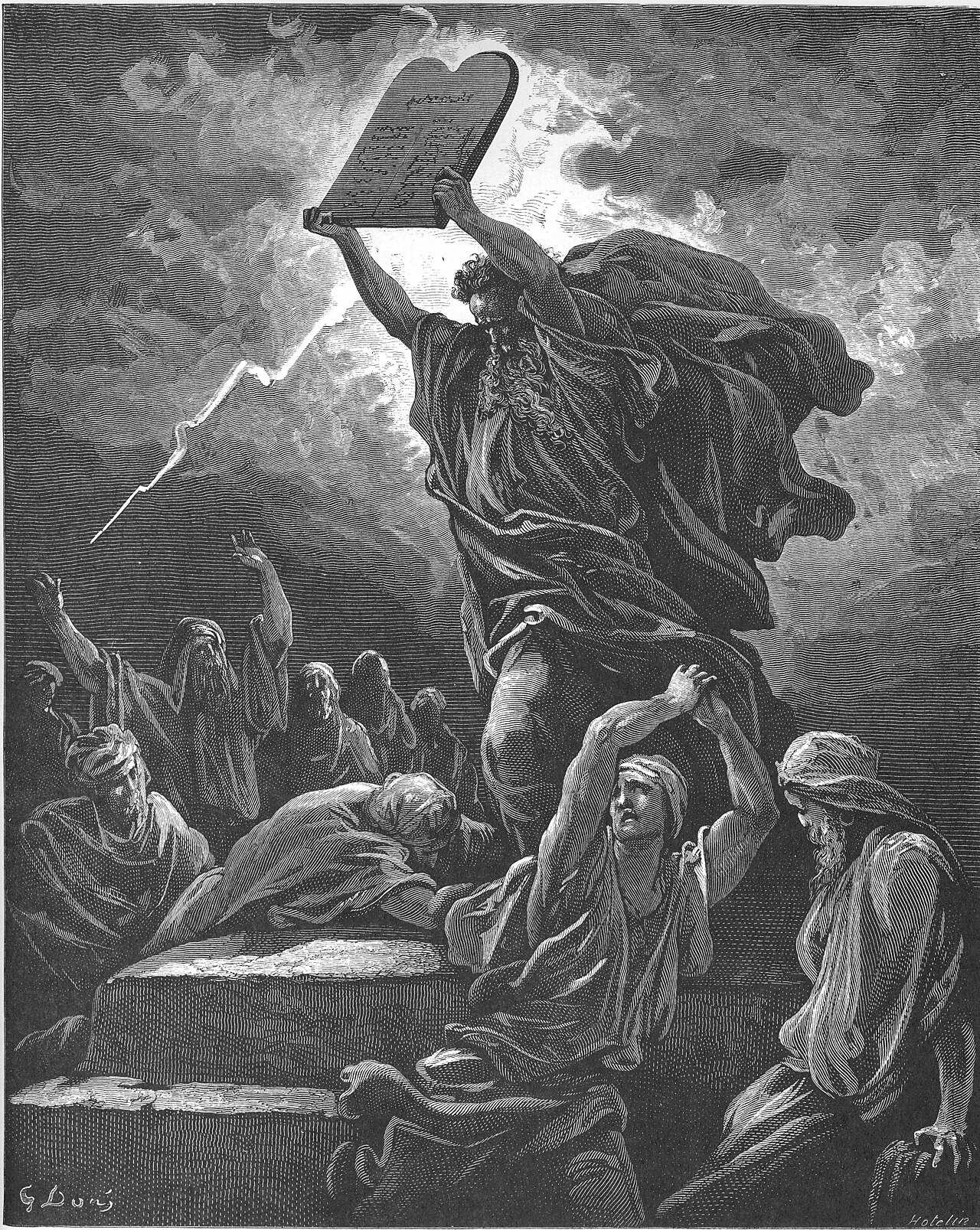
in Exodus 32So Moses stood at the entrance to the camp and said, “Whoever is for the LORD, come to me.” And all the Levites gathered around him.
BSB
The same verse in ASV and KJV ▾
ASV
then Moses stood in the gate of the camp, and said, Whoso is on Jehovah’s side, let him come unto me. And all the sons of Levi gathered themselves together unto him.
KJV
Then Moses stood in the gate of the camp, and said, Who is on the Lord’s side? let him come unto me. And all the sons of Levi gathered themselves together unto him.
⋯
This verse in Exodus 32
Commentary
10 notes on this verseA commentator
Jamieson, Fausset & Brown1802–1910
Commentary Critical and Explanatory on the Whole Bible (1871)
Moses stood in the gate of the camp, and said--The camp is supposed to have been protected by a rampart after the attack of the Amalekites. Who is on the Lord's side? let him come unto me--The zeal and courage of Moses was astonishing, considering he opposed an intoxicated mob.
This site's exposition
Moses saw that the people were naked
on Exodus 32:25-26
The word rendered naked carries the sense of loosed or broken away, and Adam Clarke points to the same verb at 2 Chronicles 28:19 for Judah made naked under Ahaz. Moses stands in the gate and asks who is on the LORD's side, which requires every man in a camp of thousands to walk somewhere and be counted. The sons of Levi gather to him, and Genesis 49:5 through 7 had cursed the sword of Levi and scattered the tribe in Israel.
This site's exposition
Whoever is for the LORD, come to me
Adam Clarke reads the call as a summons to everyone free of the idolatry, and takes the Levites as having no part in it. Matthew Henry says the case admits no neutral ground. Moses and Aaron were themselves of Levi, by the line of 6:16 to 20.
The record, by era
The Puritans and the Awakening2 voices
The interest of sin and wickedness is the devil's interest, and all wicked people side with that interest; the interest of truth and holiness is God's interest, with which all godly people side; and it is a case that will not admit a neutrality.
Then Moses stood in the gate of the camp,....
The Nineteenth Century3 voices
DURING the last few days in which the stir of a general election has moved the most quiet of our streets, every one of you must have been asked, many times, on which side you are. Some are enthusiastic on this side and some are quite as warm on the other and the interest of all ranks and classes is awakened. Now that the Lord's Day has come I hope you will forget all about politics and listen to me while I ask a far more important question, namely, "Who is on the Lord's side?" May God grant us Grace to give an honest answer and may that answer be, "Yes, Lord, You know all things, You know that I love You." May thousands of you say to the Lord what Amaziah and his band said to David, "Yours are we, David, and on your side, son of Jesse." Before I enlarge upon this exceedingly personal and practical question, I must ask you to remember the man who asked it. It was Moses who put this question, "Who is on the Lord's side?" and he put it to Israel when sin was rampant in the camp. It is well to remember that he stood there as a lone man, the solitary champion of Jehovah and challenged the whole nation to decide for God! His own brother had practically deserted him and become the means of making the golden calf. The 70 elders who ought to have been by his side were, none of them, present with him except his lieutenant Joshua. He stood alone in the midst of the multitude just when they were intoxicated with their lustful pleasures and their fanatical worship. He was equal to the emergency! Thoughtless altogether of his own safety, dauntless, brave and bold, he dashes down their idol and commands it to be ground small and cast into the water of which the nation would drink. He upbraids them to their faces and strides among them, as much superior to them all as a shepherd is superior to the flock he tends.
DURING the last few days in which the stir of a general election has moved the most quiet of our streets, every one of you must have been asked, many times, on which side you are. Some are enthusiastic on this side and some are quite as warm on the other and the interest of all ranks and classes is awakened. Now that the Lord's Day has come I hope you will forget all about politics and listen to me while I ask a far more important question, namely, "Who is on the Lord's side?"
A commentator
Charles Spurgeon1834–1892
The Metropolitan Tabernacle Pulpit, Sermon No. 2884: “'Who Is on the Lord's Side?'” (lightly modernized text, CCEL edition) · Written before 1892.
proposed
THOSE idolatrous people seem to have been awestruck by the appearance of Moses in their midst. You can picture them gathered around Aaron, worshipping the golden calf and performing their unclean rites—but, as soon as ever Moses marches into the camp, they recognize his commanding presence and his kingly authority. "Drag down that abomination," he cries! "And break it in pieces." And though, just now, they were adoring it, they implicitly obey him. The calf is hurled from its pedestal, burnt in the fire, ground to powder and mingled with the water that the idolaters drank.
2 more voices on this verse
The Nineteenth Century2 voices
A commentator
Charles Spurgeon1834–1892
The Metropolitan Tabernacle Pulpit, Sermon No. 2884: “'Who Is on the Lord's Side?'” (lightly modernized text, CCEL edition) · Written before 1892.
proposed
THOSE idolatrous people seem to have been awestruck by the appearance of Moses in their midst. You can picture them gathered around Aaron, worshipping the golden calf and performing their unclean rites—but, as soon as ever Moses marches into the camp, they recognize his commanding presence and his kingly authority. "Drag down that abomination," he cries! "And break it in pieces." And though, just now, they were adoring it, they implicitly obey him. The calf is hurled from its pedestal, burnt in the fire, ground to powder and mingled with the water that the idolaters drank. Then rings out the grand challenge of our text. The brave man who seems to stand like a solid rock amid the raging billows, feels it necessary to strike a decisive blow for Jehovah—and once and for all put an end to that shameful idolatry. So, taking his stand, as though to lift up the banner of Jehovah, he cries, "'Whoever is on the Lord's side—come to me!' And all the sons of Levi gathered themselves together to him"—the men who afterwards became the priests of the Most High God. Then came that just but terrible command to execute the idolaters—and three thousand of the people perished as a warning to the rest—and that cursed image-worship was stamped out of the camp, at least, for a time. Now, dear Friends, very much as Moses did on that occasion, needs to be done very frequently in every age. It is necessary that a banner should be displayed because of the Truth of God and that men should be called out to rally around it.
Who is on the Lord’s side? - That is, Who among you is free from this transgression? And all the sons of Levi, etc. - It seems they had no part in this idolatrous business.
The words behind it
13 Hebrew wordsEvery Hebrew word of this verse in the order it stands, with what it means and the door to its own study. The last column counts the times a word stands in the whole Bible: the rarer the word, the more the places it appears belong together.
| Hebrew | Sound | Meaning | Word study | In the Bible |
|---|---|---|---|---|
| וַיַּעֲמֹ֤ד | vaiyaamod | and he stood | H5975 → | 521 times |
| מֹשֶׁה֙ | mosheh | Moses | H4872 → | 765 times |
| בְּשַׁ֣עַר | beshaar | at [the] gate of | H8179 → | 374 times |
| הַֽמַּחֲנֶ֔ה | hamachaneh | the camp | H4264 → | 215 times |
| וַיֹּ֕אמֶר | vaiyomer | and he said | H559 → | 5305 times |
| מִ֥י | mi | who? | H4310 → | 423 times |
| לַיהוָ֖ה | layahweh | [belongs] to Yahweh | H3068 → | 6520 times |
| אֵלָ֑י | ʾelai | to me | H413 → | 5510 times |
| וַיֵּאָסְפ֥וּ | vaiyeasefu | and they gathered themselves | H622 → | 200 times |
| אֵלָ֖יו | ʾelav | to him | H413 → | 5510 times |
| כָּל־ | kol- | all | H3605 → | 5413 times |
| בְּנֵ֥י | benei | [the] descendants of | H1121 → | 4930 times |
| לֵוִֽי׃ | levi | Levi | H3878 → | 59 times |
וַיַּעֲמֹ֤דand he stood
vaiyaamodH5975 →521 times
מֹשֶׁה֙Moses
moshehH4872 →765 times
בְּשַׁ֣עַרat [the] gate of
beshaarH8179 →374 times
הַֽמַּחֲנֶ֔הthe camp
hamachanehH4264 →215 times
וַיֹּ֕אמֶרand he said
vaiyomerH559 →5305 times
מִ֥יwho?
miH4310 →423 times
לַיהוָ֖ה[belongs] to Yahweh
layahwehH3068 →6520 times
אֵלָ֑יto me
ʾelaiH413 →5510 times
וַיֵּאָסְפ֥וּand they gathered themselves
vaiyeasefuH622 →200 times
אֵלָ֖יוto him
ʾelavH413 →5510 times
כָּל־all
kol-H3605 →5413 times
בְּנֵ֥י[the] descendants of
beneiH1121 →4930 times
לֵוִֽי׃Levi
leviH3878 →59 times
A shaded row is a word that stands 400 times or fewer in the Bible.
The walk
8 stopsEach card is a verse this one points to, and under it the verses that one points to in turn. Where several paths arrive at the same place, that place is listed first: the text keeps returning to it.
Through
Matthew 12:30He who is not with Me is against Me, and he who does not gather with Me scatters.
it leads to
- Mark 9:40
For whoever is not against us is for us.
- Luke 11:23
He who is not with Me is against Me, and he who does not gather with Me scatters.
- Luke 9:50
“Do not stop him,” Jesus replied, “for whoever is not against you is for you.”
- Joshua 24:15
But if it is unpleasing in your sight to serve the LORD, then choose for yourselves this day whom you will serve, whether the gods your fathers served beyond the Euphrates, or the gods…
- 1 John 2:19
They went out from us, but they did not belong to us. For if they had belonged to us, they would have remained with us. But their departure made it clear that none of…
- Mark 9:40
Through
Joshua 5:13Now when Joshua was near Jericho, he looked up and saw a man standing in front of him with a drawn sword in His hand. Joshua approached Him and asked, “Are You for us…
it leads to
- Genesis 18:2
And Abraham looked up and saw three men standing nearby. When he saw them, he ran from the entrance of his tent to meet them and bowed low to the ground.
- Numbers 22:23
When the donkey saw the angel of the LORD standing in the road with a drawn sword in his hand, she turned off the path and went into a field. So Balaam beat her…
- Numbers 22:31
Then the LORD opened Balaam’s eyes, and he saw the angel of the LORD standing in the road with a drawn sword in his hand. And Balaam bowed low and fell facedown.
- Genesis 18:2
Where this verse is studied
About Exodus
Who and where
1 name in this verse with a page on the site.
This page draws on Adam Clarke, Commentary on the Bible; Charles Spurgeon, The Metropolitan Tabernacle Pulpit, Sermon No. 1531: “On Whose Side Are You?” (lightly modernized text, CCEL edition); Charles Spurgeon, The Metropolitan Tabernacle Pulpit, Sermon No. 2884: “'Who Is on the Lord's Side?'” (lightly modernized text, CCEL edition); Jamieson, Fausset & Brown, Commentary Critical and Explanatory on the Whole Bible; John Gill, Exposition of the Old Testament (1748-1763) and Matthew Henry, Commentary on the Whole Bible.