
Exodus 32:7
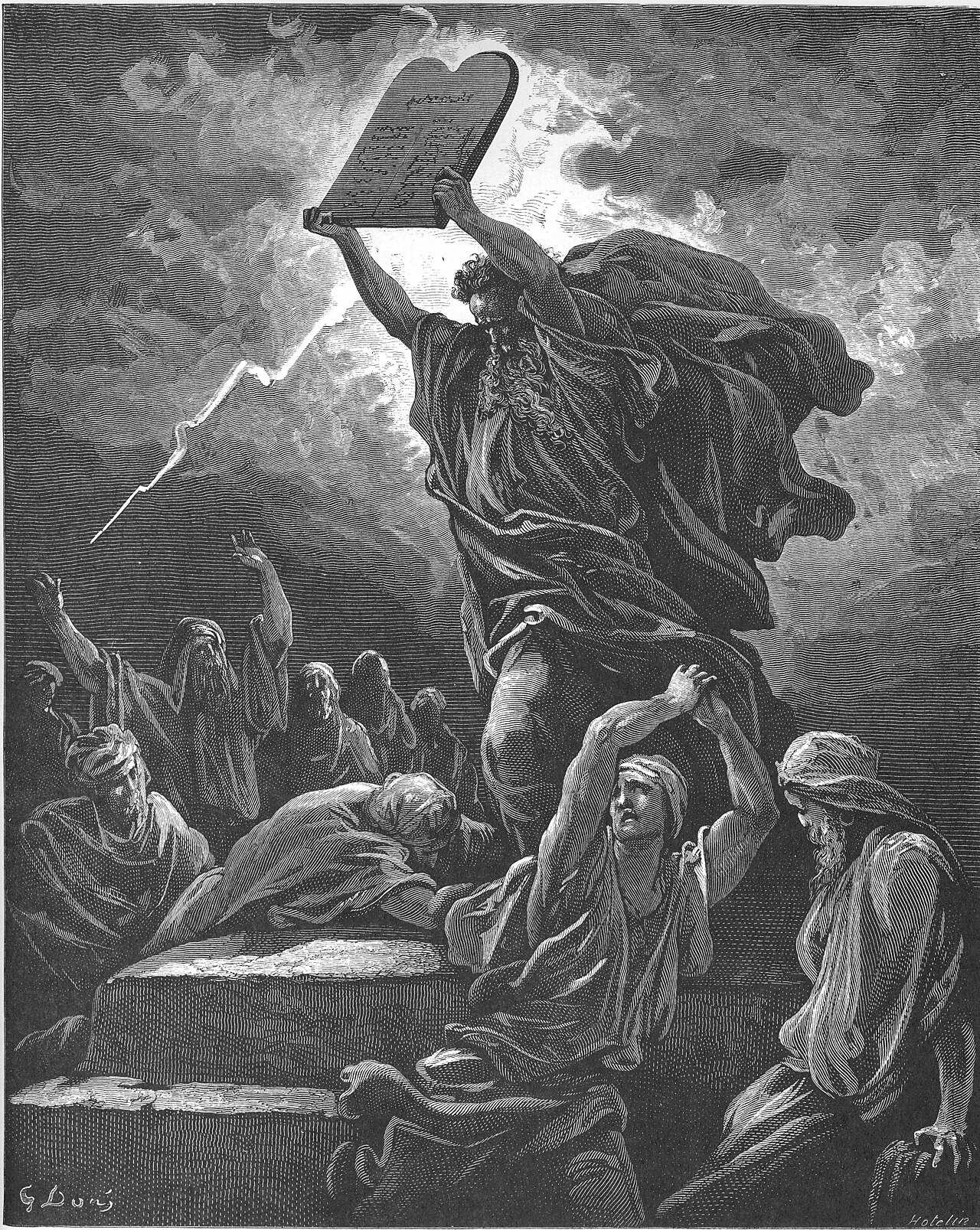
in Exodus 32Then the LORD said to Moses, “Go down at once, for your people, whom you brought up out of the land of Egypt, have corrupted themselves.
BSB
The same verse in ASV and KJV ▾
ASV
And Jehovah spake unto Moses, Go, get thee down; for thy people, that thou broughtest up out of the land of Egypt, have corrupted themselves:
KJV
And the Lord said unto Moses, Go, get thee down; for thy people, which thou broughtest out of the land of Egypt, have corrupted themselves:
⋯
This verse in Exodus 32
Commentary
8 notes on this verseThis site's exposition
for thy people, which thou broughtest out
on Exodus 32:7-8
God calls them thy people, which thou broughtest out of the land of Egypt, handing them to Moses in the same words the people had used of Moses in verse 1. They have turned aside quickly out of the way, and the way was given at 20:4 and agreed to at 24:7. What God reports to Moses is what the narrator has already shown the reader in verses 4 through 6, told back in the same sentence the people shouted.
The record, by era
The Church Fathers1 voice
A commentator
Origen of AlexandriaCOMMENTARY ON THE GOSPEL OF JOHN 10.80 · Written before 253.
proposed
Therefore just as the people are God's when they do not sin but are no longer said to be his when they sin, so also the feats are the feats of sinners when they are hated by the Lord's soul, but when they are ordained by the Lord, they are called the Lord's.
The Puritans and the Awakening3 voices
If thou didst that for them, notwithstanding their sins in Egypt, wilt thou undo it for their sins of the same nature in the wilderness?" (2.) He pleads the concern of God's glory (
quarantine:debris (2026-07-29) — unbalanced-parens+odd-straight-quotes
And the Lord said unto Moses, go, get thee down,....
To fall into sin quickly after we have renewed our covenants with God, or received special mercy from him, is very provoking. He tells him particularly what they had done: They have made a calf, and worshipped it. Note, Those sins which are concealed from our governors are naked and open before God.
The Nineteenth Century1 voice
A commentator
Jamieson, Fausset & Brown1802–1910
Commentary Critical and Explanatory on the Whole Bible (1871)
proposed
the Lord said unto Moses, Go, get thee down--Intelligence of the idolatrous scene enacted at the foot of the mount was communicated to Moses in language borrowed from human passions and feelings, and the judgment of a justly offended God was pronounced in terms of just indignation against the gross violation of the so recently promulgated laws.
quarantine:debris (2026-07-29) — starts-lowercase
2 more voices on this verse
The Nineteenth Century2 voices
Thy people - have corrupted themselves - They had not only got into the spirit of idolatry, but they had become abominable in their conduct, so that God disowns them to be his: Thy people have broken the covenant, and are no longer entitled to my protection and love. This is one pretense that the Roman Catholics have for the idolatry in their image worship. Their high priest, the pope, collects the ornaments of the people, and makes an image, a crucifix, a madonna, etc. The people worship it; but the pope says it is only to keep God in remembrance. But of the whole God says, Thy people have corrupted themselves; and thus as they continue in their idolatry, they have forfeited the blessings of the Lord’s covenant. They are not God’s people, they are the pope’s people, and he is called “our holy father the pope.”
A commentator
Albert Barnes1798–1870
Notes, Explanatory and Practical, on the Old and New Testaments (1832-1869)
proposed
The faithfulness of Moses in the office that had been entrusted to him was now to be put to the test. It was to be made manifest whether he loved his own glory better than he loved the brethren who were under his charge; whether he would prefer that he should himself become the founder of a “great nation,” or that the Lord’s promise should be fulfilled in the whole people of Israel. This may have been especially needful for Moses, in consequence of his natural disposition. See Num 12:3; and compare Exo 3:
The words behind it
13 Hebrew wordsEvery Hebrew word of this verse in the order it stands, with what it means and the door to its own study. The last column counts the times a word stands in the whole Bible: the rarer the word, the more the places it appears belong together.
| Hebrew | Sound | Meaning | Word study | In the Bible |
|---|---|---|---|---|
| וַיְדַבֵּ֥ר | vaydaber | and he spoke | H1696 → | 1141 times |
| יְהוָ֖ה | yahweh | Yahweh | H3068 → | 6520 times |
| אֶל־ | ʾel- | to | H413 → | 5510 times |
| מֹשֶׁ֑ה | mosheh | Moses | H4872 → | 765 times |
| לֶךְ־ | lekh- | go | H1980 → | 1546 times |
| רֵ֕ד | red | go down | H3381 → | 381 times |
| כִּ֚י | ki | for | H3588 → | 4482 times |
| שִׁחֵ֣ת | shichet | it has behaved corruptly | H7843 → | 146 times |
| עַמְּךָ֔ | ʾamekha | people your | H5971 → | 1873 times |
| אֲשֶׁ֥ר | ʾasher | which | H834 → | 5497 times |
| הֶעֱלֵ֖יתָ | heeleita | you brought up | H5927 → | 890 times |
| מֵאֶ֥רֶץ | meeretz | from [the] land of | H776 → | 2504 times |
| מִצְרָֽיִם׃ | mitzrayim | Egypt | H4714 → | 641 times |
וַיְדַבֵּ֥רand he spoke
vaydaberH1696 →1141 times
יְהוָ֖הYahweh
yahwehH3068 →6520 times
אֶל־to
ʾel-H413 →5510 times
מֹשֶׁ֑הMoses
moshehH4872 →765 times
לֶךְ־go
lekh-H1980 →1546 times
רֵ֕דgo down
redH3381 →381 times
כִּ֚יfor
kiH3588 →4482 times
שִׁחֵ֣תit has behaved corruptly
shichetH7843 →146 times
עַמְּךָ֔people your
ʾamekhaH5971 →1873 times
אֲשֶׁ֥רwhich
ʾasherH834 →5497 times
הֶעֱלֵ֖יתָyou brought up
heeleitaH5927 →890 times
מֵאֶ֥רֶץfrom [the] land of
meeretzH776 →2504 times
מִצְרָֽיִם׃Egypt
mitzrayimH4714 →641 times
A shaded row is a word that stands 400 times or fewer in the Bible.
The walk
8 stopsEach card is a verse this one points to, and under it the verses that one points to in turn. Where several paths arrive at the same place, that place is listed first: the text keeps returning to it.
Through
Hosea 9:9They have deeply corrupted themselves as in the days of Gibeah; He will remember their guilt; He will punish their sins.
it leads to
- Hosea 10:9
Since the days of Gibeah you have sinned, O Israel, and there you have remained. Did not the battle in Gibeah overtake the sons of iniquity?
- Judges 19:16
That evening an old man from the hill country of Ephraim, who was residing in Gibeah (the men of that place were Benjamites), came in from his work in the field.
- Hosea 10:9
Through
Judges 2:19But when the judge died, the Israelites became even more corrupt than their fathers, going after other gods to serve them and bow down to them. They would not give up their evil practices…
it leads to
- Judges 8:33
And as soon as Gideon was dead, the Israelites turned and prostituted themselves with the Baals, and they set up Baal-berith as their god.
- Judges 4:1
After Ehud died, the Israelites again did evil in the sight of the LORD.
- Judges 8:33
Through
Exodus 32:11But Moses sought the favor of the LORD his God, saying, “O LORD, why does Your anger burn against Your people, whom You brought out of the land of Egypt with great power and…
it leads to
- Deuteronomy 9:18–20
Then I fell down before the LORD for forty days and forty nights, as I had done the first time. I did not eat bread or drink water because of all the sin you…
- Deuteronomy 9:18–20
Through
Deuteronomy 9:12And the LORD said to me, “Get up and go down from here at once, for your people, whom you brought out of Egypt, have corrupted themselves. How quickly they have turned aside from…
it leads to
- Exodus 32:7–8
Then the LORD said to Moses, “Go down at once, for your people, whom you brought up out of the land of Egypt, have corrupted themselves.
- Deuteronomy 31:29
For I know that after my death you will become utterly corrupt and turn from the path I have commanded you. And in the days to come, disaster will befall you because you will…
- Judges 2:17
Israel, however, did not listen to their judges. Instead, they prostituted themselves with other gods and bowed down to them. They quickly turned from the way of their fathers, who had walked in obedience…
- Exodus 32:7–8
Where this verse is studied
About Exodus
Who and where
2 names in this verse with a page on the site.
This page draws on Adam Clarke, Commentary on the Bible; Albert Barnes, Notes, Explanatory and Practical, on the Old and New Testaments (1832-1869); Jamieson, Fausset & Brown, Commentary Critical and Explanatory on the Whole Bible; John Gill, Exposition of the Old Testament; John Gill, Exposition of the Old Testament (1748-1763); Keil and Delitzsch, Biblical Commentary on the Old Testament: The Pentateuch; Matthew Henry, Commentary on the Whole Bible and Origen of Alexandria, COMMENTARY ON THE GOSPEL OF JOHN 10.80.