
Jude 1:6
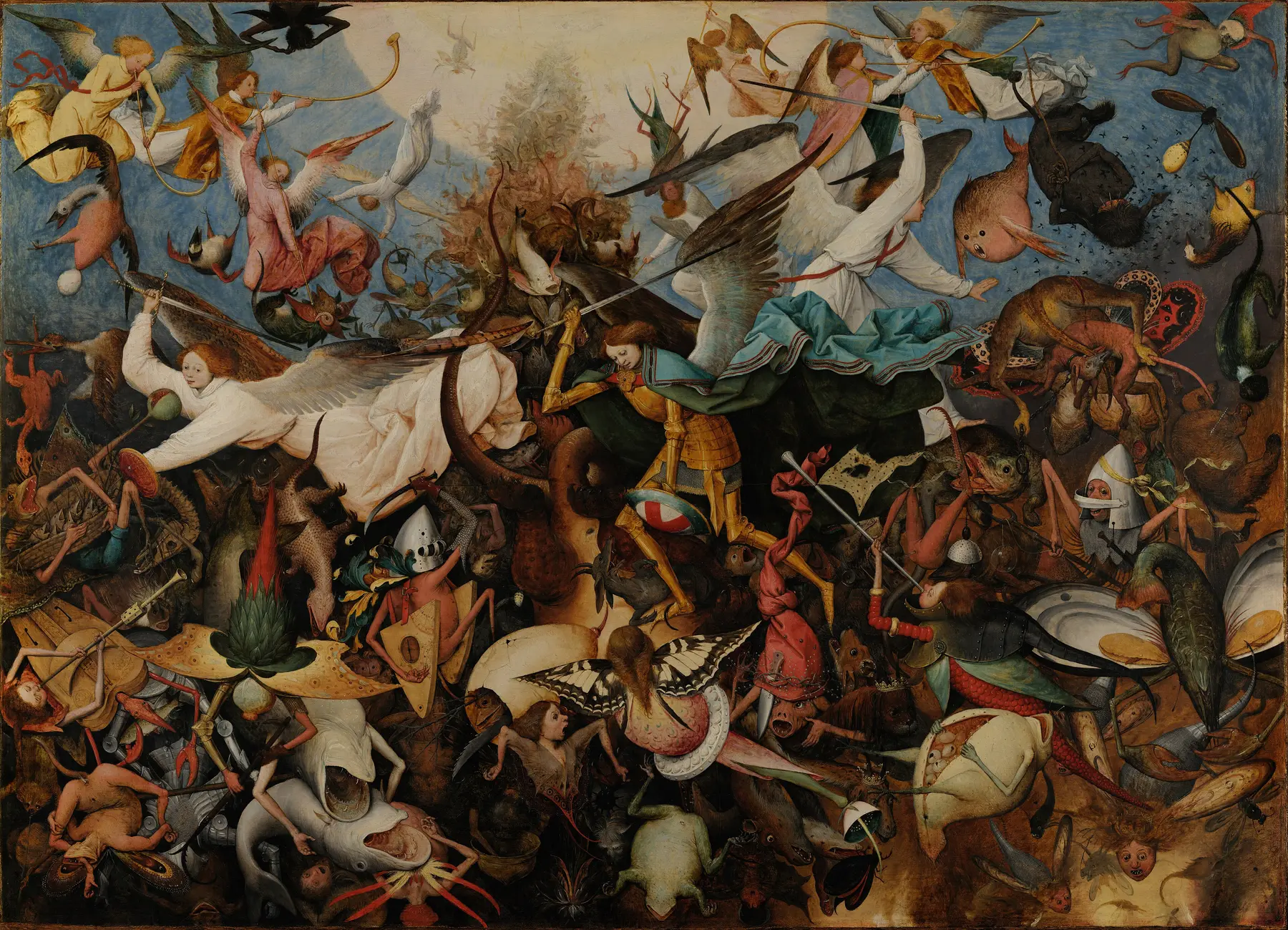
in Jude 1And the angels who did not stay within their own domain but abandoned their proper dwelling—these He has kept in eternal chains under darkness, bound for judgment on that great day.
BSB
The same verse in ASV and KJV ▾
ASV
And angels that kept not their own principality, but left their proper habitation, he hath kept in everlasting bonds under darkness unto the judgment of the great day.
KJV
And the angels which kept not their first estate, but left their own habitation, he hath reserved in everlasting chains under darkness unto the judgment of the great day.
⋯
This verse in Jude 1
Commentary
23 notes on this verseSince the Son of God is always one and the same, He gives to those who believe on Him a well of water [springing up] to eternal life, but He causes the unfruitful fig-tree immediately to dry up; and in the days of Noah He justly brought on the deluge for the purpose of extinguishing that most infamous race of men then existent, who could not bring forth fruit to God, since the angels that sinned had commingled with them, and [acted as He did] in order that He might put a check upon the sins of these men, but [that at the same time] He might preserve the archetype, the formation of Adam.
This site's exposition
did not stay within their own domain
on Jude 1:6-7
The angels did not stay within their own domain, arche, but abandoned their proper dwelling, oiketerion. Verse 7 opens In like manner; many read both verses with 2 Peter 2:4-5 and Genesis 6:1-4, others as the first fall of Satan's host. Sodom is on display, deigma.
The record, by era
The Church Fathers5 voices
I want to remind you, when we know once that the Lord, after He had saved the people from Egypt, again destroyed those who did not believe: and that He kept the angels who did not keep their own position, but left their own dwelling, …
A commentator
Origen of AlexandriaCommentary on the Gospel of John, Book 13 · Written before 253.
proposed
Not only man, but also the "sons of God, seeing the daughters of men that they are fair, took for themselves wives of all whom they chose," and consistently all those who left "their own dwelling" and did not preserve their own principality - and by "principality" I mean not in reference to power but to the beginning and foundation; just as for man, the beginning was to be in paradise, but the end perhaps due to transgression in Hades below or some such place, so also for each of the fallen ones a particular beginning is given.
A commentator
JosephusAntiquities of the Jews - Book I, Chapter 3, Section 1 · Written before 100.
proposed
For many angels of God accompanied with women, and begat sons that proved unjust, and despisers of all that was good, on account of the confidence they had in their own strength; for the tradition is, that these men did what resembled the acts of …
Who can understand God's love for his people or figure out the truth just by his own reasoning? For because of the truth he did not spare the angels who sinned, but on account of his kindness toward us he has allowed harlots and publicans …
For they, withal, who instituted them are assigned, under condemnation, to the penalty of death — those angels, to wit, who rushed from heaven on the daughters of men; so that this ignominy also attaches to woman. For when to an age much more ignorant (than ours) they had disclosed certain well-concealed material substances, and several not well-revealed scientific arts — if it is true that they had laid bare the operations of metallurgy, and had divulged the natural properties of herbs, and had promulgated the powers of enchantments, and had traced out every curious art, even to the interpretation of the stars — they conferred properly and as it were peculiarly upon women that instrumental mean of womanly ostentation, the radiances of jewels wherewith necklaces are variegated, and the circlets of gold wherewith the arms are compressed, and the medicaments of orchil with which wools are colored, and that black powder itself wherewith the eyelids and eyelashes are made prominent. What is the quality of these things may be declared meantime, even at this point, from the quality and condition of their teachers: in that sinners could never have either shown or supplied anything conducive to integrity, unlawful lovers anything conducive to chastity, renegade spirits anything conducive to the fear of God. If (these things) are to be called teachings, ill masters must of necessity have taught ill; if as wages of lust, there is nothing base of which the wages are honourable. But why was it of so much importance to show these things as well as to confer them? Was it that women, without material causes of splendour, and without ingenious contrivances of grace, could not please men, who, while still unadorned, and uncouth and — so to say — crude and rude, had moved (the mind of) angels? […]
16 more voices on this verse
The Church Fathers4 voices
And it came to pass when the children of men had multiplied that in those days were born unto them beautiful and comely daughters. And the angels, the children of the heaven, saw and lusted after them, and said to one another: 'Come, let us …
God, when He had made the whole world, and subjected things earthly to man, and arranged the heavenly elements for the increase of fruits and rotation of the seasons, and appointed this divine law-for these things also He evidently made for man-committed the care of men and of all things under heaven to angels whom He appointed over them. But the angels transgressed this appointment, and were captivated by love of women, and begat children who are those that are called demons; and besides, they afterwards subdued the human race to themselves, partly by magical writings, and partly by fears and the punishments they occasioned, and partly by teaching them to offer sacrifices, and incense, and libations, of which things they stood in need after they were enslaved by lustful passions; and among men they sowed murders, wars, adulteries, intemperate deeds, and all wickedness. Whence also the poets and mythologists, not knowing that it was the angels and those demons who had been begotten by them that did these things to men, and women, and cities, and nations, which they related, ascribed them to god himself, and to those who were accounted to be his very offspring, and to the offspring of those who were called his brother), Neptune and Pluto, and to the children again of these their offspring. For whatever name each of the angels had given to himself and his children, by that name they called them.
To which also we shall add, that the angels who had obtained the superior rank, having sunk into pleasures, told to the women the secrets which had come to their knowledge; while the rest of the angels concealed them, or rather, kept them against the coming of the Lord.
A commentator
Clement of AlexandriaFrom the Latin Translation of Cassiodorus · Written before 215.
proposed
"But the angels," he says, "that kept not their own pre-eminence," that, namely, which they received through advancement, "but left their own habitation," meaning, that is, the heaven and the stars, became, and are called apostates. "He hath reserved these to the judgment of the great day, in chains, under darkness." He means the place near the earth, that is, the dark air. Now he called "chains" the loss of the honour in which they had stood, and the lust of feeble things; since, bound by their own lust, they cannot be converted. "As Sodom and Gomorrha," he says.
The Medieval Church4 voices
And those who, having received the honor of angelic dignity, through negligence did not remain in their original state, but cast off the heavenly manner of life given to them by grace, God has hidden away in punishment for the judgment, that is, for the …
They are being kept until they are thrown into the ultimate fire and bound in those chains which cannot be seen because of the darkness. That he has kept them for the coming judgment can be seen from what Peter has written.
The Holy Spirit convicts the world of the judgment by which the ruler of this world has been judged, in these words of the apostle Jude.
The angels, indeed, who did not keep their own position, etc. And in this sentence, as in the previous one, we must first remember that Jesus our Lord punished the transgressing angels. For He, the man born at the end of the ages from a …
The Puritans and the Awakening4 voices
Light and liberty concur, chains and darkness how well do they agree and suit each other! The devils, once angels in the best sense, are reserved, &c. Observe, There is, undoubtedly there is, a judgment to come; the fallen angels are reserved to the judgment of the great day; and shall fallen men escape it?
But now he loves them no more; they are doomed to endless destruction. (for if he loved them still, he would love what is sinful:) and both his former love, and his present righteous and eternal displeasure towards the same work of his own hands, are because he changeth not; because he invariably loveth righteousness, and hateth iniquity.
And the angels which kept not their first estate,....
There are many things which we have known which yet we have unhappily forgotten. Is it of no use or service to be put afresh in remembrance of them? Now what are these things which we Christians need to be put in remembrance of?
The Nineteenth Century3 voices
The angels which kept not their first estate - Την ἑαυτων αρχην Their own principality. The words may be understood of their having invaded the office or dignity of some others, or of their having by some means forfeited their own. This is spoken of those generally termed the fallen angels; but from what they fell, or from what cause or for what crime, we know not. It is generally thought to have been pride; but this is mere conjecture.
A commentator
Jamieson, Fausset & Brown1802–1910
Commentary Critical and Explanatory on the Whole Bible (1871)
But though Jude accords with it in some particulars, it does not follow that he accords with it in all. The Hebrews name the fallen angels Aza and Azael. left--on their own accord. their own--Greek, "their proper." habitation--heaven, all bright and glorious, as opposed to the "darkness" to which they now are doomed.
A commentator
Albert Barnes1798–1870
Notes, Explanatory and Practical, on the Old and New Testaments (1832-1869)
proposed
And the angels which kept not their first estate - A second case denoting that the wicked would be punished. Compare the notes, 2Pe 2:4. The word rendered “estate” (ἀρχὴν archēn) is, in the margin, “principality.” The word properly means, “beginning, commencement;” and then that which surpasses others, which is “first,” etc., in point of rank and honor; or pre-eminence, priority, precedence, princedom. Here it refers to the rank and dignity which the angels had in heaven. That rank or pre-eminence they did not keep, but fell from it. On the word used here, compare Eph 1:2; Eph 3:10; Col 2:10, as applied to angels; 1Co 15:24; Eph 6:12; Col 2:15, as applied to demons. But left their own habitation - To wit, according to the common interpretation, in heaven. The word rendered “habitation” (οἰκητήριον oikētērion) occurs nowhere else in the New Testament. It means here that heaven was their native abode or dwelling-place. They left it by sin; but the expression here would seem possibly to mean that they became “dissatisfied” with their abode, and voluntarily preferred to change it for another. If they did become thus dissatisfied, the cause is wholly unknown, and conjecture is useless. Some of the later Jews supposed that they relinquished heaven out of love for the daughters of men - “Robinson.” He hath reserved in everlasting chains - See the notes, 2Pe 2:4. Peter says, “chains of darkness;” that is, the darkness encompasses them “as” chains. Jude says that those chains are “everlasting,” (δεσμοῖς ἀΐ́δίοις desmois aidios. Compare Rom 1:20, “his eternal power and Godhead.” The word does not elsewhere occur. It is an appropriate word to denote that which is eternal; and no one can doubt that if a Greek wished to express that idea, this would be a proper word to use. […]
Modern Voices1 voice
A commentator
GK ChestertonThe Catholic Church and Conversion, Ch. 5: The Exception Proves the Rule (1926) (1926)
proposed
In the same way, let the convert, or still more the semi-convert, face any one fact that does seem to him to deface the Catholic scheme as a falsehood; and if he faces it long enough he will probably find that it is the greatest …
The words behind it
22 Greek wordsEvery Greek word of this verse in the order it stands, with what it means and the door to its own study. The last column counts the times a word stands in the whole Bible: the rarer the word, the more the places it appears belong together.
| Greek | Sound | Meaning | Word study | In the Bible |
|---|---|---|---|---|
| ἀγγέλους | angelous | [The] angels | G32 → | |
| τε | te | both | G5037 → | |
| τοὺς | tous | <the> | G3588 → | 19766 times |
| μὴ | me | not | G3361 → | 1066 times |
| τηρήσαντας | teresantas | having kept | G5083 → | 70 times |
| τὴν | ten | <the> | G3588 → | 19766 times |
| ἑαυτῶν | he'auton | their own | G1438 → | 322 times |
| ἀρχὴν | archen | domain | G746 → | |
| ἀλλ᾽ | all᾽ | but | G235 → | |
| ἀπολιπόντας | apolipontas | having left | G620 → | |
| τὸ | to | <the> | G3588 → | 19766 times |
| ἴδιον | idion | [their] own | G2398 → | |
| οἰκητήριον, | oiketerion | dwelling, | G3613 → | |
| εἰς | eis | unto | G1519 → | 1755 times |
| κρίσιν | krisin | [the] judgment | G2920 → | 47 times |
| μεγάλης | megales | of [the] great | G3173 → | |
| ἡμέρας | hemeras | day | G2250 → | |
| δεσμοῖς | desmois | in chains | G1199 → | |
| ἀϊδίοις | aidiois | eternal | G126 → | |
| ὑπὸ | hupo | under | G5259 → | 219 times |
| ζόφον | zophon | darkness | G2217 → | |
| τετήρηκεν· | tetereken | He has kept; | G5083 → | 70 times |
ἀγγέλους[The] angels
angelousG32 →
τεboth
teG5037 →
τοὺς<the>
tousG3588 →19766 times
μὴnot
meG3361 →1066 times
τηρήσανταςhaving kept
teresantasG5083 →70 times
τὴν<the>
tenG3588 →19766 times
ἑαυτῶνtheir own
he'autonG1438 →322 times
ἀρχὴνdomain
archenG746 →
ἀλλ᾽but
all᾽G235 →
ἀπολιπόνταςhaving left
apolipontasG620 →
τὸ<the>
toG3588 →19766 times
ἴδιον[their] own
idionG2398 →
οἰκητήριον,dwelling,
oiketerionG3613 →
εἰςunto
eisG1519 →1755 times
κρίσιν[the] judgment
krisinG2920 →47 times
μεγάληςof [the] great
megalesG3173 →
ἡμέραςday
hemerasG2250 →
δεσμοῖςin chains
desmoisG1199 →
ἀϊδίοιςeternal
aidioisG126 →
ὑπὸunder
hupoG5259 →219 times
ζόφονdarkness
zophonG2217 →
τετήρηκεν·He has kept;
teterekenG5083 →70 times
A shaded row is a word that stands 400 times or fewer in the Bible.
The walk
8 stopsEach card is a verse this one points to, and under it the verses that one points to in turn. Where several paths arrive at the same place, that place is listed first: the text keeps returning to it.
Through
Ephesians 6:12For our struggle is not against flesh and blood, but against the rulers, against the authorities, against the powers of this world’s darkness, and against the spiritual forces of evil in the heavenly realms.
it leads to
- Colossians 1:13
He has rescued us from the dominion of darkness and brought us into the kingdom of His beloved Son,
- 2 Corinthians 4:4
The god of this age has blinded the minds of unbelievers so they cannot see the light of the gospel of the glory of Christ, who is the image of God.
- Ephesians 2:2
in which you used to walk when you conformed to the ways of this world and of the ruler of the power of the air, the spirit who is now at work in the…
- Colossians 2:15
And having disarmed the powers and authorities, He made a public spectacle of them, triumphing over them by the cross.
- Acts 26:18
to open their eyes, so that they may turn from darkness to light and from the power of Satan to God, that they may receive forgiveness of sins and an inheritance among those sanctified…
- Colossians 1:13
Through
2 Peter 2:9if all this is so, then the Lord knows how to rescue the godly from trials and to hold the unrighteous for punishment on the day of judgment.
it leads to
- Psalms 34:15–19
The eyes of the LORD are on the righteous, and His ears are inclined to their cry.
- 1 Corinthians 10:13
No temptation has seized you except what is common to man. And God is faithful; He will not let you be tempted beyond what you can bear. But when you are tempted, He will…
- Psalms 34:15–19
Through
2 Peter 2:4For if God did not spare the angels when they sinned, but cast them deep into hell, placing them in chains of darkness to be held for judgment;
it leads to
- Matthew 25:41
Then He will say to those on His left, ‘Depart from Me, you who are cursed, into the eternal fire prepared for the devil and his angels.
- Matthew 25:41
Where this verse is studied
On this page
Studies25
On this verse
On this chapter
Show the next 6 titles
About Jude
This page draws on 22 works. Open the list of works
This page draws on Adam Clarke, Commentary on the Bible; Albert Barnes, Notes, Explanatory and Practical, on the Old and New Testaments (1832-1869); Andreas of Caesarea, CATENA; Bede, Homilies on the Gospels 2.11; Bede, Commentary on the Catholic Epistles; Book of Enoch, 1 Enoch, Chapters 6-8; Clement of Alexandria, The Stromata Book 5; Clement of Alexandria, From the Latin Translation of Cassiodorus; GK Chesterton, The Catholic Church and Conversion, Ch. 5: The Exception Proves the Rule (1926); Hesychius of Jerusalem, CATENA; Irenaeus, Against Heresies Book IV; Jamieson, Fausset & Brown, Commentary Critical and Explanatory on the Whole Bible; John Gill, Exposition of the New Testament; John Gill, Exposition of the New Testament (1746-1748); John Wesley, Explanatory Notes upon the New Testament; Josephus, Antiquities of the Jews - Book I, Chapter 3, Section 1; Justin Martyr, The Second Apology, Chapter V; Matthew Henry, Commentary on the Whole Bible; Oecumenius, Commentary on Jude; Origen of Alexandria, Commentary on the Gospel of John, Book 13; Tertullian, On the Apparel of Women, Chapter 2 and Theophylact of Ohrid, Commentary on Jude.