
Exodus 5:9
in Exodus 5Make the work harder on the men so they will be occupied and pay no attention to these lies.”
BSB
The same verse in ASV and KJV ▾
ASV
Let heavier work be laid upon the men, that they may labor therein; and let them not regard lying words.
KJV
Let there more work be laid upon the men, that they may labour therein; and let them not regard vain words.
⋯
This verse in Exodus 5
Commentary
6 notes on this verseThis site's exposition
the same quota of bricks as before
on Exodus 5:8-9
Tale here means the count, so the quota stands while the material is withdrawn. A request to be released for the service of God is answered by increasing the service owed to Pharaoh. The Hebrew root behind both kinds of service is the same.
This site's exposition
Make the work harder on the men
Pharaoh states the aim of his order plainly. Heavier work will leave the people no strength or time to listen to Moses, whose message he calls lies. Albert Barnes, on verse 7, judges that gathering their own straw more than doubled the labor of the Israelites.
The record, by era
The Church Fathers1 voice
When both the good and the bad do the same things and suffer the same things, they are to be distinguished by their intentions, not by their acts and penalties. Pharaoh oppressed the people of God with hard labors; Moses afflicted the same people, who had fallen into idolatry, with severe punishments. They did the same things, but they did not aim at the same result. The former was puffed up with pride of power, the latter was animated by love.
The Puritans and the Awakening3 voices
Let there more work be laid upon the men,....
His suggestions were very unreasonable. (1.) That the people were idle, and that therefore they talked of going to sacrifice. The cities they built for Pharaoh, and the other fruit of their labours, were witnesses for them that they were not idle; yet he thus basely misrepresents them, that he might have a pretence to increase their burdens.
Note, The malice of Satan has often represented the service and worship of God as fit employment for those only that have nothing else to do, and the business only of the idle; whereas indeed it is the indispensable duty of those that are most busy in the world.
How the passage was read
What the Jewish commentators add
On the verses either side of this one
Of the king’s palace to the people who were working. 77 The text does not say from where they went out, hence I.E.’s comment.
This section is reception history: how the passage was read and kept in the Jewish tradition. Where a reading parts from an essential of the Christian faith, the section says so at that point.
Texts and citation data: Sefaria; each excerpt follows its version’s licence. 4 further sources are cited on this chapter that carry no English text this site may quote or only restate the verse.
The words behind it
10 Hebrew wordsEvery Hebrew word of this verse in the order it stands, with what it means and the door to its own study. The last column counts the times a word stands in the whole Bible: the rarer the word, the more the places it appears belong together.
| Hebrew | Sound | Meaning | Word study | In the Bible |
|---|---|---|---|---|
| תִּכְבַּ֧ד | tikhbad | let it be heavy | H3513 → | 113 times |
| הָעֲבֹדָ֛ה | haavodah | the labor | H5656 → | 145 times |
| עַל־ | ʾal- | on | H5921 → | 5755 times |
| הָאֲנָשִׁ֖ים | haanashim | the men | H582 → | 566 times |
| וְיַעֲשׂוּ־ | veyaasu- | so they may work | H6213 → | 2628 times |
| בָ֑הּ | vah | in <the> it | ||
| וְאַל־ | veal- | and may not | H408 → | 724 times |
| יִשְׁע֖וּ | yishu | them pay attention | H8159 → | |
| בְּדִבְרֵי־ | bedivrei- | to words of | H1697 → | 1440 times |
| שָֽׁקֶר׃ | shaker | falsehood | H8267 → | 113 times |
תִּכְבַּ֧דlet it be heavy
tikhbadH3513 →113 times
הָעֲבֹדָ֛הthe labor
haavodahH5656 →145 times
עַל־on
ʾal-H5921 →5755 times
הָאֲנָשִׁ֖יםthe men
haanashimH582 →566 times
וְיַעֲשׂוּ־so they may work
veyaasu-H6213 →2628 times
בָ֑הּin <the> it
vah
וְאַל־and may not
veal-H408 →724 times
יִשְׁע֖וּthem pay attention
yishuH8159 →
בְּדִבְרֵי־to words of
bedivrei-H1697 →1440 times
שָֽׁקֶר׃falsehood
shakerH8267 →113 times
A shaded row is a word that stands 400 times or fewer in the Bible.
The walk
8 stopsEach card is a verse this one points to, and under it the verses that one points to in turn. Where several paths arrive at the same place, that place is listed first: the text keeps returning to it.
Through
Malachi 3:14You have said, ‘It is futile to serve God. What have we gained by keeping His requirements and walking mournfully before the LORD of Hosts?
it leads to
- Isaiah 58:3
“Why have we fasted, and You have not seen? Why have we humbled ourselves, and You have not noticed?” “Behold, on the day of your fast, you do as you please, and you oppress…
- Psalms 73:8–13
They mock and speak with malice; with arrogance they threaten oppression.
- Zephaniah 1:12
And at that time I will search Jerusalem with lamps and punish the men settled in complacency, who say to themselves, ‘The LORD will do nothing, either good or bad.’
- Job 35:3
For you ask, ‘What does it profit me, and what benefit do I gain apart from sin?’
- Zechariah 7:3–6
by asking the priests of the house of the LORD of Hosts, as well as the prophets, “Should I weep and fast in the fifth month, as I have done these many years?”
- Isaiah 58:3
Through
Zechariah 1:6But did not My words and My statutes, which I commanded My servants the prophets, overtake your fathers? They repented and said, ‘Just as the LORD of Hosts purposed to do to us according…
it leads to
- Lamentations 2:17
The LORD has done what He planned; He has accomplished His decree, which He ordained in days of old; He has overthrown you without pity. He has let the enemy gloat over you and…
- Ezekiel 12:25–28
because I, the LORD, will speak whatever word I speak, and it will be fulfilled without delay. For in your days, O rebellious house, I will speak a message and bring it to pass,…
- Deuteronomy 28:15
If, however, you do not obey the LORD your God by carefully following all His commandments and statutes I am giving you today, all these curses will come upon you and overtake you:
- Lamentations 2:17
Where this verse is studied
On this page
Studies1
About Exodus
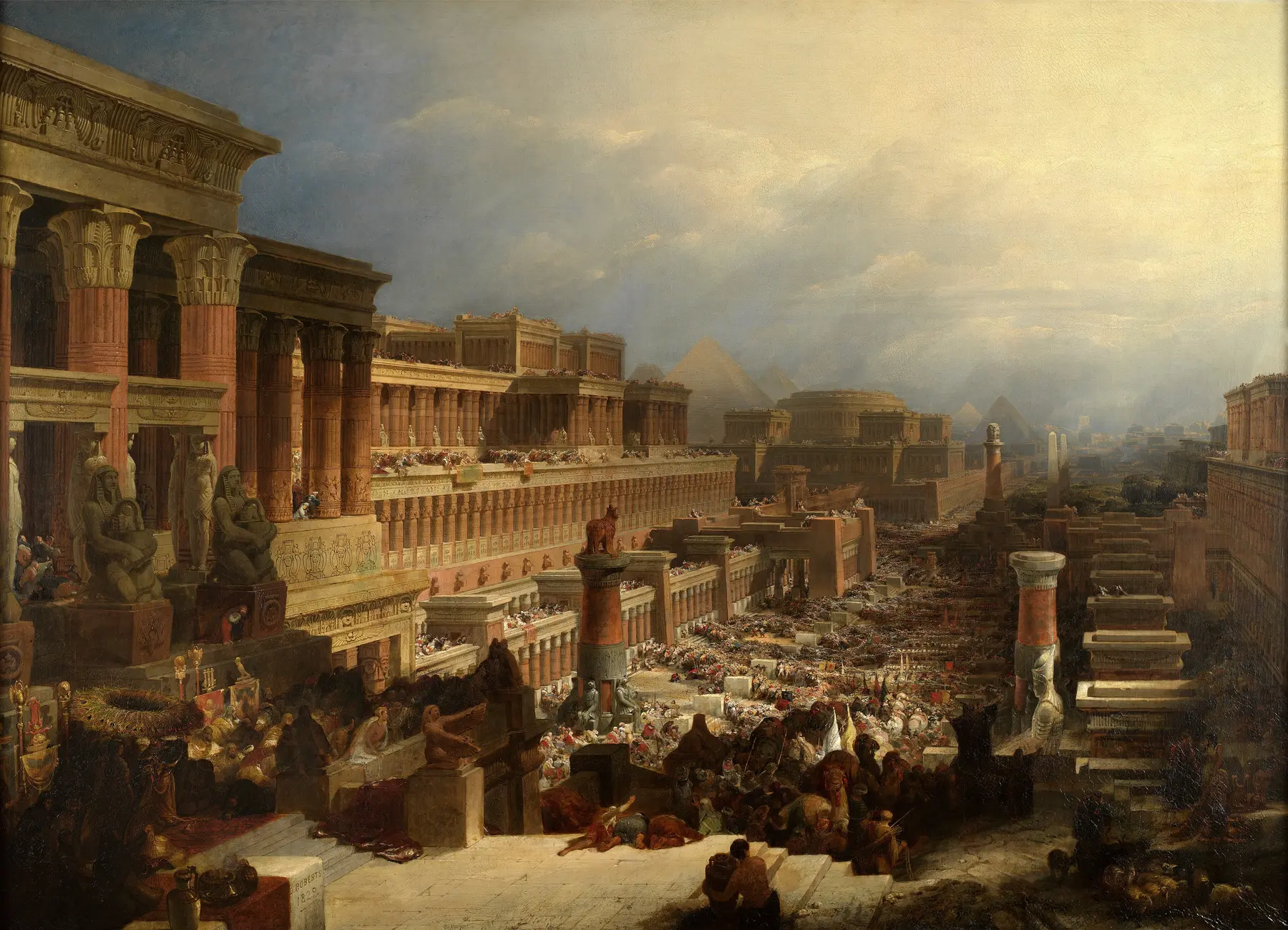
This page draws on Adam Clarke, Commentary on the Bible; Albert Barnes, Notes, Explanatory and Practical, on the Old and New Testaments; Augustine of Hippo, LETTER 93; John Gill, Exposition of the Old Testament (1748-1763) and Matthew Henry, Commentary on the Whole Bible.