
Exodus 14:28
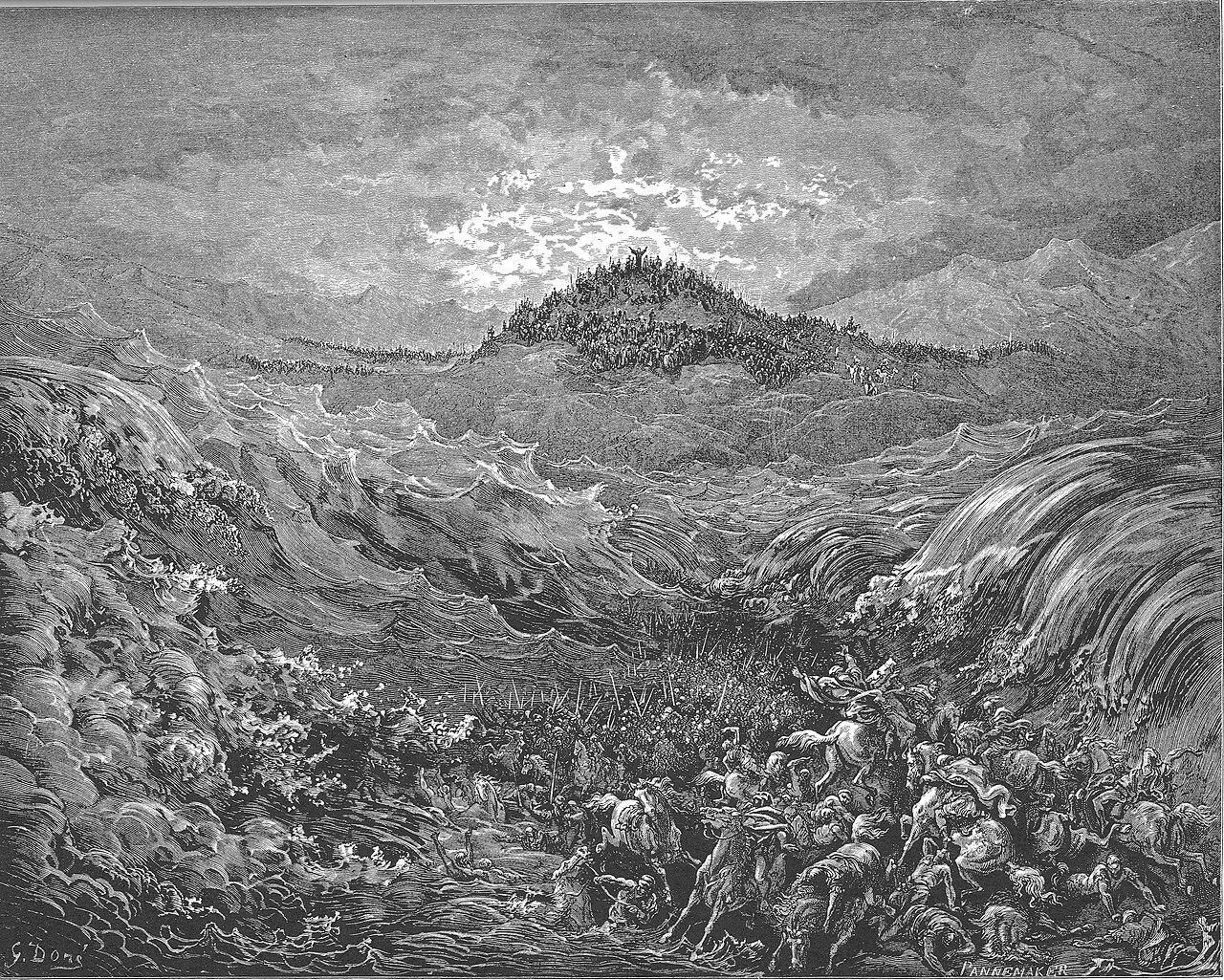
in Exodus 14The waters flowed back and covered the chariots and horsemen—the entire army of Pharaoh that had chased the Israelites into the sea. Not one of them survived.
BSB
The same verse in ASV and KJV ▾
ASV
And the waters returned, and covered the chariots, and the horsemen, even all the host of Pharaoh that went in after them into the sea; there remained not so much as one of them.
KJV
And the waters returned, and covered the chariots, and the horsemen, and all the host of Pharaoh that came into the sea after them; there remained not so much as one of them.
⋯
This verse in Exodus 14
Commentary
10 notes on this verseThe waters of the sea were held back yet at the same time surrounding the Hebrews. They then poured back and brought death upon the Egyptians, so that they destroyed one people and saved the other. What too do we find in the Gospel itself? Did not our Lord show there that the sea grew calm at his word, that the storm clouds of heaven were scattered, that the blasts of the winds subsided and that the dumb elements obeyed him and the shores were quieted?
This site's exposition
Stretch out thine hand over the sea
on Exodus 14:26-28
The gesture that opened the sea closes it, and the water returns to his strength when the morning appeared. There remained not so much as one of them, which is the same absolute the text used of Egypt's houses at 12:30, where there was not a house where there was not one dead. Nehemiah 9:11 and Psalm 136:15 sing the event back as Israel's history, and Hebrews 11:29 says the Egyptians assaying to do the same were drowned.
This site's exposition
Not one of them survived
Adam Clarke records the figure Josephus gives for Pharaoh's army, fifty thousand horsemen and two hundred thousand troops on foot, with not one of them left to carry the news to Egypt. The chapter itself numbers only the 600 best chariots of verse 7. Ambrose of Milan set these waters beside the sea that Jesus calmed with a word.
The record, by era
The Church Fathers1 voice
Pharaoh and his army and all the leaders of Egypt, "the chariots and their riders," were drowned in the Red Sea and perished for no other reason than that their foolish hearts were hardened, after the working of signs and wonders in the land of Egypt by God's servant Moses.
The Puritans and the Awakening3 voices
And now, (1.) God avenged upon the Egyptians the blood of the firstborn whom they had drowned: and the principal is repaid with interest, it is recompensed double, full-grown Egyptians for newborn Israelites; thus the Lord is righteous, and precious is his people's blood in his sight, Ps. lxxii.
And the waters returned,....
Note, It is very common, but very absurd and criminal, for people to repent of their good deeds; their justice and charity, and even their repentance, are repented of.
The Nineteenth Century1 voice
There remained not so much as one of them - Josephus says that the army of Pharaoh consisted of fifty thousand horse, and two hundred thousand foot, of whom not one remained to carry tidings of this most extraordinary catastrophe.
2 more voices on this verse
The Nineteenth Century2 voices
A commentator
Jamieson, Fausset & Brown1802–1910
Commentary Critical and Explanatory on the Whole Bible (1871)
proposed
there remained not so much as one of them--It is surprising that, with such a declaration, some intelligent writers can maintain there is no evidence of the destruction of Pharaoh himself (Ps 106:11).
quarantine:debris (2026-07-29) — starts-lowercase
A commentator
Albert Barnes1798–1870
Notes, Explanatory and Practical, on the Old and New Testaments (1832-1869)
proposed
Not so much as one of them - Escape would be impossible Exo 14:26. Pharaoh’s destruction, independent of the distinct statement of the Psalmist, Psa 136:15, was in fact inevitable. The station of the king was in the vanguard: on every monument the Pharaoh is represented as the leader of the army. The death of the Pharaoh, and the entire loss of the chariotry and cavalry accounts for the undisturbed retreat of the Israelites through a district then subject to Egypt and easily accessible to their forces. If, as appears probable, Tothmosis II was the Pharaoh, the first recorded expedition into the Peninsula took place 17 years after his death; and 22 years elapsed before any measures were taken to recover the lost ascendancy of Egypt in Syria. So complete, so marvelous was the deliverance: thus the Israelites were “baptized unto Moses in the cloud and in the sea” 1Co 10:2. When they left Baal-Zephon they were separated finally from the idolatry of Egypt: when they passed the Red Sea their independence of its power was sealed; their life as a nation then began, a life inseparable henceforth from belief in Yahweh and His servant Moses, only to be merged in the higher life revealed by His Son.
The words behind it
18 Hebrew wordsEvery Hebrew word of this verse in the order it stands, with what it means and the door to its own study. The last column counts the times a word stands in the whole Bible: the rarer the word, the more the places it appears belong together.
| Hebrew | Sound | Meaning | Word study | In the Bible |
|---|---|---|---|---|
| וַיָּשֻׁ֣בוּ | vaiyashuvu | and they returned | H7725 → | 1056 times |
| הַמַּ֗יִם | hamayim | the waters | H4325 → | 581 times |
| וַיְכַסּ֤וּ | vaykhasu | and they covered | H3680 → | 152 times |
| אֶת־ | ʾet- | <obj.> | H853 → | 10935 times |
| הָרֶ֙כֶב֙ | harekhev | the chariot[s] | H7393 → | 119 times |
| וְאֶת־ | veet | and <obj.> | H853 → | 10935 times |
| הַפָּ֣רָשִׁ֔ים | haparashim | the horsemen | H6571 → | 57 times |
| לְכֹל֙ | lekhol | to all | H3605 → | 5413 times |
| חֵ֣יל | cheil | [the] army of | H2428 → | 246 times |
| פַּרְעֹ֔ה | paroh | Pharaoh | H6547 → | 274 times |
| הַבָּאִ֥ים | habaim | which had gone | H935 → | 2568 times |
| אַחֲרֵיהֶ֖ם | ʾachareihem | after them | H310 → | 715 times |
| בַּיָּ֑ם | baiyam | in the sea | H3220 → | 396 times |
| לֹֽא־ | lo'- | not | H3808 → | 5168 times |
| נִשְׁאַ֥ר | nishar | it remained | H7604 → | 133 times |
| בָּהֶ֖ם | bahem | among them | ||
| עַד־ | ʾad- | up to | H5704 → | 1261 times |
| אֶחָֽד׃ | ʾechad | one | H259 → | 971 times |
וַיָּשֻׁ֣בוּand they returned
vaiyashuvuH7725 →1056 times
הַמַּ֗יִםthe waters
hamayimH4325 →581 times
וַיְכַסּ֤וּand they covered
vaykhasuH3680 →152 times
אֶת־<obj.>
ʾet-H853 →10935 times
הָרֶ֙כֶב֙the chariot[s]
harekhevH7393 →119 times
וְאֶת־and <obj.>
veetH853 →10935 times
הַפָּ֣רָשִׁ֔יםthe horsemen
haparashimH6571 →57 times
לְכֹל֙to all
lekholH3605 →5413 times
חֵ֣יל[the] army of
cheilH2428 →246 times
פַּרְעֹ֔הPharaoh
parohH6547 →274 times
הַבָּאִ֥יםwhich had gone
habaimH935 →2568 times
אַחֲרֵיהֶ֖םafter them
ʾachareihemH310 →715 times
בַּיָּ֑םin the sea
baiyamH3220 →396 times
לֹֽא־not
lo'-H3808 →5168 times
נִשְׁאַ֥רit remained
nisharH7604 →133 times
בָּהֶ֖םamong them
bahem
עַד־up to
ʾad-H5704 →1261 times
אֶחָֽד׃one
ʾechadH259 →971 times
A shaded row is a word that stands 400 times or fewer in the Bible.
The walk
8 stopsEach card is a verse this one points to, and under it the verses that one points to in turn. Where several paths arrive at the same place, that place is listed first: the text keeps returning to it.
Through
Habakkuk 3:13You went forth for the salvation of Your people, to save Your anointed. You crushed the head of the house of the wicked and stripped him from head to toe. Selah
it leads to
- Psalms 110:6
He will judge the nations, heaping up the dead; He will crush the leaders far and wide.
- Psalms 105:15
“Do not touch My anointed ones! Do no harm to My prophets!”
- Psalms 110:6
Through
Psalms 78:53He led them safely, so they did not fear, but the sea engulfed their enemies.
it leads to
- Exodus 14:19–20
And the angel of God, who had gone before the camp of Israel, withdrew and went behind them. The pillar of cloud also moved from before them and stood behind them,
- Exodus 15:10
But You blew with Your breath, and the sea covered them. They sank like lead in the mighty waters.
- Exodus 14:27–28
So Moses stretched out his hand over the sea, and at daybreak the sea returned to its normal state. As the Egyptians were retreating, the LORD swept them into the sea.
- Hebrews 11:29
By faith the people passed through the Red Sea as on dry land; but when the Egyptians tried to follow, they were drowned.
- Exodus 14:15
Then the LORD said to Moses, “Why are you crying out to Me? Tell the Israelites to go forward.
- Exodus 14:19–20
Through
Psalms 136:15but swept Pharaoh and his army into the Red Sea. His loving devotion endures forever.
it leads to
- Psalms 78:53
He led them safely, so they did not fear, but the sea engulfed their enemies.
- Psalms 78:53
Where this verse is studied
On this page
Studies4
About Exodus
This page draws on 9 works. Open the list of works
This page draws on Adam Clarke, Commentary on the Bible; Albert Barnes, Notes, Explanatory and Practical, on the Old and New Testaments (1832-1869); Ambrose of Milan, ON HIS BROTHER, SATYRUS 2.74; Ambrose of Milan, On His Brother, Satyrus 2.74; Clement of Rome, LETTER TO THE CORINTHIANS 51; Jamieson, Fausset & Brown, Commentary Critical and Explanatory on the Whole Bible; John Gill, Exposition of the Old Testament; John Gill, Exposition of the Old Testament (1748-1763) and Matthew Henry, Commentary on the Whole Bible.