
Exodus 7:11
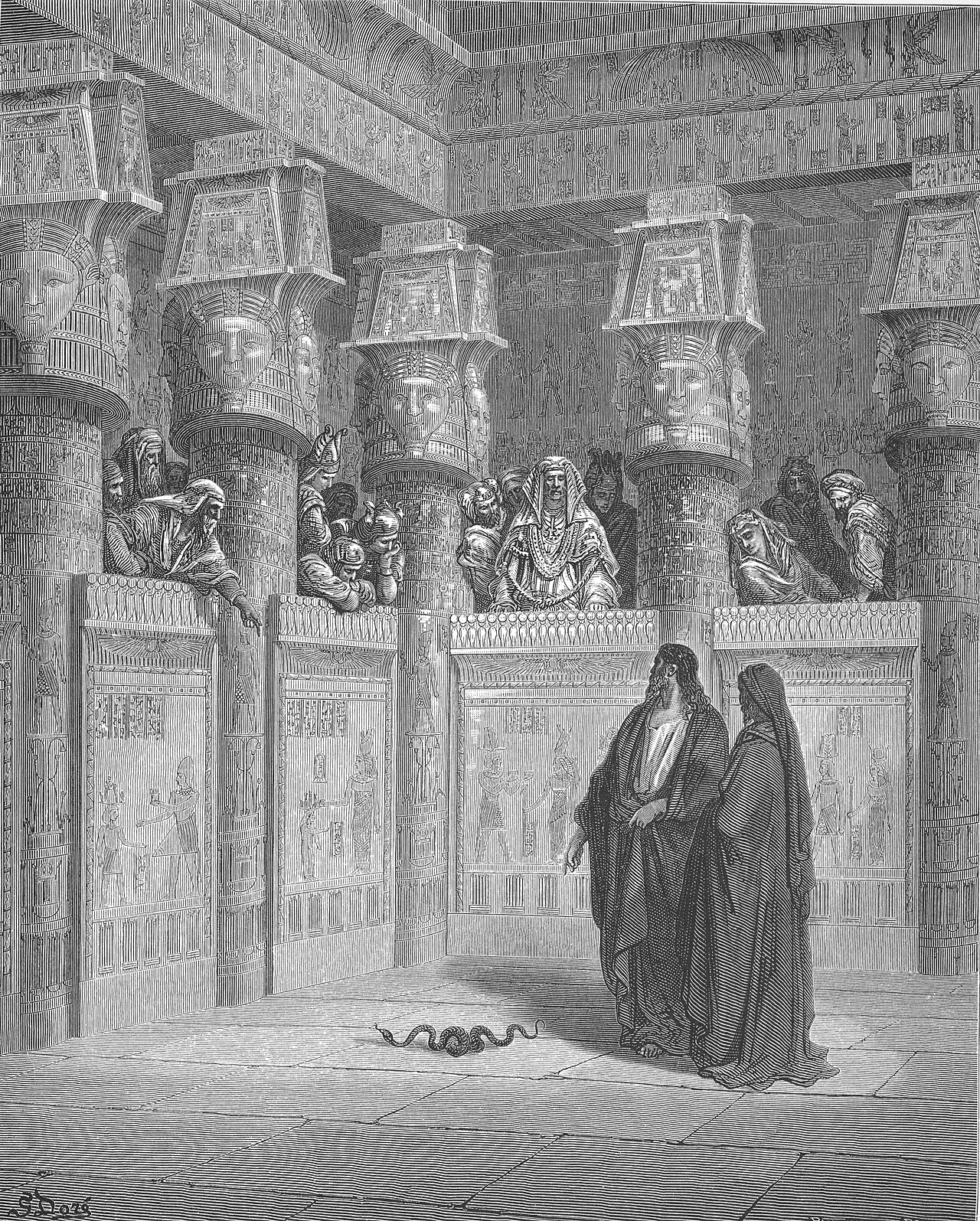
in Exodus 7But Pharaoh called the wise men and sorcerers and magicians of Egypt, and they also did the same things by their magic arts.
BSB
The same verse in ASV and KJV ▾
ASV
Then Pharaoh also called for the wise men and the sorcerers: and they also, the magicians of Egypt, did in like manner with their enchantments.
KJV
Then Pharaoh also called the wise men and the sorcerers: now the magicians of Egypt, they also did in like manner with their enchantments.
⋯
This verse in Exodus 7
Commentary
11 notes on this verseA commentator
Albert Barnes1798–1870
Notes, Explanatory and Practical, on the Old and New Testaments (1832-1869)
Three names for the magicians of Egypt are given in this verse. The “wise men” are men who know occult arts. The “sorcerers” are they who “mutter magic formulae,” especially when driving away crocodiles, snakes, asps, etc. It was natural that Pharaoh should have sent for such persons. The “magicians” are the “bearers of sacred words,” scribes and interpreters of hieroglyphic writings.
This site's exposition
Then Pharaoh also called the wise men
on Exodus 7:11-12
Egypt's own experts match the sign, and this is the first of three stages the magicians pass through in the book. They duplicate the rod here, the blood at verse 22 and the frogs at 8:7, then they fail at the lice and tell Pharaoh This is the finger of God at 8:19, and by the boils at 9:11 they cannot stand before Moses because the boils are upon them. Aaron's rod swallows their rods, so the first scene is decided by which serpent eats the others. Spurgeon preached this verse as the power of Aaron's rod and refused to settle whether the magicians used sleight of hand or something worse, on the ground that the outcome is the same either way.
The record, by era
The Church Fathers3 voices
We read that the magicians of the Egyptians were very skilled in those arts, but they were outdone by Moses, the servant of God. Yet when they performed certain wonders by their forbidden arts, he overturned all their trickery by simply calling on God.
The magicians of Pharaoh, the king of Egypt who was tyrannizing over this people, were permitted to accomplish certain wonders merely that they might be outdone by more genuine miracles. These magicians worked by the kind of sorceries and incantations to which evil spirits or demons are addicted, while Moses was powerful by his holiness and helped by the angels, and so, in the name of God, creator of heaven and earth, he easily triumphed over them.
A commentator
Augustine of HippoON EIGHTY-THREE VARIED QUESTIONS 79.1, 3-4 · Written in the 5th century.
proposed
Consequently it happens that the holy servants of God, when it is useful for them to have this gift, in accord, the power of the most high God, have command over the lowest powers in order to perform certain visible miracles. This power thus becomes publicly known, as if it were imperial law. For it is God himself who rules in them, whose temple they are, and whom they, having despised their own private power, love most fervently. However, in magical imprecation, in order to make the deception attractive so as to subjugate to themselves those [magicians] to whom they grant such things, [the lowest powers] give effect to their prayers and rituals, and they dispense through that private law what they are allowed to dispense to those who honor them and serve them and keep certain covenants with them in their mystery rites. And when the magicians appear to have command, they frighten their inferiors with the names of more elevated [powers] and exhibit to those looking on with wonder some visible effects. Due to the weakness of the flesh, these seem momentous to those unable to behold eternal things, which the true God offers through himself to those who love him. However, God permits these things through his righteous government of all things, in order that he may distribute to them the kinds of bondage or the kinds of freedom that are proportioned to their own desires and choices. And if they gain something for their own evil desires when they call upon the most high God, that is a punishment and not a kindness. […]
The Puritans and the Awakening2 voices
Moses had been originally instructed in the learning of the Egyptians, and was suspected to have improved in magical arts in his long retirement. The magicians are therefore sent for to vie with him.
Then Pharaoh also called the wise men and the sorcerers,....
4 more voices on this verse
The Puritans and the Awakening2 voices
He chastises his disobedience by a plague, the first of the ten, turning the waters into blood; but Pharaoh hardens his heart against this correction,
Here is the first of the ten plagues, the turning of the water into blood, which was, 1. A dreadful plague, and very grievous. The very sight of such vast rolling streams of blood, pure blood no doubt, florid and high-colored, could not but strike a horror upon people: much more afflictive were the consequences of it.
The Nineteenth Century2 voices
A commentator
Jamieson, Fausset & Brown1802–1910
Commentary Critical and Explanatory on the Whole Bible (1871)
proposed
Then Pharaoh also called the wise men and the sorcerers, &c.--His object in calling them was to ascertain whether this doing of Aaron's was really a work of divine power or merely a feat of magical art.
Pharaoh - called the wise men - חכמים chacamim, the men of learning. Sorcerers, כשפים cashshephim, those who reveal hidden things; probably from the Arabic root kashafa, to reveal, uncover, etc., signifying diviners, or those who pretended to reveal what was in futurity, to discover things lost, to find hidden treasures, etc. Magicians, חרטמי chartummey, decipherers of abstruse writings. See Clarke’s note on Gen 41:8. They also did in like manner with their enchantments - The word להתים lahatim, comes from להט mor lahat, to burn, to set on fire; and probably signifies such incantations as required lustral fires, sacrifices, fumigations, burning of incense, aromatic and odoriferous drugs, etc., as the means of evoking departed spirits or assistant demons, by whose ministry, it is probable, the magicians in question wrought some of their deceptive miracles: for as the term miracle signifies properly something which exceeds the powers of nature or art to produce, (see Exo 7:9), hence there could be no miracle in this case but those wrought, through the power of God, by the ministry of Moses and Aaron. There can be no doubt that real serpents were produced by the magicians. On this subject there are two opinions: 1. That the serpents were such as they, either by juggling or sleight of hand, had brought to the place, and had secreted till the time of exhibition, as our common conjurers do in the public fairs, etc. 2. That the serpents were brought by the ministry of a familiar spirit, which, by the magic flames already referred to, they had evoked for the purpose. Both these opinions admit the serpents to be real, and no illusion of the sight, as some have supposed. The first opinion appears to me insufficient to account for the phenomena of the case referred to. […]
How the passage was read
What the Jewish commentators add
AND THEY ALSO, THE MAGICIANS OF EGYPT, DID IN LIKE MANNER ‘B’LAHATEIHEM’ (WITH THEIR SECRET ARTS). Our Rabbis have said. Sanhedrin 67b.
3 more on this passage, in their own words ▾
This too, namely, that the rod became a tannin (serpent), was a wonder.
This, the swallowing of the magicians’ rods by Aaron’s staff and their consequent disappearance, 58 The magicians’ rods disappeared permanently. was a second wonder.
Moshe and Aharon came to Pharaoh and they did exactly as Adonoy commanded [them].
This section is reception history: how the passage was read and kept in the Jewish tradition. Where a reading parts from an essential of the Christian faith, the section says so at that point.
Texts and citation data: Sefaria; each excerpt follows its version’s licence. 1 further source is cited on this chapter that carry no English text this site may quote or only restate the verse.
The words behind it
12 Hebrew wordsEvery Hebrew word of this verse in the order it stands, with what it means and the door to its own study. The last column counts the times a word stands in the whole Bible: the rarer the word, the more the places it appears belong together.
| Hebrew | Sound | Meaning | Word study | In the Bible |
|---|---|---|---|---|
| וַיִּקְרָא֙ | vaiyikra' | and he summoned | H7121 → | 733 times |
| גַּם־ | gam- | also | H1571 → | 769 times |
| פַּרְעֹ֔ה | paroh | Pharaoh | H6547 → | 274 times |
| לַֽחֲכָמִ֖ים | lachakhamim | <to> the wise men | H2450 → | 138 times |
| וְלַֽמְכַשְּׁפִ֑ים | velamkhashefim | and <to> the sorcerers | H3784 → | |
| וַיַּֽעֲשׂ֨וּ | vaiyaasu | and they did | H6213 → | 2628 times |
| גַם־ | gam- | also | H1571 → | 769 times |
| הֵ֜ם | hem | they | H1992 → | 553 times |
| חַרְטֻמֵּ֥י | chartumei | [the] magicians of | H2748 → | 11 times |
| מִצְרַ֛יִם | mitzrayim | Egypt | H4714 → | 641 times |
| בְּלַהֲטֵיהֶ֖ם | belahateihem | by enchantments their | H3814 → | |
| כֵּֽן׃ | ken | thus | H3651 → | 771 times |
וַיִּקְרָא֙and he summoned
vaiyikra'H7121 →733 times
גַּם־also
gam-H1571 →769 times
פַּרְעֹ֔הPharaoh
parohH6547 →274 times
לַֽחֲכָמִ֖ים<to> the wise men
lachakhamimH2450 →138 times
וְלַֽמְכַשְּׁפִ֑יםand <to> the sorcerers
velamkhashefimH3784 →
וַיַּֽעֲשׂ֨וּand they did
vaiyaasuH6213 →2628 times
גַם־also
gam-H1571 →769 times
הֵ֜םthey
hemH1992 →553 times
חַרְטֻמֵּ֥י[the] magicians of
chartumeiH2748 →11 times
מִצְרַ֛יִםEgypt
mitzrayimH4714 →641 times
בְּלַהֲטֵיהֶ֖םby enchantments their
belahateihemH3814 →
כֵּֽן׃thus
kenH3651 →771 times
A shaded row is a word that stands 400 times or fewer in the Bible.
The walk
8 stopsEach card is a verse this one points to, and under it the verses that one points to in turn. Where several paths arrive at the same place, that place is listed first: the text keeps returning to it.
Through
2 Timothy 3:8Just as Jannes and Jambres opposed Moses, so also these men oppose the truth. They are depraved in mind and disqualified from the faith.
it leads to
- Revelation 2:20
But I have this against you: You tolerate that woman Jezebel, who calls herself a prophetess. By her teaching she misleads My servants to be sexually immoral and to eat food sacrificed to idols.
- Acts 13:8–11
But Elymas the sorcerer (for that is what his name means) opposed them and tried to turn the proconsul from the faith.
- 1 Timothy 6:5
and constant friction between men of depraved mind who are devoid of the truth. These men regard godliness as a means of gain.
- 2 Peter 2:14
Their eyes are full of adultery; their desire for sin is never satisfied; they seduce the unstable. They are accursed children with hearts trained in greed.
- Revelation 2:14–15
But I have a few things against you, because some of you hold to the teaching of Balaam, who taught Balak to place a stumbling block before the Israelites so they would eat food…
- Revelation 2:20
Through
Daniel 2:2So the king gave orders to summon the magicians, enchanters, sorcerers, and astrologers to explain his dreams. When they came and stood before the king,
it leads to
- Isaiah 47:12–13
So take your stand with your spells and with your many sorceries, with which you have wearied yourself from your youth. Perhaps you will succeed; perhaps you will inspire terror!
Reached by 2 separate paths from here.
- Daniel 1:20
In every matter of wisdom and understanding about which the king consulted them, he found them ten times better than all the magicians and enchanters in his entire kingdom.
- Daniel 4:6
So I issued a decree that all the wise men of Babylon be brought before me to interpret the dream for me.
- Isaiah 47:12–13
Where this verse is studied
On this page
Studies1
About Exodus
Who and where
1 name in this verse with a page on the site.
This page draws on 11 works. Open the list of works
This page draws on Adam Clarke, Commentary on the Bible; Albert Barnes, Notes, Explanatory and Practical, on the Old and New Testaments (1832-1869); Augustine of Hippo, LETTER 137; Augustine of Hippo, City of God 10.8; Augustine of Hippo, ON EIGHTY-THREE VARIED QUESTIONS 79.1, 3-4; Charles Spurgeon, The Metropolitan Tabernacle Pulpit, Sermon No. 521, The Power of Aaron's Rod; Jamieson, Fausset & Brown, Commentary Critical and Explanatory on the Whole Bible; John Gill, Exposition of the Old Testament; John Gill, Exposition of the Old Testament (1748-1763); John Wesley, Explanatory Notes upon the Old Testament and Matthew Henry, Commentary on the Whole Bible.