
Genesis 39 · Story · Injustice
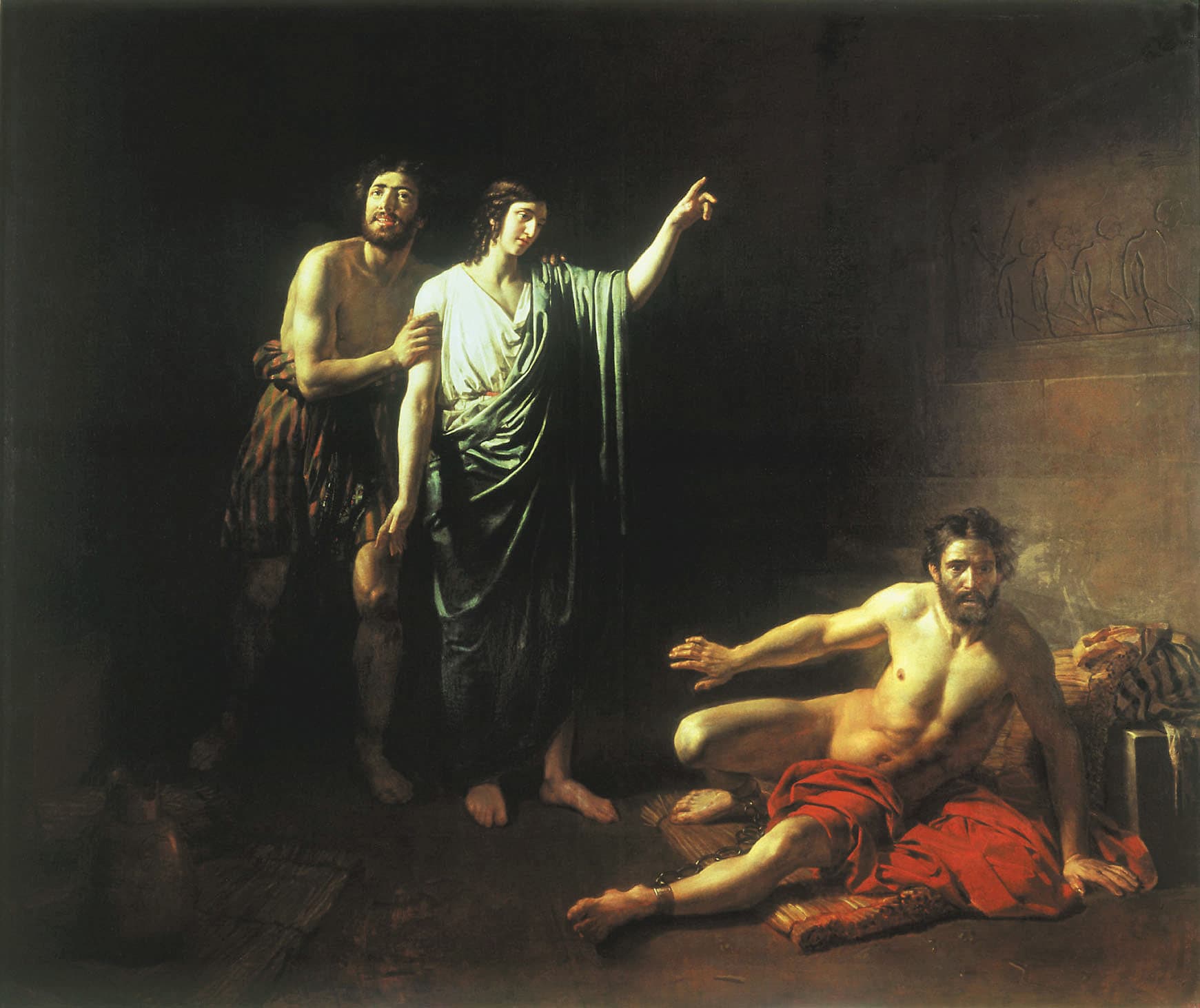
Joseph in the Prison
Genesis 39:19 to 40:23 follows Joseph from his master's anger to the day Pharaoh's cupbearer forgot him.
Joseph's master was captain of the guard, and Genesis 40:3 places the prison in the house of the captain of the guard.
the LORD was with him and extended kindness to him, granting him favor in the eyes of the prison warden.
- Where
- Egypt
- Who
- Joseph
- When
- Before Joseph entered Pharaoh's service at thirty, ending two full years after the cupbearer's release (Genesis 41:1 and Genesis 41:46)
Summary
Joseph was sent to the king's prison for a wrong he had not done. The LORD showed him kindness there, and the warden put every prisoner in his care. He read the dreams of Pharaoh's cupbearer and baker, and both came true on the third day. He asked the cupbearer to remember him. The cupbearer forgot him, and Joseph waited two more full years.
- Joseph's one plea names two wrongs, that he was stolen from his land and jailed for nothing, and it names no one who did them.
- The Hebrew word for the prison in his plea is bor, a pit, the same word as the dry cistern his brothers threw him into.
- Joseph asked the cupbearer for chesed, the kindness the LORD had already shown him in the prison.
- In Psalm 105 the LORD sent Joseph ahead of Israel, and his years in irons were a testing by the LORD's word.
The Charge Believed
Two verses carry Joseph from his master's house to a royal prison.
Joseph in the Prison is the story of a slave jailed for a crime he did not commit and then left there by a man he had helped. It belongs to the trial of injustice, the wrong done to a person who has done no wrong.
The question it answers is what Joseph did, and what God did, while he was held for a crime he had not committed. It gives the events of Genesis 39:19 to 40:23 in order, the Hebrew of Joseph's one plea, and the psalm that sings of his years in irons. It also weighs whether Joseph was right to ask a man to remember him.
When his master heard the story his wife told him, saying, “This is what your slave did to me,” he burned with anger. So Joseph’s master took him and had him thrown into the prison where the king’s prisoners were confined. While Joseph was there in the prison,The verses give the charge its effect, so the reader sees a sentence passed with no hearing and no word from Joseph.
From the Charge to the Two Years
The steps run from Potiphar's anger in Genesis 39:19 to Pharaoh's dream in Genesis 41:1.
Joseph read two dreams rightly in the prison and was still left there two full years.
- Potiphar hears his wife's account and burns with angerPotipharGenesis 39:19
- Joseph is put in the prison for the king's prisonersPotipharGenesis 39:20
- The LORD shows Joseph kindness and favor with the wardenthe LORDGenesis 39:21
- The warden gives every prisoner into Joseph's carethe wardenGenesis 39:22 to 23
- Pharaoh's cupbearer and baker are held there and assigned to JosephPharaohGenesis 40:1 to 4
- Both officers dream on one night, and Joseph asks why they look downcastJosephGenesis 40:5 to 8
- Joseph reads the dream of the vine with three branchesJosephGenesis 40:9 to 13
- Joseph asks the cupbearer to mention him to PharaohJosephGenesis 40:14 to 15
- Joseph reads the dream of the three basketsJosephGenesis 40:16 to 19
- At Pharaoh's birthday feast the cupbearer is restored and the baker hangedPharaohGenesis 40:20 to 22
- The cupbearer does not remember Josephthe cupbearerGenesis 40:23
- Pharaoh dreams after two full years have passedPharaohGenesis 41:1
A timeline of twelve steps in Genesis 39:19 to 41:1, each with the one who acts and its verse.
Joseph reads the dream of the vine with three branches, Joseph asks the cupbearer to mention him to Pharaoh, Joseph reads the dream of the three baskets, At Pharaoh's birthday feast the cupbearer is restored and the baker hanged, The cupbearer does not remember Joseph, Pharaoh dreams after two full years have passed
The Prisoner Put in Charge
Two officers of Pharaoh came under Joseph's care, and he gave the reading of their dreams to God.
When Joseph came to them in the morning, he saw that they were distraught. So he asked the officials of Pharaoh who were in custody with him in his master’s house, “Why are your faces so downcast today?” “We both had dreams,” they replied, “but there is no one to interpret them.” Then Joseph said to them, “Don’t interpretations belong to God? Tell me your dreams.”A prisoner held for no crime notices the sadness of two others, and his answer to them names God as the giver of meaning.
The cupbearer's work put Pharaoh's cup into Pharaoh's hand (Genesis 40:11 and Genesis 40:21), so the man Joseph helped would soon stand at the king's side again.
I Have Done Nothing
In the one speech where he speaks of his case, Joseph claims his innocence and asks to be remembered.
But when it goes well for you, please remember me and show me kindness by mentioning me to Pharaoh, that he might bring me out of this prison. For I was kidnapped from the land of the Hebrews, and even here I have done nothing for which they should have put me in this dungeon.”Joseph's request and his claim of innocence stand together, so his plea for help rests on the truth of his case.
The Hebrew of Genesis 40:14 asks the cupbearer to do chesed with Joseph, the same noun Genesis 39:21 uses for what the LORD extended to him in the prison. The verb of the request is zakar, to remember, given twice, remember me and bring me to remembrance before Pharaoh.
His first claim doubles the verb ganab, to steal, so that word for word he says stolen, I was stolen, from the land of the Hebrews. Adam Clarke, in his Commentary on the Bible (1832), called the two claims “simple assertions, into the proof of which he was ready to enter if called on”.
The Law of Moses later used the same verb for a crime punished by death. “Whoever kidnaps another man must be put to death, whether he sells him or the man is found in his possession” (Exodus 21:16).
His second claim is that he did nothing to deserve the bor, glossed a pit hole, especially one used as a cistern or a prison. It is the word for the pit of Genesis 37:24, where “the pit was empty, with no water in it”, and for the dungeon Pharaoh later had him brought out of (Genesis 41:14).
Joseph sought his release through the one man who could bring his case before the king. Paul calls the ruler who punishes wrongdoers God's servant (Romans 13:4).
Sent Ahead and Refined
Psalm 105 sings of Joseph's shackles as part of the LORD's care for Israel in the famine.
He sent a man before them— Joseph, sold as a slave. They bruised his feet with shackles and placed his neck in irons, until his prediction came true and the word of the LORD proved him right.The psalm stands here because it reads the prison years as the LORD's own work, sending Joseph ahead of his family and testing him by His word.
The verb the Berean renders “proved him right” is tsaraph, glossed to fuse metal, that is, to refine. The Hebrew uses a refiner's verb, so the psalm pictures the word of the LORD trying Joseph as metal is tried in the fire.
The psalm then tells of the king who set Joseph free and made him “master of his household, ruler over all his substance” (Psalm 105:21).
What Genesis Leaves Unsaid
Genesis gives no word from God to Joseph in the prison and never clears the charge.
Genesis tells what the LORD did for Joseph in the prison and records no dream or word given to him there. Apart from his plea, it leaves his thoughts in those years unrecorded.
Genesis also never says the charge was withdrawn. The cupbearer described him to Pharaoh as “a young Hebrew” and “a servant of the captain of the guard” (Genesis 41:12), and Pharaoh sent for him to read a dream (Genesis 41:14). He left the prison for a reading God gave him, and the record leaves the false accusation unanswered.
Forgotten by a Man, Kept by God
The cupbearer forgot Joseph, and years later Joseph named the purpose God had in the wrongs done to him.
Genesis 40:23 gives the cupbearer's failure in two verbs. He did not zakar, remember, the verb of Joseph's own request, and he went on to shakach, a verb glossed to be oblivious of from want of memory or attention.
Years later Joseph gave his brothers his own reading of every wrong done to him, and that reading is taught on Providence.
For if anyone endures the pain of unjust suffering because he is conscious of God, this is to be commended. How is it to your credit if you are beaten for doing wrong and you endure it? But if you suffer for doing good and you endure it, this is commendable before God.Peter writes to servants who suffer for doing good, which is the case Joseph pleaded in Genesis 40:15.
Peter then points to Christ, who “entrusted Himself to Him who judges justly” (1 Peter 2:23).
How the Prison Has Been Taught
Ambrose of Milan on the unheard case and Matthew Henry on the forgotten request.
died 397 · Ambrose of Milan
On Joseph the Patriarch
The quotation1 quotation
“Therefore I might say Joseph was happier when he was put into prison, because he was giving witness on behalf of chastity. For modesty is a good gift but one of lesser merit when it involves no risk. Where, however, it is maintained at the risk of one's safety, there it wins a more abundant crown. With his case unheard, his truthfulness unexamined, Joseph is sent into prison as if guilty of a crime. But the Lord did not abandon him even in prison.”
Ambrose of Milan · On Joseph the Patriarch · on Genesis 39:20Patristic
Matthew Henry set the forgotten request beside the request of the thief on the cross.1 paragraph
Matthew Henry, in his Commentary on the Whole Bible (1710), passed on a remark he credits to Dr. Lightfoot. “Joseph's fellow-sufferers were like the two thieves that were crucified with Christ”, he wrote. The cupbearer forgot Joseph, but of the thief who asked Jesus to remember him Henry wrote that he “was not forgotten”.
Was Joseph Wrong to Ask?
Readers differ over whether the plea of Genesis 40:14 showed a faith under strain or a wise use of the means at hand.
A longing his faith did not quietJamieson, Fausset and Brown
Jamieson, Fausset and Brown, in their Commentary Critical and Explanatory on the Whole Bible (1871), held that the plea is the first place the record shows Joseph's feelings. It “reveals a sadness and impatient longing for release, which not all his piety and faith in God could dispel”, they wrote.
The objection is that Genesis sets the plea down and passes no judgment on it, as it passes none on the cupbearer who forgot it.
A fair use of the means at handJohn Chrysostom
John Chrysostom, in his Homilies on Genesis (homily 63), praised the plea for what it left out. Joseph, he said, “says nothing against that disgusting adulteress, does not blame his master or recount his brothers' inhumanity to him”. In his reading Joseph also chose his moment, since the cupbearer was “in the ideal position to acquaint the king of his situation”.
The objection is that the double request to be remembered shows a longing for release that this reading passes over.
Kept in the Pit
Genesis 40 ends with Joseph still in the prison.
Joseph told the truth about his case and asked for help where help could come. The God who had been with him in his master's house stayed with him in the pit.
Sources
Scripture is the Berean Standard Bible.
- STEP Bible, the tagged Hebrew Bible (Tyndale House, Cambridge), CC BY 4.0.
- STEP Bible brief lexicons of Extended Strongs for Hebrew (Tyndale House, Cambridge), CC BY 4.0, with the Strong's glosses.
- Adam Clarke, Commentary on the Bible (1832), on Genesis 40:15.
- Ambrose of Milan, On Joseph the Patriarch, on Genesis 39:20.
- Matthew Henry, Commentary on the Whole Bible (1710), on Genesis 40:23.
- Robert Jamieson, A. R. Fausset and David Brown, Commentary Critical and Explanatory on the Whole Bible (1871), on Genesis 40:14.
- John Chrysostom, Homilies on Genesis, homily 63, sections 7 to 9, on Genesis 40:14.
Keep Studying
In this trial6
People and groups8
Places1