
Luke 22:6
in Luke 22Judas consented, and began to look for an opportunity to betray Jesus to them in the absence of a crowd.
BSB
The same verse in ASV and KJV ▾
ASV
And he consented, and sought opportunity to deliver him unto them in the absence of the multitude.
KJV
And he promised, and sought opportunity to betray him unto them in the absence of the multitude.
⋯
This verse in Luke 22
Commentary
9 notes on this verseThis site's exposition
Then entered Satan into Judas
on Luke 22:3-6
Then entered Satan into Judas surnamed Iscariot, being of the number of the twelve, Luke naming the spiritual reality beneath the political plot, human treachery and demonic possession acting in the same man without either erasing the other. He communed with the chief priests and captains how he might betray him, and they were glad, and covenanted to give him money, Matthew's Gospel naming the sum as thirty pieces of silver, the price of a slave under the law of Exodus 21:32. The bench notes he then sought opportunity to betray him in the absence of the multitude, the priests' fear of the people from verse 2 now supplying Judas his exact method, a quiet arrest away from the crowds that had shielded Jesus until now.
The record, by era
The Medieval Church4 voices
And sought opportunity to betray him unto them, without the crowds, that is, when he saw Him standing by Himself apart, in the absence of the multitude.
With this price, then, Judas sold Christ, and therefore it adds: And he promised. And he sought opportunity to betray him without crowds. These men shunned the crowd because they regarded him as a true Prophet: whence John seven: "Has any of the rulers believed …
Now many shudder at the wickedness of Judas, yet do not guard against it. For whosoever despises the laws of truth and love, betrays Christ who is truth and love. Above all, when he sins not from infirmity or ignorance, but after the likeness of Judas seeks opportunity, when no one is present, to change truth for a lie, virtue for crime.
Thus Judas received Satan who had entered into him and agreed to betray Jesus to those seeking Him. For this is what the word "promised" means, that is, he finally concluded the terms and the agreement. And he sought a convenient time when he might …
The Puritans and the Awakening1 voice
And he promised,.... He undertook to deliver him into their hands; he laid himself under obligation to do it; he faithfully promised he would.
3 more voices on this verse
The Nineteenth Century3 voices
A commentator
J.C. Ryle1816–1900
Expository Thoughts on the Gospels: Luke (lightly modernized text, Grace Gems edition) (1858)
proposed
The chapter which opens with these verses, begins Luke's account of our Lord's sufferings and death. No part of the Gospels is so important as this. The death of Christ — was the life of the world. No part of our Lord's history is so fully given by all the gospel writers as this. Only two of them describe the circumstances of Christ's birth. All four dwell minutely on Christ's death. And of all the four, no one supplies us with such full and interesting details as Luke.
A commentator
J.C. Ryle1816–1900
Expository Thoughts on the Gospels: Luke (lightly modernized text, Grace Gems edition) (1858)
proposed
The chapter which opens with these verses, begins Luke's account of our Lord's sufferings and death. No part of the Gospels is so important as this. The death of Christ — was the life of the world. No part of our Lord's history is so fully given by all the gospel writers as this. Only two of them describe the circumstances of Christ's birth. All four dwell minutely on Christ's death. And of all the four, no one supplies us with such full and interesting details as Luke. We see, firstly, in these verses — that high offices in the church do not preserve the holders of them from great blindness and sin. We read that "the chief priests and scribes sought how they might kill Jesus." The first step in putting Christ to death, was taken by the religious teachers of the Jewish nation. The very men who ought to have welcomed the Messiah — were the men who conspired to kill Him. The very teachers who ought to have rejoiced at the appearing of the Lamb of God — had the chief hand in slaying Him. They sat in Moses' seat. They claimed to be "guides of the blind," and "lights of those who were in darkness." (Romans 2:19.) They belonged to the tribe of Levi. They were, most of them — in direct succession and descent from Aaron. Yet they were the very men who crucified the Lord of glory! With all their boasted knowledge — they were far more ignorant than the few Galilean fishermen who followed Christ. Let us beware of attaching an excessive importance to Christian ministers because of their office. Ordination and religious office confer no exemption from error. The greatest heresies have been sown, and the greatest practical abuses have been introduced into the church — by ordained men! Respect is undoubtedly due to high official position. Order and discipline ought not to be forgotten.
And he promised - That is, to do it - εξωμολογησε: or, He accepted the proposal. See Wakefield.
How the passage was read
On Luke 22:1-23On Luke 22:1-23
The cups on the table
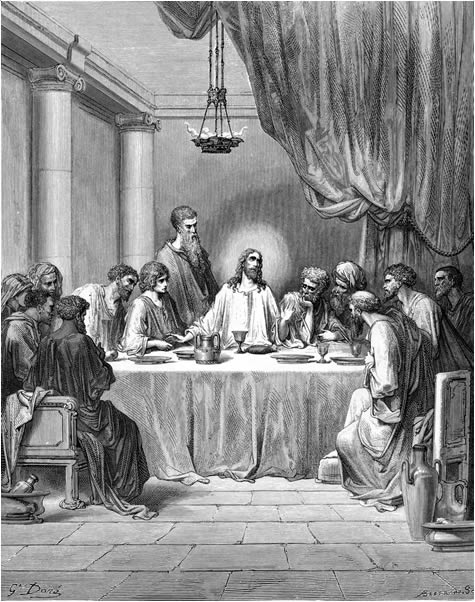
Luke alone records TWO cups (22:17, 22:20), and the detail is at home in the feast: the Passover meal was ordered around four cups of wine, a structure already fixed in the Mishnah, the first written code of Jewish oral law (Pesachim 10:1). Passover (Pesach) is the spring feast remembering the exodus; its meal, the seder (“order”), moved through blessing, story, and psalm with a cup at each station. Jesus takes the feast's own furniture, and at the cup after supper says the words that made it new: “this cup... is the new covenant in my blood.”
The seder as Jewish families keep it today descends from the same order, reshaped after the Temple fell in AD 70; the lamb on the table then is matzah and remembrance now.
This section is reception history: how the passage was read and kept in the Jewish tradition. Where a reading parts from an essential of the Christian faith, the section says so at that point.
Sources: Mishnah Pesachim 10:1 (the four cups) · The Lord's Supper (this site's study)
The words behind it
11 Greek wordsEvery Greek word of this verse in the order it stands, with what it means and the door to its own study. The last column counts the times a word stands in the whole Bible: the rarer the word, the more the places it appears belong together.
| Greek | Sound | Meaning | Word study | In the Bible |
|---|---|---|---|---|
| καὶ | kai | And | G2532 → | 9120 times |
| ἐξωμολόγησεν | exomologesen | he promised | G1843 → | |
| καὶ | kai | and | G2532 → | 9120 times |
| ἐζήτει | ezetei | was seeking | G2212 → | 117 times |
| εὐκαιρίαν | eukairian | opportunity | G2120 → | |
| τοῦ | tou | <the> | G3588 → | 19766 times |
| παραδοῦναι | paradounai | to betray | G3860 → | 119 times |
| αὐτὸν | auton | Him | G846 → | 5565 times |
| ἄτερ | ater | apart from | G817 → | |
| ὄχλου | ochlou | [a] crowd | G3793 → | 175 times |
| αὐτοῖς.¶ | autois | to them. | G846 → | 5565 times |
καὶAnd
kaiG2532 →9120 times
ἐξωμολόγησενhe promised
exomologesenG1843 →
καὶand
kaiG2532 →9120 times
ἐζήτειwas seeking
ezeteiG2212 →117 times
εὐκαιρίανopportunity
eukairianG2120 →
τοῦ<the>
touG3588 →19766 times
παραδοῦναιto betray
paradounaiG3860 →119 times
αὐτὸνHim
autonG846 →5565 times
ἄτερapart from
aterG817 →
ὄχλου[a] crowd
ochlouG3793 →175 times
αὐτοῖς.¶to them.
autoisG846 →5565 times
A shaded row is a word that stands 400 times or fewer in the Bible.
The walk
8 stopsEach card is a verse this one points to, and under it the verses that one points to in turn. Where several paths arrive at the same place, that place is listed first: the text keeps returning to it.
Through
Matthew 26:5“But not during the feast,” they said, “or there may be a riot among the people.”
it leads to
- Proverbs 19:21
Many plans are in a man’s heart, but the purpose of the LORD will prevail.
Reached by 2 separate paths from here.
- Matthew 27:24
When Pilate saw that he was accomplishing nothing, but that instead a riot was breaking out, he took water and washed his hands before the crowd. “I am innocent of this man’s blood,” he…
- Matthew 21:26
But if we say, ‘From men,’ we are afraid of the people, for they all regard John as a prophet.”
- Matthew 14:5
Although Herod wanted to kill John, he was afraid of the people, because they regarded John as a prophet.
- Isaiah 46:10
I declare the end from the beginning, and ancient times from what is still to come. I say, ‘My purpose will stand, and all My good pleasure I will accomplish.’
- Proverbs 19:21
Through
Mark 14:2“But not during the feast,” they said, “or there may be a riot among the people.”
it leads to
- Mark 11:32
But if we say, ‘From men’...” they were afraid of the people, for they all held that John truly was a prophet.
- John 12:19
Then the Pharisees said to one another, “You can see that this is doing you no good. Look how the whole world has gone after Him!”
- Mark 11:18
When the chief priests and scribes heard this, they looked for a way to kill Him. For they were afraid of Him, because the whole crowd was astonished at His teaching.
- Mark 11:32
Where this verse is studied
On this page
Studies12
On this verse
About Luke
This page draws on 9 works. Open the list of works
This page draws on Adam Clarke, Commentary on the Bible; Bede, Catena Aurea by Aquinas; Bonaventure, Commentary on Luke, Chapter 22; J. C. Ryle, Expository Thoughts on the Gospels, Luke; J.C. Ryle, Expository Thoughts on the Gospels: Luke (lightly modernized text, Grace Gems edition); John Gill, Exposition of the New Testament; John Gill, Exposition of the New Testament (1746-1748); Theophylact of Ohrid, Catena Aurea by Aquinas and Theophylact of Ohrid, Commentary on Luke.