
Luke 22:7
in Luke 22Then came the day of Unleavened Bread on which the Passover lamb was to be sacrificed.
BSB
The same verse in ASV and KJV ▾
ASV
And the day of unleavened bread came, on which the passover must be sacrificed.
KJV
Then came the day of unleavened bread, when the passover must be killed.
⋯
This verse in Luke 22
Commentary
18 notes on this verseBy its shadows, the law prefigured from of old the mystery of Christ. He is himself the witness of this when he said to the Jews, "If you would have believed Moses, you would have also believed me, for he wrote concerning me." Christ is presented everywhere by means of shadows and types, both as slain for us, as the innocent and true Lamb, and as sanctifying us by his life-giving blood. We further find the words of the holy prophets in complete agreement with those of most wise Moses.
This site's exposition
the day of Unleavened Bread
on Luke 22:7-10
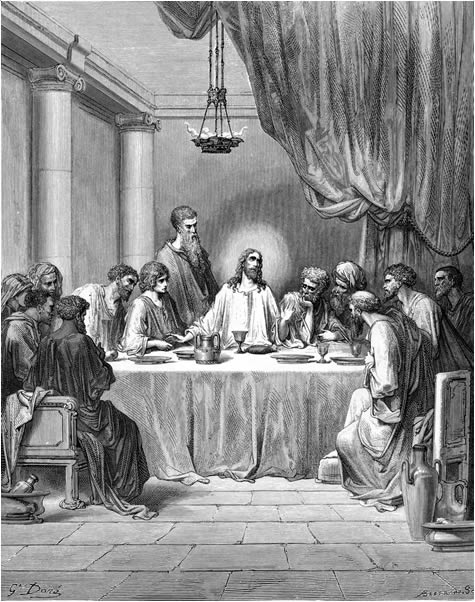
On the day of Unleavened Bread Jesus sent Peter and John to prepare the Passover. Asked where, He gives a sign: a man carrying a jug of water will meet them. Carrying water was ordinarily women's work in that culture, so the man would be easy to spot.
The record, by era
The Church Fathers3 voices
But should any one say, "If on the first day of unleavened bread the disciples of our Saviour prepare the Passover, on that day then should we also celebrate the Passover;" we answer, that this was not an admonition, but a history of the fact. It is what took place at the time of the saving Passion; but it is one thing to relate past events, another to sanction and leave them an ordinance to posterity. Moreover, the Saviour did not keep His Passover with the Jews at the time that they sacrificed the lamb. For they did this on the Preparation, when our Lord suffered. Therefore they entered not into the hall of Pilate, that they might not be defiled, but might eat the Passover. (John 18:28.) For from the time that they conspired against the truth, they drove far from them the Word of truth. Nor on the first day of unleavened bread, on which the Passover ought to be sacrificed, did they eat their accustomed Passover, for they were intent upon something else, but on the day after, which was the second of unleavened bread. But our Lord on the first day of unleavened bread, that is, on the fifth day of the week, kept the Passover with His disciples.
And the suffering of this "extermination" was perfected within the times of the lxx hebdomads, under Tiberius Caesar, in the consulate of Rubellius Geminus and Fufius Geminus, in the month of March, at the times of the passover, on the eighth day before the calends of April, on the first day of unleavened bread, on which they slew the lamb at even, just as had been enjoined by Moses. Accordingly, all the synagogue of Israel did slay Him, saying to Pilate, when he was desirous to dismiss Him, "His blood be upon us, and upon our children; " and, "If thou dismiss him, thou art not a friend of Caesar; " in order that all things might be fulfilled which had been written of Him.
For that you would do thus at the beginning of the first month of your new (years) even Moses prophesied, when he was foretelling that all the community of the sons of lsrµl was to immolate at eventide a lamb, and were to eat this solemn sacrifice of this day (that is, of the passover of unleavened bread) with bitterness; "and added that "it was the passover of the Lord," that is, the passion of Christ. Which prediction was thus also fulfilled, that "on the first day of unleavened bread" you slew Christ; and (that the prophecies might be fulfilled) the day hasted to make an "eventide,"-that is, to cause darkness, which was made at mid-day; and thus "your festive days God converted into grief, and your canticles into lamentation.
The Medieval Church2 voices
Now the day of Unleavened Bread came, on which it was necessary to sacrifice the Passover. And he sent Peter and John saying: Go and prepare the Passover for us, that we may eat. The day of unleavened bread of Passover refers to the fourteenth …
By the day of unleavened bread of the Passover, He means the fourteenth day of the first month, the day on which, having put away the leaven, they were accustomed to hold the Passover, that is, the lamb, towards evening.
11 more voices on this verse
The Medieval Church4 voices
To explain this Passover, the Apostle says, Christ our Passover is sacrificed for us. (1 Cor. 5:7.) Which Passover in truth must needs have been slain there, as it was so ordained by the Father's counsel and determination. And thus although on the next day, that is, the fifteenth, He was crucified, yet, on this night on which the lamb was slain by the Jews, being seized and bound, He consecrated the beginning of His sacrifice, that is, of His Passion.
That Pascha, called Phasek in Hebrew, signifies the departure from Egypt — many have spoken of this, and in general everything that was performed at that time during this feast the saints have explained. But we need to speak about which day is called the …
Now on the same fifth day He sends two of His disciples to prepare the Passover, namely, Peter and John, the one in truth as loving, the other as loved. In all things showing, that even to the end of His life He opposed not the law. And He sends them to a strange house; for He and His disciples had no house, else would He have kept the Passover in one of them. So it is added, And they said, Where will thou that we prepare? He sends them for this reason to an unknown man: to show them that He voluntarily underwent His Passion, since He who so swayed the mind of one unknown to Him, that He should receive them, was able to deal with the Jews just as He wished. But some say that He gave not the name of the man, lest the traitor knowing his name might open the house to the Pharisees, and they should have come and taken Him before that the supper was eaten, and He had delivered the spiritual mysteries to His disciples. But He directs them by particular signs to a certain house; whence it follows, And ye shall say to the goodman of the house, The Master saith, Where is the guestchamber, &c. And he will show you an upper room, &c. By the day of unleavened bread, we must understand that conversation which is wholly in the light of the Spirit, having lost all trace of the old corruption of Adam's first transgression. And living in this conversation, it becomes us to rejoice in the mysteries of Christ. Now these mysteries Peter and John prepare, that is, action and contemplation, fervid zeal and peaceful meekness. And these preparers a certain man meets, because in what we have just mentioned, lies the condition of man who was created after the image of God. And he carries a pitcher of water, which signifies the grace of the Holy Spirit. But the pitcher is humbleness of heart; for He giveth grace to the humble, who know themselves to be but earth and dust.
Now came the day of unleavened bread, etc. After the Evangelist described the perverse machination of Judas the betrayer, here secondly he describes the dispensative institution of the Sacrament of the altar. And since this Sacrament was to succeed the paschal lamb, therefore this part …
The Puritans and the Awakening2 voices
Then came the day of unleavened bread,.... The first of them, the fourteenth day of the month Nisan: when the passover must be killed; that is, the passover lamb, as the Persic version renders it; and which, according to the law in Exo 12:6 was to be done between the two evenings; See Gill on Mat 26:17.
Christ was made under the law, and observed the ordinances of it, particularly that of the passover, to teach us in like manner to observe his gospel institutions, particularly that of the Lord's supper, and not to neglect them. It is probable that he went to the temple to preach in the morning, when he sent Peter and John another way into the city to prepare the passover.
The Nineteenth Century5 voices
A commentator
Jamieson, Fausset & Brown1802–1910
Commentary Critical and Explanatory on the Whole Bible (1871)
proposed
the day of unleavened bread--strictly the fifteenth Nisan (part of our March and April) after the paschal lamb was killed; but here, the fourteenth (Thursday).
quarantine:debris (2026-07-29) — starts-lowercase
A commentator
J.C. Ryle1816–1900
Expository Thoughts on the Gospels: Luke (lightly modernized text, Grace Gems edition) (1858)
proposed
The chapter which opens with these verses, begins Luke's account of our Lord's sufferings and death. No part of the Gospels is so important as this. The death of Christ — was the life of the world. No part of our Lord's history is so fully given by all the gospel writers as this. Only two of them describe the circumstances of Christ's birth. All four dwell minutely on Christ's death. And of all the four, no one supplies us with such full and interesting details as Luke.
A commentator
J.C. Ryle1816–1900
Expository Thoughts on the Gospels: Luke (lightly modernized text, Grace Gems edition) (1858)
proposed
The chapter which opens with these verses, begins Luke's account of our Lord's sufferings and death. No part of the Gospels is so important as this. The death of Christ — was the life of the world. No part of our Lord's history is so fully given by all the gospel writers as this. Only two of them describe the circumstances of Christ's birth. All four dwell minutely on Christ's death. And of all the four, no one supplies us with such full and interesting details as Luke. We see, firstly, in these verses — that high offices in the church do not preserve the holders of them from great blindness and sin. We read that "the chief priests and scribes sought how they might kill Jesus." The first step in putting Christ to death, was taken by the religious teachers of the Jewish nation. The very men who ought to have welcomed the Messiah — were the men who conspired to kill Him. The very teachers who ought to have rejoiced at the appearing of the Lamb of God — had the chief hand in slaying Him. They sat in Moses' seat. They claimed to be "guides of the blind," and "lights of those who were in darkness." (Romans 2:19.) They belonged to the tribe of Levi. They were, most of them — in direct succession and descent from Aaron. Yet they were the very men who crucified the Lord of glory! With all their boasted knowledge — they were far more ignorant than the few Galilean fishermen who followed Christ. Let us beware of attaching an excessive importance to Christian ministers because of their office. Ordination and religious office confer no exemption from error. The greatest heresies have been sown, and the greatest practical abuses have been introduced into the church — by ordained men! Respect is undoubtedly due to high official position. Order and discipline ought not to be forgotten.
The passover - Πασχα, Luk 22:1, is the name of the festival; το πασχα here is supposed to be the name of that on which they feasted, viz. the sacrificed paschal lamb. But see the notes on Matthew 26 (note), and especially the observations at the end of that chapter, (Mat 26:75 (note)).
A commentator
Albert Barnes1798–1870
Notes, Explanatory and Practical, on the Old and New Testaments (1832-1869)
proposed
See this passage explained in the Mat 26:17-19 notes, and Mar 14:12-16 notes.
How the passage was read
On Luke 22:1-23On Luke 22:1-23
The cups on the table
Luke alone records TWO cups (22:17, 22:20), and the detail is at home in the feast: the Passover meal was ordered around four cups of wine, a structure already fixed in the Mishnah, the first written code of Jewish oral law (Pesachim 10:1). Passover (Pesach) is the spring feast remembering the exodus; its meal, the seder (“order”), moved through blessing, story, and psalm with a cup at each station. Jesus takes the feast's own furniture, and at the cup after supper says the words that made it new: “this cup... is the new covenant in my blood.”
The seder as Jewish families keep it today descends from the same order, reshaped after the Temple fell in AD 70; the lamb on the table then is matzah and remembrance now.
This section is reception history: how the passage was read and kept in the Jewish tradition. Where a reading parts from an essential of the Christian faith, the section says so at that point.
Sources: Mishnah Pesachim 10:1 (the four cups) · The Lord's Supper (this site's study)
The words behind it
12 Greek wordsEvery Greek word of this verse in the order it stands, with what it means and the door to its own study. The last column counts the times a word stands in the whole Bible: the rarer the word, the more the places it appears belong together.
| Greek | Sound | Meaning | Word study | In the Bible |
|---|---|---|---|---|
| Ἦλθεν | elthen | Came | G2064 → | 628 times |
| δὲ | de | then | G1161 → | 2765 times |
| ἡ | he | the | G3588 → | 19766 times |
| ἡμέρα | hemera | day | G2250 → | 389 times |
| τῶν | ton | <the> | G3588 → | 19766 times |
| ἀζύμων | azumon | of Unleavened [Bread] | G106 → | |
| ἐν | en | on | G1722 → | 2738 times |
| ᾗ | he | which | G3739 → | 1405 times |
| ἔδει | edei | it was necessary for | G1163 → | 101 times |
| θύεσθαι | thuesthai | to be sacrificed | G2380 → | 14 times |
| τὸ | to | the | G3588 → | 19766 times |
| πάσχα. | pascha | Passover lamb. | G3957 → | 29 times |
ἮλθενCame
elthenG2064 →628 times
δὲthen
deG1161 →2765 times
ἡthe
heG3588 →19766 times
ἡμέραday
hemeraG2250 →389 times
τῶν<the>
tonG3588 →19766 times
ἀζύμωνof Unleavened [Bread]
azumonG106 →
ἐνon
enG1722 →2738 times
ᾗwhich
heG3739 →1405 times
ἔδειit was necessary for
edeiG1163 →101 times
θύεσθαιto be sacrificed
thuesthaiG2380 →14 times
τὸthe
toG3588 →19766 times
πάσχα.Passover lamb.
paschaG3957 →29 times
A shaded row is a word that stands 400 times or fewer in the Bible.
The walk
8 stopsEach card is a verse this one points to, and under it the verses that one points to in turn. Where several paths arrive at the same place, that place is listed first: the text keeps returning to it.
Through
1 Corinthians 5:7Get rid of the old leaven, that you may be a new unleavened batch, as you really are. For Christ, our Passover lamb, has been sacrificed.
it leads to
- 1 Peter 1:19–20
but with the precious blood of Christ, a lamb without blemish or spot.
- Ephesians 4:22
to put off your former way of life, your old self, which is being corrupted by its deceitful desires;
- Exodus 12:15
For seven days you must eat unleavened bread. On the first day you are to remove the leaven from your houses. Whoever eats anything leavened from the first day through the seventh must be…
Reached by 2 separate paths from here.
- Colossians 3:5–9
Put to death, therefore, the components of your earthly nature: sexual immorality, impurity, lust, evil desires, and greed, which is idolatry.
- Revelation 5:12
In a loud voice they were saying: “Worthy is the Lamb, who was slain, to receive power and riches and wisdom and strength and honor and glory and blessing!”
- 1 Peter 1:19–20
Through
Exodus 12:6You must keep it until the fourteenth day of the month, when the whole assembly of the congregation of Israel will slaughter the animals at twilight.
it leads to
- Leviticus 23:5
The Passover to the LORD begins at twilight on the fourteenth day of the first month.
- 2 Chronicles 30:15–18
And on the fourteenth day of the second month they slaughtered the Passover lamb. The priests and Levites were ashamed, and they consecrated themselves and brought burnt offerings to the house of the LORD.
- Numbers 28:16
The fourteenth day of the first month is the LORD’s Passover.
- Leviticus 23:5
Where this verse is studied
On this page
Studies25
On this verse
On this chapter
- The Covenants
- Forgiving Yourself: What Scripture Says
- Gethsemane (The Garden Called the Oil Press)
- Hospitality
- Jesus on Discipleship
- Jesus on the Kingdom
Show the next 6 titles
About Luke
This page draws on 15 works. Open the list of works
This page draws on Adam Clarke, Commentary on the Bible; Albert Barnes, Notes, Explanatory and Practical, on the Gospels; Albert Barnes, Notes, Explanatory and Practical, on the Old and New Testaments (1832-1869); Bede, On the Gospel of Luke; Bede, Catena Aurea by Aquinas; Bonaventure, Commentary on Luke, Chapter 22; Cyril of Alexandria, COMMENTARY ON LUKE, HOMILY 141; Eusebius of Caesarea, Catena Aurea by Aquinas; J.C. Ryle, Expository Thoughts on the Gospels: Luke (lightly modernized text, Grace Gems edition); Jamieson, Fausset & Brown, Commentary Critical and Explanatory on the Whole Bible; John Gill, Exposition of the New Testament (1746-1748); Matthew Henry, Commentary on the Whole Bible; Tertullian, An Answer to the Jews; Theophylact of Ohrid, Commentary on Luke and Theophylact of Ohrid, Catena Aurea by Aquinas.