
Galatians 3:1
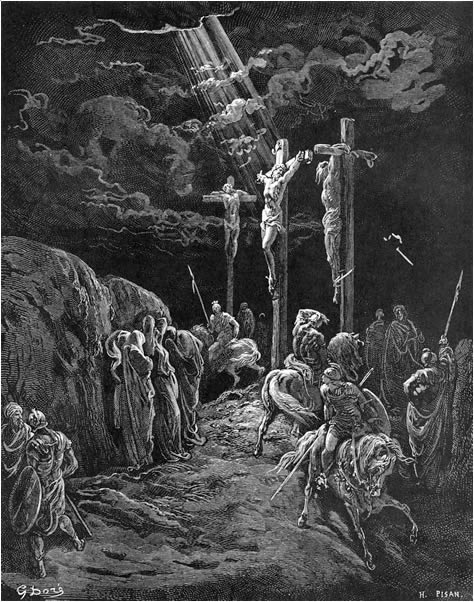
in Galatians 3O foolish Galatians! Who has bewitched you? Before your very eyes Jesus Christ was clearly portrayed as crucified.
BSB
The same verse in ASV and KJV ▾
ASV
O foolish Galatians, who did bewitch you, before whose eyes Jesus Christ was openly set forth crucified?
KJV
O foolish Galatians, who hath bewitched you, that ye should not obey the truth, before whose eyes Jesus Christ hath been evidently set forth, crucified among you?
⋯
This verse in Galatians 3
Commentary
18 notes on this verseWe must expound what follows—"Who has bewitched you?"—in a way worthy of Paul, who even if rough in his speech is not so in his understanding. It must not be interpreted in such a way as to make Paul legitimize the witchcraft that is popularly supposed to do harm.
This site's exposition
who hath bewitched you
The verb behind evidently set forth, proegraphe, describes a public placard: Paul had posted Christ crucified before Galatian eyes like an official notice. Bewitched translates ebaskanen, the language of the evil eye, and Paul's point is that only a spell could explain turning from a crucifixion they had seen so plainly preached. The chapter's whole argument begins at the cross, the third beat of the letter's crucifixion chain after 2:20.
The record, by era
The Church Fathers5 voices
Having shown himself taught not by men but by the Lord, Paul now teaches with greater authority, making a comparison between the law and faith. And he calls them foolish. For indeed it is foolish to abandon Christ and hold to the law. "Who has …
They bear in mind how the churches were rebuked by the apostle: "O foolish Galatians, who hath bewitched you? " and, "Ye did run so well; who hath hindered you? " and how the epistle actually begins: "I marvel that ye are so soon removed from Him, who hath called you as His own in grace, to another gospel.
This indicates their previous zeal for piety and manifests the fatherly affection of the apostle. He grieves over them for their loss of wealth accumulated.
Christ is rightly said to be portrayed before us, since the whole chorus of Old Testament prophets spoke of his gallows and passion, his blows and whippings.… Nor was it a small number of Galatians who believed in the crucifixion as it has previously been portrayed for them. It was of course by this means that, reading the prophets continually and knowing all the ordinances of the law, they were led in due course to belief.
(Chapter III - Verse 1) O foolish Galatians, who has bewitched you? This place can be understood in two ways. Either the foolish Galatians are called so because they have come from greater things to lesser things, having begun in the spirit and are now being consumed in the flesh. Or it is because each province has its own peculiarities. The Cretans are always liars, evil beasts, lazy gluttons, truly spoken of by the poet Epimenides, confirmed by the Apostle. The vain Moors and the fierce Dalmatians are struck by the Latin historian. Timid Phrygians, all poets tear apart. They say that more talented people are born in Athens, and philosophers boast about it. Cicero criticizes the Greeks, calling them either frivolous or cruel barbarians before Caesar. And for Flaccus, he says: 'Ingeniousness is innate, he says, and educated vanity.' The true Israel, with a heavy heart and a stiff neck, accuses all the Scriptures. Therefore, I think that the Apostle Paul also rebuked the Galatians for their regional customs. Although some, inserting profound questions as if under the guise of avoiding heresy, which introduces diverse natures, may say that even the Tyrians and Sidonians, Moabites and Ammonites, and Idumaeans, Babylonians and Egyptians, and all the Nations mentioned in the Scriptures, have certain languages for preceding reasons, and deservedly for their prior actions, so that the justice of God may not come into doubt: since it is asserted that every nation has either good or evil, which another does not have. We will pursue those declining heights: either accusing them of foolishness, saying that they cannot judge the spirit of the Law and the letter; or blaming the fault of the nation, that they are unteachable and foolish, and slower to wisdom. […]
11 more voices on this verse
The Church Fathers1 voice
Here he passes to another subject; in the former chapters he had shown himself not to be an Apostle of men, nor by men, nor in want of Apostolic instruction. Now, having established his authority as a teacher, he proceeds to discourse more confidently, and draws a comparison between faith and the Law. At the outset he said, "I marvel that ye are so quickly removing;" but here, "O foolish Galatians;" then, his indignation was in its birth, but now, after his refutation of the charges against himself, and his proofs, it bursts forth. Let not his calling them "foolish" surprise you; for it is not a transgression of Christ's command not to call one's brother a fool, but rather a strict observance of it. For it is not said simply, "Whosoever shall say to his brother, Thou fool," but, whosoever shall do so, "without a cause." And who more fittingly than they could so be called, who after so great events, adhered to past things, as if nothing else had ever happened? If on this account Paul is to be called a "reviler," Peter may likewise, on account of Annanias and Sapphira, be called a homicide; but as it would be wildness to do so in that case, much more in this. Moreover it is to be considered, that this vehemence is not used at the beginning, but after these evidences and proofs, which, rather than Paul himself, might now be held to administer the rebuke. For after he had shown that they rejected the faith, and made the death of Christ to be without a purpose, he introduces his reproof, which, even as it is, is less severe than they merited. Observe too how soon he stays his arm; for he adds not, Who has seduced you? who has perverted you? who has been sophistical with you? but, "Who hath cast an envious eye on you?" thus tempering his reprimand with somewhat of praise. […]
The Medieval Church2 voices
Above, the Apostle reproved the Galatians for their vanity and fickleness on the authority of the Gospel teaching by showing that his doctrine was approved by the other apostles. Now through reason and authority he proves the same thing, namely, that the works of the …
Having shown first that he is an apostle not from men nor through men, and having presented himself as worthy of trust, he then speaks with greater authority. Intending to compare faith and the law, he calls the Galatians foolish, in no way violating the …
The Puritans and the Awakening3 voices
O thoughtless Galatians - He breaks in upon them with a beautiful abruptness. Who hath bewitched you - Thus to contradict both your own reason and experience. Before whose eyes Jesus Christ hath been as evidently set forth - By our preaching, as if he had been crucified among you.
That wherein their folly and infatuation appeared was that they did not obey the truth; that is, they did not adhere to the gospel way of justification, wherein they had been taught, and which they had professed to embrace. Note, It is not enough to know the truth, and to say we believe it, but we must obey it too; we must heartily submit to it, and stedfastly abide by it.
O foolish Galatians,....
The Nineteenth Century5 voices
A commentator
Albert Barnes1798–1870
Notes, Explanatory and Practical, on the Old and New Testaments (1832-1869)
O foolish Galatians - That is, foolish for having yielded to the influence of the false teachers, and for having embraced doctrines that tended to subvert the gospel of the Redeemer. The original word used here (ἀνόητοι anoētoi) denotes void of understanding; and they had shown it in a remarkable manner in rejecting the doctrine of the apostles, and in embracing the errors into which they had fallen. It will be remembered that this is an expression similar to what was applied to them by others; see the introduction, Section I.
A commentator
Jamieson, Fausset & Brown1802–1910
Commentary Critical and Explanatory on the Whole Bible (1871)
"You, before whose eyes Jesus Christ hath been graphically set forth (literally, in writing, namely, by vivid portraiture in preaching) among you, crucified" (so the sense and Greek order require rather than English Version). As Christ was "crucified," so ye ought to have been by faith "crucified with Christ," and so "dead to the law" (Ga 2:19, 20).
WITH very great enthusiasm the Galatians received the Gospel when Paul preached it to them. They seem to have been a very warm-hearted but fickle people and Paul found to his great grief that while he was away from them, certain false teachers came in and turned them aside from the Gospel which he had delivered to them. He spoke out very plainly about the matter. In this verse he uses very strong terms, while he says to them—"O foolish Galatians, who has bewitched you, that you should not obey the truth?"
WITH very great enthusiasm the Galatians received the Gospel when Paul preached it to them. They seem to have been a very warm-hearted but fickle people and Paul found to his great grief that while he was away from them, certain false teachers came in and turned them aside from the Gospel which he had delivered to them. He spoke out very plainly about the matter. In this verse he uses very strong terms, while he says to them—"O foolish Galatians, who has bewitched you, that you should not obey the truth?" I do not know that any such witchery has fallen upon any of you, but I do know that, being men, we are all subject to the same dangers and I know, also, that there is a witchery in the very air at this time so that many are to be found throughout the Churches of this land to whom these words might be justly spoken. We can only hope to escape this evil which Paul so severely condemns by the use of right cautionary means. It is only, in fact, as the Holy Spirit shall keep us that we shall be preserved from the fascinations of error and kept true to the grand old Gospel of the blessed God. At this time I shall very briefly speak, in the first place, upon the subtle danger which is hinted at here—"Who has bewitched you?" Secondly, at more length I shall speak upon the blessed preservative—there is no way of being kept from this witchery like having Christ Jesus, evidently crucified, set forth among us. And, thirdly, a few words, in closing, upon the supreme folly of any who, having tried this Divine preservative, nevertheless become bewitched by error. I. First, then, let us think of THE SUBTLE DANGER which is always around us. It was hard work to preach the Gospel, at first, among the heathen. Men had to lay down their lives to do it. They had to propound new things which the heathen mind did not readily receive.
O foolish Galatians - O infatuated people; you make as little use of reason as those who have none; you have acted in this business as those do who are fascinated - they are led blindly and unresistingly on to their own destruction. That ye should not obey the truth - This clause is wanting in ABD*FG, some others, the Syriac, Erpenian, Coptic, Sahidic, Itala, Vulgate MS., and in the most important of the Greek and Latin fathers. Of the clause Professor White says, Certissime delenda, “It should certainly be expunged.” There are several various readings on this verse, from which it appears that the verse in the best ancient MSS. and versions was read thus: O foolish Galatians, who hath bewitched you? Before whose eyes Jesus Christ crucified hath been plainly set forth. Among you? - Εν ὑμιν is wanting in ABC, several others, the Syriac, Erpenian, Coptic, Sahidic, Ethiopic, Armenian, Vulgate MS., one copy of the Itala, and in several of the fathers. The words appear to disturb the sense, and have obliged commentators to have recourse to a sort of technical meaning; viz. “The doctrine of the Gospel had been so fully preached among these people that it might be said Jesus Christ had been crucified among them; so fully had his sufferings been detailed, and the design of them pointed out.”
The words behind it
13 Greek wordsEvery Greek word of this verse in the order it stands, with what it means and the door to its own study. The last column counts the times a word stands in the whole Bible: the rarer the word, the more the places it appears belong together.
| Greek | Sound | Meaning | Word study | In the Bible |
|---|---|---|---|---|
| Ὦ | o | O | G5599 → | |
| ἀνόητοι | anoetoi | foolish | G453 → | |
| Γαλάται, | galatai | Galatians! | G1052 → | |
| τίς | tis | Who | G5101 → | 563 times |
| ὑμᾶς | humas | you | G4771 → | 2973 times |
| ἐβάσκανεν | ebaskanen | has bewitched | G940 → | |
| οἷς | hois | whose | G3739 → | 1405 times |
| κατ᾽ | kat᾽ | before | G2596 → | 468 times |
| ὀφθαλμοὺς | ophthalmous | eyes | G3788 → | |
| Ἰησοῦς | iesous | Jesus | G2424 → | 908 times |
| Χριστὸς | christos | Christ | G5547 → | 523 times |
| προεγράφη | proegraphe | was publicly portrayed | G4270 → | |
| ἐσταυρωμένος; | estauromenos | [as] crucified? | G4717 → | 46 times |
ὮO
ἀνόητοιfoolish
anoetoiG453 →
Γαλάται,Galatians!
galataiG1052 →
τίςWho
tisG5101 →563 times
ὑμᾶςyou
humasG4771 →2973 times
ἐβάσκανενhas bewitched
ebaskanenG940 →
οἷςwhose
hoisG3739 →1405 times
κατ᾽before
kat᾽G2596 →468 times
ὀφθαλμοὺςeyes
ophthalmousG3788 →
ἸησοῦςJesus
iesousG2424 →908 times
ΧριστὸςChrist
christosG5547 →523 times
προεγράφηwas publicly portrayed
proegrapheG4270 →
ἐσταυρωμένος;[as] crucified?
estauromenosG4717 →46 times
A shaded row is a word that stands 400 times or fewer in the Bible.
The walk
8 stopsEach card is a verse this one points to, and under it the verses that one points to in turn. Where several paths arrive at the same place, that place is listed first: the text keeps returning to it.
Through
2 Corinthians 11:3I am afraid, however, that just as Eve was deceived by the serpent’s cunning, your minds may be led astray from your simple and pure devotion to Christ.
it leads to
- Colossians 2:8
See to it that no one takes you captive through philosophy and empty deception, which are based on human tradition and the spiritual forces of the world rather than on Christ.
- Galatians 1:6
I am amazed how quickly you are deserting the One who called you by the grace of Christ and are turning to a different gospel—
- Ephesians 4:14
Then we will no longer be infants, tossed about by the waves and carried around by every wind of teaching and by the clever cunning of men in their deceitful scheming.
- 1 John 4:1
Beloved, do not believe every spirit, but test the spirits to see whether they are from God. For many false prophets have gone out into the world.
- Colossians 2:4
I say this so that no one will deceive you by smooth rhetoric.
- Colossians 2:8
Through
Galatians 1:6I am amazed how quickly you are deserting the One who called you by the grace of Christ and are turning to a different gospel—
it leads to
- 2 Corinthians 11:4
For if someone comes and proclaims a Jesus other than the One we proclaimed, or if you receive a different spirit than the One you received, or a different gospel than the one you…
- Galatians 5:7–8
You were running so well. Who has obstructed you from obeying the truth?
- 2 Corinthians 11:4
Through
1 Peter 4:17For it is time for judgment to begin with the family of God; and if it begins with us, what will the outcome be for those who disobey the gospel of God?
it leads to
- Jeremiah 25:29
For behold, I am beginning to bring disaster on the city that bears My Name, so how could you possibly go unpunished? You will not go unpunished, for I am calling down a sword…
- Jeremiah 25:29
Where this verse is studied
On this page
Studies14
- The Abrahamic Covenant: Genesis 12 · 15 · 17
- The Bronze Serpent
- The Covenant Lawsuit: When God Sues His People
- The Covenants
- The Fruit of the Spirit
- The Seed Promise
- The Bible and Slavery
- The Garment & the Robe
- The Just Shall Live by His Faith: Habakkuk 2:4
- The Law as Tutor
- The New Perspective on Paul
- The Seed
- The Tree
- Trees: Eden, Cross, New Jerusalem
About Galatians
This page draws on 16 works. Open the list of works
This page draws on Adam Clarke, Commentary on the Bible; Albert Barnes, Notes, Explanatory and Practical, on the Old and New Testaments (1832-1869); Charles Spurgeon, The Metropolitan Tabernacle Pulpit, Sermon No. 1546: “Men Bewitched” (lightly modernized text, CCEL edition); J. B. Lightfoot, Saint Paul's Epistle to the Galatians; Jamieson, Fausset & Brown, Commentary Critical and Explanatory on the Whole Bible; Jerome, EPISTLE TO THE GALATIANS 1.3.1; Jerome, Commentary on Galatians; John Chrysostom, Homily on Galatians 3; John Gill, Exposition of the New Testament (1746-1748); John Wesley, Explanatory Notes upon the New Testament; Matthew Henry, Commentary on the Whole Bible; Oecumenius, Commentary on Galatians; Tertullian, The Prescription Against Heretics; Theodoret of Cyrus, EPISTLE TO THE GALATIANS 3.1; Theophylact of Ohrid, Commentary on Galatians and Thomas Aquinas, Commentary on Galatians.