
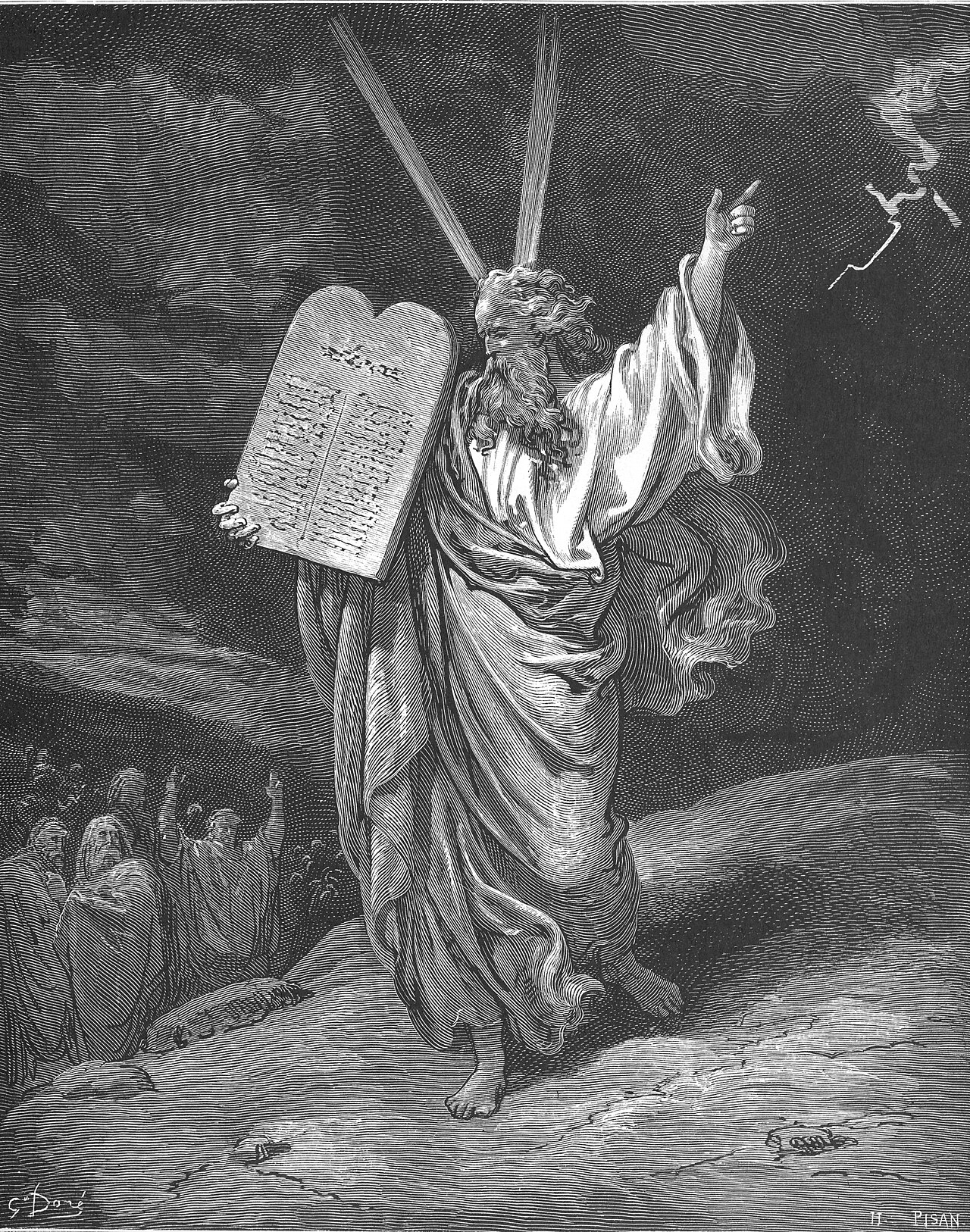
Exoduschapter 34
35 verses · Moses, by tradition · 15th or 13th century BC · The Law
In Jewish life
The reading
Weekly portion 21 of 54
כִּי תִשָּׂא Ki Tisa, Exodus 30:11 to 34:35
Read with it: 1 Kings 18:1 to 18:39 in Ashkenazi use, and 1 Kings 18:20 to 18:39 in Sephardi use.
The verse numbers here are the ones a Hebrew Bible carries, which differ from an English Bible by a verse or two in several places. The Sephardi reading is named only where this site records a difference; communities vary beyond what is listed. What these books are, and how a Christian reader meets them →
How it is read
The second tablets and the renewed covenant carry some of the best known rabbinic readings in the book. On the command to hew the tablets Rashi reports a tradition about where the stone came from. God showed Moses a quarry of sapphire inside his own tent and gave him the chips. "It was from this that Moses became so rich" (Rashi on Exodus 34:1:1, citing Midrash Tanchuma 3:9:29 and Leviticus Rabbah 32:2). The order that no man come up with him he reads as a lesson drawn from what went wrong the first time. The first tablets were given "amidst great noises and alarms and a vast assembly", and the evil eye had power over them (Rashi on Exodus 34:3:1, citing Midrash Tanchuma 3:9:31). The doubled name at the sixth verse he reads as the attribute of mercy said twice over. The first stands for mercy before a man sins, the second for mercy after he has sinned and repented (Rashi on Exodus 34:6:1, citing Rosh Hashanah 17b). The mercy stored up at the seventh verse is mercy a person does in God's presence and God keeps (Rashi on Exodus 34:7:1). Six nations are named where seven are expected, because the Girgashites left the land of their own accord (Rashi on Exodus 34:11:1, citing Leviticus Rabbah 17:6). Eating at an idolater's table he treats as consent to the worship, since the table leads to marriage between the households (Rashi on Exodus 34:15:1, citing Avodah Zarah 8a). On the Sabbath of the twenty first verse he reports the Rabbis who tie ploughing and harvest to the sabbatical year rather than to the weekly rest (Rashi on Exodus 34:21:1). The feast of the first of the wheat harvest is named for the two loaves offered on it (Rashi on Exodus 34:22:1). Rashi is quoted from the Rosenbaum and Silbermann edition of 1929 to 1934, public domain. Ibn Ezra comments at Exodus 34:4:1, 34:12:1 and 34:17:1, and Malbim at Exodus 34:16:1, all cited by reference.
What the rabbis say
The corpus records forty places where the Midrash and the Talmud draw on this chapter, cited here by reference. The hewing of the second tablets is read at Devarim Rabbah 3:12 and 3:17, and at Bereshit Rabbah 36:1. The Mekhilta DeRabbi Yishmael carries it at Tractate Bachodesh 3:15 and Tractate Pischa 11:16. The Mekhilta DeRabbi Shimon Ben Yochai reads it at 14:22 and 34:1. Beitzah 5b:4 reads the order that no man come up. Bamidbar Rabbah carries the chapter at 2:25, 4:5, 11:3, 11:7, 12:3 and 21:16. It reads the veil over Moses' face at 14:19, and Midrash Tehillim at 75:4. The laws against the altars and the covenant with the nations are read at Chullin 62b:9 and 113a:18, and at Avodah Zarah 8a:17 and 36b:9. The three feasts are read at Gittin 25a:8, Horayot 4b:8 and Bekhorot 3a:16. Midrash Lekach Tov reads the chapter at Exodus 34:11:1, 34:31:1 and 34:32:1, and Midrash Aggadah at Exodus 34:5:1 and 34:33:1.
The text, verse by verse
Each word shows the Hebrew, the English under it, how it sounds and its Strong’s number. A rule between verses marks where the Hebrew manuscripts end a paragraph.
Merciful and Gracious, Slow to Anger
Ibn Ezra on Exodus 34:1
HEW THEE. Pesal lekha (hew thee) 1 The term lekha (thee) appears to be unnecessary. Hence I.E.
Read it in full at Sefaria · Ibn Ezra's commentary on the Pentateuch, tran. and annot. by H. Norman Strickman and Arthur M. Silver. Menorah Pub., 1988-2004
Onkelos Exodus 34:1
Adonoy said to Moshe, “Carve out two stone tablets for yourself just like the first ones.
Read it in full at Sefaria · Metsudah Chumash, Metsudah Publications, 2009 [with Onkelos translation]
Break Down Their Altars
Ramban on Exodus 34:11
Of all the commandments mentioned previously He did not say I am commanding thee.
Read it in full at Sefaria · Commentary on the Torah by Ramban (Nachmanides). Translated and annotated by Charles B. Chavel. New York, Shilo Pub. House, 1971-1976
Ibn Ezra on Exodus 34:14
[A JEALOUS GOD.] Scripture mentions a jealous God here as it does in the Decalogue.
Read it in full at Sefaria · Ibn Ezra's commentary on the Pentateuch, tran. and annot. by H. Norman Strickman and Arthur M. Silver. Menorah Pub., 1988-2004
Feasts, Firstborn, and Firstfruits
The Shining Face of Moses
Hebrew words in this chapter
The 40 most used Hebrew words of the chapter, counted by lemma. The article, the object marker, the negatives and the common prepositions are left out.
| Word | Sense here | Uses | Strong’s |
|---|---|---|---|
| יְהֹוָהYᵉhôvâh | yahweh | 16 | H3068 |
| מֹשֶׁהMôsheh | Moses | 15 | H4872 |
| פָּנִיםpânîym | face | 10 | H6440 |
| בֵּןbên | son | 10 | H1121 |
| הַרhar | mountain | 8 | H2022 |
| אֱלֹהִיםʼĕlôhîym | God | 8 | H430 |
| לוּחַlûwach | tablet | 7 | H3871 |
| רָאָהrâʼâh | to see | 7 | H7200 |
| דָבַרdâbar | to speak | 7 | H1696 |
| יִשְׂרָאֵלYisrâʼêl | Israel | 6 | H3478 |
| דָּבָרdâbâr | word | 5 | H1697 |
| צָוָהtsâvâh | to command | 5 | H6680 |
| אֶרֶץʼerets | land | 5 | H776 |
| כָּרַתkârath | to cut | 5 | H3772 |
| בְּרִיתbᵉrîyth | covenant | 5 | H1285 |
| יוֹםyôwm | day | 5 | H3117 |
| אָמַרʼâmar | and he said | 4 | H559 |
| שְׁנַיִםshᵉnayim | two | 4 | H8147 |
| בֹּקֶרbôqer | morning | 4 | H1242 |
| עָלָהʻâlâh | and you will go up | 4 | H5927 |
| Word | Sense here | Uses | Strong’s |
|---|---|---|---|
| סִינַיÇîynay | Sinai | 4 | H5514 |
| קָרָאqârâʼ | and he proclaimed | 4 | H7121 |
| עָשָׂהʻâsâh | to make | 4 | H6213 |
| בּוֹאbôwʼ | about to go | 4 | H935 |
| חַגchag | festival of | 4 | H2282 |
| אֶבֶןʼeben | stone | 3 | H68 |
| רִאשׁוֹןriʼshôwn | like the former | 3 | H7223 |
| כָּתַבkâthab | to write | 3 | H3789 |
| שָׁםshâm | there | 3 | H8033 |
| אִישׁʼîysh | and anyone | 3 | H376 |
| יָרַדyârad | to go down | 3 | H3381 |
| אֵלʼêl | God | 3 | H410 |
| עָוֺןʻâvôn | iniquity | 3 | H5771 |
| קֶרֶבqereb | in midst our | 3 | H7130 |
| עַםʻam | people | 3 | H5971 |
| שָׁמַרshâmar | to keep | 3 | H8104 |
| פֵּןpên | lest | 3 | H6435 |
| זָנָהzânâh | and they will prostitute themselves | 3 | H2181 |
| אָכַלʼâkal | to eat | 3 | H398 |
| זֶבַחzebach | sacrifice | 3 | H2077 |
Keep studying
Studies5
Words12
Subjects3
Sources for this chapter
The Hebrew text
STEP Bible, the tagged Hebrew text and its English glosses and James Strong, Strong's Exhaustive Concordance.
In Jewish life
Rashi, Rashi on Exodus 34:1 to 34:24, the Pentateuch with Rashi's commentary by M. Rosenbaum and A. M. Silbermann, 1929 to 1934, public domain; Ibn Ezra, Ibn Ezra on Exodus 34:4:1, 34:12:1 and 34:17:1, cited by reference, CC-BY-NC; Malbim, Malbim on Exodus 34:16:1, cited by reference, no English version in the corpus; Midrash Tanchuma, 3:9:29 and 3:9:31, as Rashi cites them; Leviticus Rabbah, 17:6 and 32:2, as Rashi cites them; Babylonian Talmud, Rosh Hashanah 17b and Avodah Zarah 8a, as Rashi cites them, and Beitzah 5b:4 and Gittin 25a:8, cited by reference; Mekhilta DeRabbi Yishmael, Tractate Bachodesh 3:15 and Tractate Pischa 11:16, cited by reference; Bamidbar Rabbah, 2:25, 4:5, 11:3, 11:7, 12:3, 14:19 and 21:16, cited by reference; The Sefaria corpus, scripts/data/sources/sefaria/exodus/34.json, fetched 2026-09-19 and MannaFest, the commentators and their dates, src/app/featured/the-jewish-writings/page.tsx.
The rabbinic texts
Ramban, Commentary on the Torah by Ramban (Nachmanides). Translated and annotated by Charles B. Chavel. New York, Shilo Pub. House, 1971-1976; Ibn Ezra, Ibn Ezra's commentary on the Pentateuch, tran. and annot. by H. Norman Strickman and Arthur M. Silver. Menorah Pub., 1988-2004; Targum, Metsudah Chumash, Metsudah Publications, 2009 [with Onkelos translation] and Sefaria, texts and citation data.