MANNAFEST

Prophets · Zechariah

The Priest and the King, United in One Branch

No other Minor Prophet gives so much specific, image-rich material about the Messiah — a rejected Shepherd pierced for His people, and a returning King whose feet will stand on the Mount of Olives to reign over all the earth. Zechariah sees it in a single night — eight visions of restoration, capped by a high priest crowned as a living parable of the priest-king to come — then unveils it twice more in two oracular “burdens”: the King lowly and rejected first, the King pierced and reigning at the last.

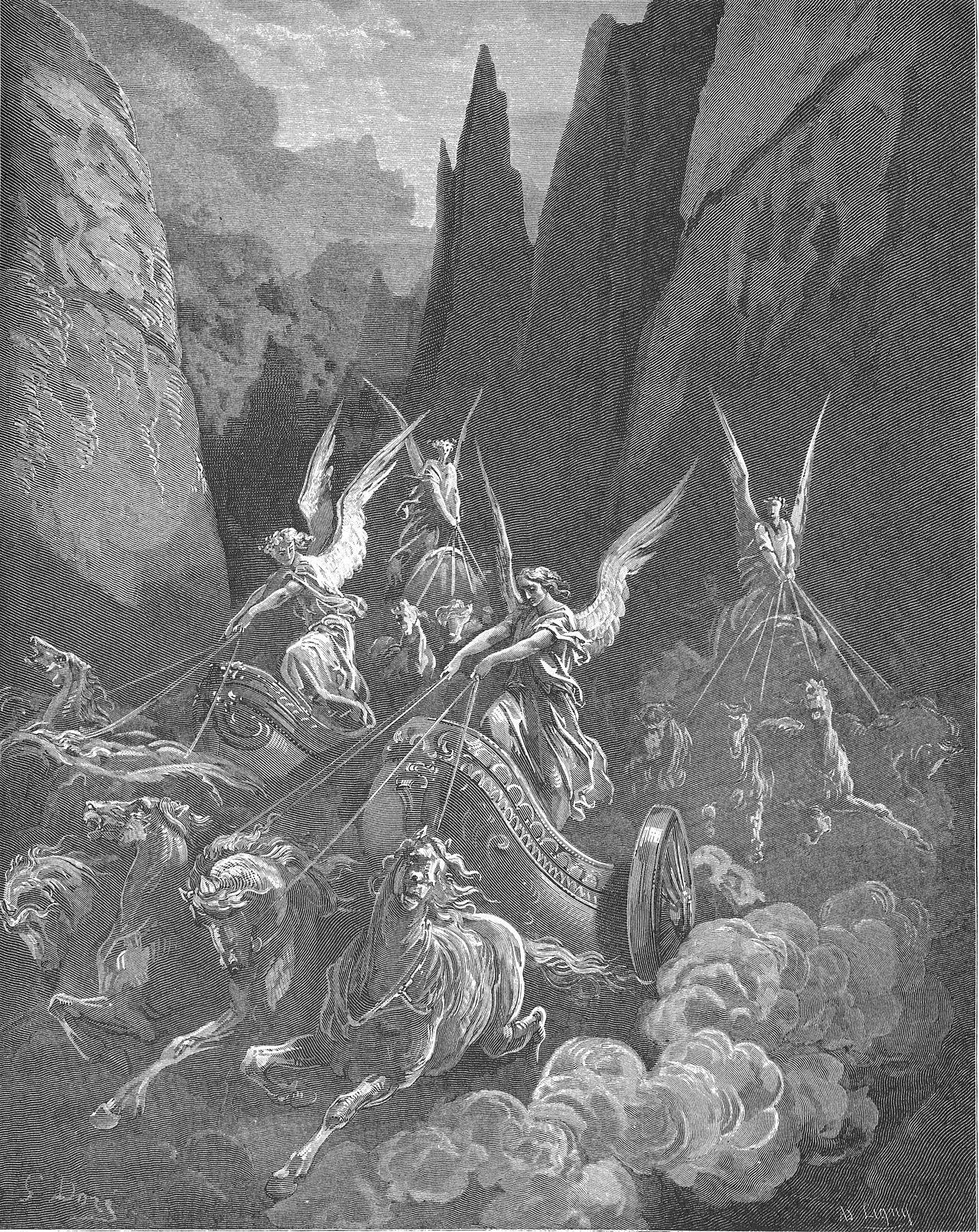
Zechariah's Vision of Four Chariots — Gustave Doré
The four chariots from between the mountains of brass — the eighth night vision's traffic of heaven — Gustave Doré, Doré’s English Bible (1866), public domain · Zechariah 6:1-5

The Night of Eight Visions

1:7–6:8 — all received in a single night, and read here as a proposed chiasm

Eight symbolic visions, one night (1:7), loosely bracket around a center. The outer pair shows heavenly patrol-agents surveying the whole earth; the next pair removes a source of harm from the land; the next concerns the land's fitness to hold God's presence — and at the center, a cleansed priesthood and a Spirit-filled lampstand, where the BRANCH is named for the first time. Stack the two rows below and the mirror is visible at a glance. The center pair even shares an image: a single stone set before Joshua with seven eyes upon it (3:9), and the lampstand's seven lamps named as the eyes of Jehovah, “which run to and fro through the whole earth” (4:10).

⚠ This precise pairing (1↔8, 2↔7, 3↔6, 4↔5) is an interpretive proposal in the dossier, not a scholarly consensus — competing outlines exist. Presented here as a proposed symmetry, not settled fact.

The Capstone

6:9–15 — Joshua crowned, a living parable of the priest-king to come

“Behold, the man whose name is the Branch: and he shall grow up out of his place; and he shall build the temple of Jehovah… and he shall be a priest upon his throne; and the counsel of peace shall be between them both” (6:12–13). Joshua the high priest is physically crowned in this scene — a real event, a real man, functioning as a sign-act pointing beyond itself: the union of priest and king forbidden to any single historical office-holder under the Law (cf. 2 Chr 26:16–21, Uzziah struck with leprosy for exactly this usurpation), fulfilled only in Christ (Heb 7; Rev 19:16 + 1:13).

The Branch across all four Old Testament texts — the full study →

The Argument

the whole book in three sentences
Author
Zechariah, son of Berechiah, son of Iddo — a prophet-priest
Date
1:1–8:23 dated 520–518 BC (Darius I) · temple finished 516 BC (Ezra 6:15) · 9:1–14:21 undated, later in his ministry
Audience
The returned exiles in Jerusalem, rebuilding the temple under Zerubbabel and Joshua
Shape
14 chapters · 8 night visions · 1 crowning · 2 “burdens”
  1. 1

    Return to Me and I will return to you (1:3) — a call to covenant faithfulness proven in eight night visions promising Jerusalem's rebuilding, cleansing and protection, sealed by the symbolic crowning of Joshua as a preview of the coming priest-king Branch.

  2. 2

    After a hinge on true fasting and justice (7–8), two oracular “burdens” unveil Israel's future: first the coming humble King, rejected and sold for a slave's price (9–11); then the piercing, mourning, cleansing, and final victory of Jerusalem, when the LORD Himself stands on the Mount of Olives and reigns as King over all the earth (12–14).

  3. 3

    No other Minor Prophet supplies so much discrete, verbally-precise messianic material — a fact the New Testament itself recognizes through direct and echoed citation clustering unusually densely around Passion week.

The Two Burdens

9:1–14:21 — massa, “oracle” — the same heading opens both, and Malachi after them

Both halves open with the same word — massa, “burden,” the formal heading of a prophetic oracle (9:1; 12:1). The identical heading opens Malachi as well (Mal 1:1), which is why some readers treat Zech 9–11, Zech 12–14 and Malachi as three linked burden-oracles standing at the close of the Twelve.

First Burden — the Rejected King (9:1–11:17)

Second Burden — the Pierced and Reigning King (12:1–14:21)

Christ in Zechariah

more discrete, verbally-precise messianic material than any other Minor Prophet
The King, lowly and riding upon an ass9:9 → Matt 21:5; John 12:15

The Gospel writers cite this verse by name for the Triumphal Entry — Matthew as direct prophecy-fulfillment, John as the disciples' post-resurrection recollection.

Open →
Thirty pieces of silver11:12–13 → Matt 27:9–10

The price paid for Judas's betrayal and the potter's field is cited by Matthew as fulfilling “that which was spoken through Jeremiah the prophet” (ASV; the KJV's familiar “Jeremy”) — the single most-discussed OT-quotation crux touching this book, since the wording quoted is Zechariah's (see Contested Points).

Open →
They shall look on him whom they pierced12:10 → John 19:37; Rev 1:7

John reads the spear-thrust as this verse's fulfillment; Revelation echoes the same verse eschatologically — one verse supplying both the first-coming and second-coming referents.

Smite the shepherd13:7 → Matt 26:31; Mark 14:27

Jesus Himself quotes this of His own arrest and the disciples' flight, hours before its fulfillment in Gethsemane — a rare case of Jesus applying a specific prophecy to Himself in real time.

The BRANCH — priest and king in one3:8; 6:12–13 → Heb 7; Rev 19:16 + 1:13

Joshua's crowning names “the man whose name is the Branch,” who “shall build the temple of Jehovah… and he shall be a priest upon his throne” — an office-union forbidden to any historical Davidic king or high priest (2 Chr 26:16–21), fulfilled only in Christ.

Open →
The returning King's feet on the Mount of Olives14:4–9 → Acts 1:11–12

The angels at the Ascension promise Jesus will return “in like manner” from the same Mount of Olives Zechariah names. MannaFest reads 14:4 as the literal Second Coming touchdown point (see Contested Points).

Open →

Themes

six load-bearing lines through the book
01

Divine jealousy for Zion

Zechariah 1:14; 8:2–3

“I am jealous for Jerusalem and for Zion with a great jealousy” — the covenant love driving every vision, and the reason “I am returned unto Zion” (8:3) closes the book's first half.

02

The cleansed priesthood

Zechariah ch. 3

Joshua's filthy garments — Israel's sin and the exile's guilt — removed and replaced with rich apparel: “I have caused thine iniquity to pass from thee” (3:4), an Old Testament picture of imputed righteousness.

03

Not by might, nor by power

Zechariah 4:6

The book's most-quoted verse across every Christian tradition — Spirit-empowered rebuilding, not human strength, and the keynote for continuationist reading of the whole restoration promise.

04

True religion over ritual

Zechariah 7:8–10; 7:5

“Did ye at all fast unto me, even to me?” The delegation asking about mourning-fasts is answered with a summons to justice and mercy — ritual without ethics is not the point.

05

The rejected yet reigning Shepherd-King

Zechariah 9:9; 11:4–17; 13:7; 14:9

The book's central thread, run twice: lowly and pierced first (chs. 9–13), then Jehovah Himself King over all the earth (ch. 14) — the two comings held together in one continuous vision.

06

The Day of the LORD and universal kingship

Zechariah ch. 14

The closing vision of the whole Book of the Twelve: cosmic geography, one LORD and one name, and “HOLY UNTO JEHOVAH” inscribed even on the horses' bells (14:20).

Original Language

eight keynote words — the book's precision runs through its vocabulary

Daqar carries the book's sharpest textual note. The Hebrew of 12:10 reads “pierced,” and John 19:37 quotes the Hebrew — not the Septuagint, which at this verse renders the verb κατωρχήσαντο (katōrchēsanto), “they danced,” a long-noted divergence between the two traditions at exactly the verse the New Testament leans on hardest.

Tsemach (“Branch”) is a different Hebrew root from netzer, the “shoot” of Isa 11:1 — the two titles converge on the same person but should stay lexically distinct. The exact Strong's numbers for techinnim (“supplications,” paired with chen in 12:10) and for ani (“lowly,” 9:9) are noted in the dossier as needing verification before a dedicated word panel — carried to verify_flags rather than asserted here.

The Approved Voices on Zechariah

the roster applied — the specific work named, so you can go to it
Chuck MisslerTier 1 · cite-only ≤50w

Zechariah commentary series (Koinonia House)

Marcus Brown's formative teacher. Reads the eight night visions as deliberately, mathematically patterned, and treats 9:9 and 12:10 as precise, fulfilled predictions within his broader Daniel's-70-weeks framework.

R. C. SproulTier 1 · cite-only ≤50w

The Holiness of God (1985)

MannaFest applies Sproul's “trauma of holiness” framework — his book's controlling pattern is Isaiah 6 — to Joshua's cleansing in ch. 3 as an Old Testament picture of imputed righteousness. His own eschatology is amillennial, making him the natural voice for the idealist reading of ch. 14, carried here at full strength.

Rabbi Jason SobelTier 2 · cite-only ≤50w

Mysteries of the Messiah (2021)

A Hebrew-roots typological reading of the Branch, the thirty pieces, and the piercing — Zechariah's dense NT-quotation profile read through Second Temple and rabbinic reception.

Charles SpurgeonTier 1 · PD · public domain

Metropolitan Tabernacle Pulpit (specific sermon ⚠VERIFY)

Preached repeatedly on 12:10 and 13:1 as gospel texts joining substitutionary atonement to Israel's future national mourning and conversion — consistent with his documented Romans-11 premillennial reading.

Jamieson–Fausset–Brown · Keil & DelitzschPD · public domain

JFB Commentary · Commentary on the Old Testament, Minor Prophets — Zechariah

The standard 19th-century verse-by-verse floor layer; K&D adds philological depth on the tsemach texts and the Persian-period setting.

Matthew HenryPD · public domain

Commentary on the Whole Bible, Zechariah

Devotional-practical application, with particular attention to true fasting (ch. 7) and the Branch (chs. 3, 6).

John CalvinPD · public domain

Commentaries on the Twelve Minor Prophets, Zechariah

Reformation-era lectures, useful for the covenant-community and true-worship material of chs. 1–8 and the fasting question of chs. 7–8.

Alfred EdersheimPD · public domain

Life and Times of Jesus the Messiah, Appendix IX

Catalogs ancient rabbinic messianic readings — Zechariah supplies several entries (9:9; 12:10; the Branch texts) among 456 passages. The rabbinic-reception layer, not a Christian proof-text.

Marcus Brown's own commentary leads above all; within a tier, all voices are equal — Missler and Spurgeon are through-lines here, never elevated above their tier.

Contested Points

presented at full strength, then MannaFest's flag

Unity and authorship — “Deutero-Zechariah”?

The critical case

Chapters 9–14 carry no date formula and no first-person “I, Zechariah” language, against the precise, repeated dating of chs. 1–8; the style shifts from dated, prose-narrated, angel-mediated visions to undated, poetic, apocalyptic oracles with no interpreting angel; 9:13 names “Javan” (Greece), read by some as presupposing the Hellenistic era; and chs. 9–14 are markedly more eschatological, less temple-focused.

The traditional case (MannaFest's flag)

The book's own superscription and the unbroken Hebrew and Greek manuscript tradition transmit all fourteen chapters as one scroll under one name — no manuscript evidence shows chs. 9–14 circulating separately. Genre change accounts for most of the stylistic distance: a dated, angel-mediated vision-report and an undated poetic oracle will not read alike even from one hand, and Isaiah displays comparable or greater range across its undisputed unity. Undated oracles are unremarkable in prophetic literature generally, and they fit a later occasion in the same ministry — once the temple was finished in 516 BC (Ezra 6:15), the prophet's burden shifts from “rebuild this house” to the greater future. And “Javan” need not be Alexander: Greek mercenaries are attested in Near Eastern service from at least the 6th century BC.

MannaFest flag — MannaFest holds traditional single authorship — Zechariah writing across an extended ministry, chs. 1–8 dated 520–518 BC and 9–14 later in the same career — as its confessional position, while presenting the critical case in full strength.

The NT-citation crux — “spoken through Jeremiah the prophet” (Matt 27:9–10)

The collection-title convention

Ancient Jewish practice (Bava Batra 14b) named the first book of a prophetic scroll-collection to cite any text within it — “Jeremiah” may function as a collection-title, not a misattribution.

A deliberate composite

Matthew may be blending Zech 11:12–13 with genuinely Jeremianic material also in view — Jeremiah's field purchase (32:6–9) and potter/valley imagery (18:2–3; 19:1–13) — naming the dominant thematic source while quoting Zechariah's wording.

A scribal-transmission proposal (weakest)

An early abbreviation may have dropped “Zechariah,” later filled in incorrectly as “Jeremiah.” Presented as the weakest of the three.

Zechariah 14 — literal or symbolic Day of the LORD?

Futurist (site posture, labeled)

A literal, still-future siege of Jerusalem, the LORD's own bodily return with His feet on a literal Mount of Olives that literally splits (14:4), a literal millennial reign, and a literal annual pilgrimage of the nations to keep Tabernacles — consistent with premillennial dispensational hermeneutics and with Acts 1:11's “in like manner” return promise naming the same location.

Idealist / symbolic (counter-reading, at its strongest)

Apocalyptic imagery — cosmic upheaval, mountains splitting, living waters — regularly functions as theological symbol for God's decisive intervention rather than literal geography-altering prediction, comparable to cosmic-collapse language used of Babylon's historical fall (Isa 13:10). On this reading Olivet's split symbolizes a way of deliverance opened for God's people.

MannaFest flag — Per the site's locked eschatological posture (pre-trib premillennial dispensational, YEC), MannaFest holds the futurist-literal reading as confessional while presenting the idealist critique in full — see the apocalyptic literature's four-position framework (preterist / historicist / idealist / futurist).

The four-position framework, applied →

The “two anointed ones” and Revelation's “two witnesses”

The immediate referents

In their own moment (4:14), almost certainly Zerubbabel and Joshua — the two post-exilic office-holders standing beside the lampstand vision, the royal and priestly lines Zechariah's whole book is working to reunite in the future Branch.

The typological minority reading

Revelation borrows this text's exact olive-tree/lampstand language for the “two witnesses” (Rev 11:4, quoting Zech 4:14 almost verbatim) — a certain literary connection. Whether that constitutes prophetic identification of the end-times two witnesses with Zerubbabel and Joshua specifically, or Revelation simply reusing evocative imagery for two new figures, is a live interpretive question.

MannaFest flag — Revelation's verbal borrowing is certain; the identification is not. MannaFest presents both readings and adjudicates neither.

People & Places

the historical anchors behind the visions
ZerubbabelGovernor of Judah, of the Davidic line — the lampstand vision names him directly (4:6–10).
Jerusalem / ZionThe book's true protagonist-place: besieged, cleansed, and the center toward which “many nations” stream.
BabylonThe exile's source — and, in 5:11, the destination of the wickedness-bearing ephah, echoing Babel's own ground.
ZechariahProphet-priest, son of Berechiah, son of Iddo — ministered alongside Haggai, 520–518 BC and likely later.
Joshua the high priestSon of Josedech — cleansed (ch. 3) and crowned (ch. 6) as the acted parable of the priest-king to come.
Darius IThe reigning Persian king supplying the book's precise regnal dating (1:1, 7; 7:1).
The Angel of the LORDIntercedes with Jehovah (1:12) and presides over Joshua's trial (3:1–6) — distinguished from both Jehovah and Satan in the same scene.
The interpreting angelThe unnamed guide who explains each night vision when Zechariah asks “what are these?” (1:9, 19; 4:1, 4–5) — a distinct figure from the Angel of Jehovah, and a device shared with Daniel and later with Revelation.
Mount of Olives14:4 — the site of the LORD's returning feet; the same location named for the Ascension (Acts 1:12).

Keep studying

— more from The Prophets

Drafted from MannaFest's research brief on Zechariah — public-domain commentators (JFB, Keil & Delitzsch, Matthew Henry, Calvin, Edersheim) and the founder's approved-voices roster (Missler, Sproul, Sobel, Spurgeon), cite-only for moderns. Scripture ASV. Every cited work — the sources registry →