
Shunem
Summary
Home of the great woman who built the prophet's chamber on the wall; her son, given and raised, is one of Elisha's greatest signs.
- A woman of Shunem gave Elisha a room on her wall, asking nothing in return.
- Elisha promised her a son, and years later stretched himself over the boy's dead body until he sneezed seven times and opened his eyes.
- After a famine sent her away, she came back and appealed to the king, who happened to be hearing her own story from Elisha's servant at that exact moment.
- Shunem was the Philistine camp the night before the battle at Gilboa, where Saul died.
- A beautiful young woman of this same town, Abishag, cared for King David in his old age, and the request to marry her cost Adonijah his life.
On this page
In Scripture
- Verses
- 3
- Books
- 3
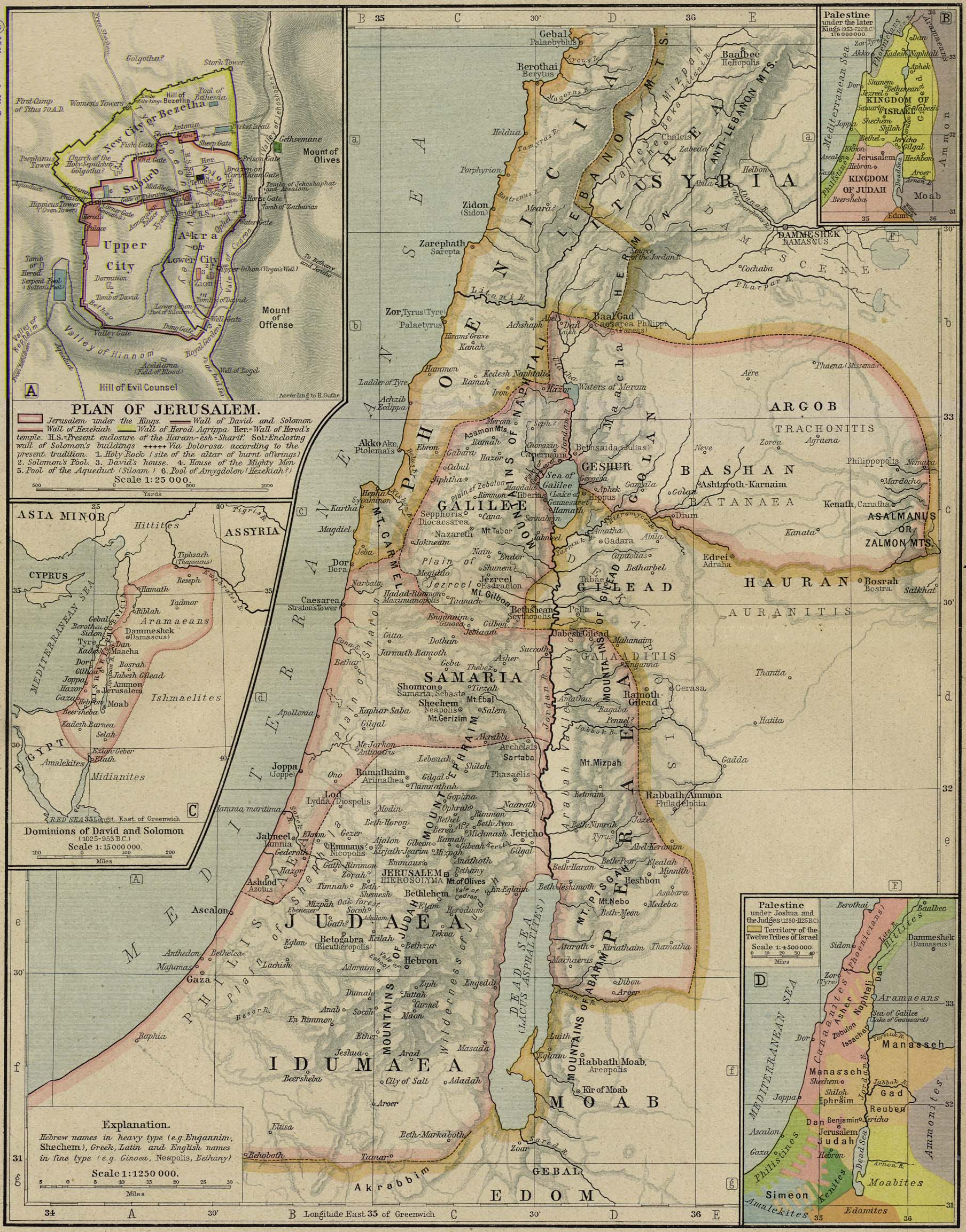
Near Shunem
- Nain3.1 km · 1.9 mi NE
- Jezreel5.5 km · 3.4 mi S
- Mount Tabor10 km · 6.5 mi NE
- Nazareth12 km · 7.2 mi N
- Mount Gilboa13 km · 7.9 mi SE
- Cana of Galilee16 km · 9.8 mi N
Straight-line distances, computed from the gazetteer coordinates.
Where it is
the country around it
- Coordinates
- 32.6056° N, 35.3343° Efind it on the Atlas →
- Region
- Jezreel Valley
- Kind of place
- Town
1 place the record names with Shunem, the farthest 5.5 km away
- Located: the gazetteer fixes one site
- A dashed line ends at a place the gazetteer does not fix
Why Shunem matters
The Shunammite's son, given and raised
2 Kings 4:8-37, in the order it happens
Read 2 Kings 4:8-37, in the order it happens
- A room on the wall for the prophet2 Kings 4:9Then the woman said to her husband, “Behold, now I know that the one who often comes our way is a holy man of God.
- "I have a home among my own people"2 Kings 4:13and Elisha said to Gehazi, “Now tell her, ‘Look, you have gone to all this trouble for us. What can we do for you? Can we speak on your behalf to the king or the commander of the army?’” “I have a home among my own people,” she replied.
- "At this time next year, you will hold a son"2 Kings 4:16And Elisha declared, “At this time next year, you will hold a son in your arms.” “No, my lord,” she said. “Do not lie to your maidservant, O man of God.”
- The boy dies on her lap at noon2 Kings 4:20After the servant had picked him up and carried him to his mother, the boy sat on her lap until noon, and then he died.
- She lays him on the prophet's bed and goes for Elisha2 Kings 4:21And she went up and laid him on the bed of the man of God. Then she shut the door and went out.
- Elisha stretches himself over the boy2 Kings 4:34Then Elisha got on the bed and lay on the boy, mouth to mouth, eye to eye, and hand to hand. As he stretched himself out over him, the boy’s body became warm.
- The boy sneezes seven times and opens his eyes2 Kings 4:35Elisha turned away and paced back and forth across the room. Then he got on the bed and stretched himself out over the boy again, and the boy sneezed seven times and opened his eyes.
- "Pick up your son"2 Kings 4:37She came in, fell at his feet, and bowed to the ground. Then she picked up her son and went out.
Elisha offered to speak to the king or the army commander on her behalf, and she answered that she had a home among her own people and needed nothing. The son she is given comes as Elisha's own idea, not her request.
What happened here, in order
in the order the canon tells it
- Shunem named in the tribal allotment of IssacharJoshua 19:18Their territory included Jezreel, Chesulloth, Shunem,
- The Philistines camp at Shunem before Gilboa1 Samuel 28:4The Philistines came together and camped at Shunem, while Saul gathered all Israel and camped at Gilboa.
- A prominent woman of Shunem persuades Elisha to eat2 Kings 4:8One day Elisha went to Shunem, and a prominent woman who lived there persuaded him to have a meal. So whenever he would pass by, he would stop there to eat.
- The son is born as Elisha promised2 Kings 4:17But the woman did conceive, and at that time the next year she gave birth to a son, just as Elisha had told her.
- Elisha finds the boy dead on his own bed2 Kings 4:32When Elisha reached the house, there was the boy lying dead on his bed.
- "Call the Shunammite woman... pick up your son"2 Kings 4:36Elisha summoned Gehazi and said, “Call the Shunammite woman.” So he called her and she came. Then Elisha said, “Pick up your son.”
- Elisha warns her to leave before a seven-year famine2 Kings 8:1Now Elisha had said to the woman whose son he had restored to life, “Arise, you and your household; go and live as a foreigner wherever you can. For the LORD has decreed a seven-year famine, and it has already come to the land.”
- She appeals to the king as Gehazi is telling her own story2 Kings 8:5And Gehazi was telling the king how Elisha had brought the dead back to life. Just then the woman whose son Elisha had revived came to appeal to the king for her house and her land. So Gehazi said, “My lord the king, this is the woman, and this is the son Elisha restored to life.”
- The king restores all that was hers2 Kings 8:6When the king asked the woman, she confirmed it. So the king appointed for her an officer, saying, “Restore all that was hers, along with all the proceeds of the field from the day that she left the country until now.”
- Abishag the Shunammite is brought to King David1 Kings 1:3Then they searched throughout Israel for a beautiful girl, and they found Abishag the Shunammite and brought her to the king.
- Solomon reads Adonijah's request for Abishag as a claim on the throne1 Kings 2:22King Solomon answered his mother, “Why do you request Abishag the Shunammite for Adonijah? Since he is my older brother, you might as well request the kingdom for him and for Abiathar the priest and for Joab son of Zeruiah!”
- "Come back, come back, O Shulammite"Song of Solomon 6:13Come back, come back, O Shulammite! Come back, come back, that we may gaze upon you. Why do you look at the Shulammite, as on the dance of Mahanaim?
Shunem in Scripture
3 verses name it, in 3 books
Open a book to read its mentions here. Text: Berean Standard Bible.
Old TestamentNew Testamentsegment width = share of mentions
Old Testament3 books · 3 mentions
1 Samuel1 mention
Common questions
Why does the Shunammite woman ask Elisha for nothing when he offers to repay her?
Elisha asks through Gehazi whether she wants a word spoken on her behalf to the king or the army commander, and she answers plainly that she has a home among her own people. She had not been serving Elisha to gain anything. The son she is given comes entirely as Elisha's own idea, prompted by Gehazi's observation that she had no son and her husband was old.
Why did she go to fetch Elisha without telling her husband the boy had died?
She laid her son on the prophet's bed, shut the door, and asked her husband only for a servant and a donkey so she could hurry to Elisha, saying only that it would be well. She acted on a settled expectation that the same prophet who gave her this son through God's word could undo what had happened, and she moved toward that answer instead of stopping to explain her grief first.
How does the Shunammite's son compare to the raising of the widow's son at nearby Nain under Jesus?
Both are only children given back to a mother who had already lost hope of a child, or in the widow's case, already lost her only support. Elisha stretches himself physically over the boy and works through a process, sending Gehazi ahead with his staff first and coming himself after. Jesus at Nain simply touches the coffin and speaks, and the man sits up at once. Both accounts point past the prophet or the healer to the same God who gives life.
Why did the Philistines camp at Shunem before the battle at Gilboa?
Shunem sits on flat ground at the edge of the Jezreel Valley, well suited to chariots, while Gilboa across the valley is high ground where Saul's army camped. The Philistines chose the ground that favored their strength, and once Israel's line broke on the ridge there was nowhere for Saul's men to retreat but further up the slope.
Is the "Shulammite" of Song of Solomon 6:13 a woman of this town?
Readers differ; the positions are named
The Hebrew word differs from "Shunammite" by a single letter, and one reading identifies her as a woman of Shunem, sometimes proposed to be Abishag herself given her place in the account of David's household. Other readings take "Shulammite" simply as a feminine form of Solomon's own name, or leave the identification open. Scripture does not settle which reading is correct.
Has Shunem itself been excavated?
Yes. Archaeologists have excavated Tel Shunem, under the modern village of Sulam, and found occupation layers running from the Late Bronze Age through the Roman and Byzantine periods. The report was published by Karen Covello-Paran and Eran Arie in the Israel Antiquities Authority journal 'Atiqot in 2016.
Sources cited
- OpenBible.info Bible Geocoding: Shunemread 2026-08-20The coordinates on this page. Used under CC-BY with attribution to OpenBible.info.
- Berean Standard BiblePublic domain since 2023. All Scripture quoted on this page, from the site's own verse store.
- Karen Covello-Paran and Eran Arie, "Excavations at Tel Shunem (Sulam): Areas G and G1"'Atiqot 84 (2016), 25-62
Keep studying
On this page
Doorway2
Keep this page