
Luke 22:8
in Luke 22Jesus sent Peter and John, saying, “Go and prepare for us to eat the Passover.”
BSB
The same verse in ASV and KJV ▾
ASV
And he sent Peter and John, saying, Go and make ready for us the passover, that we may eat.
KJV
And he sent Peter and John, saying, Go and prepare us the passover, that we may eat.
⋯
This verse in Luke 22
Commentary
11 notes on this verseAnd he sent Peter and John,.... That is, Jesus sent them, as the Syriac, Persic, and Ethiopic versions express it; these were two favourite disciples of Christ, and were now sent by him from Bethany to Jerusalem: saying, go and prepare us the passover, that we may eat; it together; so servants used to be sent, to go and prepare the passover for their masters; See Gill on Mat 26:17.
This site's exposition
the day of Unleavened Bread
on Luke 22:7-10
On the day of Unleavened Bread Jesus sent Peter and John to prepare the Passover. Asked where, He gives a sign: a man carrying a jug of water will meet them. Carrying water was ordinarily women's work in that culture, so the man would be easy to spot.
This site's exposition
Jesus sent Peter and John
John Gill notes that servants were commonly sent ahead to prepare the Passover for their masters. Here the task goes to two of the closest disciples. Luke alone names the pair, and the same two will stand together again in the early chapters of Acts.
The record, by era
The Church Fathers2 voices
If you fear to lose salvation, know that you can die; and, moreover, death should be contemned by you, for whom Christ was slain. Let the examples of the Lords passion, I beseech you, pass before your eyes; let the offerings, and the rewards, and the distinctions prepared come together before you, and look carefully at both events, how great a difficulty they have between them. For you will not be able to confess unless you know what a great mischief you do if you deny.
Our Lord, in order to leave us a heavenly Passover, ate a typical one, removing the figure, that the truth might take its place.
The Medieval Church3 voices
Now on the same fifth day He sends two of His disciples to prepare the Passover, namely, Peter and John, the one in truth as loving, the other as loved. In all things showing, that even to the end of His life He opposed not the law. And He sends them to a strange house; for He and His disciples had no house, else would He have kept the Passover in one of them. So it is added, And they said, Where will thou that we prepare? He sends them for this reason to an unknown man: to show them that He voluntarily underwent His Passion, since He who so swayed the mind of one unknown to Him, that He should receive them, was able to deal with the Jews just as He wished. But some say that He gave not the name of the man, lest the traitor knowing his name might open the house to the Pharisees, and they should have come and taken Him before that the supper was eaten, and He had delivered the spiritual mysteries to His disciples. But He directs them by particular signs to a certain house; whence it follows, And ye shall say to the goodman of the house, The Master saith, Where is the guestchamber, &c. And he will show you an upper room, &c. By the day of unleavened bread, we must understand that conversation which is wholly in the light of the Spirit, having lost all trace of the old corruption of Adam's first transgression. And living in this conversation, it becomes us to rejoice in the mysteries of Christ. Now these mysteries Peter and John prepare, that is, action and contemplation, fervid zeal and peaceful meekness. And these preparers a certain man meets, because in what we have just mentioned, lies the condition of man who was created after the image of God. And he carries a pitcher of water, which signifies the grace of the Holy Spirit. But the pitcher is humbleness of heart; for He giveth grace to the humble, who know themselves to be but earth and dust.
Second, as regards carrying out the command of the Master, he adds: And he sent Peter and John, saying: Go and prepare the passover for us, that we may eat. He sent Peter and John as the two who were among the others more principal: …
So then, on Thursday, perhaps in the morning, the Lord sends the disciples Peter and John, one as the loving one, the other as the beloved one, and sends them to a "stranger's" house; for neither He Himself nor the disciples had their own, otherwise …
3 more voices on this verse
The Nineteenth Century3 voices
A commentator
J.C. Ryle1816–1900
Expository Thoughts on the Gospels: Luke (lightly modernized text, Grace Gems edition) (1858)
proposed
The chapter which opens with these verses, begins Luke's account of our Lord's sufferings and death. No part of the Gospels is so important as this. The death of Christ — was the life of the world. No part of our Lord's history is so fully given by all the gospel writers as this. Only two of them describe the circumstances of Christ's birth. All four dwell minutely on Christ's death. And of all the four, no one supplies us with such full and interesting details as Luke.
A commentator
J.C. Ryle1816–1900
Expository Thoughts on the Gospels: Luke (lightly modernized text, Grace Gems edition) (1858)
proposed
The chapter which opens with these verses, begins Luke's account of our Lord's sufferings and death. No part of the Gospels is so important as this. The death of Christ — was the life of the world. No part of our Lord's history is so fully given by all the gospel writers as this. Only two of them describe the circumstances of Christ's birth. All four dwell minutely on Christ's death. And of all the four, no one supplies us with such full and interesting details as Luke. We see, firstly, in these verses — that high offices in the church do not preserve the holders of them from great blindness and sin. We read that "the chief priests and scribes sought how they might kill Jesus." The first step in putting Christ to death, was taken by the religious teachers of the Jewish nation. The very men who ought to have welcomed the Messiah — were the men who conspired to kill Him. The very teachers who ought to have rejoiced at the appearing of the Lamb of God — had the chief hand in slaying Him. They sat in Moses' seat. They claimed to be "guides of the blind," and "lights of those who were in darkness." (Romans 2:19.) They belonged to the tribe of Levi. They were, most of them — in direct succession and descent from Aaron. Yet they were the very men who crucified the Lord of glory! With all their boasted knowledge — they were far more ignorant than the few Galilean fishermen who followed Christ. Let us beware of attaching an excessive importance to Christian ministers because of their office. Ordination and religious office confer no exemption from error. The greatest heresies have been sown, and the greatest practical abuses have been introduced into the church — by ordained men! Respect is undoubtedly due to high official position. Order and discipline ought not to be forgotten.
He sent Peter and John, etc. - See the subject of these verses largely explained on Mat 26:17-19 (note), and Mar 14:13, Mar 14:15 (note).
How the passage was read
On Luke 22:1-23On Luke 22:1-23
The cups on the table
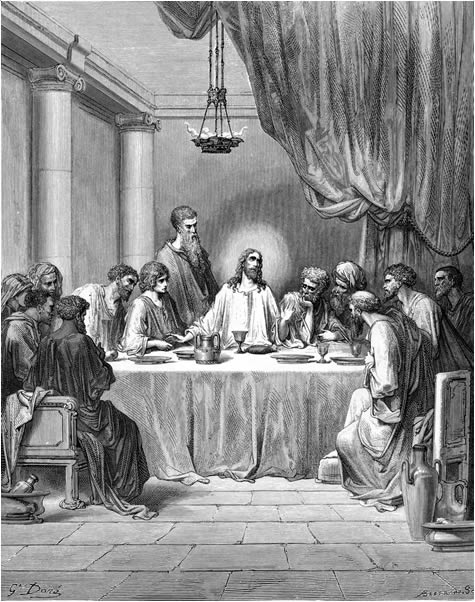
Luke alone records TWO cups (22:17, 22:20), and the detail is at home in the feast: the Passover meal was ordered around four cups of wine, a structure already fixed in the Mishnah, the first written code of Jewish oral law (Pesachim 10:1). Passover (Pesach) is the spring feast remembering the exodus; its meal, the seder (“order”), moved through blessing, story, and psalm with a cup at each station. Jesus takes the feast's own furniture, and at the cup after supper says the words that made it new: “this cup... is the new covenant in my blood.”
The seder as Jewish families keep it today descends from the same order, reshaped after the Temple fell in AD 70; the lamb on the table then is matzah and remembrance now.
This section is reception history: how the passage was read and kept in the Jewish tradition. Where a reading parts from an essential of the Christian faith, the section says so at that point.
Sources: Mishnah Pesachim 10:1 (the four cups) · The Lord's Supper (this site's study)
The words behind it
13 Greek wordsEvery Greek word of this verse in the order it stands, with what it means and the door to its own study. The last column counts the times a word stands in the whole Bible: the rarer the word, the more the places it appears belong together.
| Greek | Sound | Meaning | Word study | In the Bible |
|---|---|---|---|---|
| καὶ | kai | And | G2532 → | 9120 times |
| ἀπέστειλεν | apesteilen | He sent | G649 → | 132 times |
| Πέτρον | petron | Peter | G4074 → | 155 times |
| καὶ | kai | and | G2532 → | 9120 times |
| Ἰωάννην | ioannen | John | G2491 → | 134 times |
| εἰπών· | eipon | having said; | G2036 → | 925 times |
| πορευθέντες | poreuthentes | Having gone | G4198 → | 147 times |
| ἑτοιμάσατε | hetoimasate | do prepare | G2090 → | 40 times |
| ἡμῖν | hemin | for us | G3165 → | 1936 times |
| τὸ | to | the | G3588 → | 19766 times |
| πάσχα | pascha | Passover | G3957 → | 29 times |
| ἵνα | ina | that | G2443 → | 668 times |
| φάγωμεν. | phagomen | we may eat [it]. | G5315 → | 93 times |
καὶAnd
kaiG2532 →9120 times
ἀπέστειλενHe sent
apesteilenG649 →132 times
ΠέτρονPeter
petronG4074 →155 times
καὶand
kaiG2532 →9120 times
ἸωάννηνJohn
ioannenG2491 →134 times
εἰπών·having said;
eiponG2036 →925 times
πορευθέντεςHaving gone
poreuthentesG4198 →147 times
ἑτοιμάσατεdo prepare
hetoimasateG2090 →40 times
ἡμῖνfor us
heminG3165 →1936 times
τὸthe
toG3588 →19766 times
πάσχαPassover
paschaG3957 →29 times
ἵναthat
inaG2443 →668 times
φάγωμεν.we may eat [it].
phagomenG5315 →93 times
A shaded row is a word that stands 400 times or fewer in the Bible.
The walk
8 stopsEach card is a verse this one points to, and under it the verses that one points to in turn. Where several paths arrive at the same place, that place is listed first: the text keeps returning to it.
Through
Acts 4:13When they saw the boldness of Peter and John and realized that they were unschooled, ordinary men, they marveled and took note that these men had been with Jesus.
it leads to
- 1 Corinthians 1:27
But God chose the foolish things of the world to shame the wise; God chose the weak things of the world to shame the strong.
- John 7:15
The Jews were amazed and asked, “How did this man attain such learning without having studied?”
- Matthew 11:25
At that time Jesus declared, “I praise You, Father, Lord of heaven and earth, because You have hidden these things from the wise and learned, and revealed them to little children.
- Acts 2:7–12
Astounded and amazed, they asked, “Are not all these men who are speaking Galileans?
- 1 Corinthians 1:27
Through
Acts 3:1One afternoon Peter and John were going up to the temple at the hour of prayer, the ninth hour.
it leads to
- Psalms 55:17
Morning, noon, and night, I cry out in distress, and He hears my voice.
- Acts 10:3
One day at about the ninth hour, he had a clear vision of an angel of God who came to him and said, “Cornelius!”
- Acts 4:13
When they saw the boldness of Peter and John and realized that they were unschooled, ordinary men, they marveled and took note that these men had been with Jesus.
- Luke 1:10
And at the hour of the incense offering, the whole congregation was praying outside.
- Psalms 55:17
Where this verse is studied
On this page
Studies25
On this verse
On this chapter
- The Covenants
- Forgiving Yourself: What Scripture Says
- Gethsemane (The Garden Called the Oil Press)
- Hospitality
- Jesus on Discipleship
- Jesus on the Kingdom
Show the next 6 titles
About Luke
This page draws on 9 works. Open the list of works
This page draws on Adam Clarke, Commentary on the Bible; Albert Barnes, Notes, Explanatory and Practical, on the Gospels; Bonaventure, Commentary on Luke, Chapter 22; Cyprian, Pseudo-Cyprian On the Glory of Martyrdom; J.C. Ryle, Expository Thoughts on the Gospels: Luke (lightly modernized text, Grace Gems edition); John Gill, Exposition of the New Testament (1746-1748); Theophylact of Ohrid, Catena Aurea by Aquinas; Theophylact of Ohrid, Commentary on Luke and Titus of Bostra, Catena Aurea by Aquinas.