
Luke 22:18
in Luke 22For I tell you that I will not drink of the fruit of the vine from now on until the kingdom of God comes.”
BSB
The same verse in ASV and KJV ▾
ASV
for I say unto you, I shall not drink from henceforth of the fruit of the vine, until the kingdom of God shall come.
KJV
For I say unto you, I will not drink of the fruit of the vine, until the kingdom of God shall come.
⋯
This verse in Luke 22
Commentary
17 notes on this verseWhen he came to his passion, he wanted to declare to Abraham and those with him the good news of the opening of the inheritance. After he gave thanks while holding the cup and then drank from it … he promised that he would again drink of the produce of the vine with his disciples. Christ thus showed the inheritance of the earth, in which the new produce of the vine is drunk, and the physical resurrection of his disciples.
This site's exposition
divide it among yourselves
on Luke 22:17-18
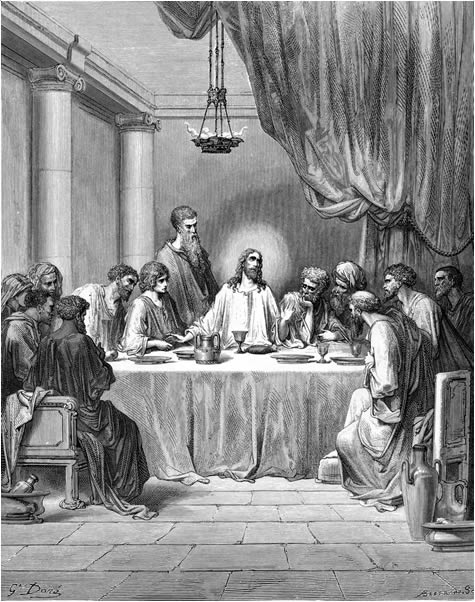
He gave thanks for the cup and said to them, Take this and divide it among yourselves. Luke places it, one of several Passover cups, before the bread of verse 19. He will not drink of the fruit of the vine from now on until the kingdom of God comes.
This site's exposition
until the kingdom of God comes
Theophylact takes the kingdom of God here as the resurrection, since it destroyed death. On his reading the vow looks to the risen Christ, who ate and drank with his disciples to prove the resurrection real. It pairs with the vow in verse 16.
The record, by era
The Church Fathers2 voices
He said, "I will not drink again of this fruit of the vine until the kingdom of my Father," to show that he foresaw his imminent departure from them. He said, "until the kingdom of my Father," that is, until his resurrection. Simon Peter revealed …
(conc. de Laz.) Remember then when thou sittest down to meat that after the meal thou must pray; therefore satisfy thy hunger, but with moderation, lest being overcharged thou shouldest not be able to bend thy knees in supplication and prayer to God. Let us not then after our meals turn to sleep, but to prayer. For Christ plainly signifies this, that the partaking of food should not be followed by sleep or rest, but by prayer and reading the holy Scripture. It follows, For I say unto you, I will not drink of the fruit of the vine, until the kingdom of God come.
The Medieval Church3 voices
The resurrection is called the kingdom of God, because it has destroyed death. Therefore David also says, The Lord reigneth: He hath put on beauty, (Ps. 93:1.) that is, a beautiful robe, having put off the corruption of the flesh. (Isa. 63:1.) But when the resurrection comes, He again drinks with His disciples; to prove that the resurrection was not a shadow only.
For I tell you, I will not drink of the fruit of the vine until the kingdom of God comes. This verse can indeed be taken simply, that from this hour of the supper until the time of the resurrection, when He would come in …
This may be also taken literally, for from the hour of supper up to the time of resurrection He was about to drink no wine. Afterwards He partook both of meat and drink, as Peter testifies, Who did eat and drink with him after he rose from the dead. (Acts 10:41.)
9 more voices on this verse
The Medieval Church3 voices
But it is far more natural, that as before of the typical lamb, so now also of the drink of the Passover, He should say that He would no more taste, until the glory of the kingdom of God being made manifest, the faith of the whole world should appear; that so by means of the spiritual changing of the two greatest commands of the law, namely, the eating and drinking of the Passover, you might learn that all the Sacraments of the law were to be transferred to a spiritual observance.
The words "I will not drink of the fruit of the vine until the Kingdom of God comes" some of the saints understood thus: until I rise again. For after the resurrection, while spending time with the disciples, He ate and drank with them, as …
And therefore it is added: For I say to you, that I will not drink of the fruit of the vine, until the kingdom of God comes: which is indeed true, whether the kingdom of God is understood to be justice, according to Romans 14: …
The Puritans and the Awakening3 voices
In the great day you shall sit on thrones, as assessors with Christ, to approve of and applaud his judgment of the twelve tribes of Israel. " If the saints shall judge the world ( 1 Cor. vi.
quarantine:debris (2026-07-29) — unbalanced-parens+odd-straight-quotes
For I say unto you, I will not drink of the fruit of the vine,....
I will not drink of the fruit of the vine any more, I will not have it any more drank of, till the kingdom of God shall come, till the Spirit be poured out, and then you shall in the Lord's supper commemorate a much more glorious redemption, of which both the deliverance out of Egypt and the passover commemoration of it were types and figures.
The Nineteenth Century3 voices
A commentator
J.C. Ryle1816–1900
Expository Thoughts on the Gospels: Luke (lightly modernized text, Grace Gems edition) (1858)
proposed
These verses contain Luke's account of the institution of the Lord's supper. It is a passage which every true Christian will always read with deep interest. How astonishing it seems that an ordinance, so beautifully simple at its first appointment, should have been obscured and mystified by man's inventions! What a painful proof it is of human corruption — that some of the bitterest controversies which have disturbed the Church, have been concerning the table of the Lord. Great indeed is the ingenuity of man, in perverting God's gifts!
A commentator
J.C. Ryle1816–1900
Expository Thoughts on the Gospels: Luke (lightly modernized text, Grace Gems edition) (1858)
proposed
These verses contain Luke's account of the institution of the Lord's supper. It is a passage which every true Christian will always read with deep interest. How astonishing it seems that an ordinance, so beautifully simple at its first appointment, should have been obscured and mystified by man's inventions! What a painful proof it is of human corruption — that some of the bitterest controversies which have disturbed the Church, have been concerning the table of the Lord. Great indeed is the ingenuity of man, in perverting God's gifts! The ordinance that should have been for his wealth — is too often made an occasion of stumbling. We should notice, for one thing in these verses — that the principal object of the Lord's supper was to remind Christians of Christ's death for sinners. In appointing the Lord's supper, Jesus distinctly tells His disciples that they were to do what they did, "in remembrance of Me." In one word, the Lord's supper is not a sacrifice. It is eminently a commemorative ordinance. The bread that the believer eats at the Lord's table, is intended to remind him of Christ's body given to death on the cross for his sins. The wine that he drinks, is intended to remind him of Christ's blood shed to make atonement for his transgressions. The whole ordinance was meant to keep fresh in his memory — the sacrifice of Christ on the cross, and the satisfaction which that sacrifice made for the sin of the world. The two elements of bread and wine were intended to preach Christ crucified as our substitute under lively emblems. They were to be a visible sermon, appealing to the believer's senses, and teaching the old foundation-truth of the Gospel — that Christ's death on the cross, is the life of man's soul. We shall do well to keep this simple view of the Lord's supper steadily in view.
I will not drink of the fruit of the vine - That is, before the time of another passover, the Holy Ghost shall descend, the Gospel of the kingdom be established, and the sacramental supper shall take place of the paschal lamb; for in a few hours his crucifixion was to take place. See on Mat 26:29 (note).
How the passage was read
On Luke 22:1-23On Luke 22:1-23
The cups on the table
Luke alone records TWO cups (22:17, 22:20), and the detail is at home in the feast: the Passover meal was ordered around four cups of wine, a structure already fixed in the Mishnah, the first written code of Jewish oral law (Pesachim 10:1). Passover (Pesach) is the spring feast remembering the exodus; its meal, the seder (“order”), moved through blessing, story, and psalm with a cup at each station. Jesus takes the feast's own furniture, and at the cup after supper says the words that made it new: “this cup... is the new covenant in my blood.”
The seder as Jewish families keep it today descends from the same order, reshaped after the Temple fell in AD 70; the lamb on the table then is matzah and remembrance now.
This section is reception history: how the passage was read and kept in the Jewish tradition. Where a reading parts from an essential of the Christian faith, the section says so at that point.
Sources: Mishnah Pesachim 10:1 (the four cups) · The Lord's Supper (this site's study)
The words behind it
22 Greek wordsEvery Greek word of this verse in the order it stands, with what it means and the door to its own study. The last column counts the times a word stands in the whole Bible: the rarer the word, the more the places it appears belong together.
| Greek | Sound | Meaning | Word study | In the Bible |
|---|---|---|---|---|
| λέγω | lego | I say | G3004 → | 1325 times |
| γὰρ | gar | for | G1063 → | 1039 times |
| ὑμῖν· | humin | to you; | G4771 → | 2973 times |
| ὅτι | hoti | that | G3754 → | 1292 times |
| οὐ | ou | certainly | G3756 → | 1664 times |
| μὴ | me | not | G3361 → | 1066 times |
| πίω | pio | shall I drink | G4095 → | 72 times |
| ἀπὸ | apo | from | G575 → | 640 times |
| τοῦ | tou | <the> | G3588 → | 19766 times |
| νῦν | nun | now | G3568 → | 145 times |
| ἀπὸ | apo | of | G575 → | 640 times |
| τοῦ | tou | the | G3588 → | 19766 times |
| γενήματος | genematos | fruit | ||
| τῆς | tes | of the | G3588 → | 19766 times |
| ἀμπέλου | ampelou | vine | G288 → | |
| ἕως | he'os | until | G2193 → | 146 times |
| οὗ | hou | that [time] | G3739 → | 1405 times |
| ἡ | he | the | G3588 → | 19766 times |
| βασιλεία | basileia | kingdom | G932 → | 162 times |
| τοῦ | tou | <the> | G3588 → | 19766 times |
| θεοῦ | theou | of God | G2316 → | 1312 times |
| ἔλθῃ.¶ | elthe | may come. | G2064 → | 628 times |
λέγωI say
legoG3004 →1325 times
γὰρfor
garG1063 →1039 times
ὑμῖν·to you;
huminG4771 →2973 times
ὅτιthat
hotiG3754 →1292 times
οὐcertainly
ouG3756 →1664 times
μὴnot
meG3361 →1066 times
πίωshall I drink
pioG4095 →72 times
ἀπὸfrom
apoG575 →640 times
τοῦ<the>
touG3588 →19766 times
νῦνnow
nunG3568 →145 times
ἀπὸof
apoG575 →640 times
τοῦthe
touG3588 →19766 times
γενήματοςfruit
genematos
τῆςof the
tesG3588 →19766 times
ἀμπέλουvine
ampelouG288 →
ἕωςuntil
he'osG2193 →146 times
οὗthat [time]
houG3739 →1405 times
ἡthe
heG3588 →19766 times
βασιλείαkingdom
basileiaG932 →162 times
τοῦ<the>
touG3588 →19766 times
θεοῦof God
theouG2316 →1312 times
ἔλθῃ.¶may come.
eltheG2064 →628 times
A shaded row is a word that stands 400 times or fewer in the Bible.
The walk
8 stopsEach card is a verse this one points to, and under it the verses that one points to in turn. Where several paths arrive at the same place, that place is listed first: the text keeps returning to it.
Through
Colossians 1:13He has rescued us from the dominion of darkness and brought us into the kingdom of His beloved Son,
it leads to
- Ephesians 5:8
For you were once darkness, but now you are light in the Lord. Walk as children of light,
- Acts 26:18
to open their eyes, so that they may turn from darkness to light and from the power of Satan to God, that they may receive forgiveness of sins and an inheritance among those sanctified…
- 1 Peter 2:9
But you are a chosen people, a royal priesthood, a holy nation, a people for God’s own possession, to proclaim the virtues of Him who called you out of darkness into His marvelous light.
- Titus 3:3–6
For at one time we too were foolish, disobedient, misled, and enslaved to all sorts of desires and pleasures—living in malice and envy, being hated and hating one another.
- 1 Thessalonians 2:12
encouraging you, comforting you, and urging you to walk in a manner worthy of God, who calls you into His own kingdom and glory.
- Ephesians 5:8
Through
Isaiah 55:1“Come, all you who are thirsty, come to the waters; and you without money, come, buy, and eat! Come, buy wine and milk without money and without cost!
it leads to
- John 7:37–38
On the last and greatest day of the feast, Jesus stood up and called out in a loud voice, “If anyone is thirsty, let him come to Me and drink.
- Revelation 21:6
And He told me, “It is done! I am the Alpha and the Omega, the Beginning and the End. To the thirsty I will give freely from the spring of the water of life.
- Revelation 22:17
The Spirit and the bride say, “Come!” Let the one who hears say, “Come!” And let the one who is thirsty come, and the one who desires the water of life drink freely.
- John 7:37–38
Where this verse is studied
On this page
Studies25
On this chapter
About Luke
This page draws on 13 works. Open the list of works
This page draws on Adam Clarke, Commentary on the Bible; Albert Barnes, Notes, Explanatory and Practical, on the Gospels; Bede, On the Gospel of Luke; Bede, Catena Aurea by Aquinas; Bonaventure, Commentary on Luke, Chapter 22; Ephrem the Syrian, COMMENTARY ON TATIAN'S DIATESSARON 19.5; Irenaeus, AGAINST HERESIES 5.33.1; J.C. Ryle, Expository Thoughts on the Gospels: Luke (lightly modernized text, Grace Gems edition); John Chrysostom, Catena Aurea by Aquinas; John Gill, Exposition of the New Testament (1746-1748); Matthew Henry, Commentary on the Whole Bible; Theophylact of Ohrid, Catena Aurea by Aquinas and Theophylact of Ohrid, Commentary on Luke.