
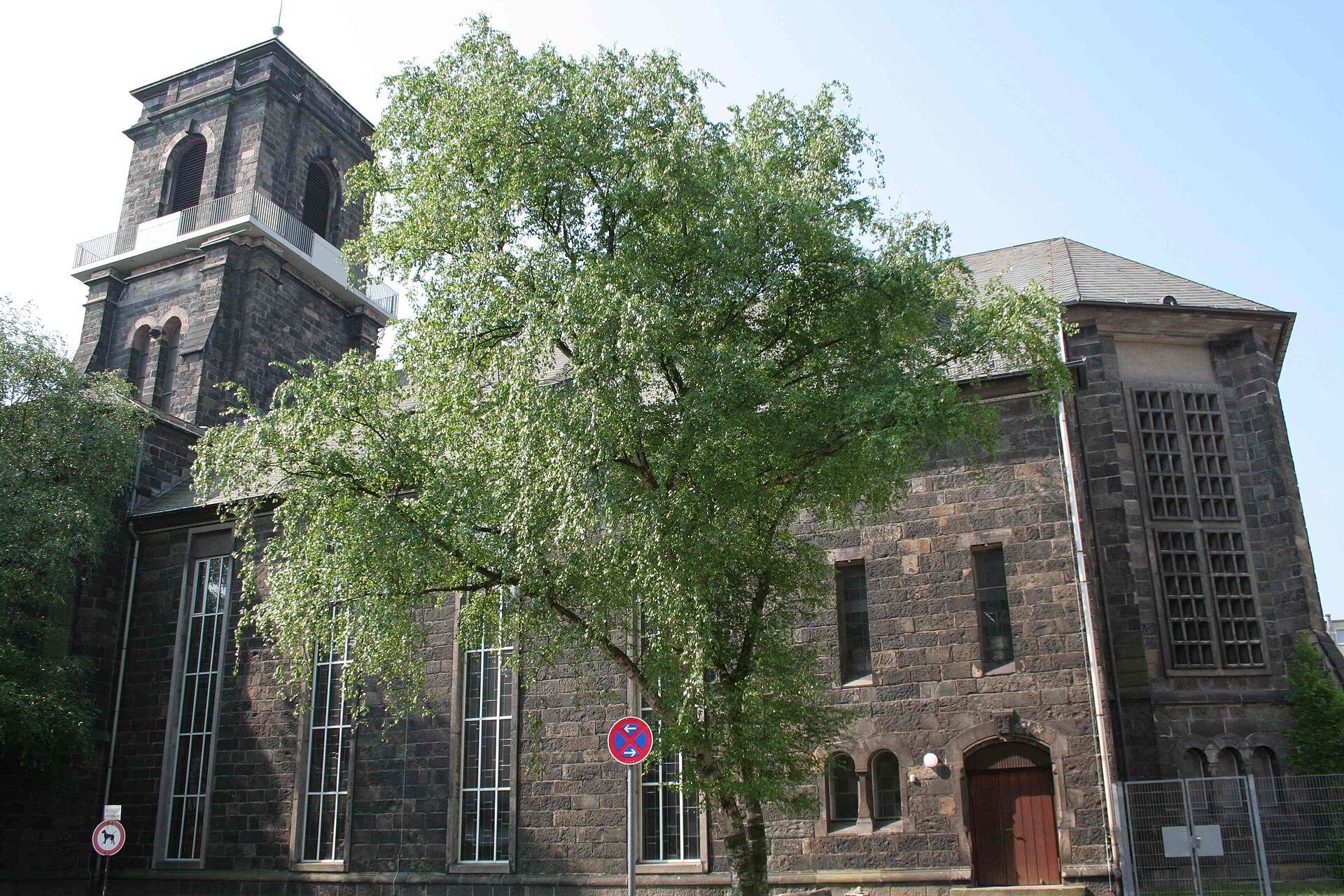
Scribo, the Gemarke Church at Wuppertal-Barmen, 2007. Public domain.
Germany under Hitler · Story · Featured Study
The Confessing Church
German pastors who refused the racial church of the German Christians faced the courts and the camps, and a few of them died there.
- Where
- Barmen, Dahlem, Finkenwalde, Buchenwald
- Who
- Martin Niemöller, Karl Barth, Paul Schneider, Dietrich Bonhoeffer
- When
- From the church elections to April 1945
From the barred window of his cell at Buchenwald, Paul Schneider called Bible verses and accusations to the prisoners on the roll-call ground.
Jesus answered, “I am the way and the truth and the life. No one comes to the Father except through Me.
Summary
The Confessing Church grew out of a protest by pastors. It declared itself at Barmen from 29 to 31 May 1934. Karl Barth wrote most of its theses, and Hans Asmussen is named as co-drafter. The first thesis held that Christ is the one Word of God the church must hear.
- The Rhineland church counts 139 delegates at Barmen, 138 men and one woman.
- That same church says Barmen said nothing on the racial persecution of the Jews.
- Bonhoeffer's Nachfolge came out at Munich and reached English as The Cost of Discipleship in October 1948.
The Texts of Barmen
Barmen headed each thesis with a verse.
This study asks what the Confessing Church confessed, what it cost the people who held to it, and where it stayed silent. It gives four men's ends, the story from the Aryan paragraph to Flossenbürg, and six sayings with the witness each one rests on. It also sets out where historians differ, over whether the church resisted the state or defended itself, and over Bonhoeffer's part in the conspiracy.
Treat everyone with high regard: Love the brotherhood of believers, fear God, honor the king.
Barmen set these words at the head of its fifth thesis, the one on what the state may and may not claim.
1 Peter 2:17BSB
But Peter and the other apostles replied, “We must obey God rather than men.
Elsa-Ulrike Ross, who chairs the society named for Paul Schneider, gives this verse as the rule of his life.
Acts 5:29BSB
What It Cost Four Men
A lawyer and three pastors came to their ends by different roads.
Weißler and Schneider died in the camps before the war, Niemöller survived eight years of custody, and Bonhoeffer was hanged in the war's last weeks.
| The man | Who he was | What followed | The witness |
|---|---|---|---|
| Friedrich Weißler | A church lawyer with a key part in the memorandum to Hitler | Arrested in October 1936, murdered at Sachsenhausen in February 1937 | German Resistance Memorial Center |
| Martin Niemöller | Pastor at Dahlem | Arrested 1 July 1937 and held until 1945 | United States Holocaust Memorial Museum |
| Paul Schneider | Pastor of Dickenschied and Womrath | Killed at Buchenwald on 18 July 1939 | Buchenwald Memorial |
| Dietrich Bonhoeffer | A pastor who came back from America in July 1939 | Arrested 5 April 1943, hanged 9 April 1945 | Flossenbürg Memorial |
From the Aryan Paragraph to Flossenbürg
The quarrel began inside the church and ended with its people in the state's hands.
The German Christians took up the nationalist and racial parts of Nazi teaching and wanted one Reich Church. With Hitler's support they won a two-thirds majority in the church elections of 23 July 1933. Ludwig Müller became Reich Bishop at the end of September.
On 6 and 7 September the Old Prussian Synod brought in the Aryan paragraph, and Niemöller and others founded the Pastors' Emergency League in answer. The German Historical Museum says about 7,000 pastors had joined by January 1934, about a third of the Protestant clergy.
At the Sports Palace rally that year Reinhold Krause and the German Christians demanded that the Old Testament be excluded. In November their movement split as members left in large numbers. After Barmen, the Dahlem synod of 19 and 20 October proclaimed the church's emergency law.
When a protest was read from Confessing pulpits in March 1935 the authorities briefly arrested over 700 pastors, by the Holocaust Museum's count. A secret memorandum went to Hitler in May 1936, naming the camps and antisemitism, and a pulpit statement of 30 August owned it. In 1937 alone, the German Historical Museum says, nearly 800 Confessing pastors and church lawyers were brought to court.
Niemöller was convicted in February 1938 and given seven months and a fine, a sentence already served. The Gestapo sent him to Sachsenhausen anyway, and to Dachau in 1941. Bonhoeffer's seminary, first at Zingst and later at Finkenwalde, ran from 1935 until the state closed it.
Paul Schneider4 paragraphs
Schneider, born in 1897, briefly joined the German Christians in July 1933 and then turned against them. The church authorities moved him in 1934 to Dickenschied and Womrath in the Hunsrück, where he joined the Confessing Church.
The Gestapo expelled him from the Rhine Province in July 1937. He held himself committed to serving his congregations, so he came back and led the harvest service at Dickenschied on 3 October. He was arrested that day, and reached Buchenwald in late November.
At the flag ceremony on Hitler's birthday in 1938 he would not take off his cap, and the SS locked him in the detention block for the rest of his life. Ernst Cramer, held there six weeks after the pogrom of 1938, remembered his voice carrying the beatitude of the persecuted over the roll-call ground.
The camp doctor Erwin Ding-Schuler killed him with an overdose of strophanthin. While he was held, the Rhineland church's leadership worked with the Gestapo to retire him.
The Sayings and Their Witnesses
Six sayings go about under two names, and each one stands on a different footing.
Two stand in Bonhoeffer's writings, one rests on a witness, Niemöller's has no fixed text, and two are attributed to Bonhoeffer with no source found.
| The saying | The verdict | What it rests on |
|---|---|---|
| "When Christ calls a man, He bids him come and die" | In the book | Fuller's abridged English of 1948; Rainer Mayer quotes the German as "Jeder Ruf Christi führt in den Tod" |
| "put a spoke in the wheel" | In the essay, in other English | The critical edition, volume 12, page 353, in the Holocaust Museum's summary; Huber shows it was a common idiom |
| "This is the end. For me the beginning of life" | Reported | The English officer Payne Best, as Bethge quotes him in Bonhoeffer's letters |
| "First they came for the socialists" | A form, with no fixed text | Harold Marcuse found no text Niemöller authorized; a prose form of 6 January 1946 and a verse form by 1955 |
| "Silence in the face of evil is itself evil" | Attributed | Warren Throckmorton quotes Victoria Barnett that it appears nowhere in his writings, and he finds it first in 1998 |
| "Not to speak is to speak. Not to act is to act" | Attributed | Printed with it in the same lists; Doris Bergen wrote in 2013 that the formulation has not been found in his works |
Barmen and the Jews
Movements in the German churches defended converted members far more readily than church leaders opposed antisemitism.
Bonhoeffer finished his essay "The Church and the Jewish Question" by 15 April 1933. It says the church may have to fall into the spokes of the wheel itself. The Holocaust Museum notes that the same essay repeats traditional anti-Jewish teaching.
Barth later called it a fault of his own that he had not made the Jewish question decisive, as the Rhineland church quotes him. The Museum records that Niemöller telegraphed Hitler his congratulations that October and stayed an outspoken antisemite through the 1930s. It finds virtually no public opposition from church leaders to antisemitism.
The Confession at Stuttgart
The German church's leaders accused themselves before visitors from the churches abroad.
On 19 October 1945 the Council of the Evangelical Church in Germany met representatives of the World Council of Churches at Stuttgart. Niemöller and Asmussen were among the eleven who signed.
“we accuse ourselves for not witnessing more courageously, for not praying more faithfully, for not believing more joyously, and for not loving more ardently.”
The Council of the Evangelical Church in Germany · The Stuttgart Declaration, at DialogikaGerman Protestant
How the Key Verse Was Taught
Three writers of the early church on Christ as the one way and the truth, the verse at the head of Barmen's first thesis.
Tertullian (died 220)
On the Veiling of Virgins
Tertullian set Christ's name of Truth against any custom that resists Him.
“For these, for the most part, are the sources whence, from some ignorance or simplicity, custom finds its beginning; and then it is successionally confirmed into an usage, and thus is maintained in opposition to truth. But our Lord Christ has surnamed Himself Truth, not Custom.”
on John 14:6Patristic
Ambrose of Milan (died 397)
DEATH AS A GOOD 12.55
Ambrose of Milan turned the verse into a prayer to be led only by Christ.
“Lord Jesus, we do follow you, but we can come only at your bidding. No one can make the ascent without you, for you are our way, our truth, our life, our strength, our confidence, our reward. Be the way that receives us, the truth that strengthens us, the life that invigorates us.”
on John 14:6Patristic
Peter Chrysologus (died 450)
SERMON 16.4
Peter Chrysologus preached that God is reached by no road except through God.
“‘I am the way,’ he says, so that the power of demons may not prevail in impeding those coming to the way through the Way, to God through God. It is not possible to attain to God except through God.”
on John 14:6Patristic
In Their Own Words
Three sentences of Barmen in the English the German church publishes, with two men's letters.
Paul Schneider (1897 to 1939)
Letter to his wife, in the Buchenwald Memorial's English
From Buchenwald
“How quickly the weeks and months fly by for us younger ones, too, despite our tribulations! May we only learn and grow through what is set before us, and overcome it!”
German Protestant
About this saying1 paragraph
Paul Schneider wrote this to his wife Margarete on 3 July 1939, fifteen days before he died, and the Buchenwald Memorial gives it in English.
Dietrich Bonhoeffer (1906 to 1945)
Letter to Niebuhr, in Christian History (1991)
Going back
“I have come to the conclusion that I have made a mistake in coming to America. I must live through this difficult period of our national history with the Christian people of Germany.”
Confessing Church
About this saying1 paragraph
Bonhoeffer wrote this to Reinhold Niebuhr in 1939 as Christian History gave it in 1991, and other printings word it differently.
The Synod of Barmen
The Barmen Declaration, thesis 1
Still other events and powers
“We reject the false doctrine, as though the church could and would have to acknowledge as a source of its proclamation, apart from and besides this one Word of God, still other events and powers, figures and truths, as God's revelation.”
Barmen synod
About this saying1 paragraph
The first thesis of 1934 named what the church could not hear beside Christ.
The Synod of Barmen
The Barmen Declaration, thesis 5
Justice and peace
“Scripture tells us that, in the as yet unredeemed world in which the church also exists, the state has by divine appointment the task of providing for justice and peace.”
Barmen synod
About this saying1 paragraph
The fifth thesis of 1934 began with the task God gave the state.
The Synod of Barmen
The Barmen Declaration, thesis 5
The single and totalitarian order
“We reject the false doctrine, as though the state, over and beyond its special commission, should and could become the single and totalitarian order of human life, thus fulfilling the church's vocation as well.”
Barmen synod
About this saying1 paragraph
The same thesis of 1934 then refused the larger claim.
Where Historians Differ
They differ over what kind of stand Barmen was, over Bonhoeffer's part in the plot and over how he died.
Did it resist the state or defend the church?2 paragraphs
Nicole Kuropka and Thomas Martin Schneider, church historians, said in 2024 that Barmen was no declaration of resistance to Hitler. Schneider says many delegates were German nationalists and some were Nazi Party members.
The authors of the memorandum of 1936, Weißler among them, carried Barmen's refusal of the state's total claim into a protest to Hitler over the camps.
How far was Bonhoeffer a conspirator?2 paragraphs
Eberhard Bethge, his friend and biographer, writes that he "no longer saw any way of escape into some region of piety". Michael DeJonge quotes Bethge's report that Bonhoeffer was prepared to kill Hitler if it fell to him. Charles Marsh, in Strange Glory (2014), holds that by 1940 he had joined the conspiracy.
Sabine Dramm judges his part slight, "a modest balance sheet of operational steps, specific missions, and factual results", as DeJonge quotes her. Victoria Barnett reports her view that Bethge's own telling shaped the story.
How did he die?1 paragraph
The camp doctor H. Fischer-Hüllstrung gave an account in 1955 of Bonhoeffer praying before the execution, and the Augsburg court's judgment of that year puts him there. Vito Mancuso, writing in la Repubblica in 2015, calls that account a cover story, citing the Danish survivor Jørgen Mogensen.
Books to Read Next
The Barmen Declaration
The Synod of Barmen · 1934
These are the six theses in the English the German church publishes.
Read Barmen free at the EKDPrisoner for God
Dietrich Bonhoeffer, edited by Eberhard Bethge · 1959
Bethge's foreword and Bonhoeffer's letters from Tegel prison are the record of his last years.
Read Prisoner for God free at the Internet ArchiveWhat Barmen Left
The first thesis of Barmen stands today in the Book of Confessions of the Presbyterian Church (U.S.A.). The German church takes its English from there.
Sources
Scripture is the Berean Standard Bible.
- The Holy Bible, Berean Standard Bible (read 2026)
- The Theological Declaration of Barmen (31 May 1934), the EKD's English text from the Presbyterian Book of Confessions.
- LeMO, German Historical Museum, "Bekennende Kirche" and "Deutsche Christen".
- United States Holocaust Memorial Museum, Holocaust Encyclopedia, "The German Churches and the Nazi State".
- United States Holocaust Memorial Museum, Holocaust Encyclopedia, Martin Niemöller.
- United States Holocaust Memorial Museum, Holocaust Encyclopedia, Dietrich Bonhoeffer.
- German Resistance Memorial Center, biographies of Friedrich Weißler and Dietrich Bonhoeffer.
- Buchenwald Memorial, biography of Paul Schneider.
- Evangelischer Pressedienst, on Paul Schneider, evangelisch.de, 19 July 2014.
- Evangelischer Pressedienst, on Barmen, evangelisch.de, 27 May 2024.
- Evangelische Kirche im Rheinland, Themenpaket Barmer Theologische Erklärung.
- Flossenbürg Memorial, Dietrich Bonhoeffer.
- Dietrich Bonhoeffer, Prisoner for God: Letters and Papers from Prison, edited by Eberhard Bethge (Macmillan, 1959; copyright 1953), the Editor's Foreword, quoting S. Payne Best, The Venlo Incident.
- Dietrich Bonhoeffer, The Cost of Discipleship, translated by R. H. Fuller (Macmillan, 1948 and 1949)
- Wolfgang Huber, Blätter 4/2020, and WiBiLex, on Die Kirche vor der Judenfrage, Dietrich Bonhoeffer Werke 12, page 353.
- Harold Marcuse, "Martin Niemöller's famous quotation" (UCSB, updated 22 April 2021)
- Warren Throckmorton, "The Popular Bonhoeffer Quote That Isn't in Bonhoeffer's Works", 25 August 2016, and a second post.
- The Stuttgart Declaration of Guilt (19 October 1945), English text, Council of Centers on Jewish-Christian Relations (Dialogika)
- Christian History 32 (1991), Bonhoeffer's letter to Niebuhr.
- Michael DeJonge, review of Sabine Dramm, Christian Century, 30 October 2013, quoting Bethge.
- Victoria Barnett, review of Sabine Dramm, Contemporary Church History, May 2008.
- Charles Marsh, Strange Glory (Knopf, 2014), the publisher's question and answer.
- Passau teaching sheet, quoting Justiz und NS-Verbrechen, volume 8, number 420.
- Vito Mancuso, la Repubblica, 9 April 2015.
Keep Studying
People and groups6
Church history6
Trials of life1
Values1