
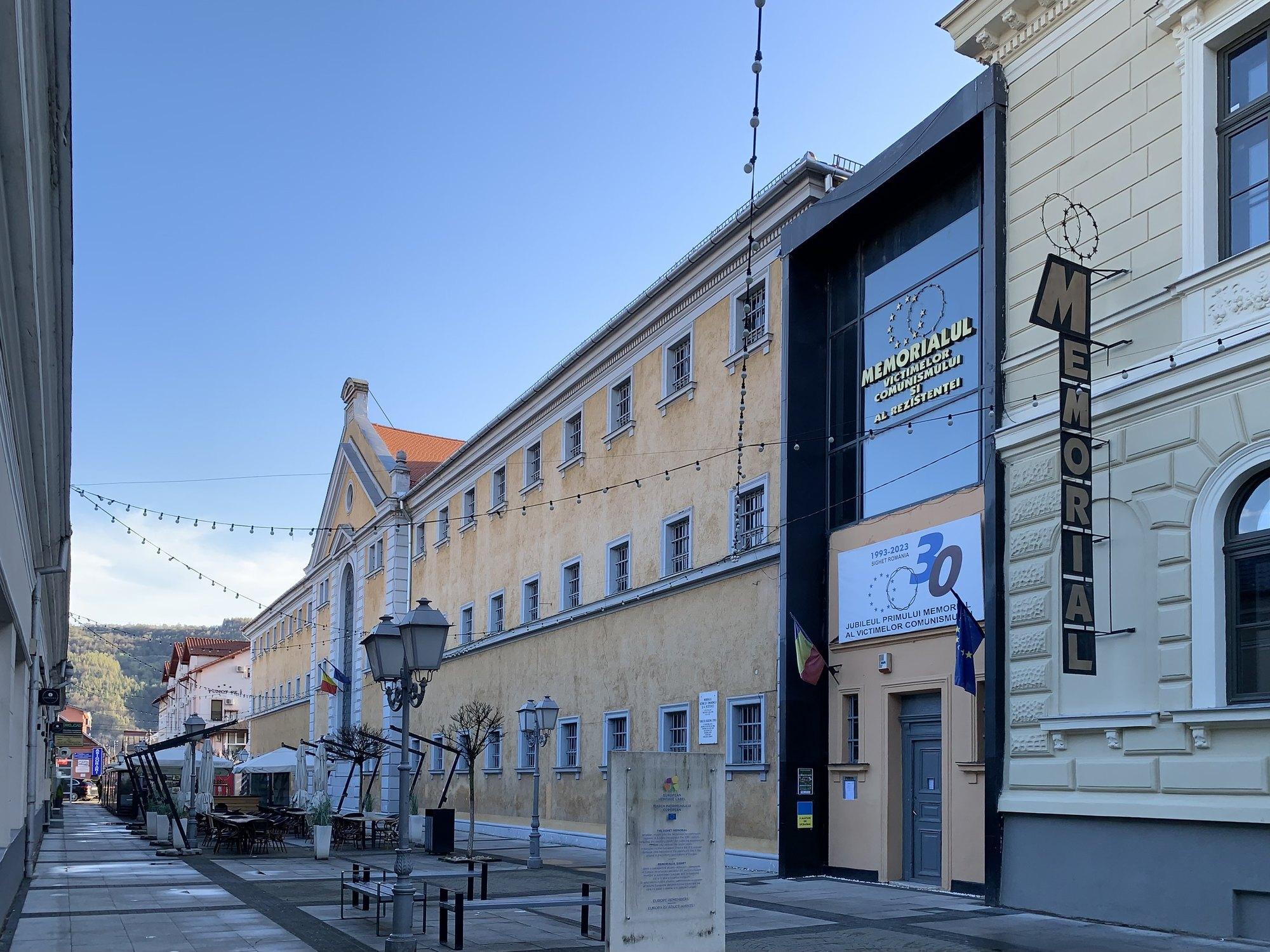
Chainwit, the former prison at Sighet, 2023. CC BY-SA 4.0.
Romania, from 1948 · Story · Featured Study
The Romanian Underground
Romania's Communist state jailed clergy of every confession, and each confession keeps its own record of those years.
- Where
- Blaj, Sighet, Pitești, Aiud, Bucharest
- Who
- Richard Wurmbrand, Sabina Wurmbrand, Iuliu Hossu, Traian Dorz, Dumitru Stăniloae, Iosif Țon
- When
- 1948 to 1989
In 1948 Romania dissolved the Greek Catholic Church by decree, and all seven of the bishops later beatified were arrested that year.
Remember those in prison as if you were bound with them, and those who are mistreated as if you were suffering with them.
Summary
Greek Catholic bishops, Orthodox monks, the Lord's Army, Baptists and a Lutheran of Jewish birth all met the same state. Each met it in its own way.
- A court, a pope and a synod have since spoken on parts of the record.
- Many of those proposed as saints had a fascist past, and that is argued over.
- Wurmbrand told his story to two committees of Congress. Much of it has no second witness in the record read here.
The Texts They Took
A pope at Blaj and a dying prisoner in Wurmbrand's book each reached for a saying of the Gospels.
and His disciples asked Him, “Rabbi, who sinned, this man or his parents, that he was born blind?”
Francis opened his homily at the beatification with the disciples' question about the man born blind.
John 9:2BSB
Then Jesus said, “Father, forgive them, for they do not know what they are doing.” And they divided up His garments by casting lots.
Wurmbrand tells of a Christian about to be shot who told his wife he died loving his killers, in these words of Jesus.
Luke 23:34BSB
Each Confession and Its Record
The state's measures fell differently on each body, and each row names who keeps the record.
The Greek Catholics lost their church outright, and the other confessions lost members, monks or freedom.
| Confession | What fell on it | The witness |
|---|---|---|
| Greek Catholic | Decree 358 of 1948 dissolved the church, and its parish property passed to the Orthodox under Decree 177. | European Court of Human Rights, 2016 |
| Orthodox | The Burning Bush group went to prison in 1958, and a decree of 1959 cut down the monasteries. | George Enache, from the Securitate file; Ioachim Băcăuanul |
| The Lord's Army | The movement inside Orthodoxy was announced dissolved in 1948, and Traian Dorz spent seventeen years in prison. | Religion in Communist Lands 8:4, with the movement's own document |
| Lutheran | Richard Wurmbrand was seized in 1948 and held for fourteen years by his count. | His own testimony, to the Senate in 1966 and under oath before the House in 1967 |
| Baptist, Pentecostal and Brethren | Dissenters who signed a paper on the churches went into custody in the 1970s. | Christianity Today, 20 May 1977 |
The Prisons and Who Filled Them
The story runs from the decrees through the prisons to the dissent of the 1970s.
The European Court of Human Rights records that the Greek Catholic Church was dissolved and its parish property given to the Orthodox Church. A Romanian appeal court, as the Court quotes it, said the state unlawfully dispossessed that church of its places of worship.
Vatican News reports that Vasile Aftenie died of his wounds in 1950 and Valeriu Frențiu in 1952. Ioan Bălan died in 1959 without trial, and Alexandru Rusu in 1963 under a sentence of twenty-five years. Tit Liviu Chinezu was consecrated a bishop in prison by fellow prisoners.
The Orthodox Church had its own prisoners. George Enache, reading the Securitate file, finds that the Burning Bush group received sentences of five to twenty-five years. The indictment called it a legionary movement. Ioachim Băcăuanul, an Orthodox bishop-vicar, says the terms of Decree 410 let monks stay only at 55 and over and nuns only at 50. Thousands, he says, were put out.
Iosif Trifa founded the Lord's Army in 1923 as a lay mission inside Orthodoxy, and his own church defrocked him before he died in 1938. Its document of the 1970s says the dissolution was announced through a priest, with no decree yet published. It credits Metropolitan Nicolae Corneanu with winning three of its members an acquittal in 1965.
Ciobanu dates the re-education of prisoners by torture at Pitești to the years up to 1951, with 22 deaths. Wurmbrand told the Senate that people were arrested to build the Danube Canal, and a dictionary names it beside Aiud, Turda and Gherla.
Wurmbrand writes that the secret police took him from the street on his way to church on Sunday 29 February 1948. A Swedish mission's letter, read into the Senate record, puts him in prison from that year to 1956 and again from 1959 to July 1964. He counts that as fourteen years, and he left Romania in December 1965. His wife Sabina worked on the canal, by his testimony. The family foundation dates her arrest to 1951, while the book's publisher puts it in the same year as his.
Christianity Today reported in May 1977 that the Baptist pastor Iosif Țon and five other evangelicals were taken into custody over a twenty-page paper. Its signers included a Pentecostal minister and a Brethren physician. Government officials charged it with misrepresenting the facts, and Baptist leaders said some of its cases were more complex.
The ransom1 paragraph
His book says the Norwegian Mission to the Jews and the Hebrew Christian Alliance paid $10,000 for him. Under oath in 1967 he named the same two bodies and said $7,000. The publisher's note gives $1,900 as the usual price of a prisoner, and the Alliance's letter gives no sum. By his account the police warned him afterwards that $1,000 would buy a gangster to kill him.
The scars1 paragraph
He told the Senate he would forfeit his salvation if he exaggerated, and he showed his scars at Senator Dodd's request. He told the House committee that he carried eighteen marks, and its summary places them on his back.
Who the Prisoners Had Been
Two scholars weigh the political past of the Pitești prisoners and reach opposite conclusions.
Monica Ciobanu writes that the victims at Pitești were mostly legionaries, members of the Iron Guard. Many of the prisoners proposed as saints, she says, had belonged to it. A Romanian ordinance of 2015 defines the Guard as fascist and criminal. Holocaust survivors, through the Elie Wiesel Institute, have warned against the cult of these prison saints.
Enache answers that the regime conferred a legionary profile on men it wanted to convict for religion. He grants that many legionaries sought refuge in the church, and says the others who entered were far more.
The Counts and Who Made Them
Each figure here is a list or an estimate with its maker.
The numbers differ because each counts a different group.
| Counter | What is counted | The number |
|---|---|---|
| The Imprisoned Church (Romanian National Institute for the Study of Totalitarianism, 1999), through John Breck | Church people of all confessions, 1944 to 1989 | More than 2,500 cases in a dictionary, which is a list and no total |
| Monica Ciobanu, on the commemorative year 2017 | Confessors of the faith | About 2,000, an estimate with no estimator named |
| Ioachim Băcăuanul | Those put out of the religious houses in 1959 | Several thousand, an estimate |
| Wurmbrand, Senate, 1966 | Bishops, priests and monks in prison | Hundreds, with no count behind it |
| Wurmbrand, House, 1967 | Greek Catholic priests then in prison | Something like 200, his estimate |
| The Lord's Army, through Keston | Its members | Up to 400,000, the movement's claim |
What Stands Beside the Testimony
Part of Wurmbrand's account has other witnesses, and part rests on his word and on letters he read aloud himself.
Places and deaths have other witnesses, and the scene at Pitești and the sum do not.
| What he says | What stands beside it |
|---|---|
| Catholic bishops died in prison. | Vatican News reports the deaths in custody of the bishops beatified in 2019. |
| Torture in the prisons. | A historian of the prison saints gives the number who died at one of them. |
| Forced labour for Sabina Wurmbrand. | A list of imprisoned clergy names the Canal. |
| A young Christian was tied to a cross at Pitești. | He gives this alone, and he does not say there that he saw it. |
| He was ransomed for $10,000, or $7,000. | The Alliance's letter says it raised funds and gives no sum. |
| Others swore to the same tortures. | Milan Haimavici's letter says so, and Wurmbrand is the one who read it out. |
The only form of Communist Romania's reply read here is his report of the police's words. A letter in the Congressional Record of 1967 says eleven years, against his fourteen.
What the Churches Have Done Since
A parish went to the European Court, and Rome and the Orthodox Synod named their dead.
Decree 358 was repealed on 31 December 1989. In 2016 the Grand Chamber in the Lupeni case found, twelve votes to five, that the parish had not been denied access to a court. It found unanimously that the Romanian courts had breached legal certainty.
Pope Francis beatified the seven bishops at Blaj on 2 June 2019. The Orthodox Synod approved sixteen canonizations on 11 and 12 July 2024, among them Dumitru Stăniloae as a Holy Confessor Priest.
How the Key Verse Was Taught
Two writers of the eighteenth century on remembering those in chains.
Matthew Henry (1662 to 1714)
Commentary on the Whole Bible, Hebrews 13:3
Matthew Henry saw that God lets some churches suffer while others have peace.
“God often orders it so that while some Christians and churches are in adversity others enjoy peace and liberty. All are not called at the same time to resist unto blood.”
Puritan
John Gill (1697 to 1771)
Exposition of the New Testament (1746-1748)
John Gill limited the verse to those in chains for Christ and the gospel.
“Remember them that are in bonds,.... Not for criminal actions, or for debt, though such should be remembered, and pity showed them, especially the latter; but such as are in bonds for the sake of Christ, and the Gospel.”
on Hebrews 13:3Reformed
In Their Own Words
A Lutheran witness, a pope and two of the seven bishops, each with where the words were read.
Richard Wurmbrand (1909 to 2001)
Tortured for Christ
A deal
“It was a deal; we preached and they beat us. We were happy preaching. They were happy beating us, so everyone was happy.”
Lutheran
About this saying1 paragraph
Wurmbrand wrote this in 1967 of the prisoners who preached to one another.
Richard Wurmbrand
Testimony, Communist Exploitation of Religion, Senate Internal Security Subcommittee, 6 May 1966, his testimony
All the confessions
“Nearly all Catholic bishops died in prison. Innumerable Orthodox and Protestants have been in prison, too.”
Lutheran
About this saying1 paragraph
On 6 May 1966 he set the confessions side by side.
Richard Wurmbrand
Testimony, Communist Exploitation of Religion, Senate Internal Security Subcommittee, 6 May 1966, his testimony
The fourth day
“One Sunday morning in the prison of Pitesti a young Christian was already the fourth day, day and night, tied to the cross.”
Lutheran
About this saying1 paragraph
This is his testimony of 1966 on a scene at Pitești, and he does not say there that he saw it himself.
Pope Francis
Homily at the beatification of seven Greek Catholic bishops, Blaj, 2 June 2019, the homily
An illiberal system
“The new Beati endured suffering and gave their lives to oppose an illiberal ideological system”
Roman Catholic, pope
About this saying1 paragraph
Pope Francis said this in 2019 of the deaths in custody.
Iuliu Hossu
Attributed, as quoted by Pope Francis, homily at Blaj, 2 June 2019, the homily
This darkness
“God has sent us into this darkness of suffering in order to offer forgiveness and to pray for the conversion of all”
Romanian Greek Catholic
About this saying1 paragraph
The Pope in 2019 attributed these words to Bishop Iuliu Hossu in prison, and he gave no source.
Ioan Suciu
Attributed, as reported by Vatican News, in Herald Malaysia, 3 June 2019, the notice of the seven bishops
We cannot sell
“We cannot sell Christ or the Church”
Romanian Greek Catholic
About this saying1 paragraph
Vatican News in 2019 attributed this line to Bishop Ioan Suciu.
What Is Disputed
Three questions divide the churches and the historians.
Did the Orthodox bishops preserve the church or betray it?4 paragraphs
The Orthodox Church answers, as Ciobanu reports it, that Patriarch Justinian Marina was a protector and that minor compromises bought survival.
Wurmbrand told the Senate that the Orthodox hierarchy nearly entirely cooperated, and he charged the Baptist leadership as well.
The Lord's Army's defenders and Tom Keppeler record the hierarchy's opposition to that movement.
Ciobanu notes that the church canonized 19 saints between 1959 and 1989, and that the Commission of 2006 confirmed some of the charges, while the church issued its own counter-report.
May a prisoner with an Iron Guard past be a saint?2 paragraphs
The prison saints' foundations answer that their concern is faith under torture and leaves politics aside.
Their opponents answer that the cult brings the Guard's symbols back, and that the state's own law calls the Guard criminal.
Who owns the Greek Catholic churches now?2 paragraphs
The Greek Catholic applicants in the Lupeni case hold that the state took the buildings unlawfully and that they should return.
The decree of 1990 weighs the wishes of the worshippers now in possession, and the Orthodox parish held registered title from 1967.
Books to Read Next
Criminals, Martyrs or Saints? Romania's Prison Saints Debate Revisited
Monica Ciobanu · 2018
Ciobanu sets out the debate over the prison saints and the Iron Guard.
Free at Cultures of HistoryThe Lord's Army Movement in the Romanian Orthodox Church
Religion in Communist Lands 8:4 · 1980
The journal printed the movement's own document on the ban.
Free at Biblical StudiesOastea Domnului: the Army of the Lord in Romania
Tom Keppeler · 1993
Keppeler traces how the Orthodox hierarchy treated Trifa and his movement.
Free at Biblical StudiesWhat the Record Leaves
The Romanian record holds bishops who died in custody, monks put out of their houses, prisoners with fascist pasts and one Lutheran's sworn account. No one church can speak for the rest.
Sources
Scripture is the Berean Standard Bible.
- The Holy Bible, Berean Standard Bible (read 2026)
- European Court of Human Rights, Grand Chamber, Lupeni Greek Catholic Parish and Others v. Romania, 29 November 2016.
- Pope Francis, homily at the beatification of seven Greek Catholic martyr bishops, Blaj, 2 June 2019.
- "Seven martyrs", Herald Malaysia, 3 June 2019, credited to Vatican News.
- George Enache, on the Burning Bush group, journal of the University of Galați.
- Ioachim Băcăuanul, in Răstignirea monahismului românesc: Decretul 410/1959 (Doxologia, sample pages)
- Monica Ciobanu, "Criminals, Martyrs or Saints? Romania's Prison Saints Debate Revisited", Cultures of History Forum, 19 February 2018.
- Keston headnote and the document of the Christian Committee (ALRC), Religion in Communist Lands 8:4, page 314.
- Tom Keppeler, "Oastea Domnului: the Army of the Lord in Romania", Religion, State and Society 21:2 (1993)
- Christianity Today, 20 May 1977, on the Ploiești pastor and his paper.
- Richard Wurmbrand, Tortured for Christ (copyright 1967; Living Sacrifice Book Company printing)
- Communist Exploitation of Religion, Hearing before the Senate Internal Security Subcommittee, 6 May 1966 (Washington: Government Printing Office, 1966), read in a later reprint.
- The New Communist Propaganda Line on Religion, Hearing before the House Committee on Un-American Activities, 10 August 1967, in the same reprint.
- Congressional Record, Extension of Remarks of Rep. Joel T. Broyhill, 1967.
- Richard Wurmbrand Foundation, biographies.
- John Breck, Orthodox Church in America, quoting The Imprisoned Church: Romania 1944-1989 (Romanian National Institute for the Study of Totalitarianism, 1999)
- Matthew Henry, Commentary on the Whole Bible, on Hebrews 13:3.
- Basilica.ro, the Patriarchate's news agency, 12 July 2024.
Keep Studying
Studies1
People and groups5
Go further2
Church history1
Values2
Trials of life1