
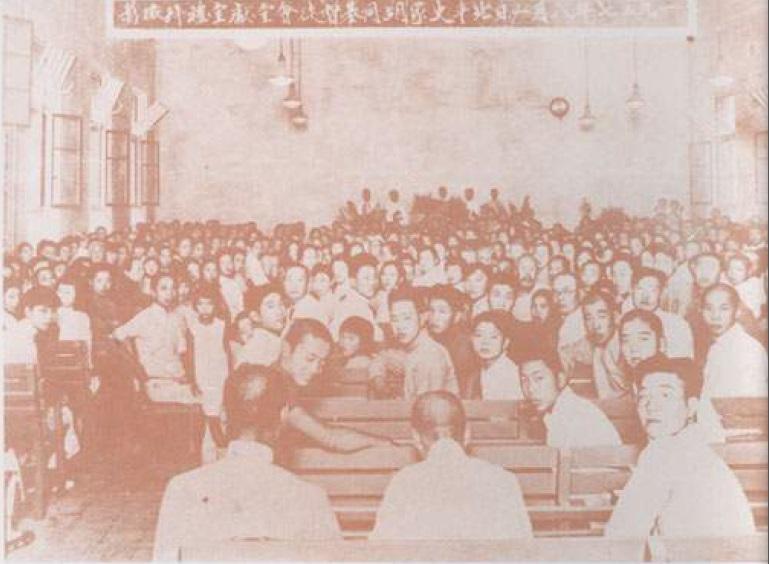
The dedication of the Christian Tabernacle, Peking, 1 August 1937, 施美玲. CC BY-SA 3.0.
Peking and Shanghai, 1900 to 1991 · Person · Featured Study
Wang Mingdao
He was the pastor of the Christian Tabernacle in Peking, and he spent more than twenty years in Communist prisons.
- Born
- 1900, in the Boxer year
- Died
- 28 July 1991
- Family
- Wife: Liu Jingwen, married 26 November 1926
- Places
- Peking, Baoding, Shanghai
In August 1955 a Peking pastor preached his last sermon, gave out a pamphlet, and was taken from his bed by the police that night.
But Peter and the other apostles replied, “We must obey God rather than men.
Summary
Wang Mingdao was born in 1900 and became a Christian at fourteen. He led a church of his own and wrote a magazine for it. He kept his church out of the union of the Japanese years. Later he refused to join the church movement of the Communist state.
- Lyall writes that he owed as little as any Christian worker to foreign missions: they never trained, ordained or employed him.
- He confessed in public after his first arrest and then took it back, and that sent him to prison again.
- He came out at last in 1979 or 1980 and spent his last years in Shanghai.
The Texts He Stood On
The apostles' answer to the council and Paul's warning against an unequal yoke were the ground of his refusal.
The house churches of China took up his stand after him, and their story is told in The Chinese House Churches.
Do not be unequally yoked with unbelievers. For what partnership can righteousness have with wickedness? Or what fellowship does light have with darkness?This is the command he refused to set aside when the state's church movement called for union.
The Life in Order
The dates stand on Lyall, Harvey and Yading Li, and the witnesses differ on three of them.
He spent most of his sixties and seventies in prison.
- 1900Birth in PekingA Stone Made Smooth, the preface; Lyall (1973)
- Aged fourteenConversionLi (2008)
- 26 November 1926MarriageHarvey (2002)
- 1927Began Spiritual Food QuarterlyHarvey; Lyall (1960), page 40
- 1 August 1937Dedication of the Christian TabernacleThe Commons file of the photograph
- Spring 1954Accusation meetingLyall, page 42
- 7 August 1955ArrestLyall, pages 48 to 49
- 30 September 1956Release and confessionLyall, pages 49 to 50
- 1957 or early 1958Retraction; prison againGill (2018); Lyall, page 81
- 1979 or January 1980Final releaseLi (2008); A Stone Made Smooth
- 28 July 1991DeathLi (2008)
Each step of the life stands with its witness.
7 August 1955, 30 September 1956, 1957 or early 1958, 1979 or January 1980, 28 July 1991
From the Tabernacle to the Prison
An independent Chinese pastor kept his church out of two state unions and paid for the second with his freedom.
He was born in Peking in 1900, the year of the Boxer rising, and was named Iron. He was converted through the work of a foreign mission and educated in a Peking mission school. As a teacher at Baoding he soon disagreed sharply with the missionary staff.
He married Liu Jingwen in 1926, and the next year he began Spiritual Food Quarterly. He named his congregation the Christian Tabernacle; by 1949 it had 570 members.
Under the Japanese occupation he was pressed again and again to bring his church into a union sponsored by the puppet government. He refused, and Lyall writes that he bought a coffin and kept it at home for the day he might die for his stand.
After the Communist victory he refused to join the Three-Self Patriotic Movement. In the spring of 1954 the movement called the churches of Peking to a meeting to accuse him, and later it ordered accusation meetings against him all over China.
When the police came for him in August 1955, they also took his wife and eighteen young members of his church. He was released in the autumn of 1956 and read a statement called Self Examination at a public meeting in Peking. He later took the confession back, and he and his wife went back to their cells.
In his last years he lived in Shanghai with his wife and son and held meetings in their small flat. He died in 1991.
In Their Own Words
Four lines in Leslie Lyall's English: two from his magazine, one from his last pamphlet and one from his confession.
Wang Mingdao (1900 to 1991)
Spiritual Food Quarterly, November 1951, in Leslie T. Lyall, Come Wind, Come Weather (Chicago: Moody Press, 1960), page 41
The courage of Martin Luther
“I know that this will come to pass. I am prepared to meet it. I covet the courage and faithfulness of Martin Luther.”
Independent Chinese church
About this saying1 paragraph
He wrote this in Spiritual Food Quarterly in November 1951, after the Three-Self movement began.
Wang Mingdao
Truth or Poison?, Spiritual Food Quarterly, in Leslie T. Lyall, Come Wind, Come Weather (Chicago: Moody Press, 1960), page 46
Any price for the Word
“We are ready to pay any price to preserve the Word of God and we are equally willing to sacrifice anything in order to preach the Word of God.”
Independent Chinese church
About this saying1 paragraph
He closed his article Truth or Poison? with these words to the saints, before his arrest in 1955.
Wang Mingdao
We, Because of Our Faith (1955), in Leslie T. Lyall, Come Wind, Come Weather, the close of the statement
We will never join
“we will not be united with unbelievers, and we will never join any of their organizations.”
Independent Chinese church
About this saying1 paragraph
He ended his last pamphlet, We, Because of Our Faith, with these words in 1955.
Wang Mingdao
Self Examination (1956), from Heavenly Wind, in Leslie T. Lyall, Come Wind, Come Weather, the confession
The confession
“I am a person guilty of anti-revolutionary deeds.”
Independent Chinese church
About this saying1 paragraph
He opened his Self Examination of 1956 with these words of guilt.
The People Around Him
The witnesses name his wife, the young people taken with him, his accusers and the men who wrote his story.
His wife shared both of his imprisonments.
| Person | Tie to Wang | The witness |
|---|---|---|
| Liu Jingwen | His wife | Harvey; Lyall, pages 49 and 81 |
| Eighteen young Christians | Of college age, taken the same night | Lyall, page 49 |
| Professor Hsieh | A writer who analysed his thinking and ended with a threat | Lyall, page 44 |
| Leslie T. Lyall | Told his stand in 1960 and his life in 1973 | Come Wind, Come Weather; Three of China's Mighty Men |
| Thomas Alan Harvey | Wrote the study Acquainted with Grief in 2002 | Harvey |
The Places of His Life
His life ran from Peking to a mission school at Baoding, back to Peking and, after prison, to Shanghai.
Peking was his city for most of his life.
| Place | What the witnesses say | The witness |
|---|---|---|
| Peking | His birthplace, the city of the Christian Tabernacle and of his arrest | A Stone Made Smooth; Lyall |
| Baoding | Where he taught as a young man | Harvey; A Stone Made Smooth |
| Shanghai | His home after prison | Li (2008) |
A Church That Answers to Christ
He held that a church which keeps only its services has already been taken.
In Truth or Poison? he took the doctrines the Three-Self leaders called poison, among them the command not to be unequally yoked with unbelievers, and argued that they were the teaching of Scripture.
He warned that a church with Sunday services and outward forms but no inner life would in fact have "already been liquidated". Lyall calls those words prophetic in the light of what followed.
How the Key Verse Was Taught
Commentators from the fifth century to the nineteenth read Peter's reply to the council.
John Chrysostom (died 407)
Homilies on the Acts of the Apostles, Homily 13, on Acts 5:29
John Chrysostom marked the tone of the apostles' reply.
“Again in the way of exhortation and advice, and with much mildness, they make answer.”
Patristic
John Gill (1697 to 1771)
Exposition of the New Testament, on Acts 5:29
John Gill set the limit of obedience to rulers at what is against the will of God.
“men, civil magistrates, and ecclesiastical rulers, are to be obeyed in things which are not repugnant to the will of God; but in things that are, God is to be obeyed, and not men.”
Reformed Baptist
Adam Clarke (1762 to 1832)
Commentary on the Bible, on Acts 5:29
Adam Clarke put the answer as a commission from God that the apostles dared not lay down.
“We have received our commission from God; we dare not lay it down at the desire or command of men.”
Methodist
What the Witnesses Leave Open
The witnesses differ on the dates of his prisons and on whether his stand was wise.
When he was released at lastYading Li; the preface of A Stone Made Smooth
Yading Li writes in Christian History (2008) that he was released in 1979. The preface of his own A Stone Made Smooth, printed in English in 1981, says he was released in January 1980.
When he went back to prisonJohn Gill; Leslie T. Lyall
John Gill wrote in 2018 that he was arrested again on 29 April 1957 and retracted the confession made under duress. Lyall tells the retraction in his account of the start of 1958 and gives no date.
The sentenceLeslie T. Lyall; Thomas Alan Harvey
Lyall writes that he was first sentenced to fifteen years and released after thirteen months. Harvey quotes the paper of his final release, which names a life sentence commuted to time served, and says he refused to sign it.
A stand of faith or of politicsLeslie T. Lyall; Thomas Alan Harvey; Philip Wickeri
Lyall reports a delegate of the Friends Mission to China who held that he had brought trouble on himself by his fundamentalist outlook, his opposition to the Three-Self movement and his unwise political attitudes. Lyall calls this precisely the Communist view. Harvey reports that Philip Wickeri finds three valid criticisms of him.
Books to Read Next
A Stone Made Smooth
Wang Mingdao (Wong Ming-Dao) · 1981
He wrote this account of his life, and it was printed in English after his release.
In print: find it wherever books are sold.
Come Wind, Come Weather
Leslie T. Lyall · 1960
Lyall tells of the church under the Three-Self movement and gives Wang's words in English.
Read Lyall free at the Internet ArchiveAcquainted with Grief: Wang Mingdao's Stand for the Persecuted Church in China
Thomas Alan Harvey · 2002
Harvey studies his life and thought and sets out the critics' case.
In print: find it wherever books are sold.
What Wang Mingdao Left
He left the years of his magazine, his last pamphlet and the record of a confession he took back.
Sources
Scripture is the Berean Standard Bible.
- The Holy Bible, Berean Standard Bible (read 2026)
- Leslie T. Lyall, Come Wind, Come Weather (Chicago: Moody Press, 1960), chapter Mr. Valiant-for-Truth and after.
- Leslie T. Lyall, Three of China's Mighty Men (1973), part 3, Wang Ming-dao.
- Wong Ming-Dao, A Stone Made Smooth (Mayflower Christian Books, 1981; Berean Publishers reprint), the preface.
- Thomas Alan Harvey, Acquainted with Grief: Wang Mingdao's Stand for the Persecuted Church in China (Grand Rapids: Brazos Press, 2002)
- Yading Li, "No Compromise", Christian History 98 (2008)
- John Gill, The Gospel Coalition, 3 August 2018, on Wang Mingdao.
- John Gill, Exposition of the New Testament (1746 to 1748), on Acts 5:29.
- John Chrysostom, Homilies on the Acts of the Apostles, Homily 13, on Acts 5:29.
- Adam Clarke, Commentary on the Bible (1832), on Acts 5:29.
Keep Studying
People and groups1
Church history1
Trials of life1