
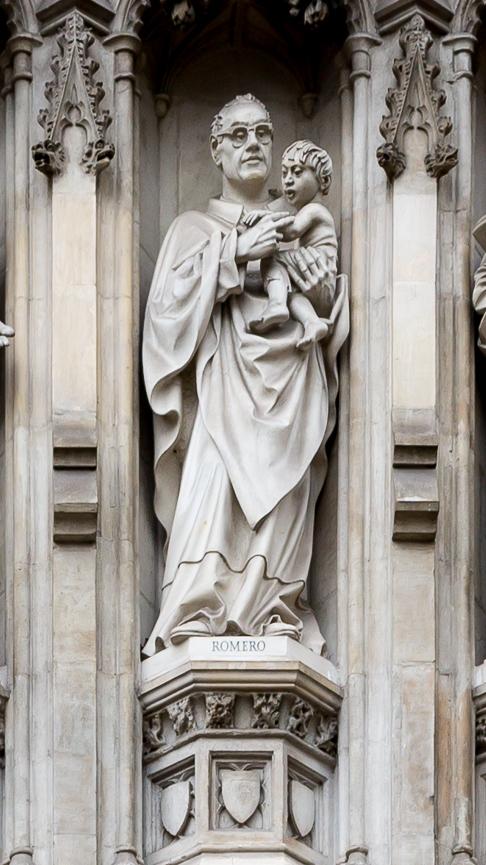
Uwe Aranas, the statue of Oscar Romero at Westminster Abbey, 2013. CC BY-SA 3.0.
El Salvador, to 1980 · Person · Featured Study
Oscar Romero
He was Archbishop of San Salvador from 1977 until a gunman shot him at the altar in 1980.
As the archbishop finished his homily at a hospital chapel, one bullet fired from a red Volkswagen struck him.
Truly, truly, I tell you, unless a kernel of wheat falls to the ground and dies, it remains only a seed; but if it dies, it bears much fruit.
Truly, truly, I tell you, unless a kernel of wheat falls to the ground and dies, it remains only a seed; but if it dies, it bears much fruit.
- Born
- 15 August 1917, at Ciudad Barrios
- Died
- 24 March 1980, in the chapel of the Divina Providencia hospital in San Salvador
- Family
- father: Santos Romero; mother: Guadalupe de Jesús Galdámez
- Places
- Ciudad Barrios, San Miguel, Rome, Santiago de María, San Salvador
Summary
Oscar Romero served more than twenty years as a priest in San Miguel. Many found him a conservative when he became a bishop. As archbishop he named the killings of the army and the death squads in his Sunday sermons. His archdiocese gathered the reports of the abuses.
- In May 1979 he gave John Paul II seven dossiers of reports on El Salvador.
- Robert Runcie was installed as Archbishop of Canterbury within twelve hours of his death.
- Ten years after he died, the archdiocese published the full texts of his sermons.
The Gospel of His Last Mass
John 12 was read at the Mass where he died, and he preached on verse 24.
The readings of that Mass were 1 Corinthians 15:20 to 28, Psalm 23 and John 12:23 to 26. His homily turned on John 12:24 and 25.
The question of this life is how a bishop many thought conservative came to preach against the killings, and what the UN found of his death.
Whoever loves his life will lose it, but whoever hates his life in this world will keep it for eternal life.This verse was read with it in the Gospel of that Mass.
The Life in Order
The Romero Trust's chronology gives the life, and the report of the UN Commission gives the death.
The last three years of the life hold most of its dates.
- 15 August 1917He was born at Ciudad BarriosThe Romero Trust
- 4 April 1942He was ordained a priest in RomeThe Trust's chronology
- 21 June 1970He was ordained auxiliary bishop of San SalvadorThe Trust, for 1970
- 1974He was made bishop of Santiago de MaríaWestminster Abbey
- February 1977He was appointed and installed as archbishop after a fraudulent electionThe Trust, for 1977
- 12 March 1977A death squad struck on the road from Aguilares to El PaisnalThe Trust's page on Rutilio Grande
- 17 February 1980He opposed United States military aid in his sermonThe Commission, page 128
- 23 March 1980He preached his last Sunday homilyHomily 192 in the Trust's English
- 24 March 1980He died at 18.26, during an evening MassThe Trust, for that Monday
- 23 May 2015He was beatified in San SalvadorThe Abbey's page
- 14 October 2018Pope Francis canonized him in RomeFrancis, homily of that day
Each step of the life stands with its witness.
17 February 1980, 23 March 1980, 24 March 1980, 23 May 2015, 14 October 2018
From San Miguel to the Hospital Chapel
As archbishop he committed himself more and more to the poor and the persecuted, the Abbey writes.
In 1931 he left an apprenticeship to a carpenter for the minor seminary at San Miguel. In 1937 he was sent to the Pío Latino College in Rome. Sent home in 1943, he was held in Cuba for three months on the way.
At San Miguel his sermons went out on five local radio stations. The Abbey writes that many found him a conservative in views and by temperament, and that as auxiliary bishop he busied himself with administration.
When his friend Rutilio Grande was shot with two companions in March 1977, Romero saw that there was no official enquiry. He closed the churches of the archdiocese the next Sunday and said a single Mass before the cathedral, which the Trust says 100,000 people attended. In July he stayed away from the new president's inauguration.
The Commission writes that his sermons carried the cases of the archdiocese's legal aid office. The Commission quotes a sermon from the last February of his life on who held power: "They only know how to repress the people and defend the interests of the Salvadorian oligarchy". The press attacked him, and he answered that the church was not a political movement.
That Monday evening he said an anniversary Mass for Sara Meardi de Pinto in the hospital chapel. The printed homily ends, "(At that moment, a shot rang out.)"
What the Commission Found
The Commission on the Truth for El Salvador made the killing one of its illustrative cases.
The Commission was set up under the peace agreements between the government and the FMLN, and its report of 1993 is the UN document S/25500.
It found that former Major Roberto D'Aubuisson gave the order to kill the archbishop. He gave precise instructions to his security service, acting as a death squad. It named Captains Alvaro Saravia and Eduardo Avila, with Fernando Sagrera and Mario Molina, as active in the planning.
One man who was present gave the Commission its account of the shot, and the Trust notes that the Commission could not identify the marksman.
In Their Own Words
Three sayings from his last two homilies, in the Romero Trust's English.
Óscar Romero (1917 to 1980)
Homily of 23 March 1980
Stop the repression
“In the name of God, then, and in the name of this suffering people, whose laments rise up each day more tumultuously toward heaven, I beg you, I beseech you, I order you in the name of God: stop the repression!”
Roman Catholic
About this saying1 paragraph
In 1980, on the last Sunday of his life, he closed his appeal to the soldiers with these words.
Óscar Romero
The Church Serves Personal, Communal, and Transcendent Liberation, homily of 23 March 1980, homily 192, the words to the National Guard, the police and the troops
He addressed the National Guard, the police and the troops
“No soldier is obliged to obey an order against the law of God.”
Roman Catholic
About this saying1 paragraph
In the same homily of 1980 he told the soldiers that the law of God comes before any order.
Óscar Romero
The Final Homily of Archbishop Romero, 24 March 1980, homily 193
The risks that history calls for
“we must not love our lives so much that we avoid taking the risks in life that history calls for.”
Roman Catholic
About this saying1 paragraph
In 1980, at the hospital chapel the next day, he said this of the Gospel just read.
The People Around Him
A murdered friend, the men the Commission named and the churchmen who carried his cause stand in the record.
The men the Commission named held army rank or served the death squad.
| Person | Tie to Romero | The record |
|---|---|---|
| Rutilio Grande | A Jesuit friend, master of ceremonies at his ordination as bishop | The Romero Trust, for 1970 |
| Roberto D'Aubuisson | Named in the Commission's first finding | The Commission on the Truth |
| Alvaro Saravia | A former captain whom the Supreme Court kept from extradition | The Commission on the Truth |
| Amado Antonio Garay | Saravia's driver, assigned to take the gunman to the chapel | The Commission, page 127 |
| John Paul II | The pope who received him, at an audience the Trust calls difficult | The Romero Trust's chronology |
| Arturo Rivera Damas | The archbishop who announced the process for his canonization | The Romero Trust, for March 1990 |
| Gregorio Rosa Chávez | An auxiliary bishop who worked with him, made a cardinal in 2017 | The Romero Trust, for June 2017 |
| Vincenzo Paglia | The postulator of his cause in Rome | The Romero Trust's chronology |
Gregorio Rosa Chávez, Vincenzo Paglia
The Places of His Life
His life runs from the mountains of the east to the capital and to Rome.
All but one of the places stand in El Salvador.
| Place | What the records say | The record |
|---|---|---|
| Ciudad Barrios | A town in the mountainous east of the country | The Romero Trust, for 1917 |
| San Miguel | The eastern diocese where he was secretary to the bishop | The Romero Trust's chronology |
| Rome | Where he studied for the priesthood | The Romero Trust, for 1937 |
| Santiago de María | A small rural diocese in the coffee country | The Romero Trust, for 1974 |
| San Salvador | The capital and his archdiocese from 1977 | The Romero Trust, for 1977 |
| The Divina Providencia hospital | A cancer hospital, where he lived and where he died | The Romero Trust, for March 1980 |
How His Church Judged Him
The Catholic Church declared him a martyr in 2015 and a saint in 2018.
On 8 January 2015 the nine theologians who advised the Congregation for the Causes of Saints voted him a martyr in odium fidei. The Latin means killed out of hatred of the faith, so no miracle was needed for his beatification. Pope Francis issued the decree on 3 February.
At the canonization Francis said that Romero "left the security of the world, even his own safety, in order to give his life according to the Gospel".
What the Witnesses Leave Open
The records differ on the gunman, the long wait of his cause, two dates, his family and one saying.
Who fired the shotThe Commission on the Truth; the Romero Trust
The Commission named who ordered and planned the killing, and the man who fired it stays unnamed. The Trust reports that police found documents on the death squad when they arrested D'Aubuisson on 7 May 1980.
Why his cause waitedThe Romero Trust, reporting Benedict XVI, Pope Francis and Archbishop Müller
In May 2007 Benedict XVI told journalists, "That Romero as a person merits beatification, I have no doubt", and the Trust reports that the words were removed from the Vatican's transcript. In 2013 Francis said the cause had been blocked "for prudential reasons", and Archbishop Müller of the doctrinal congregation confirmed that no doctrinal reservation stood against it.
The date of the Commission's reportThe UN document; the Romero Trust
The Secretary-General's letter says the Commission presented its report on 15 March 1993. The Trust gives 5 March.
The bomb of March 1980The Commission; the Romero Trust
The Commission says an attaché case with a bomb was found near the high altar behind the pulpit on 10 March. The Trust writes of a suitcase of dynamite behind the altar of the basilica where he was to preach on 9 March.
His familyThe Romero Trust; Westminster Abbey
The Trust calls him the second of eight children, and the Abbey the second of seven.
A saying the Abbey printsWestminster Abbey
The Abbey sets these words at the head of its page as his, with no date or source: "I do not believe in death without resurrection. If I am killed, I shall arise in the Salvadoran people."
Books to Read Next
From Madness to Hope: the 12-year war in El Salvador
The Commission on the Truth for El Salvador, UN document S/25500 · 1993
The report gives the evidence of witnesses and documents for each of its findings.
Read the report free at the United NationsThe Final Homily of Archbishop Romero
Oscar Romero, in the English of the Archbishop Romero Trust · 1980
The text of his last homily stands with the readings of that Mass and the note of the shot.
Read his last homily free at the Romero TrustWhat Romero Left
Romero left three years of Sunday homilies from the capital, which his archdiocese printed in full. His church carried his cause to its end in 2018.
Sources
Scripture is the Berean Standard Bible.
- The Holy Bible, Berean Standard Bible (read 2026)
- The Archbishop Romero Trust, "The Century of Romero: 1917 to 2018" and "Rutilio Grande SJ".
- Oscar Romero, "The Church Serves Personal, Communal, and Transcendent Liberation", homily of 23 March 1980, no. 192 in the Romero Trust's English, volume 6.
- Oscar Romero, "The Final Homily of Archbishop Romero", 24 March 1980, homily 193 of the sixth volume of the Trust's translation.
- From Madness to Hope: the 12-year war in El Salvador, Report of the Commission on the Truth for El Salvador, UN document S/25500, 1 April 1993, part IV, illustrative case: Archbishop Romero.
- Westminster Abbey, "St Oscar Romero", the Abbey's commemoration page.
- Francis, homily at the Holy Mass and canonizations of 14 October 2018.
Keep Studying
Read it1
People and groups4