
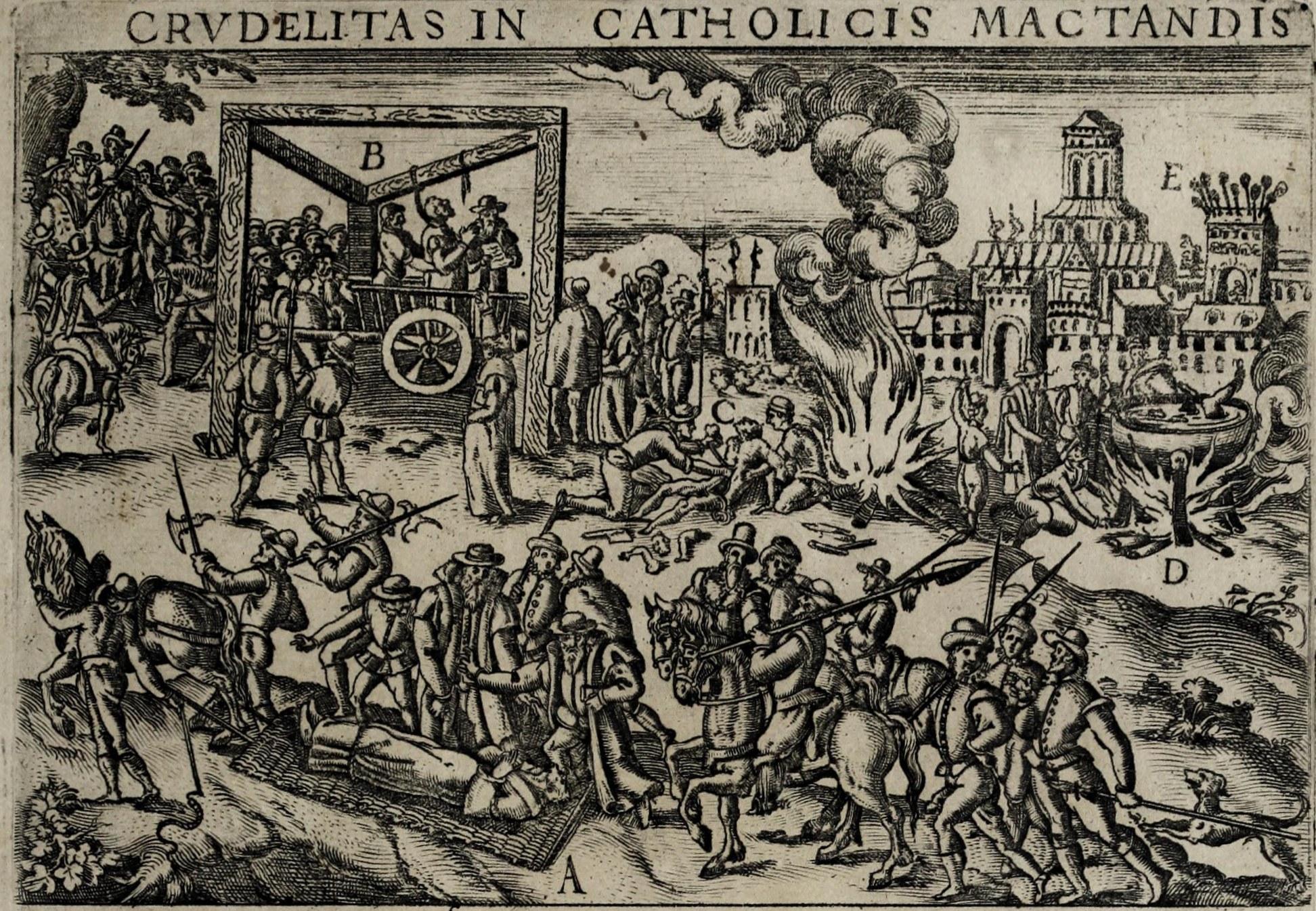
Giovanni Battista de' Cavalieri, Crudelitas in Catholicis Mactandis, 1584. Public domain.
Launceston to Tyburn, from 1577 · Story · Featured Study
The Catholic Martyrs of England
The English Crown executed priests and the people who hid them, and both sides published why.
- Where
- Launceston, Tyburn, York, Douai
- Who
- Cuthbert Mayne, Edmund Campion, Margaret Clitherow, William Cecil, Lord Burghley, William Allen
- When
- 29 November 1577 into the reign of James I
From the cart at Tyburn Edmund Campion denied the treason he was dying for and declared himself a Catholic and a priest.
“Caesar’s,” they answered. So Jesus told them, “Give to Caesar what is Caesar’s, and to God what is God’s.”
Summary
In 1570 a pope declared Elizabeth deposed. Parliament then made it treason to bring anyone back to Rome, and from 1585 a priest trained abroad was a traitor in England.
- Richard Challoner counts 124 priests and 63 lay men and women dead from 1577 to 1603.
- William Cecil said they died for treason. William Allen said they died for religion.
- The same Crown burned two Anabaptists in 1575 and hanged three Separatists in 1593.
The Texts from the Cart
Two of the condemned spoke Paul's words to the crowd before they died.
A Catholic account printed in 1582 says Campion began to preach on the first of these verses. Sir Francis Knowles and the sheriffs cut him off. Richard Challoner says Robert Southwell began with the second, his hands tied, and that the sheriff tried to interrupt him.
For it seems to me that God has displayed us apostles at the end of the procession, like prisoners appointed for death. We have become a spectacle to the whole world, to angels as well as to men.
Campion told the crowd that these words were verified that day in him.
If we live, we live to the Lord, and if we die, we die to the Lord. So whether we live or die, we belong to the Lord.
Southwell gave this verse to the people at Tyburn in February 1595.
Romans 14:8BSB
The Law Year by Year
A papal bull and the statutes around it set what a priest or his host could die for.
Each statute after the bull made a further act a crime or set a further test.
| Year | The act | What it did |
|---|---|---|
| 1559 | Act of Supremacy, 1 Elizabeth c. 1 | It set an oath that the Queen is the only supreme governor in spiritual as well as temporal causes. |
| 1570 | Regnans in Excelsis, Pius V | It declared Elizabeth a heretic, took away her title and released her subjects from their oaths. |
| 1571 | 13 Elizabeth c. 1 and c. 2 | It made it high treason to call the Queen a heretic or usurper, to use a bull from Rome, or to reconcile anyone by one. |
| 1581 | 23 Elizabeth c. 1 | It made it treason to draw a subject from the established religion to Rome, or to be so reconciled. |
| 1585 | 27 Elizabeth c. 2 | It ordered priests ordained abroad since 1559 out within forty days, made staying high treason, and made aiding them felony. |
| 1606 | 3 James I c. 4 | It set an oath abjuring as heretical the doctrine that a prince excommunicated by the Pope may be deposed or murdered. |
From the Mission to Tyburn
William Allen's seminary sent priests into England from the 1570s, and the Crown met them with the rack and the rope.
Allen opened his college at Douai at Michaelmas 1568. Cuthbert Mayne, the first of its missionary priests to die, was hanged, drawn and quartered at Launceston on 29 November 1577. John Stow's chronicle gives the cause as "preferring Roman power". Allen answered that Mayne was condemned for the case of an Agnus Dei, a wax disc, and a printed bull of jubilee long expired.
Campion, a Jesuit, reached Dover in June, two and a half years after Mayne's death. He wrote a declaration to the Council in under half an hour, to be read if he were taken. He gave a copy to Thomas Pounde to hold back. He forgot to seal it, Pounde let it out, and William Charke and Meredith Hanmer answered it in print.
At Lyford a man named Eliot, who carried a warrant, heard Campion say Mass and then fetched the arresting party. On 30 July 1581 the Council ordered that if he denied the truth he should be dealt with by the rack. A first draft of the indictment charged only absolving and reconciling. The one he was tried on charged a plot at Rome and at Rheims, made before he sailed, to depose and kill the Queen. Simpson, his Catholic biographer, calls that plot forged. At the arraignment on 14 November his arms, racked, could not be raised to plead without help. He died at Tyburn on 1 December, and Ralph Sherwin and Alexander Briant died with him.
J. H. Pollen, a Jesuit historian, says that from 1585 almost all the priests suffered merely for their priestly character. The law of that year also reached their hosts, and nearly all the lay martyrs of the next years died for harbouring. Pollen says that from the oath of 1606 to the end of the reign the martyrs might have saved their lives by swearing it.
Margaret Clitherow at York1 paragraph
The judge at York charged her with harbouring Jesuits and priests, and she refused to be tried by a jury. Her priest John Mush says she was pressed to death on 25 March 1586 under seven or eight hundredweight, with a sharp stone beneath her back. He says she took a quarter of an hour to die. A second account in the same volume, by a Yorkshire recusant, gives five or six hundredweight.
Southwell, Owen and Garnet1 paragraph
Southwell confessed himself a priest and a Jesuit at Tyburn and said he had always prayed for the Queen. Nicholas Owen, a Jesuit lay brother called Little John, was racked in prison in 1606 and died soon after he was taken off. Henry Garnet died at St Paul's churchyard on 3 May 1606 after the Gunpowder Plot. Challoner says he knew of the plot only through confession, and Pollen asked in 1909 whether he was killed for the faith or judged guilty by human error.
A Country Expecting War
The executions ran beside Babington's plot and the Spanish fleet, and Allen stood with Spain.
Prothero wrote that Babington's plot showed men would risk their lives to destroy Elizabeth while Mary Queen of Scots lived. Simpson grants that the young gentlemen who guided the priests also furnished the principals of many plots, real or pretended.
Allen wrote in his Defence that no war in the world is so just as one for the Roman religion. The Dictionary of National Biography says he worked with Robert Parsons for the Spanish party and held that Philip II had just ground for war. He signed the Admonition of 1588 on the war of the King of Spain. The same entry says his seminaries left the deposing power out of their course. It adds that English Catholics remained true to their queen when the fleet came. Burton and Pollen count thirty-one martyrs put to death in 1588.
The Crown's Other Dead
Elizabeth's government also killed Protestants who refused its church.
Two Dutch Anabaptists were burned at Smithfield on 22 July 1575. John Foxe, the martyrologist, wrote to the Queen pleading for clemency, as Albert Peel records, and the plea failed. Stow's chronicle, which Peel prints, says they "died in great horror with roaring and crying".
Henry Barrow and John Greenwood, Separatists, were hanged at Tyburn on 6 April 1593 under the statute of 1581 on seditious writing. John Penry followed at St Thomas-a-Watering on 29 May.
Under Mary the fires had burned the other way, and Herbert Thurston, a Catholic writer, gives 277 burned in under four years.
The Counts and Who Made Them
No single agreed total stands, so each number here keeps its counter.
Each counter uses his own span and his own definition of who suffered for religion.
| Witness | Span | The number |
|---|---|---|
| Richard Challoner, Memoirs of Missionary Priests | 1577 to 1603 | He counts 124 priests and 63 lay men and women who "suffered for religion". |
| J. H. Pollen, Catholic Encyclopedia (1909) | 1534 to 1729 | He gives no total for Elizabeth, only classes: 63 beatified, 241 Venerable, 44 Dilati and about 242 Praetermissi. |
| Burton and Pollen, Lives of the English Martyrs (1914) | 1585 to 1588 | They count forty priests and seventeen lay people. |
| Jesuits in Britain Archives | 1886 to 1987 | It counts 285 beatified and 43 canonised by Rome over a century. |
How Each Side Kept Them
Rome named them over a century, where England's law had named them traitors.
The Jesuit archive records 54 beatified on 29 December 1886, nine on 13 May 1895 and 136 on 15 December 1929. Paul VI canonised forty on 25 October 1970. A further 84 were beatified on 22 November 1987, by the same archive's count.
Paul VI said in his homily that the forty were faithful subjects of the royal power. Their loyalty, he said, came into conflict with their fidelity to God. William Cecil, Lord Burghley, had said the reverse in 1583.
How the Key Verse Was Taught
Three writers of three eras on what belongs to Caesar.
Tertullian (died 220)
Scorpiace
Tertullian tied Paul's command to obey the powers to the things of Caesar and of God.
“Then he goes on also to show how he wishes you to be subject to the powers, bidding you pay ‘tribute to whom tribute is due, custom to whom custom,’ that is, the things which are Caesar's to Caesar, and the things which are God's to God; but man is the property of God alone.”
on 1 Peter 2:13Patristic
Jerome (died 420)
Catena Aurea by Aquinas
Jerome took the things of Caesar to mean the coin and the things of God to mean tithes and offerings.
“They say unto Him, Cæsar's; not Augustus, but Tiberius, under whom also the Lord suffered. All the Roman Emperors were called Cæsar, from Caius Cæsar who first seized the chief power. Render therefore unto Cæsar the things which are Cæsar's; i. e. the coin, tribute, or money.”
on Matthew 22:21Patristic
The rest1 more paragraph
That is, tithes, first-fruits, oblation, and victims; as the Lord Himself rendered to Cæsar tribute, both for Himself and for Peter; and also rendered unto God the things that are God's in doing the will of His Father.
John Wesley (1703 to 1791)
Explanatory Notes upon the New Testament
John Wesley read the coin as the sign of who governs and turned the verse on both parties who asked.
“And indeed this is a standing rule. The current coin of every nation shows who is the supreme governor of it. Render therefore, ye Pharisees, to Caesar the things which ye yourselves acknowledge to be Caesar's: and, ye Herodians, while ye are zealous for Caesar, see that ye render to God the things that are God's.”
on Matthew 22:21Evangelical
In Their Own Words
The condemned, the Crown's minister and the Catholic answer, in the English of their editors before 1930.
Edmund Campion (died 1581)
Letter to the Privy Council, 1580, article 4
Matters of state
“I never had mind, and am straitly forbid by our fathers that sent me, to deal in any respects with matters of state or policy of this realm”
Roman Catholic, Jesuit
About this saying1 paragraph
Campion's fourth article, in the letter of 1580 that reached print against his wish, states his commission.
Edmund Campion
Letter to the Privy Council, 1580, article 8
Your Tyburn
“cheerfully to carry the cross that you shall lay upon us, and never to despair your recovery while we have a man left to enjoy your Tyburn, or to be racked with your torments, or to be consumed with your prisons.”
Roman Catholic, Jesuit
About this saying1 paragraph
His eighth article of 1580 tells the Council what the Jesuits have resolved.
Margaret Clitherow (died 1586)
At York, 1586, in John Mush's Life, the arraignment
The answer at York
“Having made no offence, I need no trial.”
Roman Catholic, laywoman
About this saying1 paragraph
Mush gives Clitherow's answer in 1586 when the judge asked how she would be tried.
William Allen (1532 to 1594)
A True, Sincere and Modest Defence of English Catholics (1584), quoting Ambrose of Milan to the emperor, volume 2
The palaces and the churches
“The palaces pertain to the emperor, the churches to the priest.”
Roman Catholic, cardinal
About this saying1 paragraph
Allen in 1584 quotes Ambrose of Milan to the emperor on the key verse, and he turns the words on Elizabeth's supremacy.
William Cecil, Lord Burghley
The Execution of Justice in England (1583), as quoted in William Allen, A True, Sincere and Modest Defence, chapter 1
Their life as nature would
“no one was called into any capital or bloody question upon matters of religion, but have all enjoyed their life as the course of nature would.”
Church of England
About this saying1 paragraph
Cecil wrote this in 1583 of the deprived bishops, abbots and deans, and Allen quotes it from The Execution of Justice as a general claim in order to deny it.
Treason or Religion?
The quarrel began in print in 1583 and still divides the record.
Why did they die?3 paragraphs
Cecil ran the words "Execution for Treason" and "and not for Religion" across the pages of his book, and the preamble of 1585 says the priests came to stir up sedition and rebellion.
Allen's title answers that the Protestants deny their persecution untruly, and he points to Mayne and to new statutes that made conscience into treason.
Prothero, writing in 1913, held that after the bull and the statutes no one could be both a good Roman Catholic and a good subject.
Were the priests political?4 paragraphs
Campion's letter forbids him matters of state, and the Dictionary of National Biography says Allen kept the work of the seminaries apart from his politics.
Allen himself, who founded those seminaries, backed the Spanish war.
The bloody question brought the matter to one sentence: whose part would you take if the Pope made war on the Queen.
Burton and Pollen note that no statute commanded that question, and Pollen adds that no statute made an opinion on the sentence treason.
Books to Read Next
Memoirs of Missionary Priests
Richard Challoner · 1741 to 1742
Challoner gives his count and the lives, read here in a printing of 1839.
Free at the Internet ArchiveEdmund Campion: A Biography
Richard Simpson · 1896
Simpson prints Campion's letter and the indictment and argues the Catholic case.
Free at the Internet ArchiveA True, Sincere and Modest Defence of English Catholics
William Allen · 1584
Allen quotes Cecil's book at length in order to answer it.
Free at the Internet ArchiveSelect Statutes and Other Constitutional Documents
G. W. Prothero · 1913
Prothero prints the statutes and the bull in full or in part.
Free at the Internet ArchiveWhat They Leave
Between Rome's bull and England's statutes these men and women found their obedience divided, and each side wrote its dead into a book.
Sources
Scripture is the Berean Standard Bible.
- The Holy Bible, Berean Standard Bible (read 2026)
- G. W. Prothero, Select Statutes and Other Constitutional Documents (Internet Archive date 1913)
- Pius V, Regnans in Excelsis (25 February 1570), English of Papal Encyclicals Online, translator not named; the Latin in Prothero.
- Richard Simpson, Edmund Campion: A Biography, new edition (London: John Hodges, 1896)
- A Briefe Historie of the Glorious Martyrdom of Twelve Reverend Priests (1582), edited by J. H. Pollen (London: Burns and Oates, 1908)
- William Allen, A True, Sincere and Modest Defence of English Catholics (1584), edited in two volumes (Roehampton: John Griffin, 1914)
- William Cecil, Lord Burghley, The Execution of Justice in England (London, 1583)
- Richard Challoner, Memoirs of Missionary Priests (Philadelphia: John T. Green, 1839); the printing of 1741 to 1742 was not read.
- John Mush, Life of Margaret Clitherow, in John Morris, The Troubles of Our Catholic Forefathers, third series (London: Burns and Oates, 1877)
- E. H. Burton, editor, Lives of the English Martyrs, second series (London: Longmans, Internet Archive date 1914)
- J. H. Pollen, "English Confessors and Martyrs", Catholic Encyclopedia, volume 5 (1909)
- "Allen, William", Dictionary of National Biography.
- "Barrow, Henry", Dictionary of National Biography.
- "Penry, John", Dictionary of National Biography.
- Albert Peel, "A Conscientious Objector of 1575", Transactions of the Baptist Historical Society 7.1 (1920), pages 71 to 128.
- Herbert Thurston, "Mary Tudor", Catholic Encyclopedia, volume 9 (1910)
- Jesuits in Britain Archives, on the cause of the English and Welsh martyrs.
- Paul VI, homily at the canonisation of the forty martyrs, 25 October 1970, in Italian.
Keep Studying
People and groups2
Go further4
Church history5
Trials of life1
Values1