
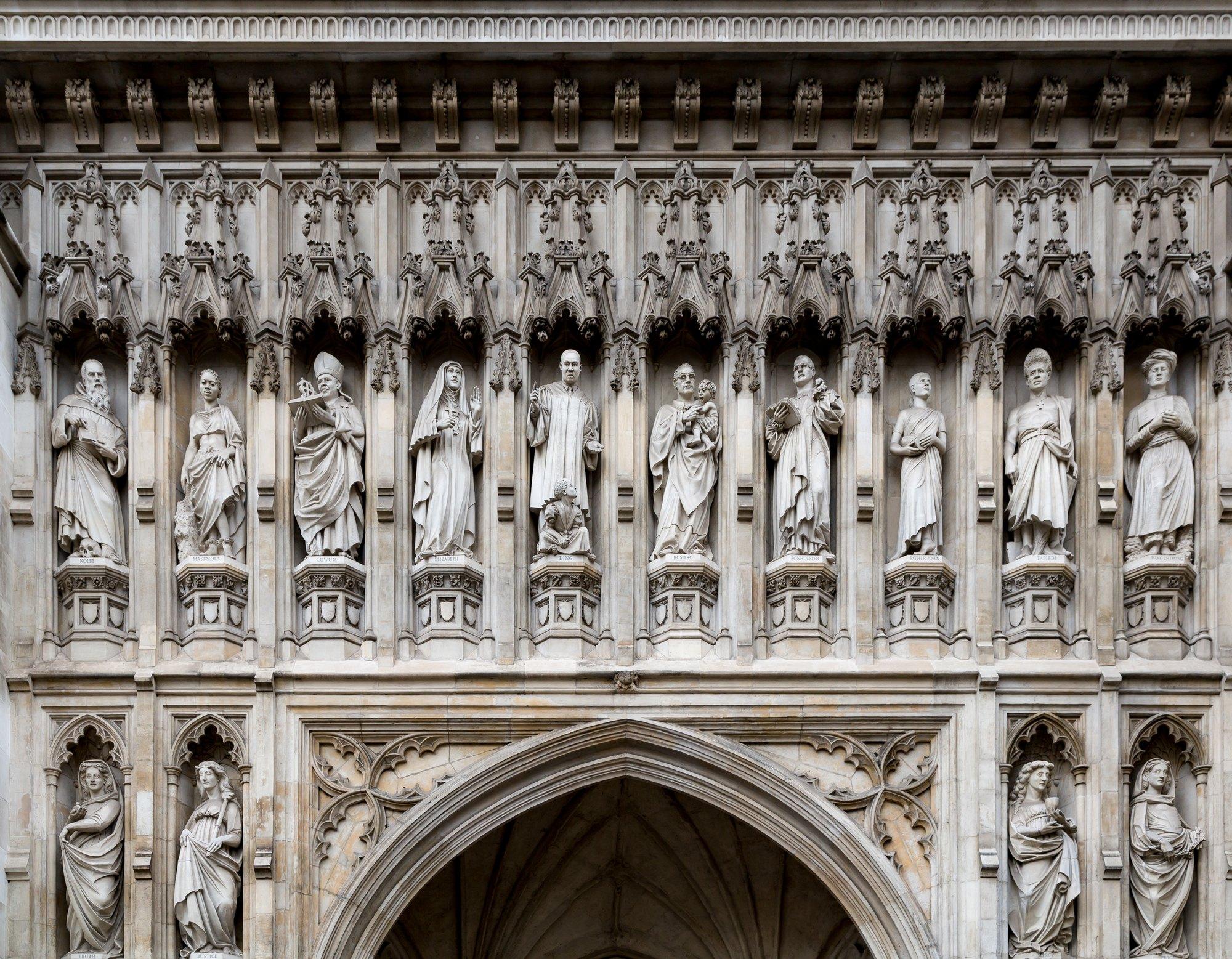
CEphoto, Uwe Aranas, 2013. CC BY-SA 3.0.
China, from July 1950 · Story · Featured Study
The Church Under Mao
The new state drew China's churches into patriotic movements, and those who refused, with at least one who joined, went to prison or died.
- Where
- Beijing, Shanghai, Wuding, Tilanqiao prison
- Who
- Y. T. Wu, Wang Mingdao, Watchman Nee, Ignatius Kung, Wang Zhiming, K. H. Ting
- When
- 1950 to 1979
Wang Zhiming, a Miao pastor who had supported the Three-Self Movement, was executed before more than 10,000 people at Wuding.
But Peter and the other apostles replied, “We must obey God rather than men.
Summary
In July 1950 a manifesto called on China's churches to help build the new China. In 1954 a national conference founded the Three-Self committee.
- Catholics met the same pressure, and the Pope would not accept a Chinese church cut off from Rome.
- Wang Mingdao refused to join. He signed a confession in prison, took it back, and was held until 1979.
- No witness read here gives a total of the dead.
The Texts the Movement Used
The movement's speakers and its editor cited these verses, and the Abbey set one on the memorial at Wuding.
We have different gifts according to the grace given us. If one’s gift is prophecy, let him use it in proportion to his faith;
K. H. Ting cited this text in 1955 for one Spirit and many gifts, as Wang Mingdao himself prints him.
Romans 12:6BSB
He who conceals his sins will not prosper, but whoever confesses and renounces them will find mercy.
The editor of Heavenly Wind cited this verse in 1956 on the confession of the pastor who had refused the movement.
And I heard a voice from heaven telling me to write, “Blessed are the dead—those who die in the Lord from this moment on.” “Yes,” says the Spirit, “they will rest from their labors, for their deeds will follow them.”
The Abbey prints words of this verse at the foot of the Wuding pastor's memorial.
Proverbs 28:13, Revelation 14:13
The Line from 1950
Each date stands with the witness who gives it, and the state's dates come from the state.
The pressure on the churches began in 1950 and did not wait for the Cultural Revolution.
| When | What happened | The witness |
|---|---|---|
| July 1950 | The Manifesto appears over the names of Y. T. Wu and others. | United Front Work Department |
| 1950 to 1952 | Country churches are closed during land reform, and the order to reopen comes in 1951 and 1952. | Leslie Lyall |
| April 1951 | Church leaders are called to Peking, and public denunciations begin. | Leslie Lyall |
| April 1952 to 1956 | Watchman Nee is arrested, tried at Shanghai and given fifteen years. | G. Wright Doyle; Joseph Lee |
| 12 July to 6 August 1954 | A national conference founds the Three-Self committee. | United Front Work Department |
| 7 August 1955 | Wang Mingdao is arrested, and Bishop Kung follows on 8 September. | John Gill; the Cardinal Kung Foundation |
| September 1958 | Churches are ordered to unite, and Peking falls from about eighty churches to four. | Leslie Lyall |
| 23 August 1966 | Red Guards come to Moore Memorial Church in Shanghai. | History of Missiology, Boston University |
| 30 May 1972 | Watchman Nee dies in custody. | Joseph Lee; Living Stream Ministry |
| 29 December 1973 | The rally at Wuding ends in a pastor's death. | Westminster Abbey |
| 2 September 1979 | Moore Memorial reopens. | History of Missiology, Boston University |
| 1982 | The party's Document 19 admits a great many false cases. | Document 19 |
September 1958, 23 August 1966, 30 May 1972, 29 December 1973, 2 September 1979, 1982
From the Manifesto to the Closing
The story runs from the Manifesto to Wuding, and those it names did not all stand on one side.
The state's history says Zhou Enlai talked with Y. T. Wu and his colleagues in May 1950, and that forty signers issued the Manifesto that July. The movement dates its full text in the People's Daily to 23 September that year. It says the Manifesto marked the point when the church in China began to govern, support and propagate itself. Leslie Lyall, a missionary who opposed it, says the Premier and the delegation drew up its broad terms. By the state's count some 370,000 had signed by the end of 1952, which it calls 60 percent of China's Protestants.
Lyall records that 158 leaders were brought to Peking in April 1951, and he calls that meeting the prototype of the accusation meetings that followed. He also says no edict expelled the Protestant missionaries, and that their societies withdrew them under pressure through that year. The Abbey says flatly that they were expelled.
Catholics faced the government's demand for a patriotic church with a bishop of Rome over them. Kim-Kwong Chan records that the Jesuit Bede Cheung was arrested in 1951 and died in jail three months later. Pius XII wrote in 1954 that those who held to the Three Autonomies could not bear the name of Catholic. Bishops were consecrated without papal approval in 1958, and Pius XII called those acts valid but gravely illicit.
Wang Mingdao of the Christian Tabernacle in Beijing refused the movement's six visitors in May 1955. His article of that year ends with a line that says in Chinese, "we are for the sake of faith". He was arrested in the night of 7 August with his wife and eighteen young Christians. Lyall records that the charge was resistance to the government.
The Abbey says Red Guards closed the churches in the Cultural Revolution and forced Christians to meet in secret. One dated case is Moore Memorial in Shanghai, where its pastor Xie Songsan was beaten and later imprisoned for two years. Chan says many priests and nuns were forced to marry.
Wang Zhiming was arrested with members of his family in May 1969, and the Abbey says he was condemned four years later. Philip Wickeri writes that he backed the movement and was named a model worker, and that he refused to denounce landlords and former missionaries. His son told Liao Yiwu in 2007 that former church members denounced him from the stage. The son himself was told that his father was shot at an old airport. The Abbey adds that his wife was held three years and two sons nine, and that the party rehabilitated him in October 1980.
Wang Mingdao's confession1 paragraph
Lyall records a sentence of fifteen years, of which he served about thirteen months before release in September 1956. He read a confession titled Self Examination at the meeting that welcomed him. He then said the statement was not his own, and John Gill, writing in 2018, dates his rearrest to 29 April 1957. Yading Li and Gill both date his final release to 1979, against 1980 in weaker sources.
Watchman Nee's trial1 paragraph
G. Wright Doyle says he was arrested in April 1952 on charges of tax evasion and corrupt business, and found guilty on political grounds four years later, with a sentence of fifteen years. Lyall says that on 30 January 1956 the vice-mayor of Shanghai told 2,500 Christians summoned to a meeting that Nee had seduced more than a hundred women, which stands here as the state's charge. Joseph Lee says the security dossier has not been released, that the prison years rest on a cellmate's account, and that such accounts are problematic in their hagiography. Lee adds that the prison made Nee a team leader in his cellblock.
Bishop Kung1 paragraph
The Cardinal Kung Foundation, which bears his name, says Ignatius Kung of Shanghai was arrested on 8 September 1955 with several hundred priests and church leaders and given life imprisonment five years later. It says the Legion of Mary was declared illegal as espionage under religion and that hundreds of its members received ten to twenty years.
The Missions and the Treaties
Part of the state's charge against the missions had ground, as its opponents grant.
The state's article says the missionaries came in by the unequal treaties, and the party in 1982 called the older church a tool of aggression. Lyall grants that the missions had been slow and hesitant to transfer responsibility to the Chinese church. Chan writes that in 1922 all 41 bishops in China were foreigners, and that the suspicion of serving Western interests was not ungrounded.
What Is Not Known
Nee's security dossier remains shut, and much of this record rests on family, movement and missionary witnesses.
No witness read here counts the Christians killed under Mao, and the party gives no number. By whose order the Wuding pastor was shot is unknown here, and the sentence at the rally is his son's testimony. Nee's end has two forms, since Lee has him die alone in his cell on 30 May 1972 and Doyle says he died on the way. The note found under his pillow is one Lee marks as alleged.
The figures for the churches come from the party and the Abbey, and neither shows a method.
| Counter | What is counted | Before | After |
|---|---|---|---|
| Document 19, 1982 | Protestants in China | About 700,000 at liberation | About 3 million |
| Document 19, 1982 | Catholics in China | About 2.7 million at liberation | Over 3 million |
| Westminster Abbey | Christians in Wuding county | 2,795 in the mid 1960s | Around 30,000 today |
A Martyr Who Joined
The Abbey's Chinese martyr had supported the movement that the refusers refused.
The Abbey unveiled Wang Zhiming's statue above its west door in 1998, by the sculptor Neil Simmons. Joining the movement did not keep him safe. Document 19 dates the party's error in religion from 1957.
How the Key Verse Was Taught
Three writers of three eras on obeying God rather than men.
John Chrysostom (died 407)
Homilies on the Acts of the Apostles, Homily 13, on Acts 5:29
John Chrysostom heard mildness in the apostles' answer to the council.
“Again in the way of exhortation and advice, and with much mildness, they make answer.”
Patristic
John Gill (1697 to 1771)
Exposition of the New Testament, on Acts 5:29
John Gill set the limit of obedience where it conflicts with God's will.
“men, civil magistrates, and ecclesiastical rulers, are to be obeyed in things which are not repugnant to the will of God; but in things that are, God is to be obeyed, and not men.”
Reformed Baptist
Adam Clarke (1762 to 1832)
Commentary on the Bible, on Acts 5:29
Adam Clarke rested the answer on the apostles' commission.
“We have received our commission from God; we dare not lay it down at the desire or command of men.”
Methodist
In Their Own Words
A bishop, two pastors, the movement's leader and a pope, each with how the words reached print.
Ignatius Kung Pin-Mei (born 1901)
Attributed, in the Cardinal Kung Foundation, A Brief Biography of Cardinal Kung, the biography
My duties
“You can cut off my head, but you can never take away my duties.”
Roman Catholic, bishop
About this saying1 paragraph
The Cardinal Kung Foundation attributes these words to the bishop, arrested in 1955, and it names no early source.
Wang Zhiming (died 1973)
As told by his son, in Liao Yiwu, God Is Red (2011), translated by Wenguang Huang, the excerpt in Asymptote
What the family heard
“Listen to what 'the above' tells you.”
Chinese Protestant, Miao
About this saying1 paragraph
Wang Zisheng told Liao Yiwu in 2007 what his father said to the family on 28 December 1973, the day before his death, and the English is Wenguang Huang's adaptation.
Wang Mingdao (1900 to 1991)
We, Because of Our Faith (1955), in Leslie T. Lyall, Come Wind, Come Weather, the close of the statement
With unbelievers
“we will not be united with unbelievers, and we will never join any of their organizations.”
Independent Chinese church
About this saying1 paragraph
Wang Mingdao closed his statement of 1955 with this, in an English whose translator Lyall does not name.
Wang Mingdao
Self Examination (1956), from Heavenly Wind, in Leslie T. Lyall, Come Wind, Come Weather, the confession
Guilty
“I am a person guilty of anti-revolutionary deeds.”
Independent Chinese church
About this saying1 paragraph
Heavenly Wind printed these words in 1956 from the confession he read on his release, as Lyall gives them, and he later took them back.
Y. T. Wu
Heavenly Wind, 30 June 1958, in Leslie T. Lyall, Come Wind, Come Weather, the article of 30 June 1958
Without the Party
“Without the Communist Party there would not have been the Three-Self Movement of the Christian church”
Chinese Protestant
About this saying1 paragraph
Y. T. Wu, the movement's first chairman, gave the party credit for it on 30 June 1958, by Lyall's English.
Pius XII
Ad Apostolorum Principis, 29 June 1958, the description of the association
Ruinous policies
“it is perfectly clear that this association is simply an attempt to execute certain well defined and ruinous policies”
Roman Catholic, pope
About this saying1 paragraph
Pius XII wrote this of the Catholic patriotic association on 29 June 1958.
Collaboration or Coming of Age?
The Chinese churches still divide over how to read the movement, and over how the church grew.
Was Three-Self the church's coming of age?2 paragraphs
The movement and the party hold that a church run by Chinese believers, free of the treaties that brought the missions, is at last the Chinese church's own. K. H. Ting wrote in 1955 that the movement respects each church's own faith and requires no change to it, in the Chinese that Wang himself prints.
Lyall calls it a manifesto of betrayal and the movement an agent of the state, yet he grants that signing must have seemed the only way to keep the church alive.
Was the refusal about doctrine?2 paragraphs
Wang Mingdao quotes Wu calling the virgin birth, the resurrection and the return of Christ beyond belief, and he refuses any union with such unbelief.
Heavenly Wind answered that he had a heart of lead toward the people, as Lyall prints it, and Ting answered that all Christians share one Father, one Bible and one Christ, as Wang prints it.
Could a Catholic bishop be consecrated without Rome?2 paragraphs
Pius XII answered that a national church is no longer Catholic, and that such a consecration incurs excommunication.
Chan writes that those who consecrated thought it the only way for the church to go on, and that even those loyal to Rome lamented its high hand with the Chinese church.
Did the church grow under persecution or because of it?3 paragraphs
The Abbey's count for Wuding and the party's for all China both rise.
The party's count for Catholics rises far less, under the same pressure.
Document 19 itself says violence drove believers into secret and scattered meetings, where they grew somewhat.
Books to Read Next
Come Wind, Come Weather
Leslie T. Lyall · 1960
Lyall opposed the movement and prints much of its own press.
Free at the Internet ArchiveWang Zhiming, in the Biographical Dictionary of Chinese Christianity
Philip Wickeri · 2001
Wickeri tells the pastor's life in a short entry.
Free at the DictionaryWhat the Years Leave
China's churches came out of those years with their dead uncounted and their quarrel over the movement unsettled.
Sources
Scripture is the Berean Standard Bible.
- The Holy Bible, Berean Standard Bible (read 2026)
- United Front Work Department, on the Three-Self patriotic movement, carried on the Communist Party news site, in Chinese.
- China Christian Council and the Three-Self Patriotic Movement, report of the seventieth anniversary (2020)
- Chinese Communist Party Central Committee, Document 19 (1982), in Chinese, with Donald E. MacInnis's selections in English.
- Leslie T. Lyall, Come Wind, Come Weather (Chicago: Moody Press, 1960)
- Wang Mingdao, 我们是为了信仰 (We, Because of Faith), 1955, in the CCLW collected works, volume 9, in Chinese.
- Yading Li, "No Compromise", Christian History 98 (2008); John Gill, The Gospel Coalition, 3 August 2018.
- G. Wright Doyle, "Watchman Nee", Biographical Dictionary of Chinese Christianity.
- Joseph Tse-Hei Lee, "Dying For Faith, Transforming Memories", MRI Journal.
- Kim-Kwong Chan, "Caught Between Rome and Beijing", Christian History 98 (2008)
- Pius XII, Ad Sinarum Gentem, 7 October 1954.
- Pius XII, Ad Apostolorum Principis, 29 June 1958.
- Westminster Abbey, "Wang Zhiming".
- Philip Wickeri, "Wang Zhiming", from A Dictionary of Asian Christianity (2001), in the Biographical Dictionary of Chinese Christianity.
- Liao Yiwu, God Is Red (HarperOne, 2011), translated by Wenguang Huang, excerpt in Asymptote; the translator says he condensed and adapted the book.
- "Xie Songsan (Zs Zia)", History of Missiology, Boston University, 2020.
Keep Studying
Read it4
People and groups2
Values1
Go further3
Church history1
Trials of life1