
Acts 1:11
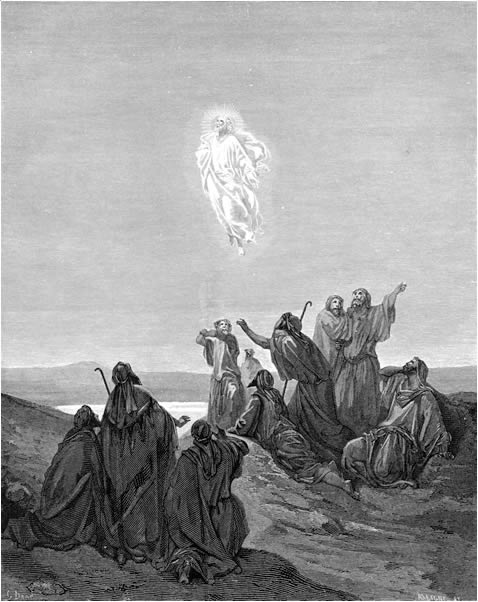
in Acts 1“Men of Galilee,” they said, “why do you stand here looking into the sky? This same Jesus, who has been taken from you into heaven, will come back in the same way you have seen Him go into heaven.”
BSB
The same verse in ASV and KJV ▾
ASV
who also said, Ye men of Galilee, why stand ye looking into heaven? this Jesus, who was received up from you into heaven, shall so come in like manner as ye beheld him going into heaven.
KJV
Which also said, Ye men of Galilee, why stand ye gazing up into heaven? this same Jesus, which is taken up from you into heaven, shall so come in like manner as ye have seen him go into heaven.
⋯
This verse in Acts 1
Commentary
31 notes on this verseAfter that, Pentecost is a most joyous space for conferring baptisms; wherein, too, the resurrection of the Lord was repeatedly proved among the disciples, and the hope of the advent of the Lord indirectly pointed to, in that, at that time, when He had been received back into the heavens, the angels told the apostles that "He would so come, as He had withal ascended into the heavens; " at Pentecost, of course.
This site's exposition
as He was taken up
on Acts 1:9-11
Luke tells the ascension briefly: they watched as He was taken up, and a cloud hid Him from their sight. The cloud recalls the pillar of cloud in Exodus and the cloud of the transfiguration.
This site's exposition
This same Jesus
The angels promise that the Jesus who left is the one who returns. Theophylact stresses that He will come with a body, in the same way He went. Bede adds that He returns as judge in that same flesh.
The record, by era
The Church Fathers5 voices
[Daniel 7:13-14] "And behold, there came One with the clouds of heaven like unto the Son of man."
A commentator
Augustine of HippoTRACTATES ON THE GOSPEL OF JOHN 21.13.2-4 · Written before 430.
proposed
How did they see him go? In the flesh which they touched, which they felt, the scars of which they even probed by touching; in that body in which he went in and out with them for forty days, manifesting himself to them in truth, not in any falsity; not as an apparition, not as a shadow, not as a spirit, but as he himself said, not deceiving, "Handle and see, for a spirit does not have flesh and bones, as you see me to have." Now, indeed, that body is worthy of a heavenly dwelling place, not subject to death, not changeable through ages. For as he had grown to that age from infancy, so he does not decline to old age from the age which was young adulthood. He remains as he ascended. He is going to come to those to whom, before he comes, he wanted his word to be preached. So, therefore, he will come in a human form. The ungodly, too, will see this. Those placed to the right will see it too; those separated to the left will see it too, as it was written, "They shall see him whom they have pierced." If they will see him whom they have pierced, they will see the same body which they thrust through with a spear; [for] the Word is not struck by a spear. Therefore, the ungodly will be able to see this very one whom they were also able to wound. They will not see the God lying hidden in the body; after the judgment he will be seen by those who will be on the right. This, therefore, is why he said, "The Father judges no one but has given all judgment to the Son," because the Son will come, clearly visible, to the judgment, appearing in human body to human beings, saying to those on the right, "Come, blessed of my Father, receive the kingdom"; saying to those on the left, "Go into everlasting fire which was prepared for the devil and his angels."
He is seen by Stephen, at his martyrdom by stoning, still sitting at the right hand of God [Acts 7:55] where He will continue to sit, until the Father shall make His enemies His footstool. [Hebrews 10:12-13] He will come again on the clouds of heaven, just as He appeared when He ascended into heaven. [Acts 1:11]
When [Scripture] defines the very Christ to be but one, it shakes the fancies of those who exhibit a multiform Christ, who make Christ to be one being and Jesus another — representing one as escaping out of the midst of the crowds, and the other as detained by them; one as appearing on a solitary mountain to three companions, clothed with glory in a cloud, the other as an ordinary man holding intercourse with all, one as magnanimous, but the other as timid; lastly, one as suffering death, the other as risen again, by means of which event they maintain a resurrection of their own also, only in another flesh. Happily, however, He who suffered "will come again from heaven," [Acts 1:11] and by all shall He be seen, who rose again from the dead. They too who crucified Him shall see and acknowledge Him; that is to say, His very flesh, against which they spent their fury, and without which it would be impossible for Himself either to exist or to be seen; so that they must blush with shame who affirm that His flesh sits in heaven void of sensation, like a sheath only, Christ being withdrawn from it; as well as those who (maintain) that His flesh and soul are just the same thing, or else that His soul is all that exists, but that His flesh no longer lives.
We must after all this turn our attention to those scriptures also which forbid our belief in such a resurrection as is held by your Animalists (for I will not call them Spiritualists), that it is either to be assumed as taking place now, as soon as men come to the knowledge of the truth, or else that it is accomplished immediately after their departure from this life... Who has yet beheld Jesus descending from heaven in like manner as the apostles saw Him ascend, according to the appointment of the two angels? [Acts 1:11] Up to the present moment they have not, tribe by tribe, smitten their breasts, looking on Him whom they pierced. [John 19:37; Zechariah 12:10] No one has as yet fallen in with Elias; [Malachi 4:5] no one has as yet escaped from Antichrist; [1 John 4:3] no one has as yet had to bewail the downfall of Babylon. [Revelation 18:2] And is there now anybody who has risen again, except the heretic? He, of course, has already quitted the grave of his own corpse — although he is even now liable to fevers and ulcers; he, too, has already trodden down his enemies — although he has even now to struggle with the powers of the world. And as a matter of course, he is already a king — although he even now owes to Cæsar the things which are Cæsar's. [Matthew 22:21]
23 more voices on this verse
The Church Fathers14 voices
In the same way, also, when it defines the very Christ to be but one, it shakes the fancies of those who exhibit a multiform Christ, who make Christ to be one being and Jesus another,-representing one as escaping out of the midst of the crowds, and the other as detained by them; one as appearing on a solitary mountain to three companions, clothed with glory in a cloud, the other as an ordinary man holding intercourse with all, one as magnanimous, but the other as timid; lastly, one as suffering death, the other as risen again, by means of which event they maintain a resurrection of their own also, only in another flesh. Happily, however, He who suffered "will come again from heaven," and by all shall He be seen, who rose again from the dead.
Who is it then, that has aroused the Lord, now at God's right hand so unseasonably and with such severity "shake terribly" (as Isaiah expresses it ("that earth," which, I suppose, is as yet unshattered? Who has thus early put "Christ's enemies beneath His feet" (to use the language of David ), making Him more hurried than the Father, whilst every crowd in our popular assemblies is still with shouts consigning "the Christians to the lions? " Who has yet beheld Jesus descending from heaven in like manner as the apostles saw Him ascend, according to the appointment of the two angels? Up to the present moment they have not, tribe by tribe, smitten their breasts, looking on Him whom they pierced.
He will come again on the clouds of heaven, just as He appeared when He ascended into heaven. Meanwhile He has received from the Father the promised gift, and has shed it forth, even the Holy Spirit-the Third Name in the Godhead, and the Third Degree of the Divine Majesty; the Declarer of the One Monarchy of God, but at the same time the Interpreter of the Economy, to every one who hears and receives the words of the new prophecy; and "the Leader into all truth," such as is in the Father, and the Son, and the Holy Ghost, according to the mystery of the doctrine of Christ.
The Passover affords a more than usually solemn day for baptism; when, withal, the Lord's passion, in which we are baptized, was completed. Nor will it be incongruous to interpret figuratively the fact that, when the Lord was about to celebrate the last Passover, He said to the disciples who were sent to make preparation, "You will meet a man bearing water." He points out the place for celebrating the Passover by the sign of water. After that, Pentecost is a most joyous space for conferring baptisms; wherein, too, the resurrection of the Lord was repeatedly proved among the disciples [Acts 1:3], and the hope of the advent of the Lord indirectly pointed to, in that, at that time, when He had been received back into the heavens [Acts 1:9], the angels told the apostles that "He would so come, as He had withal ascended into the heavens;" [Acts 1:11] at Pentecost, of course. But, moreover, when Jeremiah says, "And I will gather them together from the extremities of the land in the feast-day," he signifies the day of the Passover and of Pentecost, which is properly a "feast-day." However, every day is the Lord's; every hour, every time, is apt for baptism: if there is a difference in the solemnity, distinction there is none in the grace.
Now they saw his nature as limited. For I have heard the words of the Lord, "You shall see the Son of man coming in the clouds of heaven," and I acknowledge that what is seen by human eyes is limited, for the unlimited nature …
Any one who takes into view the ascension into Heaven of our Lord Christ, and the angels clothed in white raiment announcing to the Apostles his second coming, would never cease magnifying Jesus who showed and opened up to men the ascent into the future …
And to speak briefly they were trained by wars and miracles and dreams and their sacred books, and were thus taught to know Him who was truly God, Him whom the Jews revere and worship, in order that they also might be the better prepared …
What then? tell me. Did He put away the flesh, and is He now not with that body? Away with the thought, for He is even now clothed in flesh; for "this Jesus Who is taken up from you into Heaven shall so come." So? How? In flesh, with His body. How then doth he say, "Even though we have known Christ after the flesh, yet now henceforth no more?" For in us indeed "after the flesh" is being in sins, and "not after the flesh" not being in sins; but in Christ, "after the flesh" is His being subject to the affections of nature, such as to thirst, to hunger, to weariness, to sleep. For "He did no sin, neither was guile found in His mouth." Wherefore He also said, "Which of you convicteth Me of sin?" and again, "The prince of this world cometh, and he hath nothing in Me." And "not after the flesh" is being thenceforward freed even from these things, not the being without flesh. For with this also He cometh to judge the world, His being impassible and pure. Whereunto we also shall advance when "our body" hath been "fashioned like unto His glorious body."
Moreover the Angels did not say, "whom you have seen taken up," but, "going into heaven:" ascension is the word, not assumption; the expression "taken up," belongs to the flesh. For the same reason they say, "He which is taken up from you shall thus come," not, "shall be sent," but, "shall come. He that ascended, the same is he also that descended" (Eph. iv. 10). So again the expression, "a cloud received Him:" for He Himself mounted upon the cloud. Of the expressions, some are adapted to the conceptions of the disciples, some agreeable with the Divine Majesty. Now, as they behold, their conceptions are elevated: He has given them no slight hint of the nature of His second coming. For this, "Shall thus come," means, with the body; which thing they desired to hear; and, that he shall come again to judgment "thus" upon a cloud.
But wherefore does not Christ Himself tell them these things, instead of the Angels? He had beforehand told them all things; "What if ye shall see the Son of Man going up where He was before?" (John vi. 62). "Shall thus come," say they. If any therefore desires to see Christ; if any grieves that he has not seen Him: having this heard, let him show forth an admirable life, and certainly he shall see Him, and shall not be disappointed. For Christ will come with greater glory, though "thus," in this manner, with a body; and much more wondrous will it be to see Him descending from heaven.
"Shall thus come," etc. This is a confirmation of the Resurrection; for if he was taken up with a body, much rather must He have risen again with a body. Where are those who disbelieve the Resurrection? Who are they, I pray? Are they Gentiles, or Christians? for I am ignorant. But no, I know well: they are Gentiles, who also disbelieve the work of Creation. For the two denials go together: the denial that God creates anything from nothing, and the denial that He raises up what has been buried.
Everywhere it is Angels as at the Nativity, "for that which is conceived in her," saith one, "is by the Holy Ghost" (Matt. i. 20): and again to Mary, "Fear not, Mary." (Luke i. 30.) And at the Resurrection: "He is not here; He is risen, and goeth before you." (Luke xxiv. 6.) "Come, and see!" (Matt. xxviii. 6.) And at the Second Coming. For that they may not be utterly in amaze, therefore it is added, "Shall thus come." They recover their breath a little; if indeed He shall come again, if also thus come, and not be unapproachable! And that expression also, that it is "from them" He is taken up, is not idly added. And of the Resurrection indeed Christ Himself bears witness (because of all things this is, next to the Nativity, nay even above the Nativity, the most wonderful: His raising Himself to life again): for, "Destroy," He says, "this Temple, and in three days I will raise it up." (John ii. 19.)
Men spoke to men, yet they were not similar in substance.
So that the disciples might not be disturbed, and as the teacher had departed, and his body was being taken from them, they would not thereby become hopeless of the expectation of him, and for this reason be scattered elsewhere by faint-heartedness and fear; for …
The Medieval Church3 voices
This Jesus, who was taken up from you into heaven. For two reasons the angels are seen: that they might console them in their sorrow of the ascension with the remembrance of his return, and to show that he truly ascends into heaven, and not …
He will come in the same way as you saw him go into heaven. That is, he will come to judge in the same form and substance of the flesh in which he came to be judged. To whom certainly immortality was given, but nature …
"He will come," it says, not "He will be sent." "He will come in the same way," that is, with a body. This is what they desired to hear, and also that He will come again in the days of judgment on a cloud (cf. …
The Puritans and the Awakening2 voices
Which also said, ye men of Galilee,....
With a general idea of the embryo of the Christian church, and its state from Christ's ascension to the pouring out of the Spirit,
The Nineteenth Century4 voices
A commentator
Albert Barnes1798–1870
Notes, Explanatory and Practical, on the Old and New Testaments (1832-1869)
Ye men of Galilee - Galilee was the place of their former residence, and they were commonly known by the name of Galileans. Why stand ye ... - There is doubtless a slight degree of censure implied in this, as well as a design to call their attention away from a vain attempt to see the departed Saviour. The impropriety may have been: (1) In the feeling of disappointment, as if he would not restore the kingdom to Israel.
A commentator
Jamieson, Fausset & Brown1802–1910
Commentary Critical and Explanatory on the Whole Bible (1871)
Lest it should be thought He had disappeared when they were looking in some other direction, and so was only concluded to have gone up to heaven, it is here expressly said that "while they were looking He was taken up, and a cloud received Him out of their sight." So Elijah, "If thou see me when I am taken from thee" (2Ki 2:10);
A commentator
Jamieson, Fausset & Brown1802–1910
Commentary Critical and Explanatory on the Whole Bible (1871)
Ye men of Galilee, why stand ye gazing up into heaven, &c.--"as if your now glorified Head were gone from you never to return: He is coming again; not another, but 'this same Jesus'; and 'as ye have seen Him go, in the like manner shall He come'--as personally, as visibly, as gloriously; and let the joyful expectation of this coming swallow up the sorrow of that departure." Ac 1:12-26.
Gazing up into heaven - Not to the top of a mountain, to which an unbridled fancy, influenced by infidelity, would intimate he had ascended, and not to heaven. This same Jesus - Clothed in human nature, shall so come in like manner - with the same body, descending from heaven by his sovereign and all-controlling power, as ye have seen him go into heaven. Thus shall he come again to judge the quick and the dead. It was a very ancient opinion among Christians, that when Christ should come again to judge the world he would make his appearance on Mount Olivet. Some think that his coming again to destroy the Jewish nation is what the angels refer to. See a connected account of the different appearances of Christ at the end of this chapter.
The words behind it
31 Greek wordsEvery Greek word of this verse in the order it stands, with what it means and the door to its own study. The last column counts the times a word stands in the whole Bible: the rarer the word, the more the places it appears belong together.
| Greek | Sound | Meaning | Word study | In the Bible |
|---|---|---|---|---|
| οἳ | hoi | who | G3739 → | 1405 times |
| καὶ | kai | also | G2532 → | 9120 times |
| εἶπαν· | eipan | said; | G2036 → | 925 times |
| ἄνδρες | andres | Men | G435 → | 216 times |
| Γαλιλαῖοι, | galilaioi | Galileans, | G1057 → | 11 times |
| τί | ti | why | G5101 → | 563 times |
| ἑστήκατε | hestekate | have you stood | G2476 → | 153 times |
| ἐμβλέποντες | emblepontes | looking | G1689 → | |
| εἰς | eis | into | G1519 → | 1755 times |
| τὸν | ton | <the> | G3588 → | 19766 times |
| οὐρανόν; | ouranon | heaven? | G3772 → | 272 times |
| οὗτος | houtos | This | G3778 → | 1381 times |
| ὁ | ho | <the> | G3588 → | 19766 times |
| Ἰησοῦς | iesous | Jesus | G2424 → | 908 times |
| ὁ | ho | who | G3588 → | 19766 times |
| ἀναλημφθεὶς | analemphtheis | having been taken up | G353 → | 12 times |
| ἀφ᾽ | aph᾽ | from | G575 → | 640 times |
| ὑμῶν | humon | you | G4771 → | 2973 times |
| εἰς | eis | into | G1519 → | 1755 times |
| τὸν | ton | <the> | G3588 → | 19766 times |
| οὐρανὸν | ouranon | heaven | G3772 → | 272 times |
| οὕτως | houtos | thus | G3779 → | 208 times |
| ἐλεύσεται | eleusetai | will come | G2064 → | 628 times |
| ὃν | hon | in that | G3739 → | 1405 times |
| τρόπον | tropon | manner | G5158 → | 13 times |
| ἐθεάσασθε | etheasasthe | you beheld | G2300 → | 20 times |
| αὐτὸν | auton | Him | G846 → | 5565 times |
| πορευόμενον | poreuomenon | going | G4198 → | 147 times |
| εἰς | eis | into | G1519 → | 1755 times |
| τὸν | ton | <the> | G3588 → | 19766 times |
| οὐρανόν.¶ | ouranon | heaven. | G3772 → | 272 times |
οἳwho
hoiG3739 →1405 times
καὶalso
kaiG2532 →9120 times
εἶπαν·said;
eipanG2036 →925 times
ἄνδρεςMen
andresG435 →216 times
Γαλιλαῖοι,Galileans,
galilaioiG1057 →11 times
τίwhy
tiG5101 →563 times
ἑστήκατεhave you stood
hestekateG2476 →153 times
ἐμβλέποντεςlooking
emblepontesG1689 →
εἰςinto
eisG1519 →1755 times
τὸν<the>
tonG3588 →19766 times
οὐρανόν;heaven?
ouranonG3772 →272 times
οὗτοςThis
houtosG3778 →1381 times
ὁ<the>
hoG3588 →19766 times
ἸησοῦςJesus
iesousG2424 →908 times
ὁwho
hoG3588 →19766 times
ἀναλημφθεὶςhaving been taken up
analemphtheisG353 →12 times
ἀφ᾽from
aph᾽G575 →640 times
ὑμῶνyou
humonG4771 →2973 times
εἰςinto
eisG1519 →1755 times
τὸν<the>
tonG3588 →19766 times
οὐρανὸνheaven
ouranonG3772 →272 times
οὕτωςthus
houtosG3779 →208 times
ἐλεύσεταιwill come
eleusetaiG2064 →628 times
ὃνin that
honG3739 →1405 times
τρόπονmanner
troponG5158 →13 times
ἐθεάσασθεyou beheld
etheasastheG2300 →20 times
αὐτὸνHim
autonG846 →5565 times
πορευόμενονgoing
poreuomenonG4198 →147 times
εἰςinto
eisG1519 →1755 times
τὸν<the>
tonG3588 →19766 times
οὐρανόν.¶heaven.
ouranonG3772 →272 times
A shaded row is a word that stands 400 times or fewer in the Bible.
The walk
8 stopsEach card is a verse this one points to, and under it the verses that one points to in turn. Where several paths arrive at the same place, that place is listed first: the text keeps returning to it.
Through
1 Thessalonians 4:16For the Lord Himself will descend from heaven with a loud command, with the voice of an archangel, and with the trumpet of God, and the dead in Christ will be the first to…
it leads to
- Revelation 1:7
Behold, He is coming with the clouds, and every eye will see Him—even those who pierced Him. And all the tribes of the earth will mourn because of Him. So shall it be! Amen.
Reached by 3 separate paths from here.
- 1 Corinthians 15:51–52
Listen, I tell you a mystery: We will not all sleep, but we will all be changed—
- Matthew 24:30–31
At that time the sign of the Son of Man will appear in heaven, and all the tribes of the earth will mourn. They will see the Son of Man coming on the clouds…
- Revelation 1:7
Through
Revelation 1:7Behold, He is coming with the clouds, and every eye will see Him—even those who pierced Him. And all the tribes of the earth will mourn because of Him. So shall it be! Amen.
it leads to
- Daniel 7:13
In my vision in the night I continued to watch, and I saw One like the Son of Man coming with the clouds of heaven. He approached the Ancient of Days and was led…
Reached by 2 separate paths from here.
- Matthew 24:30
At that time the sign of the Son of Man will appear in heaven, and all the tribes of the earth will mourn. They will see the Son of Man coming on the clouds…
- Zechariah 12:10
Then I will pour out on the house of David and on the people of Jerusalem a spirit of grace and prayer, and they will look on Me, the One they have pierced. They…
- Mark 14:62
“I am,” said Jesus, “and you will see the Son of Man sitting at the right hand of Power and coming with the clouds of heaven.”
- Daniel 7:13
Through
John 14:3And if I go and prepare a place for you, I will come back and welcome you into My presence, so that you also may be where I am.
it leads to
- 1 Thessalonians 4:16–17
For the Lord Himself will descend from heaven with a loud command, with the voice of an archangel, and with the trumpet of God, and the dead in Christ will be the first to…
- 1 Thessalonians 4:16–17
Where this verse is studied
On this page
Studies16
On this verse
On this chapter
About Acts
This page draws on 25 works. Open the list of works
This page draws on Adam Clarke, Commentary on the Bible; Albert Barnes, Notes, Explanatory and Practical, on the Old and New Testaments (1832-1869); Augustine of Hippo, TRACTATES ON THE GOSPEL OF JOHN 21.13.2-4; Bede, Commentary on Acts; Cosmas Indicopleustes, The Christian Topography, Book 6; Cosmas Indicopleustes, The Christian Topography, Book 12; Jamieson, Fausset & Brown, Commentary Critical and Explanatory on the Whole Bible; Jerome, St. Jerome, Commentary on Daniel, CHAPTER SEVEN; John Calvin, Commentary upon the Acts of the Apostles; John Chrysostom, Homilies on the Acts of the Apostles; John Chrysostom, HOMILIES ON 2 CORINTHIANS 11.3; John Chrysostom, Homily on Acts 2; John Gill, Exposition of the New Testament (1746-1748); Matthew Henry, Commentary on the Whole Bible; Oecumenius, Commentary on Acts; Tertullian, On Baptism; Tertullian, Against Praxeas, Chapter 30; Tertullian, On the Flesh of Christ, Chapter 24; Tertullian, On the Resurrection of the Flesh, Chapter 22; Tertullian, On the Flesh of Christ; Tertullian, On the Resurrection of the Flesh; Tertullian, Against Praxeas; Tertullian, On Baptism, Chapter 19; Theodoret of Cyrus, DIALOGUE 2 and Theophylact of Ohrid, Commentary on Acts.