
Judgeschapter 9
57 verses · BSBJudges book hub →
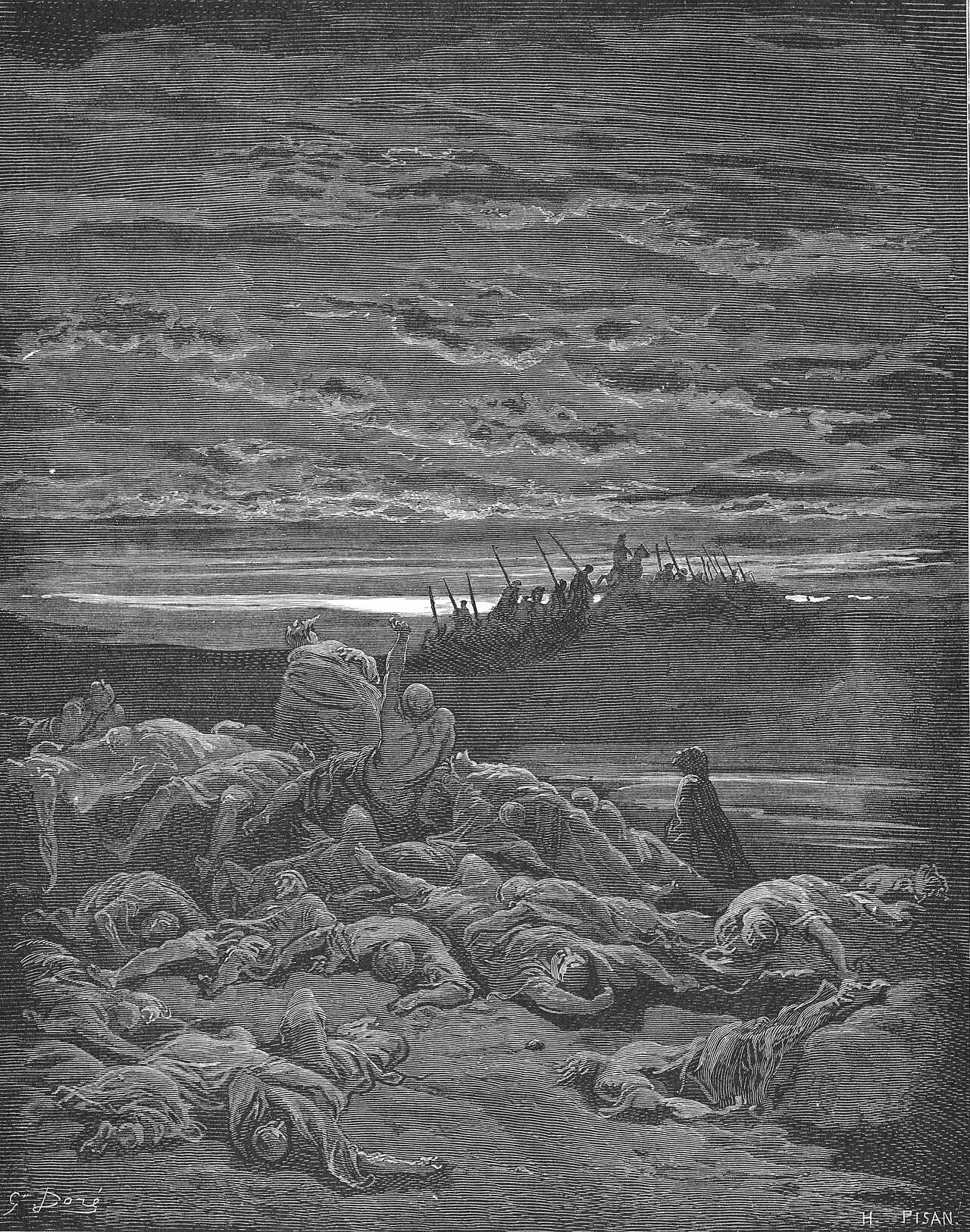
The Death of Gideon's Sons, Gustave Doré, Doré's English Bible (1866), public domain
Key verse
“Please ask all the leaders of Shechem, ‘Is it better for you that seventy men, all the sons of Jerubbaal, rule over you, or just one man?’ Remember that I am your own flesh and blood.”
It stands in scene A of the chapter, verses 1 to 6.
The chapter
Chapter summary
Abimelech asks the men of Shechem whether seventy rulers are better than one, takes silver from the house of Baal-berith, hires vain and light fellows, and murders his seventy brothers upon one stone; only Jotham, the youngest, escapes. From Mount Gerizim Jotham shouts his fable: the olive, fig, and vine each refuse the crown rather than leave their fatness, sweetness, and wine, and the bramble accepts, inviting all to take refuge in its shade or be devoured by its fire. Within three years God sends an evil spirit between Abimelech and Shechem; Gaal rebels, the city is razed and sown with salt, the tower burned. At Thebez a woman drops an upper millstone on his head, and God requites the wickedness.
Context
History · Samuel · Judges overview
Where the chapter sits
Judges 9 falls in The twelve judges (chapters 3–16). Othniel, Ehud, Shamgar, Deborah, Gideon, Tola, Jair, Jephthah, Ibzan, Elon, Abdon, Samson (and Abimelech as anti-judge). Seven oppression-deliverance cycles.
Abimelech the anti-judge. Jotham's parable of the trees; Gideon's son crowned at Shechem; the bramble that burns.
Before it: Incomplete conquest; programmatic cycle, chapters 1–2. After it: Appendix: diagnosis of Israel, chapters 17–21.
The whole shape of Judges→The world behind this chapter
Judges 9The history
Shechem sits in the pass between two mountains and had been a covenant place since Abraham's day; it is where Joshua gathered Israel to renew the covenant. By this period it held a mixed population, and the temple of Baal-berith, the name means lord of the covenant, funds Abimelech's coup out of its treasury. Excavation at the site has uncovered a massive fortress-temple with walls some five meters thick, matching the stronghold the chapter describes.
The rest of the history, and what it meant to them
Killing seventy brothers on one stone is a purge, not a brawl. New kings in the ancient Near East routinely eliminated rival claimants, and doing it on a single stone reads like an execution ritual. Jotham, the youngest, survives by hiding, which is the standard way the youngest survives in these accounts.
Jotham's fable is a fable in the exact ancient sense, trees that talk, told to make one point. Olive, fig, and vine all decline the crown because they have real work to do producing oil, sweetness, and wine. The bramble, a worthless thornbush that gives no fruit and no shade and starts wildfires in dry season, accepts instantly and threatens to burn the cedars. He shouted it from the slope of Gerizim, which forms a natural sounding board above the town.
The end is a siege detail. Sowing a captured city with salt was a symbolic curse of permanent barrenness. And the millstone that kills Abimelech is the upper stone of a household hand mill, a disc a woman could lift and turn, heavy enough to crush a skull when dropped from a tower. His demand that his armor-bearer finish him so it will not be said a woman killed him tells you exactly how that death would be remembered, and it was remembered that way for centuries.
What it meant to them
This is the Bible's first experiment in kingship, and it is a disaster from beginning to end: bought with temple money, built on murdered brothers, ended by a woman on a roof. Hearers who would later ask Samuel for a king had this story in the family memory.
Jotham's curse is also the chapter's frame. He asks whether Shechem acted in good faith toward Gideon's house, and says if not, let fire come from Abimelech and from Shechem and consume them both. Three years later both are ash.
Sources cited
- Keil and Delitzsch, Biblical Commentary on the Old Testament: Joshua, Judges, Ruth
- John H. Walton, Victor H. Matthews, and Mark W. Chavalas, The IVP Bible Background Commentary: Old Testament
A. Seventy brothers killed on one stone
1. (vv. 1-3)
a.Gideon told Israel at 8:23 that neither he nor his son would rule them, and his son opens this chapter canvassing for the crown. Abimelech argues from kinship rather than from any claim of right, and the phrase he uses, I am your bone and your flesh, is the formula Laban used of Jacob at Genesis 29:14 and the one the tribes use to make David king at 2 Samuel 5:1. Shechem is his mother's town, named at 8:31, so among those men the seventy sons of Gideon are outsiders and he is not.
Judges 9:1, 1 voiceWhat preachers and commentators have said about this verse, in their own words.
Judges 9:1
“We are not told how soon after the death of Gideon these events happened. There must have been time for the apostacy and establishment of Baal-worship, and for the development of ill-will between Abimelech and his brethren.”
Judges 9:2, 2 voices
Judges 9:2
“Whether is better for you, either that all the sons - This was a powerful argument: Whether will you have seventy tyrants or only one? For, as he had no right to the government, and God alone was king at that time in Israel; so he must support his usurped rule by whatever means were most likely to effect it: a usurped government is generally supported by oppression and the sword.”
Adam Clarke· Commentary on the Bible (1810-1826)evangelical
Judges 9:2
“Whether is better for you, either that all the sons of Jerubbaal, . . . or that one reign over you--a false insinuation, artfully contrived to stir up jealousy and alarm. Gideon had rejected, with abhorrence, the proposal to make himself or any of his family king, and there is no evidence that any of his other sons coveted the title.”
Jamieson, Fausset & Brown· Commentary Critical and Explanatory on the Whole Bible (1871)reformed
Judges 9:3, 1 voice
Judges 9:3
“The Ephraimite pride revolted from Abi-ezrite rulers, and inclined them to one who was a Shechemite by birth. (Compare the same spirit in the time of David and Rehoboam, 2Sa 20:1; 1Ki 12:16.)”
2. (vv. 4-5)
a.The money comes out of the temple treasury of Baal-berith, the god Israel took up as soon as Gideon died at 8:33, so the shrine funds the coup. Seventy pieces of silver buy seventy deaths, one coin a brother, and the men hired are called vain and light, the same sort of following Jephthah gathers at 11:3. The killing is done upon one stone, which reads as an execution block rather than a battle, and the youngest son escapes by hiding, as Joash later does at 2 Kings 11:2.
Judges 9:4, 2 voices
Judges 9:4
“Threescore and ten pieces of silver - Probably shekels; and this was the whole of his exchequer. As he was now usurping the government of God, he begins with a contribution from the idol temple. A work begun under the name and influence of the devil is not likely to end to the glory of God, or to the welfare of man. Hired vain and light persons - אנשים ריקים ופחזים anashim reykim uphochazim, worthless and dissolute men; persons who were living on the public, and had nothing to lose. Such was the foundation of his Babel government.”
Adam Clarke· Commentary on the Bible (1810-1826)evangelical
Judges 9:4
“Pieces of silver - Not shekels, which were too small a sum for this purpose; but far larger pieces, the exact worth whereof it is not possible for us now to know. The house of Baal-berith - Out of his sacred treasury; having since Gideon's death built this temple (which he would never have suffered whilst he lived) and endowed it with considerable revenues.”
John Wesley· Explanatory Notes upon the Old Testament (1765)evangelical
Judges 9:5, 2 voices
Judges 9:5
“And he went to his father's house at Ophrah,.... Which, according to Bunting (a), was ten miles from Shechem: and slew his brethren the sons of Jerubbaal, being seventy persons, upon one stone: in which he was assisted by the ruffians he had hired with seventy pieces of silver; these were laid one after another upon one and the same stone, as being convenient for the execution of them; or as serving as an altar on which they were sacrificed to Baal, out of whose temple the money was taken to hire the executioners with.”
Judges 9:5
“Slew his brethren - His brothers by the father’s side, Jdg 8:30. This was a usual way of securing an ill-gotten throne; the person who had no right destroying all those that had right, that he might have no competitors. Yet Jotham - was left - That is, all the seventy were killed except Jotham, if there were not seventy besides Jotham.”
Adam Clarke· Commentary on the Bible (1810-1826)evangelical
3. (v. 6)
a.The crowning happens by the plain of the pillar in Shechem, and the King James margin reads oak. Joshua 24:26 set a great stone under an oak by the sanctuary of the Lord in this same town, on the day Israel swore to serve the Lord and no other god. Keil and Delitzsch take the two trees as one and read the coronation as staged at the covenant memorial itself, and the text names the spot without settling it. The house of Millo is the citadel quarter of the town, and the name turns up again in Jerusalem at 2 Samuel 5:9.
Judges 9:6, 1 voice
Judges 9:6
“Of the pillar - Or, by the oak of the pillar, by the oak, where Joshua erected a pillar as a witness of the covenant renewed between God and Israel, Josh. xxiv, 26. This place they chose, to signify that they still owned God, and their covenant with him; and did not worship Baal in opposition to God, but in conjunction with him, or in subordination to him.”
John Wesley· Explanatory Notes upon the Old Testament (1765)evangelical
B. Jotham's fable of the trees and the bramble
1. (v. 7)
a.Gerizim is the mountain of blessing, appointed at Deuteronomy 11:29 and 27:12 and used at Joshua 8:33 when the nation stood between the two hills and heard the law read. Jotham climbs the blessing side and speaks a curse from it. His opening line sets the terms, hearken unto me, that God may hearken unto you, so what follows is offered as testimony rather than as a story told for its own sake.
Judges 9:7, 1 voice
Judges 9:7
“Mount Gerizim - Which lay near Shechem. The valley between Gerizim and Ebal, was a famous place, employed for the solemn reading of the law, and its blessings and curses: and it is probable it was still used, even by the superstitious and idolatrous Israelites for such occasions, who delighted to use the same places which their ancestors had used.”
John Wesley· Explanatory Notes upon the Old Testament (1765)evangelical
2. (vv. 8-9)
a.Trees choosing a king is the shape of the speech, and the only other fable of this kind in Scripture is the thistle and the cedar that Jehoash sends to Amaziah at 2 Kings 14:9 and 2 Chronicles 25:18. What the trees offer is anointing, which is the Torah word for making a priest or a king, so the picture is a throne rather than a captaincy for one campaign. The olive answers first, because olive oil is what fills the lamps and does the anointing, and its reason for refusing is that the promotion would cost it the work it already does.
Judges 9:8, 1 voice
Judges 9:8
“The trees went forth on a time to anoint a king over them,.... This is an apologue or fable, and a very fine and beautiful one; it is fitly expressed to answer the design, and the most ancient of the kind, being made seven hundred years before the times of Aesop, so famous for his fables, and exceeds anything written by him.”
Judges 9:9, 1 voice
Judges 9:9
“Wherewith - they honor God and man - I believe the word אלהים elohim here should be translated gods, for the parable seems to be accommodated to the idolatrous state of the Shechemites. Thus it was understood by the Vulgate, Arabic, and others.”
Adam Clarke· Commentary on the Bible (1810-1826)evangelical
3. (vv. 10-13)
a.Olive, fig and vine are the three crops that stand for a settled land, listed together in Deuteronomy 8:8 and drawn again in the picture of every man under his vine and his fig tree at 1 Kings 4:25. Each refuses in the same terms, that ruling would cost it its own fruit, and each answer names something the tree gives away for nothing. The vine's phrase, my wine, which cheereth God and man, points at the drink offering of Numbers 15:5 as much as at the table.
Judges 9:10, 1 voice
Judges 9:10
“And the trees said to the fig tree,.... Another useful and fruit bearing tree, and to which also good men are sometimes compared, see Son 2:13, come thou, and reign over us: which Jarchi applies to Deborah, but may be better applied to one of Gideon's sons, who, though they had not a personal offer of kingly government themselves, yet it was made to them through their father, and refused, as for himself, so for them; and had it been offered to them, they would have rejected it, as Jotham seems to intimate by this parable.”
Judges 9:11, 2 voices
Judges 9:11
“And the fig tree said unto them,.... Rejecting the offer made: should I forsake my sweetness and my good fruit; for such the fruit of the fig tree is, sweet and good: so Julian (d) the emperor shows from various authors, Aristophanes, Herodotus, and Homer, that nothing is sweeter than figs, excepting honey, and that no kind of fruit is better, and, where they are, no good is wanting: and go to be promoted over the trees? the same is designed by this as the former. (d) Opera, par. 2. ep. 24. Sarapioni, p. 142.”
Judges 9:11
“But the fig tree said - Should I forsake my sweetness - The fruit of the fig tree is the sweetest or most luscious of all fruits. A full-ripe fig, in its own climate, has an indescribable sweetness; so much so that it is almost impossible to eat it, till a considerable time after it is gathered from the trees, and has gone through an artificial preparation. This I have often noticed.”
Adam Clarke· Commentary on the Bible (1810-1826)evangelical
Judges 9:13, 1 voice
Judges 9:13
“Which cheereth God and man - I believe אלהים elohim here is to be taken in the same sense proposed on Jdg 9:9. Vast libations of wine, as well as much oil, were used in heathenish sacrifices and offerings; and it was their opinion that the gods actually partook of, and were delighted with, both the wine and oil. The pagan mythology furnishes the most exquisite wines to its gods in heaven, and hence the nectar and ambrosia so much talked of and praised by the ancients.”
Adam Clarke· Commentary on the Bible (1810-1826)evangelical
4. (vv. 14-15)
a.The bramble carries no fruit and throws no shade a man would stand in, and dry thorn is the quickest thing in a field to catch fire. Its offer is trust in my shadow, and the verb behind put your trust is the word for taking refuge in God at Psalm 2:12. The threat attached to it happens twice before the chapter ends, fire coming out of the bramble to devour the cedars of Lebanon, which are the tallest trees Scripture names and the furthest thing from a thorn.
Judges 9:14, 1 voice
Judges 9:14
“Then said all the trees unto the bramble - The word אטד atad, which we translate bramble, is supposed to mean the rhamnus, which is the largest of thorns, producing dreadful spikes, similar to darts. See Theodoret on Psa 58:10. There is much of the moral of this fable contained in the different kinds of trees mentioned. 1. The olive; the most profitable tree to its owner, having few equals either for food or medicine.”
Adam Clarke· Commentary on the Bible (1810-1826)evangelical
Judges 9:15, 2 voices
Judges 9:15
“Come and put your trust in any shadow - The vain boast of the would-be sovereign; and of the man who is seeking to be put into power by the suffrages of the people. All promise, no performance. Let fire come out of the bramble - A strong catachresis. The bramble was too low to give shelter to any tree; and so far from being able to consume others, that the smallest fire will reduce it to ashes, and that in the shortest time.”
Adam Clarke· Commentary on the Bible (1810-1826)evangelical
Judges 9:15
“If in truth - If you deal truly and justly in making me king. Then trust - Then you may expect protection under my government. Devour the cedars - In stead of protection, you shall receive destruction by me; especially you cedars, that is, nobles, such as the house of Millo, who have been most forward in this work.”
John Wesley· Explanatory Notes upon the Old Testament (1765)evangelical
5. (vv. 16-18)
a.Jotham drops the picture and names the men standing below him. His charge has three parts: Gideon fought for Shechem and adventured his life, they killed his sons upon one stone, and they crowned the one son born to a maidservant because he was a local. The words upon one stone repeat verse 5 exactly, which is the speech quoting the narrative back at the town that did it.
Judges 9:18, 1 voice
Judges 9:18
“Maidservant - His concubine, whom he so calls by way of reproach. Over Shechem - By which limitation of their power, and his kingdom, he reflects contempt upon him, and chargeth them with presumption, that having only power over their own city, they durst impose a king upon all Israel.”
John Wesley· Explanatory Notes upon the Old Testament (1765)evangelical
6. (vv. 19-21)
a.The curse is framed as a condition and it runs both ways, fire from Abimelech devouring Shechem and fire from Shechem devouring Abimelech. Both halves are reported as done by verse 49 and verse 53, and the narrator says so outright at verse 57. Jotham then runs to Beer and leaves the book, so the one survivor of the seventy never comes back to claim anything.
Judges 9:20, 2 voices
Judges 9:20
“Let fire come out from Abimelech - As the thorn or bramble may be the means of kindling other wood, because it may be easily ignited; so shall Abimelech be the cause of kindling a fire of civil discord among you, that shall consume the rulers and great men of your country. A prophetic declaration of what would take place.”
Adam Clarke· Commentary on the Bible (1810-1826)evangelical
Judges 9:20
“Devour Abimelech - This is not so much a prediction as an imprecation, which, being grounded upon just cause, had its effect, as others in like case had.”
John Wesley· Explanatory Notes upon the Old Testament (1765)evangelical
Judges 9:21, 1 voice
Judges 9:21
“Went to Beer - Mr. Maundrell, in his journey from Aleppo to Jerusalem, p. 64, 5th edit., mentions a place of this name, which he thinks to be that to which Jotham fled, and supposed to be the same as Mishmash, 1Sa 14:5, 1Sa 14:31. It is situated, he says, towards the south, on an easy declivity; and has a fountain of excellent water at the bottom of the hill from which it has taken its name.”
Adam Clarke· Commentary on the Bible (1810-1826)evangelical
C. Shechem turns on the king it crowned
1. (vv. 22-24)
a.Then God sent an evil spirit between Abimelech and the men of Shechem, and this is the first place in Scripture where the words evil spirit stand together, checked against the King James text; the next are Saul's at 1 Samuel 16:14 and after. Readers divide over what the sending means, some taking a created spirit given its errand and others a spirit of suspicion stirred among men, with Gill and Clarke both laying weight on the second while holding that God governs it. Verse 24 gives the reason ahead of the events, which the book rarely does, and the blood is laid on the town as well as on the man, because Shechem paid for the killing.
Judges 9:22, 2 voices
Judges 9:22
“Had reigned - Rather, “had ruled.” It is not the phrase used in Jdg 9:6. It looks as if the Shechemites alone had made him king, and the rest of Israel had submitted to his dominion, without allowing his title of king.”
Judges 9:22
“None could "reign" in Israel, except by rebellious usurpation; and hence the reign of Abimelech is expressed in the original by a word signifying "despotism," not that which describes the mild and divinely authorized rule of the judge.”
Jamieson, Fausset & Brown· Commentary Critical and Explanatory on the Whole Bible (1871)reformed
Judges 9:23, 2 voices
Judges 9:23
“God sent an evil spirit - He permitted jealousies to take place which produced factions; and these factions produced insurrections, civil contentions, and slaughter.”
Adam Clarke· Commentary on the Bible (1810-1826)evangelical
Judges 9:23
“Their own lusts were evil spirits; they are devils in men's own hearts; from them come wars and fightings. These God gave them up to, and so might be said to send the evil spirits between them. When men's sin is made their punishment, though God is not the author of the sin, yet the punishment is from him.”
Matthew Henry· Commentary on the Whole Bible (1707-1721)puritan
2. (vv. 25-27)
a.The town turns first by robbing the roads, which cuts off the tolls and traffic a ruler lives on. Gaal the son of Ebed arrives with a following and the men of Shechem put their confidence in him, the same confidence they had given Abimelech three years earlier. The cursing happens at the vintage feast inside the house of their god, so the break with Abimelech is sworn in the shrine that paid for him at verse 4.
Judges 9:26, 2 voices
Judges 9:26
“Gaal the son of Ebed - Of this person we know no more than is here told. He was probably one of the descendants of the Canaanites, who hoped from the state of the public mind, and their disaffection to Abimelech, to cause a revolution, and thus to restore the ancient government as it was under Hamor, the father of Shechem.”
Adam Clarke· Commentary on the Bible (1810-1826)evangelical
Judges 9:26
“This Gaal is said to be the son of Ebed, which signifies a servant, perhaps denoting the meanness of his extraction. As Abimelech was by the mother's side, so he by the father's, the son of a servant.”
Matthew Henry· Commentary on the Whole Bible (1707-1721)puritan
Judges 9:27, 1 voice
Judges 9:27
“Seditious and lawless acts Jdg 9:25-26 now broke out into open rebellion. It was at an idolatrous feast in the house of Baal-berith, on occasion of the vintage, and when they were excited with wine, that the rebellion was matured. Those present began to “curse Abimelech,” to speak insultingly of him, and to revile him (compare Lev 20:9; 2Sa 19:21; Isa 8:21).”
3. (vv. 28-29)
a.Gaal tells the town to go back to its old line, serve the men of Hamor the father of Shechem, which names Genesis 33:19 and Genesis 34 out loud. Hamor's house is the family Simeon and Levi destroyed after Dinah, so the appeal reaches past Israel altogether to the Canaanite city Jacob camped beside. He also calls Abimelech the son of Jerubbaal, the Baal-fighting name given at 6:32, and turns it into a reason for a Baal-berith town to be rid of him.
Judges 9:28, 1 voice
Judges 9:28
“This he might speak sincerely, as being himself a Canaanite and Shechemite, and possibly came from one of those little ones whom Simeon and Levi spared when they slew all the grown males, Gen. xxxiv, 29. And it may be that he was one of the royal blood, a descendent of Hamor, who hereby sought to insinuate himself into the government, as it follows, ver. 29.”
John Wesley· Explanatory Notes upon the Old Testament (1765)evangelical
Judges 9:29, 2 voices
Judges 9:29
“Would to God this people were under my hand - The very words and conduct of a sly, hypocritical demagogue. Increase thine army, and come out - When he found his party strong, and the public feeling warped to his side, then he appears to have sent a challenge to Abimelech, to come out and fight him.”
Adam Clarke· Commentary on the Bible (1810-1826)evangelical
Judges 9:29
“My hand - That is, under my command; I wish you would unanimously submit to me, as your captain and governor; for he found them divided; and some of them hearkening after Abimelech, whom they had lately rejected, according to the levity of the popular humour.”
John Wesley· Explanatory Notes upon the Old Testament (1765)evangelical
4. (vv. 30-33)
a.Zebul holds the town for Abimelech and sends word privily, so the man Gaal dismissed as an officer at verse 28 is the one who undoes him. The plan he sends is the ambush of Joshua 8 in small compass, lie in the field by night, rise at sunrise, and let the city come out to you. Nobody in the chapter asks God about any of it, and no priest, prophet or word from the Lord appears in the fifty-seven verses.
Judges 9:31, 1 voice
Judges 9:31
“Privily - See the margin. The word is probably the name of a place in “Tormah”, some think the same as “Arumah” Jdg 9:41. Zebul was faithful to Abimelech, but dissembled his sentiments, from being too weak to oppose Gaal, until Abimelech came with his army Jdg 9:38.”
D. Fire in the stronghold of the tower
1. (vv. 34-36)
a.Gaal stands in the entering of the gate, which is where a town's leaders sat to judge and to talk, and from there he sees men coming down off the hills. Zebul tells him he is looking at the shadow of the mountains, which holds him in the gateway while the companies close on him. Shadow is the bramble's own word from verse 15, where the thorn invited the trees to trust in its shadow, and here the man who trusted Gaal is told that armed men are a shadow.
2. (vv. 37-39)
a.Meonenim means the soothsayers, so the second company comes past the diviners' oak, a landmark carrying the name of the practice Deuteronomy 18:10 to 14 forbids outright. Zebul then throws Gaal's own sentence back at him, where is now thy mouth, and pushes him out of the gate to fight. Gaal goes out before the men of Shechem, and the town he talked into a rebellion is the only army he has.
Judges 9:37, 2 voices
Judges 9:37
“And Gaal spake again, and said,.... Looking towards the mountains, and taking another view of what he before saw, for further satisfaction: see, there come people down by the middle of the land; either in the valley between the two mountains; or rather those he first saw on the top of the mountains were now come down about the middle of them, called in the Hebrew text the navel, from the prominence of the mountains thereabout, or because the navel is in the middle of the body, as this part of them was the middle on which he saw them.”
Judges 9:37
“The plain of Meonenim - Translate “the oak of the soothsayers” (see the margin). Some well-known oak, so called, but which is not mentioned elsewhere.”
3. (vv. 40-41)
a.The fighting ends where it began, at the gate, and the wounded fall in the entering of it. Abimelech does not go into the city; he pulls back to Arumah and leaves Zebul to expel Gaal and his brethren, which keeps the town standing for another day. What comes next shows that the restraint was timing.
4. (vv. 42-45)
a.Three companies this time instead of four, with the gate held so that the people in the fields have nowhere to run back to. Abimelech takes the city, kills the people in it, beats it down and sows it with salt, which announces that nothing is to grow there again; Deuteronomy 29:23 describes a judged land as brimstone and salt. Leviticus 2:13 puts salt in every offering as the salt of the covenant, and here the same substance is used to unmake a town. The place that crowned him is the first place he levels.
Judges 9:42, 1 voice
Judges 9:42
“After Gaal’s expulsion, “the people went out into the field,” either to complete the vintage, or for some other agricultural operation. “They” (Zebul and his party) sent word of this to Abimelech.”
Judges 9:44, 1 voice
Judges 9:44
“This verse explains the purpose of both the present and the former division of Abimelech’s forces into several companies, namely, that while some of the companies attacked the men of Shechem in the field, another company, starting from their ambush, might occupy the approach to the city gate, and so cut off their retreat.”
Judges 9:45, 1 voice
Judges 9:45
“Sowed it with salt - Expressing by this action his hatred, and his wish, that when utterly destroyed as a city, it might not even be a fruitful field. Salt is the emblem of barrenness (see the marginal references).”
5. (vv. 46-49)
a.The survivors shut themselves inside the stronghold of the house of the god Berith, the same temple that handed Abimelech the silver at verse 4, and it does not save them. He cuts a bough on mount Zalmon, tells his men to copy what they have seen him do, and burns about a thousand men and women in the hold. Jotham's line at verse 20, let fire come out from Abimelech and devour the men of Shechem, is carried out with an axe and a pile of branches, and the trees of the fable are the fuel.
Judges 9:46, 1 voice
Judges 9:46
“A hold of the house of the god Berith - This must mean the precincts of the temple, as we find there were a thousand men and women together in that place.”
Adam Clarke· Commentary on the Bible (1810-1826)evangelical
Judges 9:48, 1 voice
Judges 9:48
“Zalmon - A lofty and thickly-wooded hill, as the etymology of the name (“shady”) implies, in the immediate neighborhood of Shechem: perhaps the same as Ebal. The setting fire to the hold, where the men of Shechem were all crowded together, with their wives and children, was the literal fulfillment of Jotham’s curse in Jdg 9:20.”
E. A millstone from the wall of Thebez
1. (vv. 50-52)
a.Thebez is named twice in the whole Bible, here and in Joab's message at 2 Samuel 11:21, and it sits a few hours north of Shechem. The people do what Shechem did, crowd into the strong tower and shut the door behind them, and Abimelech does what worked before and goes hard to the door to burn it. Going too near a wall is exactly what Joab's messenger is later told the king will ask about, and this siege is the example he is given to quote.
Judges 9:50, 1 voice
Judges 9:50
“Then went Abimelech to Thebez,.... Which, according to Ben Gersom, had rebelled against him; it was near to Shechem.”
Judges 9:52, 2 voices
Judges 9:52
“Went hard unto the door ... - i. e. went close to the door. An act of manifest danger, seeing the roof was covered with persons who would be likely to throw down missiles of all sorts on the heads of their assailants. But the hatred of Abimelech, and his thirst for revenge, made him despise danger.”
Judges 9:52
“Those who have escaped and succeeded well in one desperate attempt are apt to think the like attempt another time not desperate. This instance was long after quoted to show how dangerous it is to come near the call of a besieged city, 2 Sam. xi.”
Matthew Henry· Commentary on the Whole Bible (1707-1721)puritan
2. (vv. 53-54)
a.The upper millstone was the stone a woman turned by hand, light enough to lift and heavy enough to kill, so the weapon comes off a roof and out of a kitchen. A stone killed seventy brothers at verse 5 and a stone kills the man who used it, which is the chapter's own arithmetic. His last order is given so that men say not of me, A woman slew him, and Judges 4:9 had already put the honour of Sisera's death in a woman's hand; Saul gives his armourbearer the same order at 1 Samuel 31:4 and is refused. Joab quotes this death from memory at 2 Samuel 11:21, generations later, which shows how well it was remembered.
Judges 9:53, 2 voices
Judges 9:53
“A piece of a millstone - פלח רכב pelach recheb, a piece of a chariot wheel; but the word is used in other places for upper millstones, and is so understood here by the Vulgate, Septuagint, Syriac, and Arabic. And all to break his skull - A most nonsensical version of ותרץ את גלגלתו vattarits eth gulgolto, which is literally, And she brake, or fractured, his skull. Plutarch, in his life of Pyrrhus, observes that this king was killed at the siege of Thebes, by a piece of a tile, which a woman threw upon his head.”
Adam Clarke· Commentary on the Bible (1810-1826)evangelical
Judges 9:53
“Mill-stone - Such great stones no doubt they carried up with them, whereby they might defend themselves, or offend those who assaulted them. Here the justice of God is remarkable in suiting the punishment to his sin.”
John Wesley· Explanatory Notes upon the Old Testament (1765)evangelical
Judges 9:54, 1 voice
Judges 9:54
“Draw thy sword, and slay me - It was a disgrace to be killed by a woman; on this account, Seneca the tragedian deplores the death of Hercules: - O turpe fatum! femina Herculeae necis Autor feritur. Herc. Oetaeus, ver. 1177. “O dishonorable fate! a woman is reported to have been author of the death of Hercules.” Abimelech was also afraid that if he fell thus mortally wounded into the hands of his enemies they might treat him with cruelty and insult.”
Adam Clarke· Commentary on the Bible (1810-1826)evangelical
3. (vv. 55-57)
a.The army goes home the moment he dies, which says what had been holding it together. The last two verses are the narrator's own summing up, that God rendered the wickedness of Abimelech and rendered the evil of the men of Shechem upon their heads, and that the curse of Jotham came upon them. The book states its judgment here in its own words, and the chapter closes on the man who spoke from Gerizim and was never heard from again.
The text of this chapter
This page carries no textual note on Judges 9. Where this site has examined a place the manuscripts differ, the examination is in the manuscripts room. Every place this site examines →
This page draws on Adam Clarke; Albert Barnes; Jamieson, Fausset & Brown, Commentary Critical and Explanatory on the Whole Bible (1871); John Gill; John Wesley, Explanatory Notes upon the Old Testament (1765); Keil and Delitzsch, Biblical Commentary on the Old Testament: Joshua, Judges, Ruth and Matthew Henry.
Keep studying
On this page
Studies1