
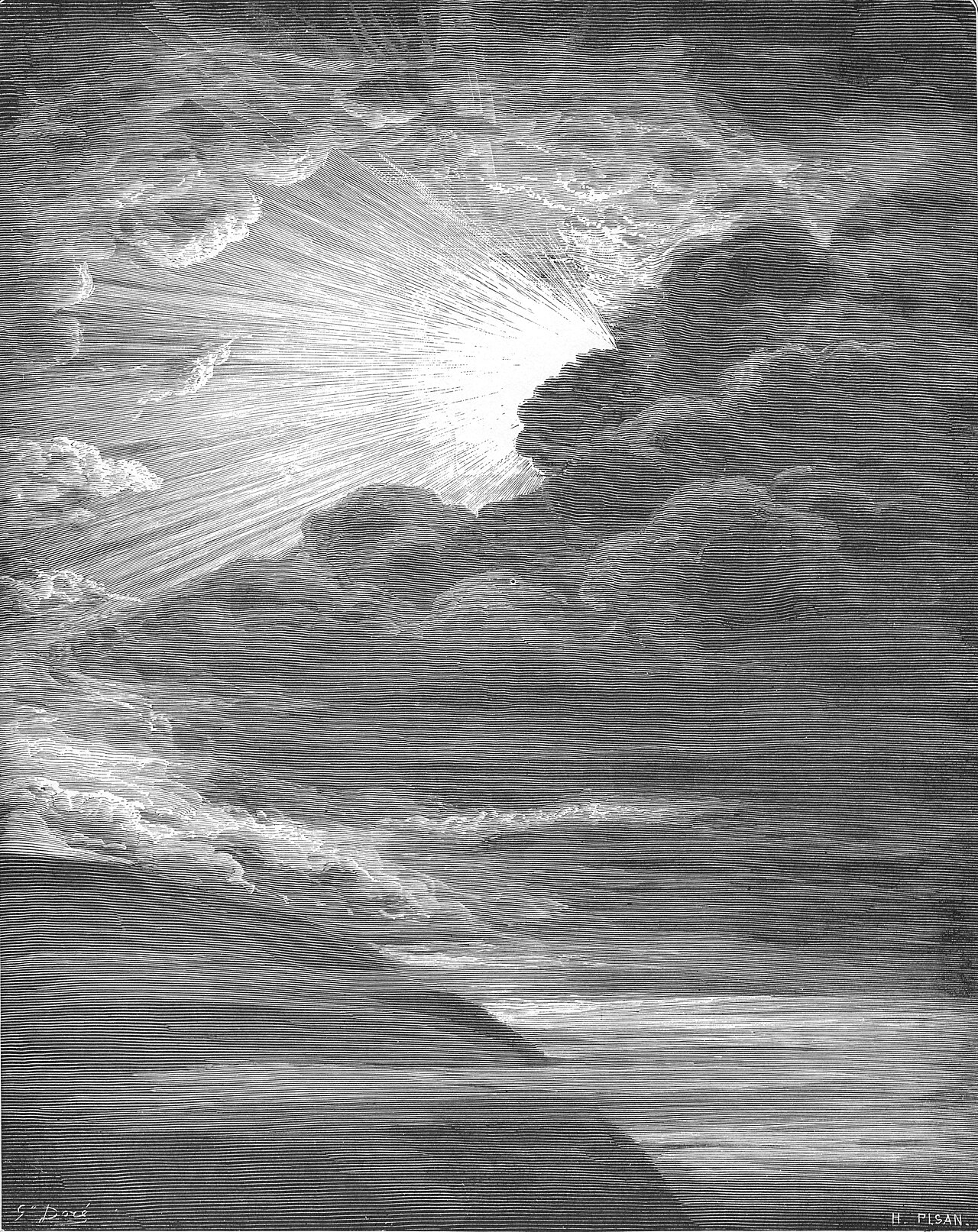
Genesischapter 1
31 verses · Moses, by tradition · 15th to 13th century BC · The Law
In the beginning God created the heavens and the earth.
The account that begins here does not stop at the end of the chapter. It closes on the seventh day, at Genesis 2:3. Read Genesis 2:1 to 2:3→
Introduction
Moses, by tradition, The Law, Genesis Overview.
Genesis was written for Israel, a people newly out of Egypt, and tradition gives it to Moses. Its first hearers had lived among nations that worshipped the sun, the river and the stars. This chapter stands before every other page of Scripture and answers the first question any of them could ask, who made the world and who rules it. It is written as an ordered account and uses repetition the way a teacher does. Listen for the phrases that return at the close of each stage, and notice which things the chapter leaves unnamed. Read it as the ground every later promise stands on.
Context
- Who
- Israel in the wilderness, lately out of a land where the sun, the Nile and the stars were worshipped as gods
- What
- An ordered account of God making the heavens and the earth by His word across six days and setting mankind in His image over it.
- Where
- The whole world, from the unformed deep to sky, sea and dry land; the chapter names no place.
- When
- Before any dated history; the chapter carries no date, and tradition places its writing in the time of Moses, about the 15th to 13th century BC.
- Why
- To teach Israel that the powers the nations worshipped are things God made, and that people bear His image and serve under Him.
Historical context
The chapter opens the section that runs to the account of the heavens and the earth at Genesis 2:4, and the speaker throughout is God. Genesis does not name its own author, and the case for Moses is built from the rest of the Torah and from later Scripture rather than from this book, which the site's published provenance entry sets out with the holders on both sides.
Show the rest of the historical context, 4 more paragraphs
Every nation around Israel told a story about how the world began, and most of those stories open with a fight. In the Babylonian poem Enuma Elish the sky and the earth are made from the split body of a defeated goddess, and people are made to carry the labour of the gods. Genesis 1 has God speak, and the thing spoken of appears.
The order of the six days is deliberate. The first three separate the empty places, light from dark, sky from sea, and dry land from water, and the next three fill them with the lights, the birds and fish, and the animals and people.
The sun and the moon go unnamed. Hebrew has ordinary words for them, shemesh and yareach, and those same words stand as the names of gods in the world around Israel, Shamash in Babylon and Yarikh in Canaan, so the chapter calls them the greater light and the lesser light.
The verb rendered created takes God as its subject everywhere it appears in the Old Testament. Human beings arrive last and are made in God's image, which in Egypt and Mesopotamia was a thing said of the king alone.
Significance
Israel had walked out of Egypt, where the sun was Ra and the Nile itself was honoured. This chapter set those powers among the things God made in the ordinary course of one week.
Show the rest of the significance, 1 more paragraph
It also told them what they were. They were image bearers, given a world to fill and to keep, and the work was given before anything went wrong.
This chapter in Jewish lifeWhat this chapter is in Jewish life and reading.
What is done
This chapter opens the portion the annual cycle numbers first, so the Sabbath it is read on is the Sabbath the cycle starts over (src/lib/hebraic/readings.ts). The portion runs on past this chapter into Genesis 6. A congregation hears the creation account as the opening of a longer reading, and the card above carries the portion and the prophetic reading set beside it.
How it is read
The Rashi quoted here is the public domain edition of M. Rosenbaum and A. M. Silbermann, Pentateuch with Rashi's commentary, 1929 to 1934. Every reference below is the one the corpus prints.
Rashi opens his commentary on the whole Torah at the first verse, and he opens it with a question about the starting point. He reports Rabbi Isaac asking why the law book of Israel began with creation instead of with the first commandment given to Israel in Egypt. His answer is that the account of creation settles God's right to the earth. When the nations call Israel robbers for taking the land of Canaan, Israel can answer that the Creator gave it to whom He pleased (Rashi on Genesis 1:1:1).
On the second day Rashi reads the making of the expanse as the fixing of something already there. The heavens were created on the first day and were still fluid, and on the second they grew solid at the command of God (Rashi on Genesis 1:6:1, citing Genesis Rabbah 4:2). He reads the fourth day the same way, holding that the lights were made on the first day and hung in the expanse on the fourth (Rashi on Genesis 1:14:1). The whole of creation was made on day one in his reading, and each thing was set in its place on the day it was commanded.
Where a Christian reader hears the plural of the twenty sixth verse as a word spoken within God, Rashi reads it as God consulting the household of heaven. The creature about to be made was in their likeness, so God took counsel with them first. Rashi draws the meekness of God from it, since the greater asked leave of the lesser (Rashi on Genesis 1:26:1, citing Midrash Tanchuma and Sanhedrin 38b). The two readings part at the doctrine of the Trinity, and this site sets them side by side at their full weight.
Ibn Ezra and Radak carry four comments on this chapter that the corpus holds by reference alone. The licence Sefaria reports for the English version keeps the text out. They are Ibn Ezra on Genesis 1:3:1, 1:17:1 and 1:18:1, and Radak on Genesis 1:23:1.
What the rabbis say
Rashi carries three sayings of the Aggadah on this chapter, and each stands here as what the rabbis taught. On the light of the first day he says that God "saw that the wicked were unworthy of using it". The light was therefore set aside for the righteous in the world to come (Rashi on Genesis 1:4:1, citing Chagigah 12a).
On the great sea creatures of the twenty first verse he reports that God made the Leviathan male and female. God then killed the female and salted her for the feast of the righteous in the time to come. A breeding pair would have been more than the world could bear (Rashi on Genesis 1:21:1, citing Bava Batra 74b).
On the two great lights he reports that the sun and the moon were made of one size. The moon was made the smaller after she said that "It is impossible for two kings to make use of one crown" (Rashi on Genesis 1:16:1, citing Chullin 60b).
The corpus records forty places where the Midrash and the Talmud cite this chapter, thirty under Midrash and ten under Talmud. It carries the locator for each one with no text, so the references stand here and the sayings are read at the source. Bereshit Rabbah reads the third verse at 3:1, the sixth at 4:1 and 4:3, the twenty second at 11:3, the twenty fourth at 17:4 and the twenty sixth at 22:2. Bamidbar Rabbah reads the second verse at 1:1, the third at 13:5, the fourth at 18:4 and 18:7, and the tenth at 13:14. Aggadat Bereshit reads the eleventh verse at 23:4, and Midrash Lekach Tov the seventh at Genesis 1:7:1.
The Talmud is cited at Arakhin 17a:6 on the first two verses, Avodah Zarah 29a:5 on the second and Berakhot 26a:17 on the fifth. It is cited again at Chullin 26b:18 on the eighteenth verse, Bava Batra 74b:5 on the twenty first, Avodah Zarah 43b:3 on the twenty seventh and Avodah Zarah 3a:6 on the thirty first. Avot DeRabbi Natan is cited at 35:9 and 26:4, and its second recension at 37:1.
Sources: Rashi, Rashi on Genesis 1, in Pentateuch with Rashi's commentary by M. Rosenbaum and A. M. Silbermann, 1929 to 1934, public domain, about 1090; Ibn Ezra and Radak, their four comments on Genesis 1, cited by reference; the licence Sefaria reports for the English version keeps the text out of the corpus; The Midrash and the Talmud, the forty locators on Genesis 1 in scripts/data/sources/sefaria/genesis/1.json; MannaFest, the annual cycle table at src/lib/hebraic/readings.ts, 2026.
The heads below are this chapter's scenes. The numbered points under each are its verses.
In the Beginning, Light
In the Beginning, Light v. 1
Genesis opens with no argument for God and no account of where He came from. It states that He made everything, then shows Him doing it. The first thing He makes is light, three days before there is a sun to carry it.
In the beginning: Time itself starts in this sentence. Scripture opens with no argument for God and no defense of Him, only the report that when anything began, God was already there. John 1:1 takes these same three words and sets the Word inside them, and John 1:3 says all things were made through Him.
God created: The verb translated created is bara, and its only subject in the Old Testament is God. The name Elohim is plural and the verb beside it is singular, which Wesley read as a first hint of the Father, the Son and the Spirit. God alone made the heavens and the earth.
the heavens and the earth: The two words together are the Hebrew way of saying everything there is. JFB press the point that nothing existed for God to work with, and the heavens and the earth came out of nothing. Colossians 1:16 says all things were created through Christ, in heaven and on earth. The whole of it is His.
Genesis 1:1
“God the Father through the Son created out of nothing everything that is not God.”
John Piper · He Commanded and They Were Created (sermon) (1981)Reformed Baptist
Genesis 1:1
“THIS is, no doubt, a literal and accurate account of God's first day's work in the creation of the world, but the first creation is not the subject of this morning's discourse—we would rather direct your minds to the second creation of God. Every man who is saved by Divine Grace is a new creation. The great work which Jesus Christ is accomplishing in the world, by the Holy Spirit through the Word, is the making all things new. We believe the old creation to have been typical of the new and we shall so use it.”
ConnectionsJohn 1:1
formless and void: The Hebrew pair is tohu wabohu, the earth formless and void with darkness over the deep. Isaiah 34:11 and Jeremiah 4:23 use the words of a land after judgment. Most readers take this as the raw state God then shapes into light, sky and dry land over six days. Missler, G. H. Pember and the Scofield Reference Bible read the verb as became and set a ruin between verse 1 and verse 2.
hovering over the surface of the waters: The verb is merachepheth, and Moses uses it again at Deuteronomy 32:11 of an eagle fluttering over its nest. JFB read it as brooding, the way a bird sits over eggs until life comes out of them. The Spirit is at work over the surface of the waters. Darkness is still on the deep.
Genesis 1:2
“The earth was without form and void - The original term תהו tohu and בהו bohu, which we translate without form and void, are of uncertain etymology; but in this place, and wherever else they are used, they convey the idea of confusion and disorder. From these terms it is probable that the ancient Syrians and Egyptians borrowed their gods, Theuth and Bau, and the Greeks their Chaos.”
Adam Clarke · Commentary on the Bible (1810-1826)evangelical
Connections2 Corinthians 4:6
God speaks and there is light. Nothing stands between the word and the thing it makes. Psalm 33:9 puts it the same way, He spoke and it came to be. Paul reads the verse at 2 Corinthians 4:6, where God has made His light shine out of darkness into the heart.
Genesis 1:4-5
He separated the light from the darkness: God separates the light from the darkness, giving each its bounds. The light He called day and the darkness night, and in Hebrew naming a thing is an act of ownership over it. The count of evening and morning starts here. It measures the whole chapter.
ConnectionsRevelation 21:23
Day and night are named here three days before the sun is made at verse 16. Basil of Caesarea held that the first light, spread out and drawn back by God, measured those early days. The Hebrew reads day one.
ConnectionsRevelation 22:5
Sky, Sea, and Dry Land
Sky, Sea, and Dry Land v. 6
Days two and three do not make new material. They sort what day one produced: water above from water below, then sea from dry ground. Once the land is dry it is told to grow, and Basil read that command as still running every spring.
Genesis 1:6-8
The Hebrew word is raqia, from a root meaning to hammer out, as metal is beaten thin into a plate. JFB give that sense and call it an expanse. The older translations took it as something solid stretched over the earth, which is how the Greek stereoma and the Latin firmamentum came to stand in for it. God set it between the waters, holding those above apart from those beneath, and He called it sky.
So God made the expanse: God made the expanse and parted the waters. Spurgeon counted the words and it was so six times on the first page of Scripture and found no failure in any of them. Those waters above return at Genesis 7:11, when the floodgates of the heavens were opened.
God called the expanse: The second day is the one day of the six that closes without the words God saw that it was good. Day three has it twice. Hippolytus held that after the first day God shaped what He had already made, and the sky here is formed out of the waters.
Genesis 1:8
“There now follows the work of the second day, which is the second vision of understanding, lifted up by faith: and of this it is not said that God "saw" but that He "called" it.”
Bonaventure · written before 1257 · Collations on the Hexaemeron, Collation 8patristic
3 more voices on this verse
Genesis 1:8
Although God had already previously made heaven, now he makes the firmament. For he made heaven first, about which he says, "Heaven is my throne." But after that he makes the firmament, that is, the corporeal heaven. For every corporeal object is, without doubt, firm and solid; and it is this that "divides the water which is above heaven from the water which is below heaven."
Origen of Alexandria · written before 253 · HOMILIES ON GENESIS 1.2patristic
Genesis 1:8
“And if the words, "God saw that it was good," are not said of the work of the second day, this is because the work of distinguishing the waters was only begun on that day, but perfected on the third.”
Thomas Aquinas · written before 1274 · Commentary (church-history corpus)patristic
Genesis 1:8
“Since Scripture called heaven the firmament, we can without absurdity hold that anything below the ethereal heaven, in which everything is peaceful and stable, is more mutable and perishable and is a kind of corporeal matter prior to the reception of beauty and the distinction of forms.”
Augustine of Hippo · written before 430 · ON THE LITERAL INTERPRETATION OF GENESIS 8.29patristic
Genesis 1:9-10
The waters under the sky gather into one place and the dry land appears. God called the land earth and the gathered waters seas. Good in this chapter means a thing does what He made it to do. Job 38:8 asks who enclosed the sea behind doors, and 38:11 sets its limit.
Genesis 1:9
“Now when Scripture says, "Let the water which is below the heavens be gathered into one gathering," these words mean that this corporeal matter is to be formed into the beauty that these visible waters have. This gathering into one place is the formation of these waters that we see and touch. For every form is reduced to a rule of unity. What else should we understand is meant by the words "let the dry land appear" than this matter receives the visible form that this earth that we see and touch now has?”
Augustine of Hippo · written before 430 · TWO BOOKS ON GENESIS AGAINST THE MANICHAEANS 1.12.18patristic
4 more voices on this verse
Genesis 1:9
“Now, the fact that Scripture speaks of one gathering does not mean that they were gathered together into one place, for notice that after this it says: "And the gathering together of the waters he called seas." Actually, the account meant that the waters were segregated by themselves apart from the earth. And so the waters were brought together into their gathering places and the dry land appeared.”
John Damascene · written before 749 · ORTHODOX FAITH 2.9patristic
Genesis 1:9
“What trouble you have given me in my previous discourses by asking me why the earth was invisible, why all bodies are naturally endued with colour, and why all colour comes under the sense of sight. And, perhaps, my reason did not appear sufficient to you, when I said that the earth, without being naturally invisible, was so to us, because of the mass of water that entirely covered it. Hear then how Scripture explains itself. Let the waters be gathered together, and let the dry land appear.”
Basil of Caesarea · written before 379 · The Hexaemeron, Homily 4: Upon the Gathering Together of the Waterspatristic
Genesis 1:9
“It was when the waters were withdrawn into their hollow abysses that the dry land became conspicuous, which was hitherto covered with its watery envelope. Then it forthwith becomes "visible," God saying, "Let the water be gathered together into one mass, and let the dry land appear." Genesis 1:9 "Appear," says He, not "be made." It had been already made, only in its invisible condition it was then waiting to appear. "Dry," because it was about to become such by its severance from the moisture, but yet "land." "And God called the dry land Earth," not Matter.”
Tertullian · written before 220 · Against Hermogenespatristic
Genesis 1:9
“Let us labor, therefore, to gather "the water that is under heaven" and cast it from us that "the dry land," which is our deeds done in the flesh, might appear. When this has been done, "men seeing our good works may glorify our Father who is in heaven." For if we have not separated from us those waters that are under heaven, that is, the sins and vices of our body, our dry land will not be able to appear nor have the courage to advance to the light.”
Origen of Alexandria · written before 253 · HOMILIES ON GENESIS 1.2patristic
the gathering of waters: The word earth now takes a narrower sense. In verse 1 it named the whole world below the heavens, and here God gives it to the dry land alone. Basil of Caesarea pictured the ground resting, freed of the weight of the water, before it was told to bring forth plants.
Genesis 1:10
“And God called the dry land Earth; and the gathering together of the waters called he Seas - These two constitute what is called the terraqueous globe, in which the earth and the water exist in a most judicious proportion to each other.”
Adam Clarke · Commentary on the Bible (1810-1826)evangelical
4 more voices on this verse
Genesis 1:10
“What trouble you have given me in my previous discourses by asking me why the earth was invisible, why all bodies are naturally endued with colour, and why all colour comes under the sense of sight. And, perhaps, my reason did not appear sufficient to you, when I said that the earth, without being naturally invisible, was so to us, because of the mass of water that entirely covered it. Hear then how Scripture explains itself. Let the waters be gathered together, and let the dry land appear.”
Basil of Caesarea · written before 379 · Commentary (church-history corpus)patristic
Genesis 1:10
“And God called the dry land, Earth: According to Augustine (De Gen. Contr. Manich. i), primary matter is meant by the word earth, where first mentioned, but in the present passage it is to be taken for the element itself.”
Thomas Aquinas · written before 1274 · Commentary (church-history corpus)patristic
Genesis 1:10
“Those that by sin were darkness by grace become light in the world. That the light was made by the word of God's power. He said, Let there be light; he willed and appointed it, and it was done immediately: there was light, such a copy as exactly answered the original idea in the Eternal Mind.”
Matthew Henry · Commentary on the Whole Bible (1707-1721)puritan
Genesis 1:10
It was when the waters were withdrawn into their hollow abysses that the dry land became conspicuous, which was hitherto covered with its watery envelope. Then it forthwith becomes "visible," God saying, "Let the water be gathered together into one mass, and let the dry land appear." "Appear," says He, not "be made." It had been already made, only in its invisible condition it was then waiting to appear. "Dry," because it was about to become such by its severance from the moisture, but yet "land." "And God called the dry land Earth," not Matter.
Tertullian · written before 220 · Against Hermogenespatristic
Genesis 1:11-13
The phrase runs through the chapter ten times, and it says that what God made reproduces along its own line. The seed-bearing plants and the fruit trees come on the third day. The earth brings them forth at God's word. The seed is in the fruit.
ConnectionsStrong's H2233
The earth produced vegetation: Plants cover the ground on the third day, a day before the sun and moon are set in the sky. Basil of Caesarea drew the lesson that the adornment of the earth is older than the sun. He aimed it at those who worshiped the sun.
The third day holds two commands of God, one at verse 9 and one at verse 11. Land appears, and then it grows green. Basil of Caesarea read the second command as a law set in the ground, which still gives it the power to bear fruit in every season.
Genesis 1:13
“And the evening and the morning were the third day.”
1 more voice on this verse
Genesis 1:13
“But whose ages, if not the Creator's? For because ages consist of times, and times are made up of days, and months, and years; since also days, and months, and years are measured by suns, and moons, and stars, which He ordained for this purpose (for "they shall be," says He, "for signs of the months and the years"), it clearly follows that the ages belong to the Creator, and that nothing of what was fore-ordained before the ages can be said to be the property of any other being than Him who claims the ages also as His own.”
Tertullian · written before 220 · Against Marcion Book Vpatristic
Lights to Rule the Days
Lights to Rule the Days v. 14
The sun and moon arrive on day four, after light, after dry land, after the plants. Genesis puts them late and gives them a job, marking days and seasons. It never gives either one a name a worshipper could use.
Genesis 1:14-15
signs to mark the seasons: The word for seasons is moadim, and Leviticus 23:2 uses it of the appointed feasts of the LORD. The lights in the expanse keep the calendar those appointments are set by. They mark the days and the years. The sky tells Israel when to come before God.
ConnectionsPsalms 19:1
The lights are given a task, to shine upon the earth, and verse 17 says it again. Basil of Caesarea noted that day and night were running before these lights were made. Their work is to order days already counted since verse 5.
Genesis 1:15
“Let them shine in the firmament and give life to the earth: The lights are of service to man, in regard to sight, which directs him in his works, and is most useful for perceiving objects.”
Thomas Aquinas · written before 1274 · Commentary (church-history corpus)patristic
1 more voice on this verse
Genesis 1:15
“And let them be for lights in the firmament of the heaven,.... To continue there as luminous bodies; as enlighteners, as the word signifies, causing light, or as being the instruments of conveying it, particularly to the earth, as follows: to give light upon the earth; and the inhabitants of it, when formed: and it was so: these lights were formed and placed in the firmament of the heaven for such uses, and served such purposes as God willed and ordered they should.”
Genesis 1:16-19
two great lights: Moses calls them the greater light and the lesser light. The ordinary Hebrew names for sun and moon were the names of gods in the nations around Israel, and this account leaves them out. God made the two great lights and set these lights in the expanse to rule the day and the night. Their light serves the earth He made.
Genesis 1:16
Indeed Moses said, "God made the two great lights, the greater light to rule the day, and the lesser light to rule the night; and [ He made ] the stars."
Ephrem the Syrian · written before 373 · Commentary (church-history corpus)patristic
4 more voices on this verse
Genesis 1:16
“GOD made the two great lights, the greater light to rule the day and the smaller one to rule the night, and He made the stars.”
Bonaventure · written before 1257 · Collations on the Hexaemeron, Collation 23patristic
Genesis 1:16
“And God made two great lights,.... This was his own work which he himself did, and not by another; and may be particularly observed to express the folly of idolaters in worshipping these luminaries which were the creations of God, and were placed by him in the heaven to serve some purposes on earth beneficial to men, but not to be worshipped. These two "great lights" are the sun and the moon; and they may well be called great, especially the former, for the diameter of the sun is reckoned to be about eight hundred thousand miles.”
Genesis 1:16
“And God made two great lights - Moses speaks of the sun and moon here, not according to their bulk or solid contents, but according to the proportion of light they shed on the earth. The expression has been cavilled at by some who are as devoid of mental capacity as of candour. “The moon,” say they, “is not a great body; on the contrary, it is the very smallest in our system.” Well, and has Moses said the contrary? He has said it is a great Light; had he said otherwise he had not spoken the truth.”
Adam Clarke · Commentary on the Bible (1810-1826)evangelical
Genesis 1:16
“To me, as I meditate and consider in my mind concerning the creation of this world in which we are kept enclosed, even such is the rapidity of that creation; as is contained in the book of Moses, which he wrote about its creation, and which is called Genesis. God produced that entire mass for the adornment of His majesty in six days; on the seventh to which He consecrated it . . . with a blessing.”
Victorinus of Pettau · written before 304 · On the Creation of the Worldpatristic
God set these lights: Each light is placed where God set it. Origen read them as a picture of Christ, who gives light to His church as these lights shine on the earth, and he tied the verse to John 1:9. The signs they give, in his reading, teach a reader how to escape judgment.
to preside over the day: On the first day God separated the light from the darkness Himself, and here the lights in the sky take over that work. The Hebrew verb behind preside, and behind rule in verse 16, is mashal, used of mastering sin at Genesis 4:7. Wesley read the daily change as a lesson in providence.
The fourth day answers the first. Light was made on day one, and on day four the lights that carry it are set in the sky, which Basil of Caesarea took to mean that day and night came before the sun. The same pairing runs on: the sky and seas of day two are filled on day five, and the land of day three on day six.
Genesis 1:19
“And the evening and the morning were the fourth day. Made by the rotation of the earth on its own axis, in the space of twenty four hours: this according to Capellus was the twenty first of April, and according to Bishop Usher the twenty sixth of October; or, as others, the fourth of September: and thus, as on the fourth day of the creation the sun was made, or appeared, so in the fourth millennium the sun of righteousness arose on our earth.”
Swarms of Living Creatures
Swarms of Living Creatures v. 20
Water and land are told to swarm. The text counts what comes out in kinds and repeats the phrase after each one, so the boundary between kinds is part of what is being said rather than a detail added later.
Genesis 1:20-21
The word behind great sea creatures is tanninim, used elsewhere of the large creatures of the sea. The nations around Israel told stories of these as monsters of chaos. Genesis puts them in a list of things God created and called good. Whatever lives in the deep belongs to Him.
Genesis 1:20
“And to such a degree has the Holy Ghost made this the rule of His Scripture, that whenever anything is made out of anything, He mentions both the thing that is made and the thing of which it is made... "And God said, Let the waters bring forth abundantly the moving creatures that have life, and fowl that may fly above the earth through the firmament of heaven. And it was so. And God created great whales, and every living creature that moveth, which the waters brought forth abundantly, after their kind."...”
Tertullian · written before 220 · Against Hermogenespatristic
4 more voices on this verse
Genesis 1:20
“Therefore God said, let the waters bring forth swarming living creatures, and flying creatures above the earth under the firmament of heaven.”
Bede · written before 735 · Commentary on Genesis (Hexaemeron)patristic
Genesis 1:20
“Let the waters bring forth abundantly - There is a meaning in these words which is seldom noticed. Innumerable millions of animalcula are found in water. Eminent naturalists have discovered not less than 30,000 in a single drop! How inconceivably small must each be, and yet each a perfect animal, furnished with the whole apparatus of bones, muscles, nerves, heart, arteries, veins, lungs, viscera in general, animal spirits, etc., etc. What a proof is this of the manifold wisdom of God! But the fecundity of fishes is another point intended in the text; no creature’s are so prolific as these.”
Adam Clarke · Commentary on the Bible (1810-1826)evangelical
Genesis 1:20
“Lest it should seem as if God had only commanded it to be done, and some one else had done it, he adds, And God made the firmament. What God requires of us he himself works in us, or it is not done. He that commands faith, holiness, and love, creates them by the power of his grace going along with his word, that he may have all the praise.”
Matthew Henry · Commentary on the Whole Bible (1707-1721)puritan
Genesis 1:20
“And God said, Let the waters bring forth abundantly the moving creature that hath life, and fowl that may fly above the earth after their kind. After the creation of the luminaries the waters are now filled with living beings and its own adornment is given to this part of the world. Earth had received hers from her own plants, the heavens had received the flowers of the stars, and, like two eyes, the great luminaries beautified them in concert. It still retained for the waters to receive their adornment.”
Basil of Caesarea · written before 379 · The Hexaemeron, Homily 7: The Creation of Moving Creaturespatristic
the great sea creatures: Bara, the verb for created, returns here from verse 1. The Hebrew behind every living thing is nephesh chayyah, the phrase used of Adam as a living being at Genesis 2:7. Adam Clarke marked what sets man apart: his life was breathed into him by God Himself.
Genesis 1:21
“And God created great sea creatures and every living creature that moves, which the waters brought forth in their kinds, and every winged bird according to its kind.”
Bede · written before 735 · Commentary on Genesis (Hexaemeron)patristic
4 more voices on this verse
Genesis 1:21
“What necessary object was there that did not immediately appear? What object of luxury was not given to man? Some to supply his needs, some to make him contemplate the marvels of creation. Some are terrible, so as to take our idleness to school. God created great whales. Genesis 1:21 Scripture gives them the name of great not because they are greater than a shrimp and a sprat, but because the size of their bodies equals that of great hills. Thus when they swim on the surface of the waters one often sees them appear like islands.”
Basil of Caesarea · written before 379 · The Hexaemeron, Homily 7: The Creation of Moving Creaturespatristic
Genesis 1:21
“And God created great whales,.... Which the Targums of Jonathan and Jarchi interpret of the Leviathan and its mate, concerning which the Jews have many fabulous things: large fishes are undoubtedly meant, and the whale being of the largest sort, the word is so rendered.”
Genesis 1:21
“And God created great whales - התנינם הגדלים hattanninim haggedolim. Though this is generally understood by the different versions as signifying whales, yet the original must be understood rather as a general than a particular term, comprising all the great aquatic animals, such as the various species of whales, the porpoise, the dolphin, the monoceros or narwal, and the shark.”
Adam Clarke · Commentary on the Bible (1810-1826)evangelical
Genesis 1:21
“The Word of God permeates every creature in the constitution of the world. Hence, as God had ordained, all kinds of living creatures were quickly produced from the earth. In compliance with a fixed law they all succeed each other from age to age according to their aspect and kind. The lion generates a lion; the tiger, a tiger; the ox, an ox; the swan, a swan; and the eagle, an eagle. What was once enjoined became in nature a habit for all time. Hence the earth has not ceased to offer the homage of its service.”
Ambrose of Milan · written before 397 · The Six Days of Creationpatristic
Genesis 1:22-23
Then God blessed them: This is the first blessing in the Bible, and it falls on fish and birds. To bless here is to hand over the power to multiply and to fill the waters of the seas. God blessed man with the same words at verse 28 and blessed Noah at Genesis 9:1. The birds are told to multiply on the earth.
Genesis 1:22
“And God saw that it was good, and He blessed them, saying: Be fruitful and multiply, and fill the waters of the seas, and let birds multiply on the earth. And there was evening and there was morning, a fifth day.”
Bede · written before 735 · Commentary on Genesis (Hexaemeron)patristic
4 more voices on this verse
Genesis 1:22
“And God blessed them,.... With a power to procreate their kind, and continue their species, as it is interpreted in the next clause, saying, be fruitful, and multiply, and fill the waters in the seas: and these creatures do multiply exceedingly, and vast quantities there are of them in the mighty waters, though the consumption of some sorts of them is very great. Our English word "fish" is derived from the Hebrew word פוש, "fush", which signifies to multiply and increase: and let fowl multiply in the earth; as they did, and continue to do to this day.”
Genesis 1:22
“Let fowl multiply in the earth - It is truly astonishing with what care, wisdom, and minute skill God has formed the different genera and species of birds, whether intended to live chiefly on land or in water. The structure of a single feather affords a world of wonders; and as God made the fowls that they might fly in the firmament of heaven, Gen 1:20, so he has adapted the form of their bodies, and the structure and disposition of their plumage, for that very purpose.”
Adam Clarke · Commentary on the Bible (1810-1826)evangelical
Genesis 1:22
“God wanted the blessing to have the power of fecundity, which is revealed in the succession of offspring. Thus, though the animals were made weak and mortal, they might by that blessing preserve their kind by giving birth.”
Augustine of Hippo · written before 430 · ON THE LITERAL INTERPRETATION OF GENESIS 15.50patristic
Genesis 1:22
“What, then, is to be said about these theories? This that those who would have it that the soul migrates into natures divergent from each other seem to me to obliterate all natural distinctions; to blend and confuse together, in every possible respect, the rational, the irrational, the sentient, and the insensate; if, that is, all these are to pass into each other, with no distinct natural order secluding them from mutual transition.”
Gregory of Nyssa · written before 395 · ON THE SOUL AND THE RESURRECTIONpatristic
Each day in the chapter is counted from evening to morning, and Israel kept its days the same way. The Day of Atonement ran on that count at Leviticus 23:32. Basil of Caesarea taught that before the sun, God Himself set the measure of each day and night.
Genesis 1:23
“And the evening and the morning were the fifth day. The sun now in the firmament, where it was fixed the day before, having gone round the earth, or the earth about that, in the space of twenty four hours; and according to Capellus this was the twenty second of April; or, as others, the fifth of September; and according to Bishop Usher the twenty seventh of October.”
Genesis 1:24-25
living creatures according to their kinds: The land animals come out of the earth, the same ground man is taken from in chapter 2. JFB read the three groups here as the livestock, the land crawlers and the beasts of the earth, which covers everything that walks. God made each according to its kind. The difference between man and beast comes in verse 26.
God made the beasts: Verse 24 says the earth brings the animals forth, and this verse says God made them. Both are true of the same animals. Cyril of Jerusalem marveled that the gentle sheep and the lion that eats flesh both came from one earth at a single command.
Genesis 1:25
“And God made the beast of the earth after his kind, etc. - Every thing both in the animal and vegetable world was made so according to its kind, both in genus and species, as to produce its own kind through endless generations. Thus the several races of animals and plants have been kept distinct from the foundation of the world to the present day. This is a proof that all future generations of plants and animals have been seminally included in those which God formed in the beginning.”
Adam Clarke · Commentary on the Bible (1810-1826)evangelical
1 more voice on this verse
Genesis 1:25
“And God made the beasts of the earth according to their kinds, and the cattle, and every creeping thing of the earth according to its kind.”
Bede · written before 735 · Commentary on Genesis (Hexaemeron)patristic
Man Made in God's Image
Man Made in God's Image v. 26
Everything else was made by a command. Man is made after a deliberation, and God speaks of Himself in the plural before He does it. Man is given the image, then given the work of ruling, and only then is the whole called very good.
God speaks in the singular through the chapter, and here the words are, Let Us make man in Our image. Wesley and the older commentators read the plural as the Godhead speaking within itself, Father, Son and Spirit. Two other readings stand: a plural of royal speech, and God addressing the heavenly council of Psalm 82, which Heiser argued. Man rules the fish and the birds in God's likeness.
Connectionsimage of god
So God created man in His own image: Colossians 1:15 calls Christ the image of the invisible God, and the word image in this verse lands on Him. God created man in His own image on the sixth day of the chapter. Adam carried that image first, and Christ is the image itself.
in the image of God He created him: The verse says it twice, created in His own image and in the image of God. Genesis 9:6 gives the image as the reason a man's blood may not be shed, and that is spoken after the flood. The image holds after the fall, and it sets what a human life is worth. Every man alive carries it.
male and female He created them: The word for image is tselem and the word for likeness is demut. Together they say that man stands for God on the earth as a son resembles a father. Male and female are named in the same breath as the image, and both carry it. Jesus quotes it at Matthew 19:4 on divorce.
Cross references
Genesis 1:27
- Quoted inMark 10:6“However, from the beginning of creation, ‘God made them male and female.’”
'made them male and female' (divorce dispute)
- Quoted inMatthew 19:4“Jesus answered, “Have you not read that from the beginning the Creator ‘made them male and female,’”
'he which made them at the beginning made them male and female' (divorce dispute)
The first words God speaks to man are be fruitful and multiply. Fill the earth and subdue it follows, and the verb behind subdue is kabash, used of bringing land under the plough. God said to them, so the blessing rests on the man and the woman together. Man is blessed and set to work.
rule over the fish of the sea: The Hebrew verb is radah, used of a king governing. The model set in front of man is the God who has just spent six days making things and calling them good. Rule here means the care of the fish, the birds and every creature that crawls, which belong to God. Man answers to the God who gave it.
Genesis 1:28
“One is completely right to ask in what sense we should understand the union of male and female before sin, as well as the blessing that said "Increase and multiply, and generate and fill the earth." Should we understand it in a physical manner or spiritually? For we are permitted to understand it spiritually and to believe that it was changed into sexual fecundity after sin.”
Augustine of Hippo · written before 430 · TWO BOOKS ON GENESIS AGAINST THE MANICHAEANS 1.19.30patristic
Genesis 1:29-30
I have given you every seed-bearing plant: God finishes the sixth day by handing over the food. Man is given the seed-bearing plants and the fruit trees, and every beast and bird is given the green plants. Origen noticed that the grant widens after the flood at Genesis 9:3, when the animals are given for meat with the blood held back. Both times God settles what may be eaten.
Beasts, birds and crawling creatures are given the green plants, as man was given seed and fruit in verse 29. Isaiah 11:7 and 65:25 picture lions feeding on straw beside cattle in the age to come. Origen dated meat to after the flood.
very good: God saw that it was good six times over in this chapter. Here He looked at all He has made, and the word changes to very good, tov meod. Everything God made stands under that word. What went wrong came in at chapter 3.
Six times the chapter has counted evening and morning, and the sixth is the last. The sixth day holds the livestock and the beasts of the earth, the man and the woman, and the food given to every creature. The making is finished, and the seventh day comes in chapter 2.
How this psalm is built
The form: A narrative of the creation, made gradual across six days for the instruction of man, as Jamieson, Fausset & Brown classes it.
The patterns in this chapter
| Device | What it does | Where to see it |
|---|---|---|
| The line that closes each day | Six verses of the chapter end a day with the same count of evening and then morning, and the count begins at the first day. John Gill reads the fourth day's line as a day made by the rotation of the earth on its own axis, in the space of twenty four hours.John Gill, Exposition of the Old Testament (1748-1763), on Genesis 1:19. | Genesis 1:5, Genesis 1:8, Genesis 1:13, Genesis 1:19, Genesis 1:23, Genesis 1:31 |
| The word and the thing done | Charles Spurgeon counts the same short line six times on the first page of Scripture, after the expanse, the dry land, the grass and the lights, and he reads it as a word that failed of its effect in no single case. The six places stand at verses 7, 9, 11, 15, 24 and 30 of the Berean text in the store.Charles Spurgeon, The Metropolitan Tabernacle Pulpit, Sermon No. 3064: And It Was So, 1907, on Genesis 1:7. | Genesis 1:7, Genesis 1:9, Genesis 1:11, Genesis 1:15, Genesis 1:24, Genesis 1:30 |
| Everything along its own line | The chapter lists what is made by its kinds rather than in one word: the seed-bearing plants, the fruit trees, the sea creatures, the birds, the livestock, the crawling things and the beasts. Adam Clarke reads the phrase as holding each race distinct in genus and species from the foundation of the world, so that what God formed in the beginning contained the generations that followed.Adam Clarke, Commentary on the Bible, 1832, on Genesis 1:25. | Genesis 1:11, Genesis 1:12, Genesis 1:21, Genesis 1:24, Genesis 1:25 |
| The plural name and the plural speech | Matthew Henry reads the Hebrew name of God in verse 1 as a plural name that speaks of Him as many though He is one, and John Wesley prints the same reading word for word. At verse 26 the speech itself turns plural, and this site's published exposition sets out three readings of that verse: the Godhead speaking within itself, a plural of royal speech, and God addressing a heavenly council.Matthew Henry, Commentary on the Whole Bible, 1710, on Genesis 1:1. | Genesis 1:1, Genesis 1:26 |
| The lights named by their light | Adam Clarke holds that Moses speaks of the sun and the moon by the proportion of light they shed on the earth rather than by their bulk, which is why the smaller of the two is still called a great light. This site's published exposition adds that the ordinary Hebrew names for the sun and the moon were the names of gods among the surrounding nations, and that this account leaves those names out and gives the two bodies their work instead.Adam Clarke, Commentary on the Bible, 1832, on Genesis 1:16. | Genesis 1:16, Genesis 1:17, Genesis 1:18 |
The debate over the days
18 more paragraphs on the patterns
The voices in this chapter's pool divide over what the six days are, and the division is old.
John Gill reads them as ordinary days measured by the turning earth. At Genesis 1:19 he states that the day was made by the rotation of the earth on its own axis, in the space of twenty four hours, and at Genesis 1:19 and Genesis 1:23 he records the calendar dates that Capellus and Bishop Usher assigned to those days. Adam Clarke reads the separation of light from darkness at verse 4 as referring by anticipation to the rotation of the earth round its own axis once in twenty-three hours, fifty-six minutes and four seconds, and holds it probable that God gave the earth that rotation at that moment (Commentary on the Bible, 1832, on Genesis 1:4). The strongest objection to this reading stands in the chapter itself: the lights that measure a day are set in the expanse on the fourth day, so the first three days are counted before the bodies that mark them. Clarke answers it at Genesis 1:14, where he holds that the sun is the monarch of the day and the moon of the night, and that the office of the lights is to distinguish the two states rather than to create them.
Jamieson, Fausset and Brown read the six days as a choice rather than a necessity. They hold that the work could have been finished in a moment as well as in six days, and that it was gradual for the instruction of man and perhaps of higher creatures, citing Job 38:7 (Commentary Critical and Explanatory on the Whole Bible, 1871, on Genesis 2:1). They add that no permanent change has been made in the course of the world since, no new species formed and no law of nature repealed or added to. The strongest objection is that this answers why the account has six days and leaves the length of each day where it found it.
Adam Clarke reads the six days and the seventh as a pattern set for a man's week. He holds it the general voice of Scripture that God finished the whole of the creation in six days and rested the seventh, giving an example that we might labour six days and rest the seventh (Commentary on the Bible, 1832, on Genesis 2:2). The objection is the same one: a pattern for a week holds whether the days are counted as hours or as ages.
Charles Spurgeon declines the question from the pulpit. He states that he leaves all discussion of the creation of the world to the learned divines and the geologists who have paid special attention to it, and that his business is moral and spiritual rather than scientific (The Metropolitan Tabernacle Pulpit, Sermon No. 1252: The First Day Of Creation, 1875, on Genesis 1:4). The objection is that a reader who came to the chapter with the question still has it.
This site's published dossier for Genesis records the wider field under its own entry on the six days, setting the reading of six ordinary days and a young earth beside the day-age and framework readings and the old-earth dating of mainstream geology, and it states that the site stamps no position on the question. The dossier's door is /featured/creation-week, where the matter is argued at length.
The debate over verse 2
This site's published exposition of Genesis 1:2 records two readings of the formless and void earth. Most take it as the raw state that God shapes across the six days, and Isaiah 34:11 uses the same pair of Hebrew words of a land after judgment. The other reading takes the verb as became and sets a ruin between verse 1 and verse 2. The objection to the second reading is that the chapter gives no account of any such ruin and moves straight from the state of verse 2 to the first word of verse 3. The objection to the first is that it has to carry the darkness and the deep of verse 2 as part of a work that the chapter later calls good.
The New Testament's use
The New Testament reads this chapter in four places, and each reading takes the chapter as an account of what God did rather than as a figure.
John 1:1 takes the chapter's first three words and sets the Word inside them, and John 1:3 says all things were made through Him. This site's published exposition of Genesis 1:1 states the connection and adds Colossians 1:16, which says all things were created through Christ.
Paul reads verse 3 at 2 Corinthians 4:6, where the God who said that light should shine out of darkness is the God who shines that light in the heart. The published exposition of Genesis 1:3 sets the two beside each other.
Jesus quotes verse 27 at Matthew 19:4 when He is asked about divorce, and He rests His answer on the making of male and female. The published exposition of Genesis 1:27 states it.
Jamieson, Fausset and Brown read Hebrews 11:3 as the ground on which the chapter is received at all, since no man was in existence to witness the creation and the light of nature can proclaim the eternal power of God without telling how the worlds were made (Commentary Critical and Explanatory on the Whole Bible, 1871, on Genesis 2:4).
What the chapter claims and what is confirmed
What the text says is that each living thing was made to reproduce along its own line, and the phrase runs through the chapter ten times in the Berean text in the store, nine of them in one wording and one in another.
What is claimed as confirmed is Adam Clarke's. He holds that the power of a seed to multiply its species has been abundantly confirmed by the most accurate observations of the best modern philosophers, and he states it as the science of 1832 rather than as a proof from the text (Commentary on the Bible, 1832, on Genesis 1:12). At Genesis 1:20 he reports that eminent naturalists had found as many as thirty thousand animalcules in a single drop of water, and he credits the figure to eminent naturalists in general, so it stands in his commentary as a report he passes on rather than as a measurement a reader can trace to its source.
What is contested is whether the order of the six days is a chronology at all. This site's published dossier records both answers and settles neither, and the four positions above divide on the same point.
Keep studying
Studies22
- Names of God
- Trees: Eden, Cross, New Jerusalem
- Mazzaroth
- The Mathematical Order of the Bible, the worked proofs
- Eve: The Mother of All Living
- Gematria and Its Limits
Show the next 6 titles
Words12
Subjects1
Sources for this chapter
The summary
Jamieson, Fausset & Brown, Commentary Critical and Explanatory; John Wesley, Notes on the Old Testament and Matthew Henry, Complete Commentary.
The context
Adam Clarke, Commentary on the Bible; Ambrose of Milan, Hexameron; Augustine; Basil of Caesarea, The Hexaemeron; Gregory of Nyssa, On the Origin of Man; Hippolytus of Rome, Exegetical Fragments on Genesis and Jamieson, Fausset & Brown, Commentary Critical and Explanatory.
The form and classifications
Adam Clarke, Commentary on the Bible, 1832, on Genesis 2:2; Charles Spurgeon, The Metropolitan Tabernacle Pulpit, Sermon No. 3064: And It Was So, 1907, on Genesis 1:7; Jamieson, Fausset & Brown, Commentary Critical and Explanatory on the Whole Bible, 1871, on Genesis 2:1 and This site's published exposition of Genesis 1, the notes at Genesis 1:4 to 5 and at Genesis 1:31, the sixth day.
The exposition
Adam Clarke, Commentary on the Bible; Basil of Caesarea; Charles Spurgeon, The Metropolitan Tabernacle Pulpit, Sermon No. 3064: “'And It Was So'” (lightly modernized text, CCEL edition); Chuck Missler; Cyril of Jerusalem, Catechetical Lecture 9:13; Hippolytus of Rome, Hippolytus Exegetical Fragments - On Genesis; Jamieson, Fausset & Brown, Commentary Critical and Explanatory on the Whole Bible; John Calvin, Commentary on Genesis; John Gill, Exposition of the Old Testament; John Wesley, Explanatory Notes upon the Old Testament; Matthew Henry, Commentary on the Whole Bible; Michael Heiser, The Unseen Realm and Origen of Alexandria.