
Genesis 1:4
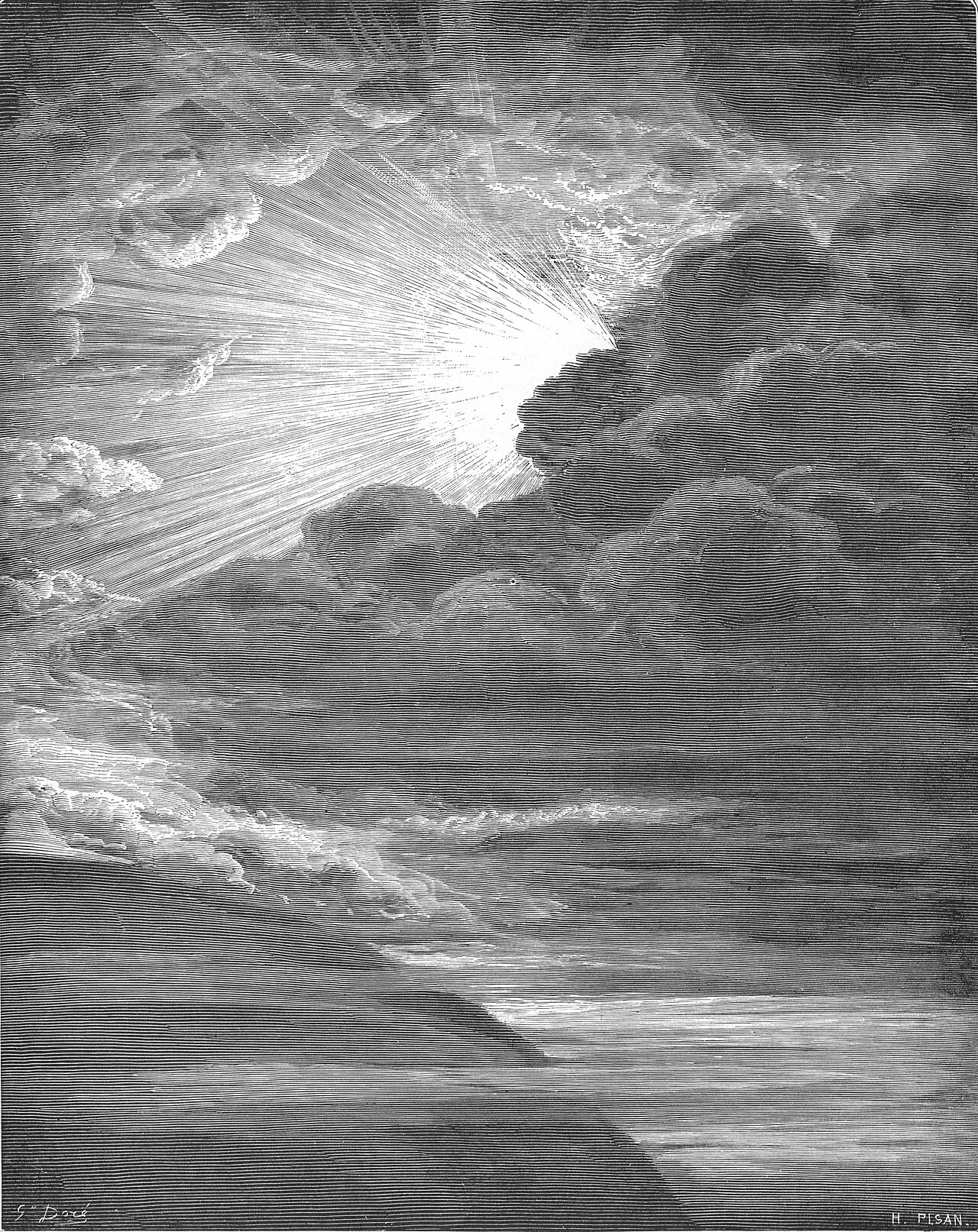
in Genesis 1And God saw that the light was good, and He separated the light from the darkness.
BSB
The same verse in ASV and KJV ▾
ASV
And God saw the light, that it was good: and God divided the light from the darkness.
KJV
And God saw the light, that it was good: and God divided the light from the darkness.
⋯
This verse in Genesis 1
Commentary
22 notes on this verseTHIS is, no doubt, a literal and accurate account of God's first day's work in the creation of the world, but the first creation is not the subject of this morning's discourse—we would rather direct your minds to the second creation of God. Every man who is saved by Divine Grace is a new creation. The great work which Jesus Christ is accomplishing in the world, by the Holy Spirit through the Word, is the making all things new. We believe the old creation to have been typical of the new and we shall so use it.
This site's exposition
He separated the light from the darkness
on Genesis 1:4-5
God separates the light from the darkness, giving each its bounds. The light He called day and the darkness night, and in Hebrew naming a thing is an act of ownership over it. The count of evening and morning starts here, and it measures the whole chapter.
The record, by era
The Church Fathers5 voices
A commentator
Basil of CaesareaThe Hexaemeron, Homily 2: The Earth Was Invisible and Unfinished · Written before 379.
proposed
How can we worthily praise light after the testimony given by the Creator to its goodness? The word, even among us, refers the judgment to the eyes, incapable of raising itself to the idea that the senses have already received. But, if beauty in bodies results from symmetry of parts, and the harmonious appearance of colours, how in a simple and homogeneous essence like light, can this idea of beauty be preserved? Would not the symmetry in light be less shown in its parts than in the pleasure and delight at the sight of it?
A commentator
Augustine of HippoON THE LITERAL INTERPRETATION OF GENESIS 5.22 · Written before 430.
proposed
We should understand that this sentence does not signify joy as if over an unexpected good but an approval of the work. For what is said more fittingly of God—insofar as it can be humanly said—than when Scripture puts it this way: "he spoke," and "it was made," "it pleased him." Thus we understand in "he spoke" his sovereignty, in "it was made" his power and in "it pleased him" his goodness. These ineffable things had to be said in this way by a man to men so that they might profit all.
A commentator
Augustine of HippoTWO BOOKS ON GENESIS AGAINST THE MANICHAEANS 1.8.13 · Written before 430.
proposed
"God saw that the light was good," and these words do not mean that God found before him a good that he had not known but that he was pleased by one that was finished.
A commentator
Basil of CaesareaThe Hexaemeron, Homily 2: The Earth Was Invisible and Unfinished · Written before 379.
proposed
Evening is then the boundary common to day and night; and in the same way morning constitutes the approach of night to day. It was to give day the privileges of seniority that Scripture put the end of the first day before that of the first night, because night follows day: for, before the creation of light, the world was not in night, but in darkness. It is the opposite of day which was called night, and it did not receive its name until after day.
God, as judge of the whole work, foreseeing what is going to happen as something completed, commends the part of his work which is still in its initial stages, being already cognizant of its termination.
15 more voices on this verse
The Medieval Church7 voices
A commentator
BonaventureCollations on the Hexaemeron, Collation 6 · Written in the 13th century.
proposed
"God saw the light that it was good; and He divided the light from the darkness." The passage, "God saw the light," is quoted on account of the first vision of the intelligence, which is infused by nature.
And God saw the light, that it was good. Not as if suddenly seeing the light previously unknown did He praise it, because He says it is good; but He declared that it, which He knew would be praiseworthy once created, was already worthy of …
And He divided the light from the darkness. For He divided them not only by their quality but also by the distance of places, namely by spreading light in the upper part of the world where human activity was to take place, while allowing the …
A commentator
BonaventureCollations on the Hexaemeron, Collation 7 · Written in the 13th century.
proposed
These philosophers had the wings of ostriches, for their affective powers were not cleansed or ordained or straightened: for this can be obtained only through faith.
A commentator
BonaventureCollations on the Hexaemeron, Collation 4 · Written in the 13th century.
proposed
God saw that the light was good. God separated the light from the darkness, etc. After every one of the works of the six days, with the exception of the second, it is said: God saw that it was good.
A commentator
BonaventureCollations on the Hexaemeron, Collation 5 · Written in the 13th century.
proposed
It has been said that truth is intellectual light radiating over intelligence either human or angelical; and that it shines forth in a manner that cannot be stopped, for it cannot be thought of as non-existing.
A commentator
BonaventureCollations on the Hexaemeron, Collation 7 · Written in the 13th century.
proposed
God saw the light that it was good; and He divided the light from the darkness. This passage is quoted to explain the vision of intelligence which is infused by nature.
The Puritans and the Awakening3 voices
God has thus divided between light and darkness, because he would daily mind us that this is a world of mixtures and changes. In heaven there is perpetual light, and no darkness; in hell utter darkness, and no light: but in this world they are counter-changed, and we pass daily from one to another; that we may learn to expect the like vicissitudes in the providence of God.
That the light was made by the word of God's power; He said, Let there be light - He willed it, and it was done; there was light - Such a copy as exactly answered the original idea in the eternal mind.
And God saw the light, that it was good,....
The Nineteenth Century4 voices
God divided the light from the darkness - This does not imply that light and darkness are two distinct substances, seeing darkness is only the privation of light; but the words simply refer us by anticipation to the rotation of the earth round its own axis once in twenty-three hours, fifty-six minutes, and four seconds, which is the cause of the distinction between day and night, by bringing the different parts of the surface of the earth successively into and from under the solar rays; and it was probably at this moment that God gave this rotation to the earth, to produce this merciful provision of day and night.
A commentator
Jamieson, Fausset & Brown1802–1910
Commentary Critical and Explanatory on the Whole Bible (1871)
proposed
divided the light from darkness--refers to the alternation or succession of the one to the other, produced by the daily revolution of the earth round its axis.
w61-jfb-recut
WE shall, this morning, leave all discussion as to the creation of the world to those learned Divines who have paid their special attention to that subject, and to those geologists who know, or at any rate think they know, a very great deal about it. It is a very interesting subject, but this is not the time for its consideration. Our business is moral and spiritual rather than scientific. We justify our present discourse by quoting that remarkable parallel text which the Holy Spirit has given us in the second Epistle to the Corinthians, fourth chapter and the sixth verse, where Paul says, "God, who commanded the light to shine out of darkness, has shined in our hearts, to give the light of the knowledge of the glory of God in the face of Jesus Christ." The creation was an instructive type of the new creation. God's methods of forming the old creation illustrate His ways in preparing and perfecting His people who are new creatures in Christ Jesus. So we shall gather light from an analogy which is evidently warranted by the New Testament. We trust we shall not be guilty of inventing things fanciful, strained, or merely curious—our objective is edification and consolation—and not a display of ingenuity. May the eternal light of the Holy Spirit shine upon us, now, that by His light we may see light. Man's fallen nature is a very chaos, "without form and void," with darkness thick and sevenfold covering all. The Lord begins His work upon man by the visitation of the Spirit, who enters the soul mysteriously and broods over it, even as of old He moved upon the face of the waters. He is the Quickener of the dead soul. In connection with the Presence of the Holy Spirit, the Lord sends into the soul, as His first blessing, light. The Lord appeals to man's understanding and enlightens it by the Gospel.
WE shall, this morning, leave all discussion as to the creation of the world to those learned Divines who have paid their special attention to that subject, and to those geologists who know, or at any rate think they know, a very great deal about it. It is a very interesting subject, but this is not the time for its consideration. Our business is moral and spiritual rather than scientific.
Modern Voices1 voice
A commentator
GK ChestertonA Miscellany of Men, The Separatist and Sacred Things (1912) (1912)
proposed
Yet there is a difference, and it is just what I suggested. The Eastern mysticism is an ecstasy of unity; the Christian mysticism is an ecstasy of creation, that is of separation and mutual surprise.
The words behind it
12 Hebrew wordsEvery Hebrew word of this verse in the order it stands, with what it means and the door to its own study. The last column counts the times a word stands in the whole Bible: the rarer the word, the more the places it appears belong together.
| Hebrew | Sound | Meaning | Word study | In the Bible |
|---|---|---|---|---|
| וַיַּ֧רְא | vaiyar' | and he saw | H7200 → | 1300 times |
| אֱלֹהִ֛ים | ʾelohim | God | H430 → | 2601 times |
| אֶת־ | ʾet- | <obj.> | H853 → | 10935 times |
| הָא֖וֹר | haor | the light | H216 → | 121 times |
| כִּי־ | ki- | that | H3588 → | 4482 times |
| ט֑וֹב | tov | [it was] good | H2895 → | 45 times |
| וַיַּבְדֵּ֣ל | vaiyavdel | and he separated | H914 → | 42 times |
| אֱלֹהִ֔ים | ʾelohim | God | H430 → | 2601 times |
| בֵּ֥ין | bein | between | H996 → | 407 times |
| הָא֖וֹר | haor | the light | H216 → | 121 times |
| וּבֵ֥ין | uvein | and between | H996 → | 407 times |
| הַחֹֽשֶׁךְ׃ | hachoshekh | the darkness | H2822 → | 80 times |
וַיַּ֧רְאand he saw
vaiyar'H7200 →1300 times
אֱלֹהִ֛יםGod
ʾelohimH430 →2601 times
אֶת־<obj.>
ʾet-H853 →10935 times
הָא֖וֹרthe light
haorH216 →121 times
כִּי־that
ki-H3588 →4482 times
ט֑וֹב[it was] good
tovH2895 →45 times
וַיַּבְדֵּ֣לand he separated
vaiyavdelH914 →42 times
אֱלֹהִ֔יםGod
ʾelohimH430 →2601 times
בֵּ֥יןbetween
beinH996 →407 times
הָא֖וֹרthe light
haorH216 →121 times
וּבֵ֥יןand between
uveinH996 →407 times
הַחֹֽשֶׁךְ׃the darkness
hachoshekhH2822 →80 times
A shaded row is a word that stands 400 times or fewer in the Bible.
The walk
8 stopsEach card is a verse this one points to, and under it the verses that one points to in turn. Where several paths arrive at the same place, that place is listed first: the text keeps returning to it.
Through
Genesis 1:31And God looked upon all that He had made, and indeed, it was very good. And there was evening, and there was morning—the sixth day.
it leads to
- 1 Timothy 4:4
For every creation of God is good, and nothing that is received with thanksgiving should be rejected,
- Psalms 104:24
How many are Your works, O LORD! In wisdom You have made them all; the earth is full of Your creatures.
- Psalms 19:1–2
The heavens declare the glory of God; the skies proclaim the work of His hands.
- Exodus 20:11
For in six days the LORD made the heavens and the earth and the sea and all that is in them, but on the seventh day He rested. Therefore the LORD blessed the Sabbath…
- Psalms 104:31
May the glory of the LORD endure forever; may the LORD rejoice in His works.
- 1 Timothy 4:4
Through
Genesis 1:12The earth produced vegetation: seed-bearing plants according to their kinds and trees bearing fruit with seed according to their kinds. And God saw that it was good.
it leads to
- Mark 4:28
All by itself the earth produces a crop—first the stalk, then the head, then grain that ripens within.
- Matthew 13:24–26
Jesus put before them another parable: “The kingdom of heaven is like a man who sowed good seed in his field.
- Mark 4:28
Through
Ecclesiastes 11:7Light is sweet, and it pleases the eyes to see the sun.
it leads to
- Ecclesiastes 7:11
Wisdom, like an inheritance, is good, and it benefits those who see the sun.
- Ecclesiastes 7:11
Where this verse is studied
On this page
Studies40
On this chapter
- Adam
- The Bible and the Ancient Near East
- The Designer's Fingerprint
- The Numbers of Scripture
- The Covenants
- Creation and Evolution
Show the next 6 titles
About Genesis
This page draws on 18 works. Open the list of works
This page draws on Adam Clarke, Commentary on the Bible; Ambrose of Milan, The Six Days of Creation; Augustine of Hippo, ON THE LITERAL INTERPRETATION OF GENESIS 5.22; Augustine of Hippo, TWO BOOKS ON GENESIS AGAINST THE MANICHAEANS 1.8.13; Basil of Caesarea, The Hexaemeron, Homily 2: The Earth Was Invisible and Unfinished; Bede, Commentary on Genesis (Hexaemeron); Bonaventure, Collations on the Hexaemeron, Collation 6; Bonaventure, Collations on the Hexaemeron, Collation 7; Bonaventure, Collations on the Hexaemeron, Collation 4; Bonaventure, Collations on the Hexaemeron, Collation 5; Charles Spurgeon, The Metropolitan Tabernacle Pulpit, Sermon No. 660: “Light—Natural And Spiritual” (lightly modernized text, CCEL edition); Charles Spurgeon, The Metropolitan Tabernacle Pulpit, Sermon No. 1252: “The First Day Of Creation” (lightly modernized text, CCEL edition); GK Chesterton, A Miscellany of Men, The Separatist and Sacred Things (1912); Jamieson, Fausset & Brown, Commentary Critical and Explanatory on the Whole Bible; John Gill, Exposition of the Old Testament; John Gill, Exposition of the Old Testament (1748-1763); John Wesley, Explanatory Notes upon the Old Testament and Matthew Henry, Commentary on the Whole Bible.