
Genesis 1:3
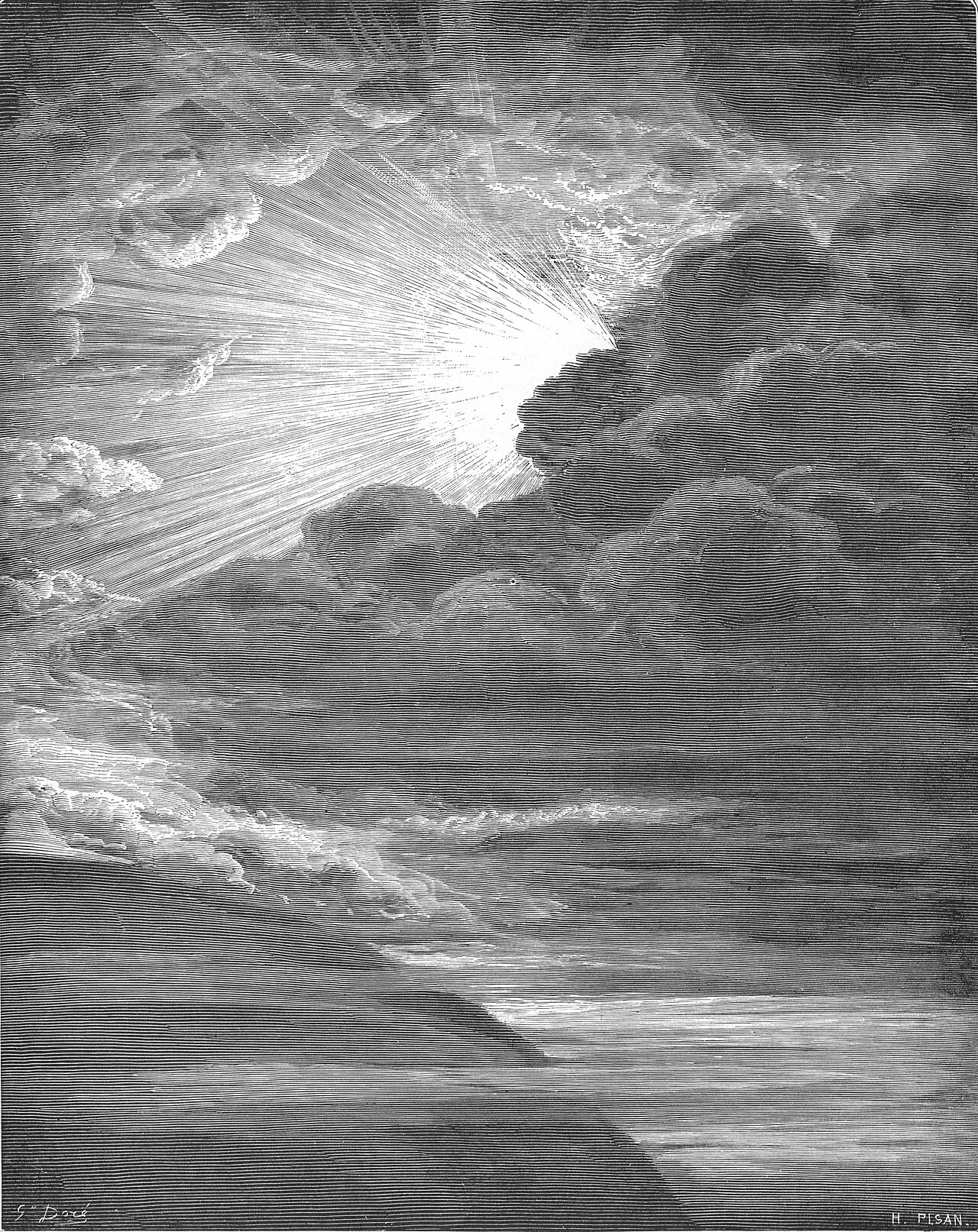
in Genesis 1And God said, “Let there be light,” and there was light.
BSB
The same verse in ASV and KJV ▾
ASV
And God said, Let there be light: and there was light.
KJV
And God said, Let there be light: and there was light.
⋯
This verse in Genesis 1
Commentary
25 notes on this verseTHIS is, no doubt, a literal and accurate account of God's first day's work in the creation of the world, but the first creation is not the subject of this morning's discourse—we would rather direct your minds to the second creation of God. Every man who is saved by Divine Grace is a new creation. The great work which Jesus Christ is accomplishing in the world, by the Holy Spirit through the Word, is the making all things new. We believe the old creation to have been typical of the new and we shall so use it.
This site's exposition
Let there be light
God speaks and there is light, and nothing stands between the word and the thing it makes. Psalm 33:9 puts it, He spoke and it came to be. Paul reads the verse at 2 Corinthians 4:6, where God has made His light shine out of darkness into the heart.
The record, by era
The Church Fathers5 voices
As the words themselves make sufficiently clear, we are told that this light was made. The light born from God is one thing; the light that God made is another. The light born from God is the very Wisdom of God, but the light made by God is something mutable, whether corporeal or incorporeal.
We ought to understand that God did not say "Let there be light" by a sound brought forth from the lungs or by the tongue and teeth. Such thoughts are those of persons physically preoccupied. To be wise in accord with the flesh is death. "Let there be light" was spoken ineffably.
A commentator
Basil of CaesareaThe Hexaemeron, Homily 2: The Earth Was Invisible and Unfinished · Written before 379.
proposed
The first word of God created the nature of light; it made darkness vanish, dispelled gloom, illuminated the world, and gave to all beings at the same time a sweet and gracious aspect. The heavens, until then enveloped in darkness, appeared with that beauty which they still present to our eyes. The air was lighted up, or rather made the light circulate mixed with its substance, and, distributing its splendour rapidly in every direction, so dispersed itself to its extreme limits. Up it sprang to the very æther and heaven.
The light was released so that it might spread over everything without being fastened down. It dispersed the darkness that was over everything although it did not move.
After Moses spoke of heaven and earth, of the darkness, the abyss and the wind that came to be at the beginning of the first night, he then turned to speak about the light that came to be at dawn of the first day.
18 more voices on this verse
The Church Fathers3 voices
"And God said, Let there be light, and there was light." Genesis 1:3 Immediately there appears the Word, "that true light, which lights man on his coming into the world," John 1:9 and through Him also came light upon the world. From that moment God willed creation to be effected in the Word, Christ being present and ministering unto Him: and so God created. The Word also Himself assume His own form and glorious garb, His own sound and vocal utterance, when God says, "Let there be light." Genesis 1:3 This is the perfect nativity of the Word, when He proceeds forth from God.
God said, Let there be light, and the nature of fire came into being. And again proceeding He says: But our souls He fenced round with the body, while He made the angels bodiless.
God is the author of light, and the place and cause of darkness is the world. But the good Author uttered the word light so that he might reveal the world by infusing brightness therein and thus make its aspect beautiful. Suddenly then, the air became bright and darkness shrank in terror from the brilliance of the novel brightness.
The Medieval Church9 voices
And God said, "Let there be light," and there was light. It is fitting for the works of God that the adornment of the world should begin with light: for since He Himself is the true light and dwells in inaccessible light, whose most blessed …
A commentator
BonaventureCollations on the Hexaemeron, Collation 1 · Written in the 13th century.
proposed
Of the central Person, it is said in Genesis: "The Lord God made to grow out of the ground all kinds of trees pleasant to the sight and good for food, the tree of life also in the midst of the garden."
Be light made: I answer, then, with Dionysius (Div. Nom. iv), that the light was the sun's light, formless as yet, being already the solar substance, and possessing illuminative power in a general way, to which was afterwards added the special and determinative power required …
Since the distinction of the bodies of the world is considered according to a threefold mode, therefore it was accomplished over three days.
Things have being in a threefold way, namely in matter or their proper nature, in created intelligence, and in the eternal art; in accordance with which three things Scripture says: "God said: let it be made: He made, and it was made."
Now rightly the whole of time, which runs its course according to a threefold law, namely the law implanted within, the law given from without, and the law infused from above, runs through seven ages and is consummated at the end of the sixth; so …
A commentator
BonaventureCollationes de Decem Praeceptis, Collation 4 · Written in the 13th century.
proposed
In the work of virtue, six things are required corresponding to the works of the six days. The first is understood in the work of the first day, when God said: Let there be light: and light was made: this is provident circumspection.
A commentator
BonaventureCollations on the Hexaemeron, Collation 3 · Written in the 13th century.
proposed
And yet Scriptures say: "God said, 'Let there be light.'" And again, "God said," that is, He begot the Word in whom He disposed all things, and, disposing them, made them.
A commentator
BonaventureCollations on the Hexaemeron, Collation 3 · Written in the 13th century.
proposed
There is a vision through that understanding which is given by nature, and a vision through that understanding which is lifted up by faith, taught by Scripture, exalted by contemplation, enlightened by prophecy, absorbed by rapture in God.
The Puritans and the Awakening3 voices
), and there was light; but this was, as it were, a chaos of light, scattered and confused: now it was collected and modelled, and made into several luminaries, and so rendered both more glorious and more serviceable.
quarantine:debris (2026-07-29) — leading-punctuation+unbalanced-parens
And God said,.... This phrase is used, nine times in this account of the creation; it is admired by Longinus the Heathen in his treatise "of the Sublime", as a noble instance of it; and it is most beautifully paraphrased and explained in Psa 33:6 as expressive of the will, power, authority, and efficacy of the divine Being; whose word is clothed with power, and who can do, and does whatever he will, and as soon as he pleases; his orders are always obeyed.
The manner how this work was effected; God created, that is, made it out of nothing. There was not any pre-existent matter out of which the world was produced.
The Nineteenth Century3 voices
A commentator
Albert Barnes1798–1870
Notes, Explanatory and Practical, on the Old and New Testaments (1832-1869)
proposed
- III. The First Day 3. אמר 'āmar, “say, bid.” After this verb comes the thing said in the words of the speaker, or an equivalent expression. In this respect it corresponds with our English “say.” אור 'ôr, “light.” Light is simply what makes a sensible impression on the organs of vision. It belongs to a class of things which occasionally produce the same effect. ויאמר vayo'mer “then said.” Here we have come to the narrative or the record of a series of events.
A commentator
Jamieson, Fausset & Brown1802–1910
Commentary Critical and Explanatory on the Whole Bible (1871)
proposed
God said--This phrase, which occurs so repeatedly in the account means: willed, decreed, appointed; and the determining will of God was followed in every instance by an immediate result. Whether the sun was created at the same time with, or long before, the earth, the dense accumulation of fogs and vapors which enveloped the chaos had covered the globe with a settled gloom. But by the command of God, light was rendered visible; the thick murky clouds were dispersed, broken, or rarefied, and light diffused over the expanse of waters. The effect is described in the name "day," which in Hebrew signifies "warmth," "heat"; while the name "night" signifies a "rolling up," as night wraps all things in a shady mantle.
w61-jfb-recut
And God said, Let there be light - הי אור ויהי אור Yehi or, vaihi or. Nothing can be conceived more dignified than this form of expression. It argues at once uncontrollable authority, and omnific power; and in human language it is scarcely possible to conceive that God can speak more like himself. This passage, in the Greek translation of the Septuagint, fell in the way of Dionysius Longinus, one of the most judicious Greek critics that ever lived, and who is highly celebrated over the civilized world for a treatise he wrote, entitled Περι Ὑψους, Concerning the Sublime, both in prose and poetry; of this passage, though a heathen, he speaks in the following terms: - Ταυτῃ και ὁ των Ιουδαιων θεσμοθετης(ουχ ὁ τυχων ανηρ,) επειδη την του θειου δυναμιν κατα την αξιαν εχωρησε, καξεφηνεν· ευθυς εν τῃ εισβολη γραψας των νομων, ΕΙΠΕΝ Ὁ ΘΕΟΣ, φησι, τι; ΓΕΝΕΣΘΩ ΦΩΣ· και εγενετο. ΓΕΝΕΣΘΩ ΓΗ· και εγενετο.“So likewise the Jewish lawgiver (who was no ordinary man) having conceived a just idea of the Divine power, he expressed it in a dignified manner; for at the beginning of his laws he thus speaks: God Said - What? Let There Be Light! and there was light. Let There Be Earth! and there was earth.” - Longinus, sect. ix. edit. Pearce. Many have asked, “How could light be produced on the first day, and the sun, the fountain of it, not created till the fourth day?” With the various and often unphilosophical answers which have been given to this question I will not meddle, but shall observe that the original word אור signifies not only light but fire, see Isa 31:9 Eze 5:2. It is used for the Sun, Job 31:26. And for the electric fluid or Lightning, Job 37:3. And it is worthy of remark that It is used in Isa 44:16, for the heat, derived from אש esh, the fire. He burneth part thereof in the fire (במו אש bemo esh): yea, he warmeth himself, and saith, Aha!
The words behind it
6 Hebrew wordsEvery Hebrew word of this verse in the order it stands, with what it means and the door to its own study. The last column counts the times a word stands in the whole Bible: the rarer the word, the more the places it appears belong together.
| Hebrew | Sound | Meaning | Word study | In the Bible |
|---|---|---|---|---|
| וַיֹּ֥אמֶר | vaiyomer | and he said | H559 → | 5305 times |
| אֱלֹהִ֖ים | ʾelohim | God | H430 → | 2601 times |
| יְהִ֣י | yehi | let it be | H1961 → | 3559 times |
| א֑וֹר | ʾor | light | H216 → | 121 times |
| וַֽיְהִי־ | vayhi- | and there was | H1961 → | 3559 times |
| אֽוֹר׃ | ʾor | light | H216 → | 121 times |
וַיֹּ֥אמֶרand he said
vaiyomerH559 →5305 times
אֱלֹהִ֖יםGod
ʾelohimH430 →2601 times
יְהִ֣יlet it be
yehiH1961 →3559 times
א֑וֹרlight
ʾorH216 →121 times
וַֽיְהִי־and there was
vayhi-H1961 →3559 times
אֽוֹר׃light
ʾorH216 →121 times
A shaded row is a word that stands 400 times or fewer in the Bible.
The walk
8 stopsEach card is a verse this one points to, and under it the verses that one points to in turn. Where several paths arrive at the same place, that place is listed first: the text keeps returning to it.
Through
1 John 1:5And this is the message we have heard from Him and announce to you: God is light, and in Him there is no darkness at all.
it leads to
- John 8:12
Once again, Jesus spoke to the people and said, “I am the light of the world. Whoever follows Me will never walk in the darkness, but will have the light of life.”
- James 1:17
Every good and perfect gift is from above, coming down from the Father of the heavenly lights, with whom there is no change or shifting shadow.
- Isaiah 60:19
No longer will the sun be your light by day, nor the brightness of the moon shine on your night; for the LORD will be your everlasting light, and your God will be your…
- John 8:12
Through
John 1:5The Light shines in the darkness, and the darkness has not overcome it.
it leads to
- John 3:19–20
And this is the verdict: The Light has come into the world, but men loved the darkness rather than the Light because their deeds were evil.
- John 12:36–40
While you have the Light, believe in the Light, so that you may become sons of light.” After Jesus had spoken these things, He went away and was hidden from them.
- 1 Corinthians 2:14
The natural man does not accept the things that come from the Spirit of God. For they are foolishness to him, and he cannot understand them, because they are spiritually discerned.
- John 3:19–20
Through
2 Corinthians 4:6For God, who said, “Let light shine out of darkness,” made His light shine in our hearts to give us the light of the knowledge of the glory of God in the face of…
it leads to
- Isaiah 60:2
For behold, darkness covers the earth, and thick darkness is over the peoples; but the LORD will rise upon you, and His glory will appear over you.
- Isaiah 60:2
Through
Isaiah 45:7I form the light and create the darkness; I bring prosperity and create calamity. I, the LORD, do all these things.
it leads to
- Ecclesiastes 7:13–14
Consider the work of God: Who can straighten what He has bent?
- Ecclesiastes 7:13–14
Where this verse is studied
On this page
Studies40
On this verse
On this chapter
- Adam
- The Bible and the Ancient Near East
- The Designer's Fingerprint
- The Numbers of Scripture
- The Covenants
- Creation and Evolution
Show the next 6 titles
By subject
Creation34 verses
About Genesis
This page draws on 24 works. Open the list of works
This page draws on Adam Clarke, Commentary on the Bible; Albert Barnes, Notes, Explanatory and Practical, on the Old and New Testaments (1832-1869); Ambrose of Milan, The Six Days of Creation; Augustine of Hippo, ON THE LITERAL INTERPRETATION OF GENESIS 5.20; Augustine of Hippo, ON THE LITERAL INTERPRETATION OF GENESIS 5.19; Basil of Caesarea, The Hexaemeron; Basil of Caesarea, The Hexaemeron, Homily 2: The Earth Was Invisible and Unfinished; Bede, Commentary on Genesis (Hexaemeron); Bonaventure, Collations on the Hexaemeron, Collation 1; Bonaventure, Breviloquium, Part 2, Chapter 2; Bonaventure, Breviloquium, Part 2, Chapter 12; Bonaventure, Breviloquium, Prologue; Bonaventure, Collationes de Decem Praeceptis, Collation 4; Bonaventure, Collations on the Hexaemeron, Collation 3; Charles Spurgeon, The Metropolitan Tabernacle Pulpit, Sermon No. 660: “Light—Natural And Spiritual” (lightly modernized text, CCEL edition); Cosmas Indicopleustes, The Christian Topography, Book 10; Ephrem the Syrian, COMMENTARY ON GENESIS 1.8.3; 9.2; Ephrem the Syrian, Commentary (church-history corpus); Jamieson, Fausset & Brown, Commentary Critical and Explanatory on the Whole Bible; John Gill, Exposition of the Old Testament (1748-1763); John Wesley, Explanatory Notes upon the Old Testament; Matthew Henry, Commentary on the Whole Bible; Tertullian, Against Praxeas and Thomas Aquinas, Commentary (church-history corpus).