
2 Thessalonians 3 · Subject · Work and Toil
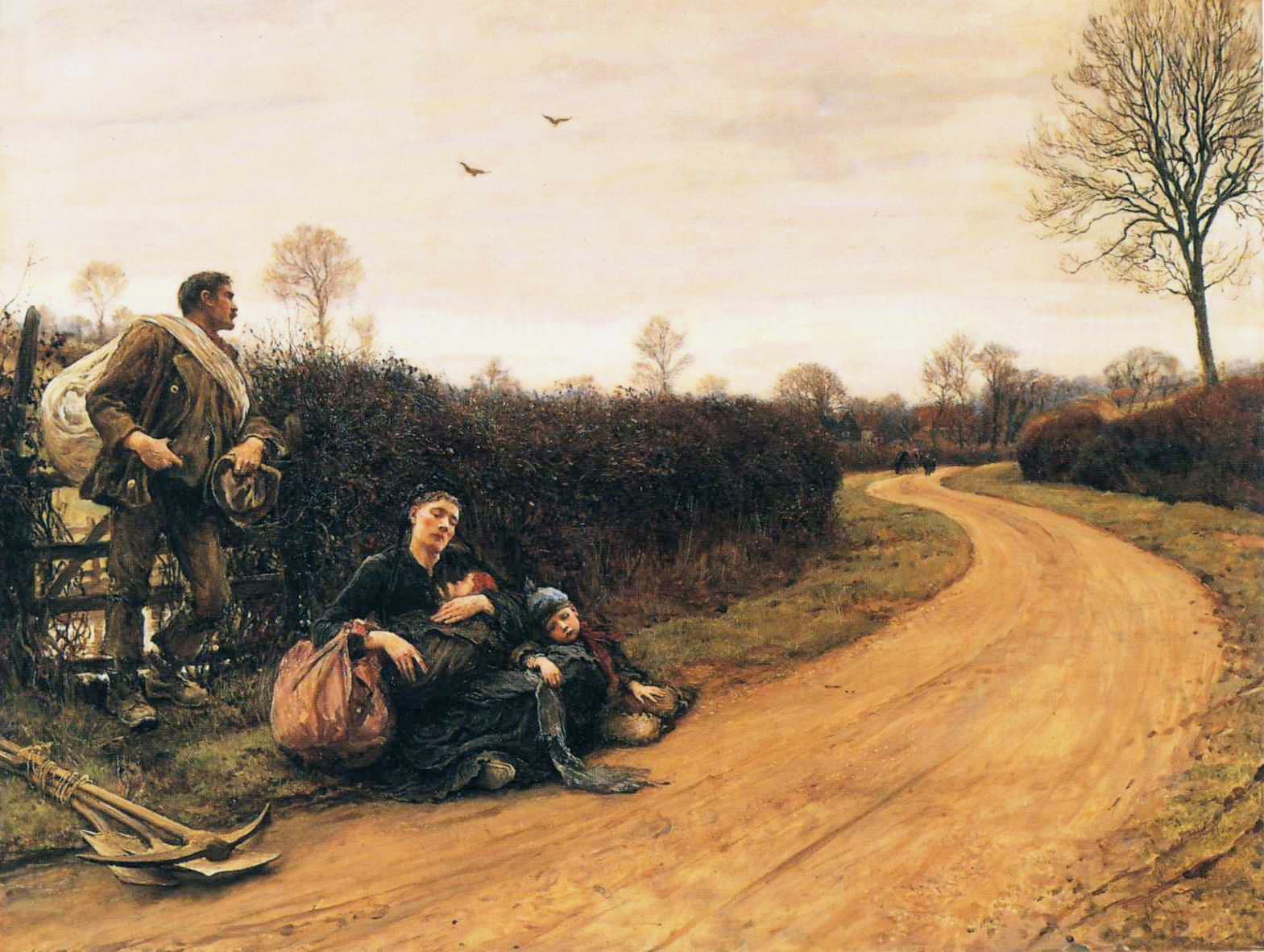
Without Work
Scripture commands work of those who are able, and it gives the man without work, the sick and the old a worth before God that work does not earn.
Ruth the Moabitess gathered barley in another man's field until evening and carried it home to her mother-in-law.
But as for you, brothers, do not grow weary in well-doing.
- Book
- 2 Thessalonians
- Hold in memory
- 1 Thessalonians 5:14
Summary
Paul's rule in 2 Thessalonians 3:10 was given to believers at Thessalonica who could work and would not, and who filled their days with meddling. Scripture meets the man who wants work and finds none, the sick, the old and the widow in need in other ways. The church cared for its widows, Christ counted care for the sick as care for Himself, and God promised to carry His people into old age.
- The Greek verb of 2 Thessalonians 3:10 is a verb of willing, so the rule falls on those who refuse to work.
- The law of Moses left the edges of every harvest for the poor to gather and commanded help for the brother who could not support himself.
- A person's standing before God rests on His making and on His grace, and good works follow from that grace.
- Commentators differ on how far the rule reaches, from the church's help for its poor to the beggar at the door.
Whom the Command Addresses
Paul wrote 2 Thessalonians 3:6 to 12 to a church in which some had stopped working.
Without Work is a study in the trial of work and toil, taken from its other side, the life of someone who has no work. It asks what Scripture says to the one who loses work or cannot find it, and to the sick and the old. It also asks how Paul's hard rule for the idle in 2 Thessalonians 3 bears on them.
The study reads whom the rule addresses and the Greek words that name the idle. It sets out what Scripture commands or gives each group, with research on unemployment and the mind as corroboration, and it weighs how readers have applied the rule. It ends with the ground of a person's worth before God.
Paul reminded the church of a command he gave while he was with them: "If anyone is unwilling to work, he shall not eat" (2 Thessalonians 3:10).
Yet we hear that some of you are leading undisciplined lives and accomplishing nothing but being busybodies.This verse is the report that moved Paul to repeat his rule, and it names the meddling that had taken the place of work.
“Such persons do what in them lies to defeat the sentence, In the sweat of thy face shalt thou eat thy bread. It was not the mere humour of the apostle, who was an active stirring man himself and therefore would have every body else to be so too, but it was the command of our Lord Jesus Christ, that with quietness we work, and eat our own bread,”
Matthew Henry · Commentary on the Whole Bible · on 2 Thessalonians 3:10Puritan
Paul had given the church his own example, working night and day so as to be a burden to no one (2 Thessalonians 3:8). The story of his trade belongs to the study of Paul the tentmaker.
And we urge you, brothers, to admonish the unruly, encourage the fainthearted, help the weak, and be patient with everyone.Paul's first letter to the same church set the unruly beside the fainthearted and the weak and gave each a different word.
What Scripture Commands or Gives Each
Seven groups of people without work stand in Scripture, and only one of them is told to go back to work.
Scripture commands work of the one who will not work, and to every other group it gives help, a share of the harvest or a promise.
| Group | What Scripture commands or gives | The Berean words |
|---|---|---|
| The able who refuse to work | They are commanded to work quietly and eat their own bread | "begin working quietly to earn their own living" |
| The able who find no work | The landowner sends the unhired men into his vineyard | "Because no one has hired us" |
| The poor and the foreigner | The edges of the harvest are left for them to gather | "Leave them for the poor and the foreigner." |
| The brother who cannot support himself | His people are to help him so that he can stay among them | "you are to help him as you would a foreigner" |
| The sick | Christ counts care for them as care for Himself | "I was sick and you looked after Me" |
| The old | God promises to carry His people when they are gray | "I will bear you up when you turn gray" |
| The widow truly in need | The church is to help her where her family cannot | "help the widows who are truly in need" |
Able to Work and Without It
Scripture and the early church both speak of the man who would work and has nothing to do.
In Matthew 20:6, in the parable of the vineyard, the landowner went out at the eleventh hour and asked the men he found, "Why have you been standing here all day long doing nothing?"
The law gave the poor work as well as food, since the gleanings were theirs to gather.
The Didache, a church order of the early centuries, told the churches to welcome a travelling believer and let him work and eat if he had a craft. If he had none, they were to "see to it that, as a Christian, he shall not live with you idle".
Sterud, Lunde, Berg, Proper and Aanesen reviewed the research on unemployment and mental health in Occupational and Environmental Medicine (2025), and 38 prospective longitudinal studies met the inclusion criteria of their review. Their pooled estimate showed higher levels of depression, anxiety and distress among the unemployed than among those in regular work, a standardised difference of 0.19, and fewer symptoms after people found work again.
The authors wrote that their results suggest that unemployment increases the risk of mental health problems, and they graded the certainty of all their evidence as low. A finding across groups cannot foretell one person's course. Distress of this kind calls for a doctor's care beside prayer, never in place of it.
Sickness, Old Age and the Widow
Scripture gives the one who can no longer work a place among God's people and a promise from God.
Do not discard me in my old age; do not forsake me when my strength fails.This prayer gives the old who can no longer work words for their fear of being set aside, and it brings that fear to God.
In old age they will still bear fruit; healthy and green they will remain,This verse answers the fear of a useless old age with a promise that the righteous still bear fruit.
Paul told Timothy to honour the widows who are truly widows, and he laid the first duty of their care on their own children and grandchildren (1 Timothy 5:3 to 4).
The widow who is truly in need and left all alone puts her hope in God and continues night and day in her petitions and prayers.The verse stands here because it shows the church whom to count as a widow in need, so that its care reaches her first.
The church enrolled a widow of at least sixty years who was known for good deeds, while Paul advised the younger widows to marry and manage their households (1 Timothy 5:9 to 14).
The Greek of the Idle
Paul's words for the idle name a will that refuses and a life out of order.
In 2 Thessalonians 3:10 the verb is thelei (Strong's G2309), glossed "is willing" and set after the word for not. Its lexicon entry gives the meaning "to will/desire".
The idle of 2 Thessalonians 3:6 and 2 Thessalonians 3:11 walk ataktōs (G814), "idly", and Paul says of his own conduct that he was not idle among them (2 Thessalonians 3:7). The first letter's "unruly" in 1 Thessalonians 5:14 are ataktous, from the same family of words.
In 2 Thessalonians 3:11 Paul sets ergazomenous, working, against periergazomenous, being busybodies (G4020), a verb that stands nowhere else in the New Testament. Jamieson, Fausset and Brown (1871) caught the play in English as "Doing none of their own business, yet overdoing in the business of others."
The busybodies of 1 Timothy 5:13 are periergoi (G4021), the word that names the magic arts at Acts 19:19.
The Image of God and the Gift of Grace
Genesis 1:27 speaks of creation and Ephesians 2:8 to 10 of salvation.
So God created man in His own image; in the image of God He created him; male and female He created them.Every person bears the image of God from creation, before any work is done.
For it is by grace you have been saved through faith, and this not from yourselves; it is the gift of God, not by works, so that no one can boast. For we are God’s workmanship, created in Christ Jesus to do good works, which God prepared in advance as our way of life.Paul sets salvation outside works and then gives works their place as the way of life God prepared for those He saved.
Scripture's teaching on work as a calling stands in the doctrine of work and vocation.
How the Rule Applies to Those Who Cannot Find Work
Commentators differ on whom the rule reaches and on what it asks of the giver.
The rule withholds help only from those who will not workAlbert Barnes
Albert Barnes, in his Notes, wrote, "The law here laid down by the apostle extends to all who are able to work for a living, and who will not do it". He applied it to poor church members, who "should not be supported by their brethren, unless they are willing to work in any way they can for their own maintenance".
Against this reading, Barnes carried the same rule to beggars at the door, which leaves each giver to judge the will of every beggar.
The rule is a law of nature for everyone who can workAdam Clarke
Adam Clarke, in his Commentary on the Bible (1832), wrote, "This is a just maxim, and universal nature inculcates it to man". He added, "Men who can work, and will rather support themselves by begging, should not get one morsel of bread."
Against this reading, the law told Israel that there would never cease to be poor in the land and commanded an open hand to the poor and needy (Deuteronomy 15:11).
The rule binds the giver as well as the poorJohn Chrysostom
John Chrysostom, in his tenth homily On Repentance and Almsgiving, warned his hearers against becoming "such a savage and inhuman judge" of the unemployed in the frost and the cold. He told them to read beside the rule "Paul's admonition to forgiveness".
Against this reading, Paul does command the church to keep away from the brother who will not work, so that he may be ashamed (2 Thessalonians 3:6 and 2 Thessalonians 3:14).
Doing Good to Everyone
The church that refuses to feed the idle is told to keep doing good to all.
Therefore, as we have opportunity, let us do good to everyone, and especially to the family of faith.Paul's charge to do good to everyone keeps the rule for the idle from becoming a reason to do nothing for the poor.
The rule for the idle stands in the last chapter of 2 Thessalonians, which ends with a greeting in Paul's own hand (2 Thessalonians 3:17).
Sources
Scripture is the Berean Standard Bible.
- STEP Bible word index (TAGNT), Tyndale House, CC BY 4.0, the Greek words of 2 Thessalonians 3:6 to 11, 1 Thessalonians 5:14, 1 Timothy 5:13 and Acts 19:19 with Strong's numbers.
- STEP Bible, Translators lexicon of Extended Strongs for Greek (Tyndale House, Cambridge), CC BY 4.0.
- T. Sterud, L. K. Lunde, R. Berg, K. I. Proper and F. Aanesen, Mental health effects of unemployment and re-employment: a systematic review and meta-analysis of longitudinal studies, Occupational and Environmental Medicine 82, no. 7 (2025): 343 to 353.
- The Didache, or Teaching of the Twelve Apostles, chapter 12.
- Matthew Henry, Commentary on the Whole Bible (1710), on 2 Thessalonians 3:10.
- Robert Jamieson, A. R. Fausset and David Brown, Commentary Critical and Explanatory on the Whole Bible (1871), on 2 Thessalonians 3:11.
- Albert Barnes, Notes, Explanatory and Practical, on the Old and New Testaments (1832 to 1869), on 2 Thessalonians 3:10.
- Adam Clarke, Commentary on the Bible (1832), on 2 Thessalonians 3:10.
- John Chrysostom, On Repentance and Almsgiving, homily 10, translator not named.
Keep Studying
Studies1
In this trial6
People and groups8