
1 Samuel 17:49
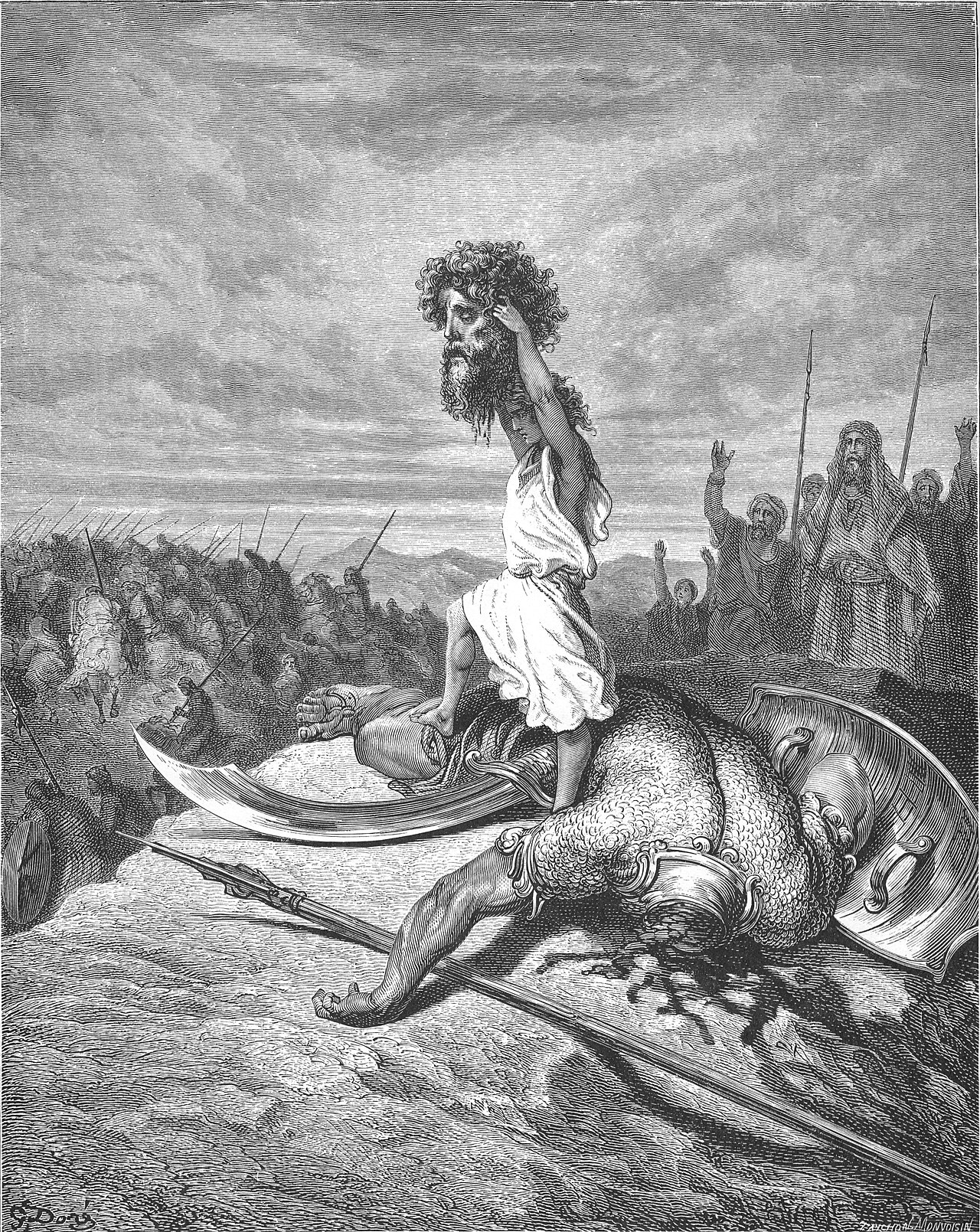
in 1 Samuel 17Then David reached into his bag, took out a stone, and slung it, striking the Philistine on the forehead. The stone sank into his forehead, and he fell facedown on the ground.
BSB
The same verse in ASV and KJV ▾
ASV
And David put his hand in his bag, and took thence a stone, and slang it, and smote the Philistine in his forehead; and the stone sank into his forehead, and he fell upon his face to the earth.
KJV
And David put his hand in his bag, and took thence a stone, and slang it, and smote the Philistine in his forehead, that the stone sunk into his forehead; and he fell upon his face to the earth.
⋯
This verse in 1 Samuel 17
Commentary
9 notes on this verseDavid never waged war unless he was driven to it. Thus prudence was combined in him with fortitude in the battle. For even when about to fight single-handed against Goliath, the enormous giant, he rejected the armor with which he was laden. His strength depended more on his own arm than on the weapons of others. Then, at a distance, to get a stronger throw, with one cast of a stone, he killed his enemy.
The record, by era
The Church Fathers3 voices
Having trust in Christ, consigning everything to the God of powers, regarding God alone as all that is highest—this has always been efficacious in achieving every good. This is the faith that has prevailed over all weapons. This was the strength that made that slight …
Therefore, let us take in our hands that stone, I mean the cornerstone, the spiritual rock. If Paul could think in these terms of the rock in the desert, no one will in any way feel resentment against me if I understand David's stone in the same sense. In the case of the Jews in the desert, it was not the nature of the visible stone but the power of the spiritual stone which sent forth those streams of water. So, too, in David's case, it was not the visible stone but the spiritual stone which sank into the barbarian's head. This is why, at that time, I promised that I would say nothing based on rational arguments. "Our weapons are not merely carnal but spiritual, demolishing sophistries and reasoning and every proud height that raises itself against the knowledge of God."
Therefore, brothers, let us arm ourselves with heavenly weapons for the coming judgment of the world: let us gird on the breastplate of faith, protect ourselves with the helmet of salvation, and defend ourselves with the word of God as with a spiritual sword. For …
The Medieval Church1 voice
And he put his hand into his bag, etc. We said above that the pastoral bag represents the hearts of the shepherds, who cling intimately to the side of Christ. Why then should not more rightly the conscience or soul of the highest and singularly …
The Puritans and the Awakening1 voice
16 ), yet was either so forgetful or presumptuous as to go with the beaver of his helmet open, and thither, to the only part left exposed, not so much David's art as God's providence directed the stone, and brought it with such force that it sunk into his head, notwithstanding the impudence with which his forehead was brazened.
quarantine:debris (2026-07-29) — leading-citation-number+unbalanced-parens
3 more voices on this verse
The Puritans and the Awakening2 voices
Forehead - Probably the proud giant had lift up that part of his helmet which covered his fore-head; in contempt of David and his weapons, and by the singular direction of providence.
And David put his hand in his bag,....
The Nineteenth Century1 voice
Smote the Philistine in his forehead - Except his face, Goliath was everywhere covered over with strong armor. Either he had no beaver to his helmet, or it was lifted up so as to expose his forehead; but it does not appear that the ancient helmets had any covering for the face.
The words behind it
22 Hebrew wordsEvery Hebrew word of this verse in the order it stands, with what it means and the door to its own study. The last column counts the times a word stands in the whole Bible: the rarer the word, the more the places it appears belong together.
| Hebrew | Sound | Meaning | Word study | In the Bible |
|---|---|---|---|---|
| וַיִּשְׁלַח֩ | vaiyishlach | and he sent | H7971 → | 845 times |
| דָּוִ֨ד | david | David | H1732 → | 999 times |
| אֶת־ | ʾet- | <obj.> | H853 → | 10935 times |
| יָד֜וֹ | yado | hand his | H3027 → | 1618 times |
| אֶל־ | ʾel- | into | H413 → | 5510 times |
| הַכֶּ֗לִי | hakeli | the bag | H3627 → | 325 times |
| וַיִּקַּ֨ח | vaiyikach | and he took | H3947 → | 966 times |
| מִשָּׁ֥ם | misham | from there | H8033 → | 834 times |
| אֶ֙בֶן֙ | ʾeven | a stone | H68 → | 273 times |
| וַיְקַלַּ֔ע | vaykala' | and he slung [it] | H7049 → | |
| וַיַּ֥ךְ | vaiyakh | and he struck | H5221 → | 499 times |
| אֶת־ | ʾet- | <obj.> | H853 → | 10935 times |
| הַפְּלִשְׁתִּ֖י | hapelishti | the Philistine | H6430 → | 287 times |
| אֶל־ | ʾel- | to | H413 → | 5510 times |
| מִצְח֑וֹ | mitzcho | forehead his | H4696 → | |
| וַתִּטְבַּ֤ע | vatitba' | and it sank | H2883 → | |
| הָאֶ֙בֶן֙ | haeven | the stone | H68 → | 273 times |
| בְּמִצְח֔וֹ | bemitzcho | in forehead his | H4696 → | |
| וַיִּפֹּ֥ל | vaiyipol | and he fell | H5307 → | 435 times |
| עַל־ | ʾal- | on | H5921 → | 5755 times |
| פָּנָ֖יו | panav | face his | H6440 → | 2123 times |
| אָֽרְצָה׃ | ʾaretzah | [the] ground towards | H776 → | 2504 times |
וַיִּשְׁלַח֩and he sent
vaiyishlachH7971 →845 times
דָּוִ֨דDavid
davidH1732 →999 times
אֶת־<obj.>
ʾet-H853 →10935 times
יָד֜וֹhand his
yadoH3027 →1618 times
אֶל־into
ʾel-H413 →5510 times
הַכֶּ֗לִיthe bag
hakeliH3627 →325 times
וַיִּקַּ֨חand he took
vaiyikachH3947 →966 times
מִשָּׁ֥םfrom there
mishamH8033 →834 times
אֶ֙בֶן֙a stone
ʾevenH68 →273 times
וַיְקַלַּ֔עand he slung [it]
vaykala'H7049 →
וַיַּ֥ךְand he struck
vaiyakhH5221 →499 times
אֶת־<obj.>
ʾet-H853 →10935 times
הַפְּלִשְׁתִּ֖יthe Philistine
hapelishtiH6430 →287 times
אֶל־to
ʾel-H413 →5510 times
מִצְח֑וֹforehead his
mitzchoH4696 →
וַתִּטְבַּ֤עand it sank
vatitba'H2883 →
הָאֶ֙בֶן֙the stone
haevenH68 →273 times
בְּמִצְח֔וֹin forehead his
bemitzchoH4696 →
וַיִּפֹּ֥לand he fell
vaiyipolH5307 →435 times
עַל־on
ʾal-H5921 →5755 times
פָּנָ֖יוface his
panavH6440 →2123 times
אָֽרְצָה׃[the] ground towards
ʾaretzahH776 →2504 times
A shaded row is a word that stands 400 times or fewer in the Bible.
The walk
8 stopsEach card is a verse this one points to, and under it the verses that one points to in turn. Where several paths arrive at the same place, that place is listed first: the text keeps returning to it.
Through
1 Kings 22:34However, a certain man drew his bow without taking special aim, and he struck the king of Israel between the joints of his armor. So the king said to his charioteer, “Turn around and…
it leads to
- 2 Chronicles 35:23
There the archers shot King Josiah, who said to his servants, “Take me away, for I am badly wounded!”
- Micah 6:13
Therefore I am striking you severely, to ruin you because of your sins.
- Revelation 9:9
They also had thoraxes like breastplates of iron, and the sound of their wings was like the roar of many horses and chariots rushing into battle.
- 2 Chronicles 35:23
Through
2 Kings 9:24Then Jehu drew his bow and shot Joram between the shoulders. The arrow pierced his heart, and he slumped down in his chariot.
it leads to
- 1 Kings 22:34
However, a certain man drew his bow without taking special aim, and he struck the king of Israel between the joints of his armor. So the king said to his charioteer, “Turn around and…
- Proverbs 21:30
There is no wisdom, no understanding, no counsel that can prevail against the LORD.
- Ecclesiastes 8:12–13
Although a sinner does evil a hundred times and still lives long, yet I also know that it will go well with those who fear God, who are reverent in His presence.
- Job 20:23–25
When he has filled his stomach, God will vent His fury upon him, raining it down on him as he eats.
- 1 Thessalonians 5:3
While people are saying, “Peace and security,” destruction will come upon them suddenly, like labor pains on a pregnant woman, and they will not escape.
- 1 Kings 22:34
Where this verse is studied
About 1 Samuel
Who and where
1 name in this verse with a page on the site.
This page draws on 9 works. Open the list of works
This page draws on Adam Clarke, Commentary on the Bible; Ambrose of Milan, On the Duties of the Clergy 1.35.177; Bede, Commentary on Samuel; John Chrysostom, AGAINST THE ANOMOEANS 11.6; John Gill, Exposition of the Old Testament (1748-1763); John Wesley, Explanatory Notes upon the Old Testament; Matthew Henry, Commentary on the Whole Bible; Maximus of Turin, SERMON 85.3 and Paulinus of Nola, POEMS 26.150.