
1 Samuel 17:51
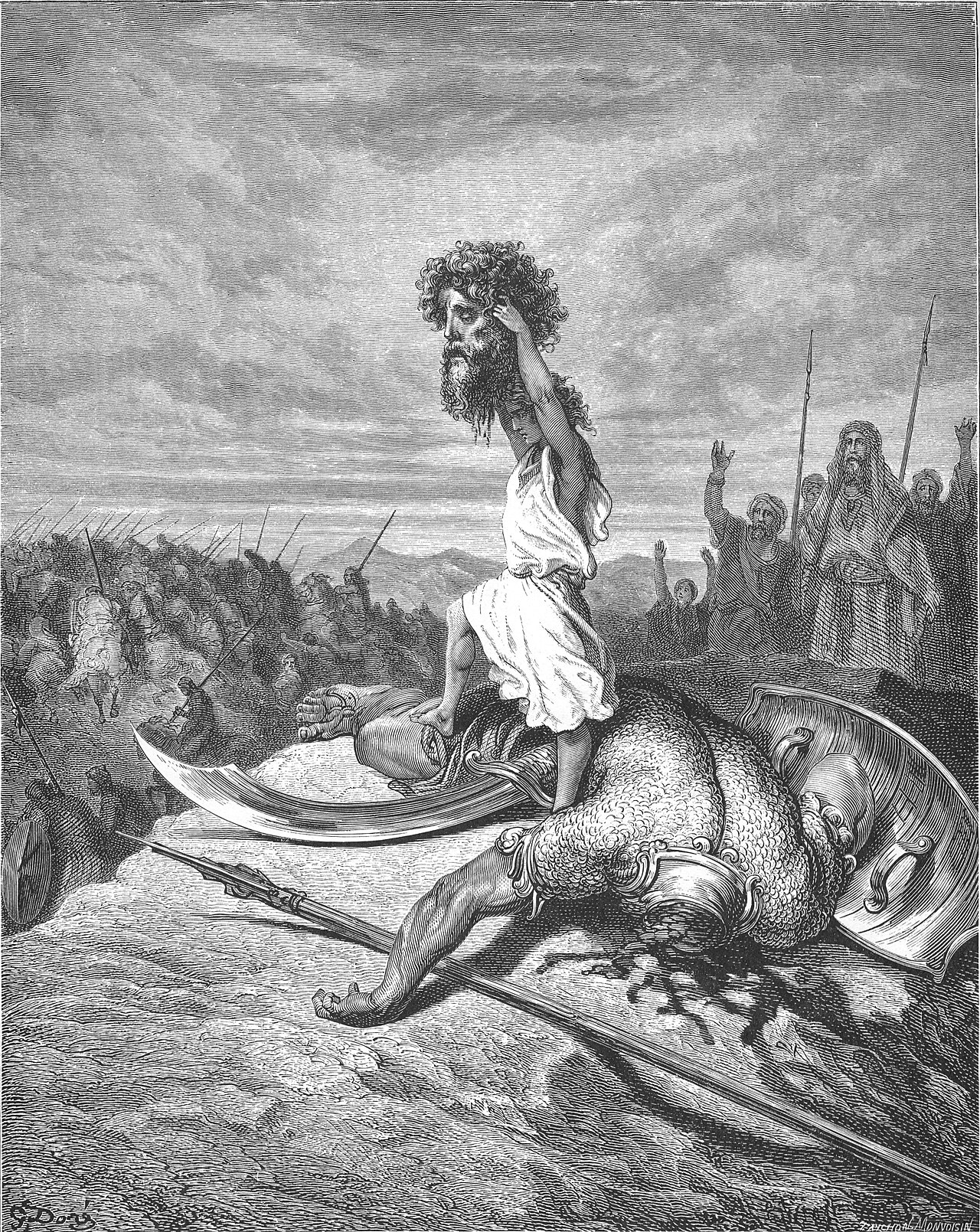
in 1 Samuel 17David ran and stood over him. He grabbed the Philistine’s sword and pulled it from its sheath and killed him; and he cut off his head with the sword. When the Philistines saw that their hero was dead, they turned and ran.
BSB
The same verse in ASV and KJV ▾
ASV
Then David ran, and stood over the Philistine, and took his sword, and drew it out of the sheath thereof, and slew him, and cut off his head therewith. And when the Philistines saw that their champion was dead, they fled.
KJV
Therefore David ran, and stood upon the Philistine, and took his sword, and drew it out of the sheath thereof, and slew him, and cut off his head therewith. And when the Philistines saw their champion was dead, they fled.
⋯
This verse in 1 Samuel 17
Commentary
9 notes on this verseWhen the Philistines saw their champion was dead, they fled - They were panic-struck; and not being willing to fulfill the condition which was stipulated by Goliath, they precipitately left the field. The Israelites took a proper advantage of these circumstances, and totally routed their enemies.
The record, by era
The Church Fathers1 voice
But our armor is Christ; it is that which the apostle Paul prescribes when, writing to the Ephesians, he says, "Take unto you the whole armor of God, that you may be able to withstand in the evil day;" and again, "Stand, therefore, having your loins gird about with truth, and having on the breastplate of righteousness; and your feet shod with the preparation of the gospel of peace; above all, taking the shield of faith, wherewith you shall be able to quench all the fiery darts of the wicked: and take the helmet of salvation, and the sword of the Spirit, which is the word of God." Armed with these weapons, king David went forth in his day to battle. Taking from the torrent's bed five smooth rounded stones, he proved that, even amidst all the eddying currents of the world, his feelings were free both from roughness and from defilement. Drinking of the brook by the way, and therefore lifted up in spirit, he cut off the head of Goliath, using the proud enemy's own sword as the fittest instrument of death, smiting the profane boaster on the forehead and wounding him in the same place in which Uzziah was smitten with leprosy when he presumed to usurp the priestly office; the very place also in which shines the glory that makes the saints rejoice in the Lord, saying, "The light of your countenance is sealed upon us, O Lord." Let us therefore also say, "My heart is fixed, O God, my heart is fixed: I will sing and give praise: awake up, my glory; awake, psaltery and harp; I myself will awake early"; that in us may be fulfilled that word, "Open thy mouth wide, and I will fill it"; and, "The Lord shall give the word with great power to them that publish it." I am well assured that your prayer as well as mine is that in our contending, the victory may remain with the truth. […]
The Medieval Church1 voice
Seeing that their strongest man had died, etc. Seeing that the unclean spirits were defeated and prostrated by the incarnation and passion of the Lord, they fled from the hearts of the believers. And all the strong ones in the Church, gathered from both the …
The Puritans and the Awakening3 voices
David took - Hence it appears, that David was not a little man, as many fancy; but a man of considerable bulk and strength, because he was able to manage a giant's sword.
God is greatly glorified when his proud enemies are cut off with their own sword and he makes their own tongues to fall upon them, Ps. lxiv. David's victory over Goliath was typical of the triumphs of the son of David over Satan and all the powers of darkness, whom he spoiled, and made a show of them openly ( Col. ii.
quarantine:debris (2026-07-29) — unbalanced-parens
), and this put life into the Israelites, who shouted and pursued them (David, it is probable, leading them on in the pursuit) even to the gates of their own cities,
quarantine:debris (2026-07-29) — leading-punctuation+unbalanced-parens
3 more voices on this verse
The Puritans and the Awakening1 voice
Therefore David ran and stood upon the Philistine,....
The Nineteenth Century2 voices
A commentator
Jamieson, Fausset & Brown1802–1910
Commentary Critical and Explanatory on the Whole Bible (1871)
proposed
cut off his head--not as an evidence of the giant's death, for his slaughter had been effected in presence of the whole army, but as a trophy to be borne to Saul. The heads of slain enemies are always regarded in the East as the most welcome tokens of victory.
quarantine:debris (2026-07-29) — starts-lowercase
A commentator
Albert Barnes1798–1870
Notes, Explanatory and Practical, on the Old and New Testaments (1832-1869)
proposed
Champion - Quite a different word from that so rendered in 1Sa 17:4, 1Sa 17:23; better “warrior.”
The words behind it
21 Hebrew wordsEvery Hebrew word of this verse in the order it stands, with what it means and the door to its own study. The last column counts the times a word stands in the whole Bible: the rarer the word, the more the places it appears belong together.
| Hebrew | Sound | Meaning | Word study | In the Bible |
|---|---|---|---|---|
| וַיָּ֣רָץ | vaiyarotz | and he ran | H7323 → | 103 times |
| דָּ֠וִד | david | David | H1732 → | 999 times |
| וַיַּעֲמֹ֨ד | vaiyaamod | and he stood | H5975 → | 521 times |
| אֶל־ | ʾel- | to | H413 → | 5510 times |
| הַפְּלִשְׁתִּ֜י | hapelishti | the Philistine | H6430 → | 287 times |
| וַיִּקַּ֣ח | vaiyikach | and he took | H3947 → | 966 times |
| אֶת־ | ʾet- | <obj.> | H853 → | 10935 times |
| חַ֠רְבּוֹ | charbo | sword his | H2719 → | 413 times |
| וַֽיִּשְׁלְפָ֤הּ | vaiyishlefah | and he drew out it | H8025 → | |
| מִתַּעְרָהּ֙ | mita'rah | from sheath its | H8593 → | |
| וַיְמֹ֣תְתֵ֔הוּ | vaymotetehu | and he killed him | H4191 → | 839 times |
| וַיִּכְרָת־ | vaiyikhrot- | and he cut off | H3772 → | 288 times |
| בָּ֖הּ | bah | with <the> it | ||
| אֶת־ | ʾet- | <obj.> | H853 → | 10935 times |
| רֹאשׁ֑וֹ | rosho | head his | H7218 → | 599 times |
| וַיִּרְא֧וּ | vaiyiru | and they saw | H7200 → | 1300 times |
| הַפְּלִשְׁתִּ֛ים | hapelishtim | the Philistines | H6430 → | 287 times |
| כִּֽי־ | ki- | that | H3588 → | 4482 times |
| מֵ֥ת | met | he had died | H4191 → | 839 times |
| גִּבּוֹרָ֖ם | giboram | mighty [man] their | H1368 → | 158 times |
| וַיָּנֻֽסוּ׃ | vaiyanusu | and they fled | H5127 → | 159 times |
וַיָּ֣רָץand he ran
vaiyarotzH7323 →103 times
דָּ֠וִדDavid
davidH1732 →999 times
וַיַּעֲמֹ֨דand he stood
vaiyaamodH5975 →521 times
אֶל־to
ʾel-H413 →5510 times
הַפְּלִשְׁתִּ֜יthe Philistine
hapelishtiH6430 →287 times
וַיִּקַּ֣חand he took
vaiyikachH3947 →966 times
אֶת־<obj.>
ʾet-H853 →10935 times
חַ֠רְבּוֹsword his
charboH2719 →413 times
וַֽיִּשְׁלְפָ֤הּand he drew out it
vaiyishlefahH8025 →
מִתַּעְרָהּ֙from sheath its
mita'rahH8593 →
וַיְמֹ֣תְתֵ֔הוּand he killed him
vaymotetehuH4191 →839 times
וַיִּכְרָת־and he cut off
vaiyikhrot-H3772 →288 times
בָּ֖הּwith <the> it
bah
אֶת־<obj.>
ʾet-H853 →10935 times
רֹאשׁ֑וֹhead his
roshoH7218 →599 times
וַיִּרְא֧וּand they saw
vaiyiruH7200 →1300 times
הַפְּלִשְׁתִּ֛יםthe Philistines
hapelishtimH6430 →287 times
כִּֽי־that
ki-H3588 →4482 times
מֵ֥תhe had died
metH4191 →839 times
גִּבּוֹרָ֖םmighty [man] their
giboramH1368 →158 times
וַיָּנֻֽסוּ׃and they fled
vaiyanusuH5127 →159 times
A shaded row is a word that stands 400 times or fewer in the Bible.
The walk
8 stopsEach card is a verse this one points to, and under it the verses that one points to in turn. Where several paths arrive at the same place, that place is listed first: the text keeps returning to it.
Through
Hebrews 11:34quenched the raging fire, and escaped the edge of the sword; who gained strength from weakness, became mighty in battle, and put foreign armies to flight.
it leads to
- 1 Samuel 17:51–52
David ran and stood over him. He grabbed the Philistine’s sword and pulled it from its sheath and killed him; and he cut off his head with the sword. When the Philistines saw that…
- 2 Kings 6:16–18
“Do not be afraid,” Elisha answered, “for those who are with us are more than those who are with them.”
- Judges 15:8
And he struck them ruthlessly with a great slaughter, and then went down and stayed in the cave at the rock of Etam.
- Psalms 144:10
to Him who gives victory to kings, who frees His servant David from the deadly sword.
- 2 Corinthians 12:9–10
But He said to me, “My grace is sufficient for you, for My power is perfected in weakness.” Therefore I will boast all the more gladly in my weaknesses, so that the power of…
- 1 Samuel 17:51–52
Through
Esther 7:10So they hanged Haman on the gallows he had prepared for Mordecai. Then the fury of the king subsided.
it leads to
- Psalms 7:16
His trouble recoils on himself, and his violence falls on his own head.
- Daniel 6:24
At the command of the king, the men who had falsely accused Daniel were brought and thrown into the den of lions—they and their children and wives. And before they had reached the bottom…
- Psalms 7:16
Through
1 Samuel 21:9The priest replied, “The sword of Goliath the Philistine, whom you killed in the Valley of Elah, is here; it is wrapped in a cloth behind the ephod. If you want, you may take…
it leads to
- 1 Samuel 17:2
Saul and the men of Israel assembled and camped in the Valley of Elah, arraying themselves for battle against the Philistines.
- 1 Samuel 17:2
Where this verse is studied
About 1 Samuel
Who and where
1 name in this verse with a page on the site.
This page draws on Adam Clarke, Commentary on the Bible; Albert Barnes, Notes, Explanatory and Practical, on the Old and New Testaments (1832-1869); Augustine of Hippo, LETTER 75.2; Bede, Commentary on Samuel; Jamieson, Fausset & Brown, Commentary Critical and Explanatory on the Whole Bible; John Gill, Exposition of the Old Testament (1748-1763); John Wesley, Explanatory Notes upon the Old Testament and Matthew Henry, Commentary on the Whole Bible.