
1 Samuel 17:54
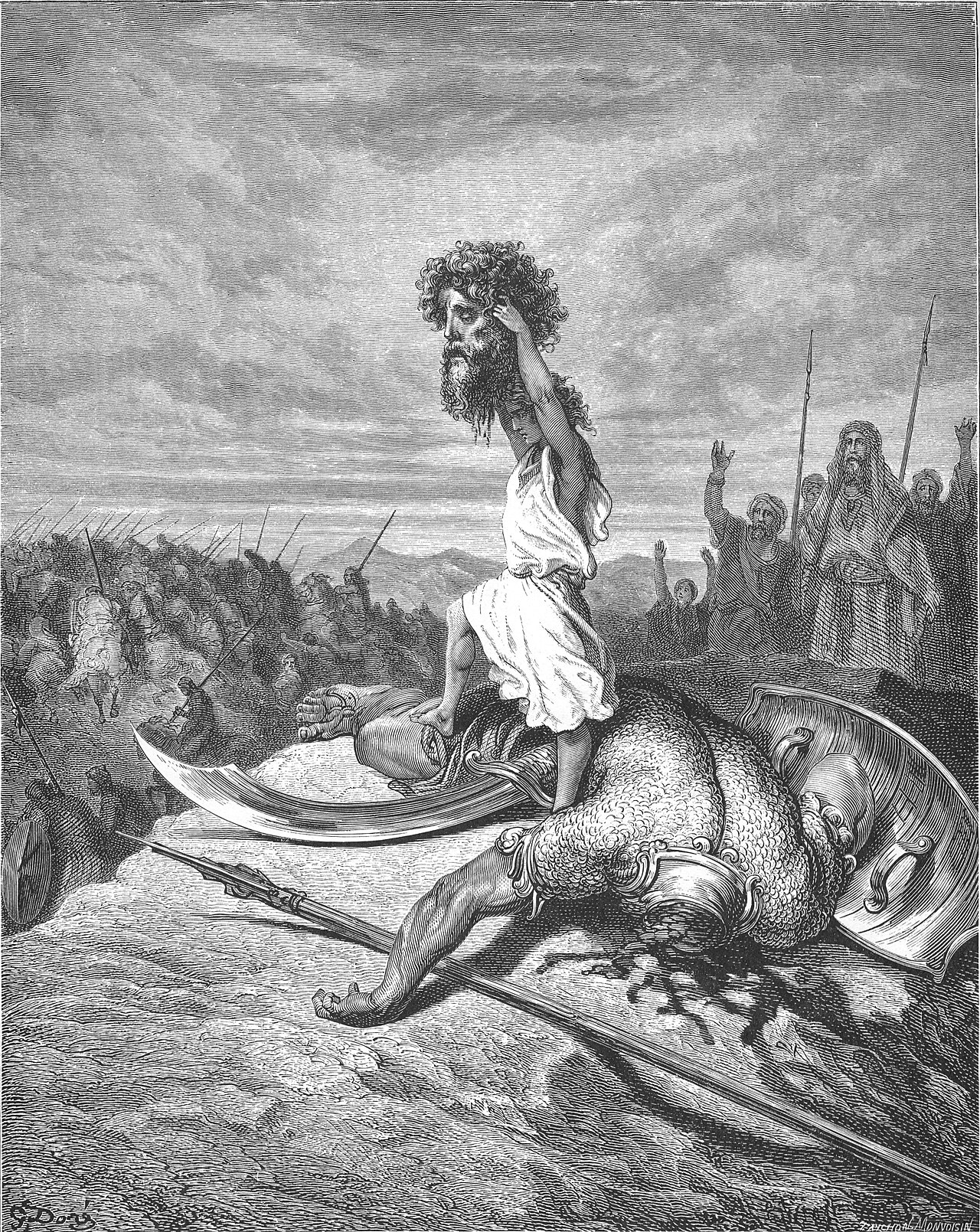
in 1 Samuel 17David took the head of the Philistine and brought it to Jerusalem, and he put Goliath’s weapons in his own tent.
BSB
The same verse in ASV and KJV ▾
ASV
And David took the head of the Philistine, and brought it to Jerusalem; but he put his armor in his tent.
KJV
And David took the head of the Philistine, and brought it to Jerusalem; but he put his armour in his tent.
⋯
This verse in 1 Samuel 17
Commentary
6 notes on this verseHe brought the head of the Philistine to Jerusalem, to be a terror to the Jebusites, who held the strong-hold of Sion: it is probable that he carried it in triumph to other cities. His armour he laid up in his tent; only the sword was preserved behind the ephod in the tabernacle, as consecrated to God, and a memorial of the victory to his honour, ch. xxi.
This site's exposition
arose, and shouted, and pursued
on 1 Samuel 17:52-54
The men who fled at the sight of one man now chase an army to the gates of Ekron, for the champion's fall was counted to his people. The wounded fall by the way to Shaaraim, even unto Gath, so the rout runs through Goliath's own town. David carries the head to Jerusalem, which in that day was still a Jebusite fortress, and the commentators note the strangeness honestly: the trophy goes ahead of the king to the city he will one day take, while the armor is laid up in his tent.
The record, by era
The Medieval Church1 voice
But David, taking the head of the Philistine, etc. I think it should be understood, according to the letter, that David took care to bring the head of such a strong adversary, which had been cut off, to the rebellious city of Jerusalem, still inhabited …
The Puritans and the Awakening1 voice
And David took the head of the Philistine, and brought it to Jerusalem,....
The Nineteenth Century2 voices
David took the head of the Philistine - It has been already remarked that this, with the following verses, and the five first verses of the eighteenth chapter, are omitted by the Septuagint. See the observations at the end, 1Sa 17:58 (note).
A commentator
Albert Barnes1798–1870
Notes, Explanatory and Practical, on the Old and New Testaments (1832-1869)
proposed
Jerusalem - See Jdg 1:8 note. His tent - Perhaps the tabernacle. David had neither tent nor house of his own. It would be quite in accordance with David’s piety that he should immediately dedicate to God the arms taken from the Philistine, in acknowledgment that the victory was not his own but the Lord’s (compare 1Sa 21:9). His tabernacle, meaning the tabernacle which he had pitched (2Sa 6:17; compare Act 15:16).
The words behind it
11 Hebrew wordsEvery Hebrew word of this verse in the order it stands, with what it means and the door to its own study. The last column counts the times a word stands in the whole Bible: the rarer the word, the more the places it appears belong together.
| Hebrew | Sound | Meaning | Word study | In the Bible |
|---|---|---|---|---|
| וַיִּקַּ֤ח | vaiyikach | and he took | H3947 → | 966 times |
| דָּוִד֙ | david | David | H1732 → | 999 times |
| אֶת־ | ʾet- | <obj.> | H853 → | 10935 times |
| רֹ֣אשׁ | rosh | [the] head of | H7218 → | 599 times |
| הַפְּלִשְׁתִּ֔י | hapelishti | the Philistine | H6430 → | 287 times |
| וַיְבִאֵ֖הוּ | vayviehu | and he brought it | H935 → | 2568 times |
| יְרוּשָׁלִָ֑ם | yerushalim | Jerusalem | H3389 → | |
| וְאֶת־ | veet | and <obj.> | H853 → | 10935 times |
| כֵּלָ֖יו | kelav | weapons his | H3627 → | 325 times |
| שָׂ֥ם | sam | he put | H7760 → | 584 times |
| בְּאָהֳלֽוֹ׃ ס | beoholo | in own tent his | H168 → | 345 times |
וַיִּקַּ֤חand he took
vaiyikachH3947 →966 times
דָּוִד֙David
davidH1732 →999 times
אֶת־<obj.>
ʾet-H853 →10935 times
רֹ֣אשׁ[the] head of
roshH7218 →599 times
הַפְּלִשְׁתִּ֔יthe Philistine
hapelishtiH6430 →287 times
וַיְבִאֵ֖הוּand he brought it
vayviehuH935 →2568 times
יְרוּשָׁלִָ֑םJerusalem
yerushalimH3389 →
וְאֶת־and <obj.>
veetH853 →10935 times
כֵּלָ֖יוweapons his
kelavH3627 →325 times
שָׂ֥םhe put
samH7760 →584 times
בְּאָהֳלֽוֹ׃ סin own tent his
beoholoH168 →345 times
A shaded row is a word that stands 400 times or fewer in the Bible.
The walk
5 stopsEach card is a verse this one points to, and under it the verses that one points to in turn. Where several paths arrive at the same place, that place is listed first: the text keeps returning to it.
Through
Exodus 16:33So Moses told Aaron, “Take a jar and fill it with an omer of manna. Then place it before the LORD to be preserved for the generations to come.”
it leads to
- Hebrews 9:4
containing the golden altar of incense and the gold-covered ark of the covenant. Inside the ark were the gold jar of manna, Aaron’s staff that had budded, and the stone tablets of the covenant.
- Hebrews 9:4
Through
1 Samuel 21:9The priest replied, “The sword of Goliath the Philistine, whom you killed in the Valley of Elah, is here; it is wrapped in a cloth behind the ephod. If you want, you may take…
it leads to
- 1 Samuel 17:2
Saul and the men of Israel assembled and camped in the Valley of Elah, arraying themselves for battle against the Philistines.
- 1 Samuel 31:10
They put his armor in the temple of the Ashtoreths and hung his body on the wall of Beth-shan.
- 1 Samuel 17:50–54
Thus David prevailed over the Philistine with a sling and a stone; without a sword in his hand he struck down the Philistine and killed him.
- Exodus 28:6–14
They are to make the ephod of finely spun linen embroidered with gold, and with blue, purple, and scarlet yarn.
- 1 Samuel 17:2
Where this verse is studied
About 1 Samuel
Who and where
2 names in this verse with a page on the site.
This page draws on Adam Clarke, Commentary on the Bible; Albert Barnes, Notes, Explanatory and Practical, on the Old and New Testaments (1832-1869); Bede, Commentary on Samuel; John Gill, Exposition of the Old Testament; John Gill, Exposition of the Old Testament (1748-1763); Keil and Delitzsch, Biblical Commentary on the Books of Samuel and Matthew Henry, Commentary on the Whole Bible.