
Luke 22:29
in Luke 22And I bestow on you a kingdom, just as My Father has bestowed one on Me,
BSB
The same verse in ASV and KJV ▾
ASV
and I appoint unto you a kingdom, even as my Father appointed unto me,
KJV
And I appoint unto you a kingdom, as my Father hath appointed unto me;
⋯
This verse in Luke 22
Commentary
20 notes on this verseA commentator
Albert Barnes1798–1870
Notes, Explanatory and Practical, on the Old and New Testaments (1832-1869)
And I appoint unto you a kingdom - He assures them here that they should “have” a kingdom - their expectations would be realized. They had continued with him; they had seen how “he” had lived, and to what trials he had been subjected; they had all along expected a kingdom, and he assures them that they should not be disappointed. As my Father ... - They had seen how God had appointed a kingdom to “him.” It was not with pomp, and splendor, and external glory, but it was in poverty, want, persecution, and trial.
This site's exposition
stood by Me in My trials
on Luke 22:28-30
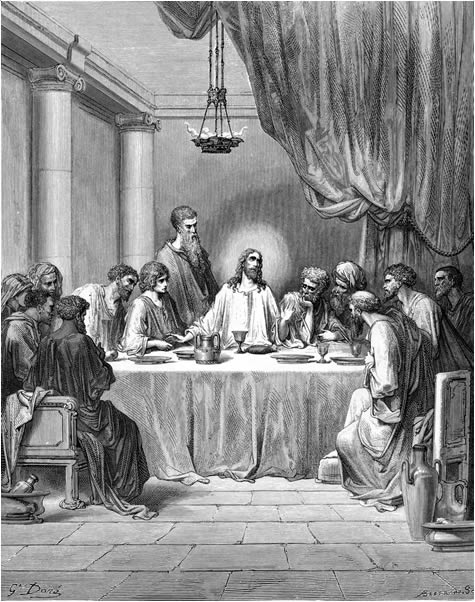
Jesus speaks to the twelve who stood by Him in His trials, just after their argument over greatness. The same verb, bestow, names the Father's grant to the Son and the Son's grant to them.
This site's exposition
just as My Father has bestowed one on Me
Jamieson, Fausset and Brown marvel that one within hours of arrest dispenses kingdoms. John Wesley reads the grant as a kingdom for every one of the twelve, with no primacy for one. Albert Barnes adds that the Son's kingdom came without pomp.
The record, by era
The Church Fathers4 voices
The kingdom of God is not of this world, But it is not equality with God, but likeness to Him, unto which man must aspire. For Christ alone is the full image of God, on account of the unity of His Father's glory expressed in Him. But the righteous man is after the image of God, if for the sake of imitating the likeness of the Divine conversation, He through the knowledge of God despises the world. Therefore also we eat the Body and Blood of Christ, that we may be partakers of eternal life.
He awards the kingdom to His disciples, as He says it had been appointed to Himself by the Father. He has power to ask, if He will, legions of angels from the Father for His help.
The kingdom of God is not of this world. Therefore, the equality of man to God is not possible, but rather an emulation of similarity. For only Christ is the perfect image of God, because of the unity of the expressed glory of the Father in Him. But a just man is in the image of God, if, for the purpose of imitating the likeness of divine conduct, he despises this world through knowledge of God and looks down upon earthly pleasures through the perception of the word of God, by which we are nourished unto life. And so we partake of the body of Christ, that we may be partakers of eternal life. For it is not food and drink that are promised to us as rewards and honors, but the sharing of heavenly grace and life. And the twelve thrones, as described, are not physical receptacles for sitting, but because just as Christ, according to his divine likeness, judges by the knowledge of hearts and not by questioning deeds, rewarding virtue and condemning impiety, so too the apostles are formed in spiritual judgment by the reward of faith and the condemnation of perfidy, refuting error with their power and pursuing sacrilege with hatred.
The Savior therefore drives away from the holy apostles the affliction of pride. They might perhaps think among themselves and even say, "What will be the reward of faithfulness? What advantage shall we, who have waited on Christ, receive when temptations happen from time to time?" Confirmed by the hope of the blessings that are in store, they throw away from their minds all laziness in virtuous pursuits. They rather choose with an eager mind to follow him and take pleasure in labor for his sake.
The Medieval Church1 voice
From the high excellence of this promise Judas is excluded. For before the Lord said this, Judas must be supposed to have gone out. They also are excluded whoever having heard the words of the incomprehensible Sacrament, have gone backwards. (John 6:67.)
12 more voices on this verse
The Medieval Church4 voices
You are those who have remained with me in my trials, and I appoint to you, as my Father appointed to me, a kingdom. Not the beginning of patience, but perseverance is granted the glory of the heavenly kingdom. Because, indeed, perseverance, which is called …
For not the first effort of patience, but long-continued perseverance, is rewarded with the glory of the heavenly kingdom, for perseverance, (which is called constancy or fortitude of mind,) is, so to say, the pillar and prop of all virtues. The Son of God then conducts those who abide with Him in His temptations to the everlasting kingdom. For if we have been planted together in the likeness of his death, we shall be also in the likeness of his resurrection. (Rom. 6:5.) Hence it follows, And I give to you a kingdom, &c.
This then is the exchange to the right hand of the Most High, (Ps. 118:15.) that those who now in lowliness rejoice to minister to their fellow-servants, shall then at our Lord's table on high be fed with the banquet of everlasting life, and they who here in temptations abide with the Lord being unjustly judged, shall then come with Him as just judges upon their tempters. Hence it follows, And sit on thrones judging the twelve tribes of Israel.
And since he who is a partaker in tribulation ought to be a partaker in honor, therefore he adds: And I dispose to you, as my Father has disposed to me, a kingdom, that you may eat and drink at my table in my kingdom, …
The Puritans and the Awakening3 voices
And I - Will preserve you in all your temptations, till ye enter into the kingdom of glory: appoint to you - By these very words. Not a primacy to one, but a kingdom to every one: on the same terms: as my Father hath appointed to me - Who have fought and conquered.
And I appoint unto you a kingdom,....
It is spoken with an air of encomium and applause: " You are they who have continued with me in my temptations, you are they who have stood by me and stuck to me when others have deserted me and turned their backs upon me." Christ had his temptations; he was despised and rejected of men, reproached and reviled, and endured the contradiction of sinners.
The Nineteenth Century5 voices
A commentator
Jamieson, Fausset & Brown1802–1910
Commentary Critical and Explanatory on the Whole Bible (1871)
I appoint, &c.--Who is this that dispenses kingdoms, nay, the Kingdom of kingdoms, within an hour or two of His apprehension, and less than a day of His shameful death?
A commentator
Jamieson, Fausset & Brown1802–1910
Commentary Critical and Explanatory on the Whole Bible (1871)
proposed
there was--or "had been," referring probably to some symptoms of the former strife which had reappeared, perhaps on seeing the whole paschal arrangements committed to two of the Twelve.
quarantine:debris (2026-07-29) — starts-lowercase
A commentator
J.C. Ryle1816–1900
Expository Thoughts on the Gospels: Luke (lightly modernized text, Grace Gems edition) (1858)
proposed
Let us observe, in this passage — how firmly pride and love of preeminence can stick to the hearts of Christian men. We are told that "There was a dispute among the disciples, as to which of them should be considered the greatest." The strife was one which had been rebuked by our Lord on a former occasion. The ordinance which the disciples had just been receiving, and the circumstances under which they were assembled — made the strife particularly inappropriate.
A commentator
J.C. Ryle1816–1900
Expository Thoughts on the Gospels: Luke (lightly modernized text, Grace Gems edition) (1858)
proposed
Let us observe, in this passage — how firmly pride and love of preeminence can stick to the hearts of Christian men. We are told that "There was a dispute among the disciples, as to which of them should be considered the greatest." The strife was one which had been rebuked by our Lord on a former occasion. The ordinance which the disciples had just been receiving, and the circumstances under which they were assembled — made the strife particularly inappropriate. And yet at this very season, the last quiet time they could spend with their Master before His death — this little flock begins a dispute, as to who should be the greatest! Such is the heart of man — ever weak, ever deceitful, ever ready, even at its best times, to turn aside to what is evil! The sin before us is a very old one. Ambition, self-esteem, and self-conceit — lie deep at the bottom of all men's hearts, and often in the hearts where they are least suspected! Thousands imagine that they are humble — who cannot bear to see an equal more honored and favored than themselves. Few indeed can be found who rejoice heartily in a neighbor's promotion over their own heads. The quantity of envy and jealousy in the world, is a glaring proof of the prevalence of pride. Men would not envy a brother's advancement — if they had not a secret thought that their own merit was greater than his. Let us live on our guard against this great evil — if we make any profession of serving Christ. The harm that it has done to the Church of Christ, is far beyond calculation. Let us learn to take pleasure in the prosperity of others — and to be content with the lowest place for ourselves. The rule given to the Philippians should be often before our eyes, "In lowliness of mind let each esteem others better than themselves."
I appoint unto you a kingdom, as my Father hath appointed unto me - The Codex Alexandrinus, with some other MSS., the later Syriac, and Origen, read in the first clause, διαθηκην, a covenant. I appoint unto you a Covenant, as my Father hath appointed unto me a kingdom: - Ye shall be ministers of the new covenant, as I am king in that spiritual kingdom to which it relates. This is a curious reading: but our Lord is probably to be understood as promising that they should get a kingdom - a state of blessedness, as he should get it - they must go through much tribulation in order to enter into the kingdom of God. So the Son of man suffered that he might enter into his glory: for the joy that was set before him, he endured the cross, and despised the shame, and is set down on the right hand of God.
The words behind it
10 Greek wordsEvery Greek word of this verse in the order it stands, with what it means and the door to its own study. The last column counts the times a word stands in the whole Bible: the rarer the word, the more the places it appears belong together.
| Greek | Sound | Meaning | Word study | In the Bible |
|---|---|---|---|---|
| κἀγὼ | kago | And I myself | G1473 →G2532 → | 839 times |
| διατίθεμαι | diatithemai | appoint | G1303 → | |
| ὑμῖν | humin | to you | G4771 → | 2973 times |
| καθὼς | kathos | even as | G2531 → | 182 times |
| διέθετό | dietheto | appointed | G1303 → | |
| μοι | moi | to Me | G3165 → | 1936 times |
| ὁ | ho | the | G3588 → | 19766 times |
| πατήρ | pater | Father | G3962 → | 410 times |
| μου | mou | of Mine | G3165 → | 1936 times |
| βασιλείαν, | basileian | a kingdom, | G932 → | 162 times |
κἀγὼAnd I myself
διατίθεμαιappoint
diatithemaiG1303 →
ὑμῖνto you
huminG4771 →2973 times
καθὼςeven as
kathosG2531 →182 times
διέθετόappointed
diethetoG1303 →
μοιto Me
moiG3165 →1936 times
ὁthe
hoG3588 →19766 times
πατήρFather
paterG3962 →410 times
μουof Mine
mouG3165 →1936 times
βασιλείαν,a kingdom,
basileianG932 →162 times
A shaded row is a word that stands 400 times or fewer in the Bible.
The walk
8 stopsEach card is a verse this one points to, and under it the verses that one points to in turn. Where several paths arrive at the same place, that place is listed first: the text keeps returning to it.
Through
Matthew 28:18Then Jesus came to them and said, “All authority in heaven and on earth has been given to Me.
it leads to
- John 3:35
The Father loves the Son and has placed all things in His hands.
- 1 Peter 3:22
who has gone into heaven and is at the right hand of God, with angels, authorities, and powers subject to Him.
- Matthew 11:27
All things have been entrusted to Me by My Father. No one knows the Son except the Father, and no one knows the Father except the Son and those to whom the Son chooses…
- Ephesians 1:20–22
which He exerted in Christ when He raised Him from the dead and seated Him at His right hand in the heavenly realms,
- Hebrews 2:8
and placed everything under his feet.” When God subjected all things to him, He left nothing outside of his control. Yet at present we do not see everything subject to him.
- John 3:35
Through
James 2:5Listen, my beloved brothers: Has not God chosen the poor of this world to be rich in faith and to inherit the kingdom He promised those who love Him?
it leads to
- Matthew 5:3
“Blessed are the poor in spirit, for theirs is the kingdom of heaven.
- Luke 6:20
Looking up at His disciples, Jesus said: “Blessed are you who are poor, for yours is the kingdom of God.
- Matthew 5:3
Through
2 Timothy 2:12if we endure, we will also reign with Him; if we deny Him, He will also deny us;
it leads to
- Romans 8:17
And if we are children, then we are heirs: heirs of God and co-heirs with Christ—if indeed we suffer with Him, so that we may also be glorified with Him.
- Romans 8:17
Where this verse is studied
On this page
Studies24
On this chapter
About Luke
This page draws on 14 works. Open the list of works
This page draws on Adam Clarke, Commentary on the Bible; Albert Barnes, Notes, Explanatory and Practical, on the Old and New Testaments (1832-1869); Ambrose of Milan, Catena Aurea by Aquinas; Ambrose of Milan, EXPOSITION OF THE GOSPEL OF LUKE 10.50; Bede, Catena Aurea by Aquinas; Bede, On the Gospel of Luke; Bonaventure, Commentary on Luke, Chapter 22; Cyril of Alexandria, COMMENTARY ON LUKE, HOMILY 143; J.C. Ryle, Expository Thoughts on the Gospels: Luke (lightly modernized text, Grace Gems edition); Jamieson, Fausset & Brown, Commentary Critical and Explanatory on the Whole Bible; John Gill, Exposition of the New Testament (1746-1748); John Wesley, Explanatory Notes upon the New Testament; Matthew Henry, Commentary on the Whole Bible and Tertullian, Against Praxeas.