
Lukechapter 10
42 verses · Luke · about AD 62 · The Gospels
So He told them, “I saw Satan fall like lightning from heaven.
Introduction
Luke, The Gospels, Luke Overview.
Luke writes this chapter as the road to Jerusalem begins. It opens with a larger band of messengers sent ahead into the towns on the road. It then gives a rare view of Jesus rejoicing and speaking to his Father. Listen for the question a teacher of the Law asks and for the question he is asked in return. Listen also for the kind of man who becomes the hero of the story. Read it as teaching on mission, on love of neighbour and on listening to Jesus.
Context
- Who
- A Greek reader learning who counts as a neighbour
- What
- The mission of the seventy-two, the prayer of Jesus to the Father, the parable of the Good Samaritan, and the visit to Martha and Mary.
- Where
- The towns on the road to Jerusalem, the road from Jerusalem down to Jericho in the parable, and a village where Martha and Mary lived.
- When
- The road to Jerusalem after the close of the Galilean ministry, about AD 29 to 30.
- Why
- To prepare the towns for the coming of Jesus, to define love of neighbour by mercy, and to teach that hearing him comes first.
Historical context
The number sent out is itself a textual question: ancient manuscripts read either seventy or seventy-two, and both are well attested. Either number echoes the table of the nations in Genesis, which some ancient traditions counted as seventy and others as seventy-two, a hint that this mission looks beyond Israel.
Show the rest of the historical context, 4 more paragraphs
The road from Jerusalem down to Jericho is the setting of the parable and it is a real, notorious stretch: about seventeen miles dropping over three thousand feet through bare rocky gorges with endless cover for ambush. Travellers were robbed on it regularly, and Josephus mentions banditry in that wilderness.
The priest and the Levite had a reason a first-century listener would recognise. Contact with a corpse made a person ritually unclean for a week, which would have interrupted temple duties. The man is described as half dead, from a distance you could not tell, so passing by on the other side was the cautious, defensible choice.
The Samaritan's help is costed out precisely: oil and wine as ordinary wound treatment, his own animal, an inn, and two denarii, two days' wages, enough to cover a stay of some length, plus an open promise for any further expense. He also puts himself in danger, since a Samaritan seen with a beaten Jew could easily be blamed.
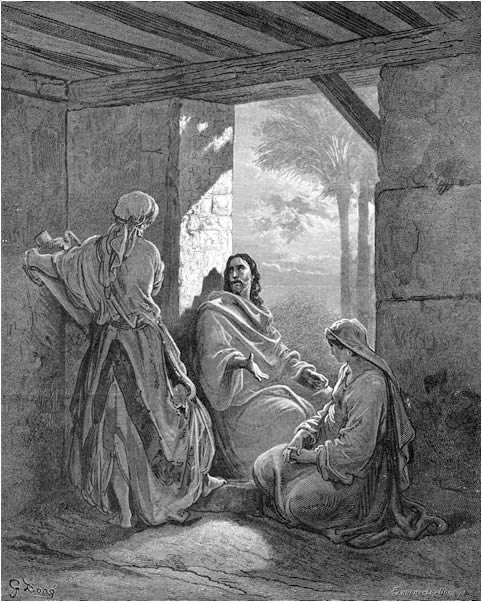
The scene in Bethany turns on posture. Sitting at a teacher's feet was the position of a disciple in training, and it was not where a woman was expected to be while the meal was being prepared.
Significance
The lawyer asks who his neighbour is, expecting a boundary. He gets a story in which the hero is the one kind of person his hearers most despised, and then he is asked to name which man acted as neighbour. He cannot even say the word Samaritan; he says, the one who showed mercy.
Show the rest of the significance, 1 more paragraph
For Theophilus, reading in a world stacked with ethnic and class boundaries, this chapter defined the ethic of the whole movement and then, in Bethany, defended a woman's right to sit and learn.
The heads below are this chapter's scenes. The numbered points under each are its verses.
The Seventy Sent On Ahead
Luke 10:1-2
the Lord appointed seventy-two others: and sent them two by two ahead of Him, a wider sending than the Twelve. Because the workers are few, prayer to the Lord of the harvest becomes the means of raising them.
Luke 10:1
“After these things - After the appointment of the twelve apostles, and the transactions recorded in the previous chapters. Other seventy - Seventy others besides the apostles. They were appointed for a different purpose from the apostles. The apostles were to be with him; to hear his instructions; to be witnesses of his miracles, his sufferings, his death, his resurrection and ascension, that they might “then” go and proclaim all these things to the world. The seventy were sent out to preach immediately, and chiefly where he himself was about to come. They were appointed for a temporary object.”
1 more voice on this verseWhat preachers and commentators have said about this verse, in their own words.
Luke 10:1
“God had made known by the Prophets that the preaching of the Gospel of salvation was to embrace not only Israel, but also the Gentile nations; and therefore after the twelve Apostles, there were other seventy-two (Vulg. septuaginta duos.) also appointed by Christ, as it is said, After these things the Lord appointed other seventy-two also. An outline of this ordinance also was set forth in the words of Moses, who at the command of God chose out seventy, upon whom God poured out His Spirit.”
Cyril of Alexandria · written before 444 · Catena Aurea by Aquinaspatristic
Theophylact compares the people who will believe to fields that need many workers at harvest. Cyril of Alexandria links the seventy-two with the promise that the gospel would reach the Gentile nations. The Lord of the harvest is asked to send them.
Luke 10:2
“That he would send forth - Εκβαλῃ. There seems to be an allusion here to the case of reapers, who, though the harvest was perfectly ripe, yet were in no hurry to cut it down. News of this is brought to the Lord of the harvest the farmer, and he is entreated to exert his authority, and hurry them out; and this he does because the harvest is spoiling for want of being reaped and gathered in. See the notes on Mat 9:37, Mat 9:38.”
Adam Clarke · Commentary on the Bible (1810-1826)evangelical
1 more voice on this verse
Luke 10:2
“They must look about, and see how great the harvest was, what abundance of people there were that wanted to have the gospel preached to them and were willing to receive it, nay, that had at this time their expectations raised of the coming of the Messiah and of his kingdom. There was corn ready to shed and be lost for want of hands to gather it in.”
Matthew Henry · Commentary on the Whole Bible (1707-1721)puritan
Luke 10:3-4
I am sending you out like lambs among wolves: , Jesus warns. Carry no purse or bag or sandals repeats the austerity given the Twelve. Do not greet anyone along the road adds haste, an errand too pressing for the long courtesies its culture expected.
Luke 10:3
“But would that if we are not sufficient for the power of preaching, we might at least maintain the duty of our position in innocence of life. For it is added: Behold, I send you as lambs among wolves. But many, when they receive the rights of governance, burn to tear apart their subjects, display the terror of power, and harm those whom they ought to have benefited.”
Gregory the Dialogist · written before 604 · Forty Gospel Homilies, Homily 17patristic
4 more voices on this verse
Luke 10:3
“Go, behold I send you as lambs among wolves. He calls the wolves the scribes and Pharisees, who are the clergy of the Jews.”
Bede · written before 735 · On the Gospel of Lukepatristic
Luke 10:3
“Lambs among wolves - See on Mat 10:16 (note).”
Adam Clarke · Commentary on the Bible (1810-1826)evangelical
Luke 10:3
“Luke next relates, that the seventy disciples obtained for themselves from Christ apostolical learning, lowliness, innocency, justice, and to prefer no worldly things to holy preachings, but to aspire to such fortitude of mind as to be afraid of no terrors, not even death itself. He adds therefore, Go. Thus He had already commanded them to have no care for these persons, when He said, I send you as lambs among wolves.”
Cyril of Alexandria · written before 444 · Catena Aurea by Aquinaspatristic
Luke 10:3
“He tells them beforehand about persecutions and about the fact that they will be as lambs among wolves, so that these things, having come upon them unexpectedly, would not trouble them by their suddenness.”
Theophylact of Ohrid · written before 1107 · Commentary on Lukepatristic
Carry no purse or bag or sandals: Chrysostom says the power of the One who sent them was their comfort in every danger. Ephrem notes that He sent them to preach without pay, as He Himself had done. They carry nothing for the road.
Luke 10:4
“Carry neither purse nor scrip - See on Mat 10:9 (note), etc., and Mar 6:8 (note), etc. Salute no man by the way - According to a canon of the Jews, a man who was about any sacred work was exempted from all civil obligations for the time; forasmuch as obedience to God was of infinitely greater consequence than the cultivation of private friendships, or the returning of civil compliments.”
Adam Clarke · Commentary on the Bible (1810-1826)evangelical
Luke 10:5-7
Whatever house you enter: Each house hears Peace to this house, the common greeting turned into an offer. If a man of peace is there, your peace will rest on him; if not, it returns unwasted. The messengers stay, since the worker is worthy of his wages, a saying Paul later cites.
Luke 10:5
“And into whatsoever house ye enter,.... When ye come into any city, town, or village, first say, peace be to this house: salute the inhabitants in the usual form, saying, peace be to you; wishing them all happiness and prosperity, temporal, spiritual, and eternal. This shows our Lord did not disapprove of civil salutations.”
If a man of peace: Theophylact says the greeting of peace is a blessing that rests on a worthy householder. Augustine notes that no one knows who is a son of peace. The peace returns to the messenger when it is refused.
Luke 10:6
“The son of peace - In the Jewish style, a man who has any good or bad quality is called the son of it. Thus, wise men are called the children of wisdom, Mat 11:19; Luk 7:35. So, likewise, what a man is doomed to, he is called the son of, as in Eph 2:3, wicked men are styled the children of wrath: so Judas is called the son of perdition, Joh 17:12; and a man who deserves to die is called, 2Sa 12:5, a son of death.”
Adam Clarke · Commentary on the Bible (1810-1826)evangelical
the worker is worthy of his wages: Theophylact says the order to stay in one house kept the apostles from seeming greedy and from offending their first hosts. He reads the wages as the eating and drinking they are offered. The worker eats as his pay.
Luke 10:7
“See the notes at Mat 10:11. On this passage Dr. Thomson (“The Land and the Book,” vol. i. p. 534) remarks: “The reason (for the command, ‘Go not from house to house’) is very obvious to one acquainted with Oriental customs. When a stranger arrives in a village or an encampment, the neighbors, one after another, must invite him to eat with them.”
Luke 10:8-9
eat whatever is set before you: relaxes Jewish table scruples, so that no table blocks the message. Heal the sick who are there joins work to the word, The kingdom of God is near you, as for the Twelve.
Luke 10:8
“Probably, Christ here refers to the traditions of the elders about their meat which were so many that those who observed them were extremely critical, you could hardly set a dish of meat before them, but there was some scruple or other concerning it; but Christ would not have them to regard those things, but eat what was given them, asking no question for conscience' sake.”
Matthew Henry · Commentary on the Whole Bible (1707-1721)puritan
Theophylact says the healings were meant to draw people to the preaching. Maximus the Confessor reads near as describing the readiness of people for the kingdom, which he calls present in all believers in power. Healing and message go together.
Luke 10:9
“That the kingdom of God was neither new nor unheard of, He in this way affirmed, whilst at the same time He bids them announce that it was near at hand. Now it is that which was once far off, which can be properly said to have become near.”
Tertullian · written before 220 · Against Marcion Book IVpatristic
1 more voice on this verse
Luke 10:9
“The kingdom of God is come nigh unto you - Εφ ὑμας, is just upon you. This was the general text on which they were to preach all their sermons. See it explained, Mat 3:2 (note).”
Adam Clarke · Commentary on the Bible (1810-1826)evangelical
Luke 10:10-12
if you enter a town and they do not welcome you: Where a town refuses them, the messengers wipe off its dust as a testimony and still declare, The kingdom of God is near. Jesus says it will be more bearable on that day for Sodom than for that town, for hearing and refusing brings a heavier judgment.
Luke 10:10
“But into whatsoever city ye enter,.... On the other hand Christ here directs how to behave towards other cities they should come to, and be rejected: and they receive you not; refuse to admit them into their houses, or provide in any shape for them, nor hear their message: go your ways out into the streets of the same. The Ethiopic version reads, "cast the dust off your feet into the streets of it: and say"; aloud, in the most public manner, in the ears of all the people, as follows.”
we wipe off as a testimony against you: Origen hears the gesture as saying that the dust of their sins will come upon them. Theophylact notes that the same announcement, the kingdom is near, brings a blessing in verse 9 and a curse here. The message stays the same.
Luke 10:11
“How, if there can be a threat without its accomplishment, can you have in a threatening god, one that executes also, and in both, one that is a judicial being? So, again, He commands that the dust be shaken off against them, as a testimony,-the very particles of their ground which might cleave to the sandal, not to mention any other sort of communication with them. But if their churlishness and inhospitality were to receive no vengeance from Him, for what purpose does He premise a testimony, which surely forbodes some threats?”
Tertullian · written before 220 · Against Marcion Book IVpatristic
more bearable on that day for Sodom: Eusebius recalls that Sodom still held Lot, who received the angels into his house. A town that receives no disciple at all is judged worse. That day names the judgment.
Luke 10:12
“And it was He who rained fire and brimstone from heaven, in the days of Lot, upon Sodom and Gomorrah, "an example of the righteous judgment of God," that all may know, "that every tree that bringeth not forth good fruit shall be cut down, and cast into the fire." And it is He who uses [the words], that it will be more tolerable for Sodom in the general judgment than for those who beheld His wonders, and did not believe on Him, nor receive His doctrine.”
Irenaeus · written before 202 · Against Heresies Book IVpatristic
1 more voice on this verse
Luke 10:12
“But I say unto you,.... The same that he said to the twelve apostles, when he sent them out, Mat 10:15, that it shall be more tolerable in that day for Sodom than for that city. By "that day" is meant, the famous day to come, the last day; the day of judgment, as it is expressed in Matthew; and so the Ethiopic version reads here, "it shall be better in the day of judgment".”
Luke 10:13-15
Woe to you, Chorazin!: Woe falls on Chorazin and Bethsaida, which saw most of His miracles, for Tyre and Sidon would have repented long ago. Privilege raises the standard: it will be more bearable for Tyre and Sidon at the judgment than for you. Capernaum, His adopted home, will be brought down to Hades.
Luke 10:13
“He also teaches that those who judged that the gospel should not be followed should be subjected to a harsher punishment than those who thought that the law should be dissolved.”
Ambrose of Milan · written before 397 · Commentary on Lukepatristic
more bearable for Tyre and Sidon: Ambrose says a heavier sentence falls on those who refuse the gospel than on those who broke the law. Chrysostom says the Lord mourns over these towns as a lesson for others. Chorazin and Bethsaida saw the miracles.
Luke 10:14
“But it shall be more tolerable for Tyre and Sidon at the judgment,.... Or "in the day of judgment", as read the Syriac, Persic, Ethiopic, and Gothic versions; and as it is in Mat 11:22 than for you; the inhabitants of Chorazin and Bethsaida, who will be more severely punished than these Gentile cities; for by how much greater were their light, privileges, and advantages against which they sinned, by so much will be their severer punishment.”
1 more voice on this verse
Luke 10:14
“Chorazin, Bethsaida, and Capernaum, all bordering upon the sea of Galilee, where Christ was most conversant, are the places here mentioned. [1.] They enjoyed greater privileges. Christ's mighty works were done in them, and they were all gracious works, works of mercy.”
Matthew Henry · Commentary on the Whole Bible (1707-1721)puritan
you will be brought down to Hades!: Theophylact says Capernaum was glorified by many miracles and still refused to believe. Gill reads lifted up to heaven as its privileges under the ministry of Christ. Privilege raises the height of the fall.
Luke 10:15
“And thou Capernaum, which art exalted to heaven,.... Referring either to the situation of it, which was on a very high hill; or to its privileges, through the ministry and miracles of Christ; or the phrase may be expressive of the pride and loftiness of the inhabitants of it, who were elated with the mercies they enjoyed, it being a most delightful, pleasant, and comfortable place to live in, as its name signifies.”
Whoever listens to you listens to Me: Whoever rejects Me rejects the One who sent Me binds the messenger's reception to the Father's authority in an unbroken chain. A town's welcome or refusal of ordinary messengers therefore reaches all the way back to God.
Luke 10:16
Faithfully and strenuously shalt thou resist them in defence of the only true and life-giving faith, which the Church has received from the apostles and imparted to her sons. For the Lord of all gave to His apostles the power of the Gospel, through whom also we have known the truth, that is, the doctrine of the Son of God; to whom also did the Lord declare: "He that heareth you, heareth Me; and he that despiseth you, despiseth Me, and Him that sent Me."
Irenaeus · written before 202 · Against Heresies Book IIIpatristic
1 more voice on this verse
Luke 10:16
“He that despiseth you, despiseth me - “The holy, blessed God said: ‘Honor my statutes, for they are my ambassadors: and a man’s ambassador is like to himself. If thou honor my precepts, it is the same as if thou didst honor me; and if thou despise them, thou despisest me.” R. Tancum. “He that murmurs against his teacher is the same as if he had murmured against the Divine Shekinah.” Sanhedrin, fol. 110.”
Adam Clarke · Commentary on the Bible (1810-1826)evangelical
I Beheld Satan Fall Like Lightning
Luke 10:17-18
The seventy-two returned with joy: Lord, even the demons submit to us in Your name. I saw Satan fall like lightning from heaven names either a vision of that fall or the collapse of his kingdom seen in their victories.
Luke 10:17
“We learn, from this passage — how ready Christians are to be puffed up with success. It is written, that the seventy returned from their first mission with joy, saying, "Lord, even the demons are subject unto us through your name." There was much false fire in that joy. There was evidently self-satisfaction in that report of achievements. The whole tenor of the passage leads us to this conclusion. The remarkable expression which our Lord uses about Satan's fall from Heaven, was most probably meant to be a caution.”
2 more voices on this verse
Luke 10:17
“According to Christ's declaration, the harvest indeed was great, but the laborers were few. In addition to those first chosen, he appointed seventy others and sent them to every village and city of Judea before his face to be his forerunners and to preach the things that belonged to him.The authority that they carried to rebuke evil spirits and the power of crushing Satan was not given to them that they might be regarded with admiration. It was given to them so that Christ would be glorified by their means.”
Cyril of Alexandria · written before 444 · Commentary on Luke, Homily 64patristic
Luke 10:17
“The possession of such power, not being expressly in their commission, as in that to the Twelve (Lu 9:1), filled them with more astonishment and joy than all else. through thy name--taking no credit to themselves, but feeling lifted into a region of unimagined superiority to the powers of evil simply through their connection with Christ.”
Jamieson, Fausset & Brown · Commentary Critical and Explanatory on the Whole Bible (1871)reformed
Jesus answers the report of verse 17 that the demons submit. Theophylact says their chief had long been cast down and has no power. Bonaventure hears a warning against pride, the sin of the fallen angels.
Luke 10:18
“I beheld Satan - Or, Satan himself, τον Σαταναν, the very Satan, the supreme adversary, falling as lightning, with the utmost suddenness, as a flash of lightning falls from the clouds, and at the same time in the most observable manner. The fall was both very sudden and very apparent. Thus should the fall of the corrupt Jewish state be, and thus was the fall of idolatry in the Gentile world.”
Adam Clarke · Commentary on the Bible (1810-1826)evangelical
1 more voice on this verse
Luke 10:18
“When therefore the Seventy say, "the devils [demons] are subject to us," and Jesus replies, "Mine eye was beholding Satan falling," it is plain that He meant to raise their minds not only from the particular to the general, but from a very temporary form of satanic operation to the entire kingdom of evil.”
Jamieson, Fausset & Brown · Commentary Critical and Explanatory on the Whole Bible (1871)reformed
Luke 10:19-20
I have given you authority to tread on snakes and scorpions: , and over all the power of the enemy, an authority covering the mission's dangers. Jesus then turns their joy from the sign to the settled fact behind it: rejoice that your names are written in heaven.
Luke 10:19
“To tread on serpents - Preservation from danger. If you tread on a poisonous reptile that would otherwise injure you, I will keep you from danger. If you go among bitter and malignant enemies that would seek your life, I will preserve you. See the notes at Mar 16:18. Scorpions - The scorpion is an animal with eight feet, eight eyes and a long jointed tail, ending in a pointed weapon or sting. It is found in tropical climates, and seldom exceeds 4 inches in length. Its sting is extremely poisonous, and it is sometimes fatal to life.”
1 more voice on this verse
Luke 10:19
“As the devils have now been subject to you, so they shall still be. (2.) A defensive power: " Nothing shall by any means hurt you; not serpents nor scorpions, if you should be chastised with them or thrown into prisons and dungeons among them; you shall be unhurt by the most venomous creatures," as St. Paul was ( Acts xxviii. 5 ), and as is promised in Mark xvi.”
Matthew Henry · Commentary on the Whole Bible (1707-1721)puritan
Theophylact notes that driving out spirits benefits others, while a name in heaven is the disciple's own good. He adds that the devil fell from above while people below have their names written above. Joy rests on grace.
Luke 10:20
“Because your names are written in heaven - This form of speech is taken from the ancient custom of writing the names of all the citizens in a public register, that the several families might be known, and the inheritances properly preserved. This custom is still observed even in these kingdoms, though not particularly noticed. Every child that is born in the land is ordered to be registered, with the names of its parents, and the time when born, baptized, or registered; and this register is generally kept in the parish church, or in some public place of safety.”
Adam Clarke · Commentary on the Bible (1810-1826)evangelical
2 more voices on this verse
Luke 10:20
“Note, Power to become the children of God is to be valued more than a power to work miracles; for we read of those who did in Christ's name cast out devils, as Judas did, and yet will be disowned by Christ in the great day. But they whose names are written in heaven shall never perish; they are Christ's sheep, to whom he will give eternal life.”
Matthew Henry · Commentary on the Whole Bible (1707-1721)puritan
Luke 10:20
"Rejoice" is too weak a word. It is "exulted in spirit"--evidently giving visible expression to His unusual emotions; while, at the same time, the words "in spirit" are meant to convey to the reader the depth of them. This is one of those rare cases in which the veil is lifted from off the Redeemer's inner man, that, angel-like, we may "look into it" for a moment (1Pe 1:12).
Jamieson, Fausset & Brown · Commentary Critical and Explanatory on the Whole Bible (1871)reformed
Luke 10:21-22
Jesus rejoiced in the Holy Spirit: , a rare notice of His emotion, praising the Father for revealing these things to little children. One of Luke's highest claims follows: No one knows who the Son is except the Father.
Luke 10:21
“Again, our Lord Jesus Christ confesses this same Being as His Father, where He says: "I confess to thee, O Father, Lord of heaven and earth." What Father will those men have us to understand [by these words], those who are most perverse sophists of Pandora? Whether shall it be Bythus, whom they have fabled of themselves; or their Mother; or the Only-begotten?”
Irenaeus · written before 202 · Against Heresies Book IVpatristic
3 more voices on this verse
Luke 10:21
“There are five remarkable points in these verses which deserve the attention of all who wish to be well-instructed Christians. Let us take each of the five in order. We should observe, in the first place — the one instance on record of our Lord Jesus Christ rejoicing . We read, that in "that hour, Jesus rejoiced in spirit." Three times we are told in the Gospels that our Lord Jesus Christ wept . Once only we are told that He rejoiced . And what was the cause of our Lord's joy? It was the conversion of souls.”
Luke 10:21
“Note, Nothing rejoices the heart of the Lord Jesus so much as the progress of the gospel, and its getting ground of Satan, by the conversion of souls to Christ. Christ's joy was a solid substantial joy, an inward joy: he rejoiced in spirit; but his joy, like deep waters, made no noise; it was a joy that a stranger did not intermeddle with.”
Matthew Henry · Commentary on the Whole Bible (1707-1721)puritan
Luke 10:21
“Rejoiced in spirit - Was truly and heartily joyous: felt an inward triumph. But τῳ πνευματι, τῳ ἁγιῳ, the Holy Spirit, is the reading here of BCDKL, six others; the three Syriac, later Persic, Coptic, Ethiopic, Armenian, Vulgate, all the Itala except one, and Augustin and Bede. These might be considered sufficient authority to admit the word into the text. I thank thee - Bishop Pearce justly observes, the thanks are meant to be given to God for revealing them to babes, not for hiding them from the others. See on Mat 11:25 (note).”
Adam Clarke · Commentary on the Bible (1810-1826)evangelical
All things have been entrusted to Me by My Father: The saying follows the praise of verse 21, where the Father hides these things from the wise and reveals them to little children. Ambrose says it pleased God to reveal His grace to the little ones. The Son alone gives the knowledge of the Father.
Luke 10:22
“The Codex Alexandrinus, several other very ancient MSS., and some ancient versions, as well as the margin of our own, begin this verse with, And turning to his disciples, he said. But as this clause begins Luk 10:23, it is not likely that it was originally in both. Griesbach has left these words out of the text, and Professor White says, Certissime delenda, “These words should most assuredly be erased.” All things are delivered to me - See on Mat 11:27 (note).”
Adam Clarke · Commentary on the Bible (1810-1826)evangelical
Luke 10:23-24
Jesus turned to the disciples and said privately: , Blessed are the eyes that see what you see. They stand at the hinge of redemptive history, for many prophets and kings desired to see what you see but did not see it.
Luke 10:23
“And he turned him unto his disciples,.... Both to the twelve apostles, and seventy disciples; and said privately; or to them apart: the phrase "privately" is wanting in the Vulgate Latin version: blessed are the eyes that see the things that ye see; the person of the Messiah, his kingdom setting up in the world, miracles wrought by him, and Satan falling before him; See Gill on Mat 13:16.”
2 more voices on this verse
Luke 10:23
Blessed are the eyes which see the things that ye see - There is a similar saying to this among the rabbins, in Sohar. Genes., where it is said, “Blessed is that generation which the earth shall bear, when the King Messiah cometh.”
Adam Clarke · Commentary on the Bible (1810-1826)evangelical
Luke 10:23
“But that you may know that as the Son revealed the Father to whom He will, the Father also reveals the Son to whom He will, hear our Lord's words, Blessed art thou, Simon Barjona, for flesh and blood have not revealed it to thee, but my Father which is in heaven.”
Ambrose of Milan · written before 397 · Catena Aurea by Aquinaspatristic
many prophets and kings desired to see what you see: Theophylact ties the blessing to verse 22, for the disciples see the Father revealed through the Son. The prophets and kings waited for this without seeing it. The disciples see it.
Luke 10:24
“For I tell you that many prophets and kings,.... As Abraham, Isaac, Jacob, who were prophets, as well as patriarchs, and David, Solomon, and others: have desired to see those things which ye see, and have not seen them, and to hear those things which ye hear, and have not heard them, meaning himself, doctrines, and miracles; See Gill on Mat 13:17.”
The Good Samaritan on the Jericho Road
Luke 10:25-28
an expert in the law stood up to test Him: Testing Him, an expert in the law asked about eternal life, a scholar probing a teacher without formal credentials. Sent back to his own text, he joined the Shema's love of God to the love of neighbor from Leviticus. Do this and you will live holds him to his answer.
Luke 10:25
“A certain lawyer - One who professed to be well skilled in the laws of Moses, and whose business it was to explain them. Stood up - Rose - came forward to address him. Tempted him - Feigned a desire to be instructed, but did it to perplex him, or to lead him, if possible, to contradict some of the maxims of the law. Inherit eternal life - Be saved. This was the common inquiry among the Jews. “They” had said that man must keep the commandments - the written and oral law.”
1 more voice on this verse
Luke 10:25
“For he was one of those who think themselves skilled in the law, and who keep the letter of the law, while they know nothing of its spirit. From a part of the law itself our Lord proves them to be ignorant of the law, showing that at the very first the law preached the Father and the Son, and announced the sacraments of the Lord's Incarnation; for it follows, And he answering said, Thou shall love the Lord thy God with all thy heart, and with all thy soul, and with all thy strength, and with all thy mind.”
Ambrose of Milan · written before 397 · Catena Aurea by Aquinaspatristic
Jesus sends the expert in the law to his own reading of Scripture. Matthew Henry calls it a mercy that the law is written and so made certain. Bonaventure sees a Master who honours the Law.
Luke 10:26
“What is written in the law?.... Christ, with great propriety, sends him to the law, to see and observe what was written there, what are the terms and conditions of life, as fixed there; partly, because this man, by his office and character, was an interpreter of the law; and partly, because his question was, what shall I do? how readest thou? in the law, every day; referring to the "Keriat Shema", the reading of the Shema, i.e. those words in Deu 6:4, &c, "Hear, O Israel, &c." morning and evening (i) as appears by his answer (i) Vid. Misn.”
1 more voice on this verse
Luke 10:26
“What is written ... - Jesus referred him to the “law” as a safe rule, and asked him what was said there. The lawyer was doubtless endeavoring to justify himself by obeying the law. He trusted to his own works. To bring him off from that ground - to make him feel that it was an unsafe foundation, Jesus showed him what the law “required,” and thus showed him that he needed a better righteousness than his own. This is the proper use of the law.”
The lawyer joins two commands of the Law into one answer. Maximus the Confessor says the threefold love for God pulls a person away from possessions, glory and pleasure. Ambrose says such experts keep the letter of the law and miss its spirit.
Luke 10:27
“And he answering said, thou shalt love the Lord thy God,.... This was part of their phylacteries, which they recited every day; See Gill on Mat 22:37, Mat 22:39, Mar 12:28, Mar 12:29.”
Cross references
Luke 10:27
- QuotingDeuteronomy 6:5“And you shall love the LORD your God with all your heart and with all your soul and with all your strength.”
'Thou shalt love the Lord thy God', the lawyer's answer
- QuotingLeviticus 19:18“Do not seek revenge or bear a grudge against any of your people, but love your neighbor as yourself. I am the LORD.”
'and thy neighbour as thyself' (Good Samaritan setup)
Theophylact says the answer was correct for a man still under the Law. Origen draws from it that the life preached by the Creator's Scriptures is eternal life. The command to do it leads to the lawyer's next question.
Luke 10:28
“He says, "What is written in the law? How do you read?" The lawyer repeated what is in the law. As if to punish his wickedness and reprove his malicious purpose, Christ, knowing all things, says, "You have answered correctly; do this, and you will live." The lawyer missed his prey. He shot off the mark. His wickedness is unsuccessful. The sting of envy ceased. The net of deceit is torn. His sowing bears no fruit, and his toil gains no profit. As some ship overwhelmed by misfortune, he has suffered a bitter shipwreck.”
Cyril of Alexandria · written before 444 · Commentary on Luke, Homily 69patristic
2 more voices on this verse
Luke 10:28
“And he said unto him, thou hast answered right,.... It is so written, and read; and this, as if he should say, is the sum and substance of the law, and what that requires men should do; wherefore, do this, and thou shalt live; for the bare reading of it was not sufficient; though these men placed great confidence in reading this passage, or in reciting their phylacteries, of which this was a part, morning and night.”
Luke 10:28
“We are concerned to know who is our neighbour, whom by the second great commandment we are obliged to love. This is another of this lawyer's queries, which he started only that he might drop the former, lest Christ should have forced him, in the prosecution of it, to condemn himself, when he was resolved to justify himself.”
Matthew Henry · Commentary on the Whole Bible (1707-1721)puritan
wanting to justify himself: But wanting to justify himself, he asked Jesus who his neighbor was, a follow-up that narrows the command's reach instead of obeying it. The parable that follows turns his question from who counts as a neighbor to how one acts as a neighbor.
Luke 10:29
“To justify himself - Desirous to appear blameless, or to vindicate himself, and show that he had kept the law. Jesus wished to lead him to a proper view of his own sinfulness, and his real departure from the law. The man was desirous of showing that he had kept the law; or perhaps he was desirous of justifying himself for asking the question; of showing that it could not be so easily settled; that a mere reference to the “words” of the law did not determine it.”
1 more voice on this verse
Luke 10:29
“Some think that their neighbor is their brother, family, relative or their kinsman. Our Lord teaches who our neighbor is in the Gospel parable of a certain man going down from Jerusalem to Jericho.… Everyone is our neighbor, and we should not harm anyone. If, on the contrary, we understand our fellow human beings to be only our brother and relatives, is it then permissible to do evil to strangers? God forbid such a belief! We are neighbors, all people to all people, for we have one Father.”
Jerome · written before 420 · Homily on Psalm 14 (15)patristic
Luke 10:30-32
A man going down from Jerusalem to Jericho fell into the hands of robbers on the dangerous desert road. A priest and a Levite, bound by the law just summarized, each passed by on the other side. Corpse defilement barred a priest from temple service, yet the man still lived.
Luke 10:30
“And Jesus answering - Rather, Then Jesus took him up. This I believe to be the meaning of the word ὑπολαβων; he threw out a challenge, and our Lord took him up on his own ground. See Wakefield’s Testament. A certain man went down from Jerusalem - Or, A certain man of Jerusalem going down to Jericho. This was the most public road in all Judea, as it was the grand thoroughfare between these two cities for the courses of priests, twelve thousand of whom are said to have resided at Jericho. See Lightfoot.”
Adam Clarke · Commentary on the Bible (1810-1826)evangelical
3 more voices on this verse
Luke 10:30
“Jericho is an image of this world. Adam, cast out from Paradise, that heavenly Jerusalem, descended to it by the mistake of his transgression, that is, departing from the living to hell, for whom change not of place but of conduct made the exile of his nature. He was greatly changed from that Adam who enjoyed eternal blessedness. When he turned aside to worldly sins, Adam fell among thieves, among whom he would not have fallen if he had not strayed from the heavenly command and made himself vulnerable to them.”
Ambrose of Milan · written before 397 · Commentary on Lukepatristic
Luke 10:30
“The mentioning of those places intimates that it was matter of fact, and not a parable; probably it happened lately, just as it is here related. The occurrences of Providence would yield us many good instructions, if we would carefully observe and improve them, and would be equivalent to parables framed on purpose for instruction, and be more affecting.”
Matthew Henry · Commentary on the Whole Bible (1707-1721)puritan
Luke 10:30
“A certain man--a Jew. from Jerusalem to Jericho--a distance of nineteen miles northeast, a deep and very fertile hollow--"the Temple of Judea" [TRENCH]. thieves--"robbers." The road, being rocky and desolate, was a notorious haunt of robbers, then and for ages after, and even to this day.”
Jamieson, Fausset & Brown · Commentary Critical and Explanatory on the Whole Bible (1871)reformed
by chance a priest was going down the same road: Adam Clarke explains the phrase by chance as the meeting of time and circumstance. The priest's coming matches the man's need exactly. Bede notes that priest and Levite both saw the man and both passed by.
Luke 10:31
“By chance - Accidentally, or as it happened. It means that he did not do it with a “design” to aid the man that was wounded. A certain priest - It is said that not less than 12,000 priests and Levites dwelt at Jericho; and as their business was at Jerusalem, of course there would be many of them constantly traveling on that road. When he saw him - He saw him lie, but came not near him. Passed by on the other side - On the farther side of the way.”
1 more voice on this verse
Luke 10:31
“And by chance there came down a certain priest that way,.... Who had been at Jerusalem, to take his turn in the courses, and was now returning to Jericho, where the stationary men were, to which he belonged: for it is said (t), that "the former prophets appointed twenty and four courses; and for every course there was a station at Jerusalem, of priests, and of Levites, and of Israelites; and when the time of the course came to go up, the priests and Levites went up to Jerusalem.”
a Levite came to that spot: Augustine reads the priest and the Levite as the times of the Law and the Prophets. Theophylact says both wished to set people right and were unable. The Levite sees and passes as the priest did.
Luke 10:32
“A Levite - The Levites, as well as the priests, were of the tribe of Levi, and were set apart to the duties of religion. The special duty of the priest was “to offer sacrifice” at the temple; to present incense; to conduct the morning and evening services of the temple, etc. The office or duty of the “Levites” was to render assistance to the priests in their services. In the journey of the Israelites through the wilderness, it was their duty to transport the various parts of the tabernacle and the sacred utensils.”
1 more voice on this verse
Luke 10:32
“It is sad when those who should be examples of charity are prodigies of cruelty, and when those who should by displaying the mercies of God, open the bowels of compassion in others, shut up their own. [3.] How he was succoured and relieved by a stranger, a certain Samaritan, of that nation which of all others the Jews most despised and detested and would have no dealings with.”
Matthew Henry · Commentary on the Whole Bible (1707-1721)puritan
Luke 10:33-35
a Samaritan on a journey came upon him: When a Samaritan came upon him, he had compassion, splanchnizomai, the verb of 7:13 at Nain. The verb is now given to the one figure the lawyer's culture despised.
Luke 10:33
“Oh, no, he came "where he was," and finding that the man could do nothing whatever for his own assistance, the good Samaritan began with him, then and there, upon the spot, putting no impossible conditions to him, proposing no stipulations which the man could not perform—but doing everything for the man, and doing it for him as he was, and where he was. Beloved, we are all quite aware that a charity of which a man cannot avail himself, is no charity at all.”
3 more voices on this verse
Luke 10:33
“That extraordinary Samaritan did not himself shun him whom the priest and the Levite had shunned. In the name of a sect, you may not shun him whom you will admire by interpretation of the word. Indeed, "guard" is signified by the name Samaritan. The interpretation means this. Who is the Guard, if not, "The Lord preserves the infants"? Thus, as there is one Jew in the letter and another in the spirit, so there is one Samaritan in public, another in secret. Here the Samaritan is going down.”
Ambrose of Milan · written before 397 · Commentary on Lukepatristic
Luke 10:33
“That such great love should be found in a Samaritan was perhaps thought as wonderful as that great faith which Christ admired in a Roman, and in a woman of Canaan; but really it was not so, for pity is the work of a man, but faith is the work of divine grace.”
Matthew Henry · Commentary on the Whole Bible (1707-1721)puritan
Luke 10:33
“Samaritan--one excommunicated by the Jews, a byword among them, synonymous with heretic and devil (Joh 8:48; see on Lu 17:18). had compassion--His best is mentioned first; for "He who gives outward things gives something external to himself, but he who imparts compassion and tears gives him something from his very self" [GREGORY THE GREAT, in TRENCH].”
Jamieson, Fausset & Brown · Commentary Critical and Explanatory on the Whole Bible (1871)reformed
pouring on oil and wine: Theophylact reads the oil as the word of teaching that prepares for virtue. He says the binding came at once, to stop the wound from growing worse. The Samaritan gives his own animal and his own care.
Luke 10:34
“Pouring in oil and wine - These, beaten together, appear to have been used formerly as a common medicine for fresh wounds. Bind up a fresh cut immediately in a soft rag or lint, moistened with pure olive oil, and the parts will heal by what is called the first intention, and more speedily than by any other means. An inn - Πανδοχειον, from παν, all, and δεχομαι, I receive; because it receives all comers.”
Adam Clarke · Commentary on the Bible (1810-1826)evangelical
1 more voice on this verse
Luke 10:34
"And bound up his wounds, pouring in oil and wine." That Physician has many remedies with which he is accustomed to cure. His speech is a remedy. One of his sayings binds up wounds, another treats with oil, another pours in wine. He binds wounds with a stricter rule. He treats with the forgiveness of sins. He stings with the rebuke of judgment as if with wine.
Ambrose of Milan · written before 397 · Commentary on Lukepatristic
two denarii: Augustine reads the two coins as the two commands of love. Theophylact notes the order: the wounds bound first, then care at the inn. The Samaritan pays in advance and promises more.
Luke 10:35
“Blessed is that innkeeper who can care for another's wounds. Blessed is he to whom Jesus says, "Whatever you shall spend over and above, I will repay you." A good steward is one who also spends over and above. Paul is a good steward, whose sermons and epistles overflow with the knowledge that he received. He followed the moderate command of the Lord with almost immoderate effort of mind and body, so that he raised many from deep sorrow by the stewardship of spiritual exhortation.”
Ambrose of Milan · written before 397 · Commentary on Lukepatristic
1 more voice on this verse
Luke 10:35
“Two pence - About 27 cents, or 1 shilling, 2d. This may seem a small sum, but we are to remember that that sum was probably ten times as valuable then as now - that is, that it would purchase ten times as much food and the common necessaries of life as the same sum would now. Besides, it is probable that all the man wanted was “attention” and kindness, and for all these it was the purpose of the Samaritan to pay when he returned. The host - The innkeeper.”
Luke 10:36-37
Which of these three: Jesus reverses the question, asking who of the three was a neighbor to the man who fell into the hands of robbers. Unable to name the Samaritan, the expert answers, The one who showed him mercy. Jesus closes with Go and do likewise, a command in place of a definition.
Luke 10:36
“Since no one is closer than he who tended to our wounds, let us love him as our Lord, and let us love him as our neighbor. Nothing is so close as the head to the members. Let us also love him who is the follower of Christ, let us love him who in unity of body has compassion on another's need.”
Ambrose of Milan · written before 397 · Commentary on Lukepatristic
Ambrose says a neighbour is made by compassion and never by kinship. Jesus turns the question of verse 29 around. The lawyer is told to act.
Luke 10:37
“He that showed mercy - His “Jewish” prejudice would not permit him “to name” the Samaritan, but there was no impropriety, even in his view, in saying that the man who showed so much mercy was really the neighbor to the afflicted, and not he who “professed” to be his neighbor, but who would “do nothing” for his welfare. Go, and do thou likewise - Show the same kindness to “all” - to friend and foe - and “then” you will have evidence that you keep the law, and not “till” then.”
Martha's Serving and Mary's Better Part
Luke 10:38-39
a woman named Martha welcomed Him into her home: , the household John places at Bethany. Her sister Mary sat at the Lord’s feet, the posture of a disciple before a rabbi, a place then held by men.
Luke 10:38
“Now it came to pass as they went,.... As Christ and his disciples went from Jerusalem, having been at the feast of tabernacles, Joh 7:2 or at the feast of dedication, Joh 10:22 to some other parts of Judea: that he entered into a certain village; called Bethany, which was about fifteen furlongs, or two miles from Jerusalem, Joh 11:1 and a certain woman named Martha.”
2 more voices on this verse
Luke 10:38
“A certain village - If this village was Bethany, where Martha and Mary lived, at less than two miles’ distance from Jerusalem, see Joh 11:1, Joh 11:18; Joh 12:2, then this must have happened later than Luke places it; because, in Luk 19:29, he represents Jesus as having arrived after this at Bethany; and what is said in Luk 13:22, and Luk 17:11, seems to confirm that this visit of Jesus to Martha and Mary ought to be placed later. Bishop Pearce.”
Adam Clarke · Commentary on the Bible (1810-1826)evangelical
Luke 10:38
“IT is not an easy thing to maintain the balance of our spiritual life. No man can be spiritually healthy who does not meditate and commune. No man, on the other hand, is as he should be unless he is active and diligent in holy service. David sweetly sang, "He makes me to lie down in green pastures." There was the contemplative. "He leads me beside the still waters." There was the active and progressive. The difficulty is to maintain the two—and to keep each in its relative proportion to the other.”
sat at the Lord’s feet listening to His message: Augustine contrasts Martha preparing food for the Lord with Mary choosing to be fed by Him. Theophylact reads sitting at the feet as being firmly settled in active virtue. Mary listens.
Luke 10:39
“Sat at Jesus’ feet - This was the ancient posture of disciples or learners. They sat at the “feet” of their teachers - that is, beneath them, in a humble place. Hence, Paul is represented as having been brought up at the “feet” of Gamaliel, Act 22:3. When it is said that Mary sat at Jesus’ feet, it means that she was “a disciple” of his; that she listened attentively to his instructions, and was anxious to learn his doctrine.”
1 more voice on this verse
Luke 10:39
“MARY was full of a love to Christ which could be very active and self-sacrificing. I have read to you of her pouring the precious box of spikenard upon our Lord for His anointing. She was, therefore, one who not only waited and listened, but she served the Lord after her sort and fashion. If she had been simply contemplative and nothing more, we might, perhaps, have considered her somewhat of a one-sided character—and while pointing to that which was good in her as an example, we might have had to comment on her deficiencies.”
Charles Spurgeon · written before 1892 · The Metropolitan Tabernacle Pulpit, Sermon No. 2927: “Love at Leisure” (lightly modernized text, CCEL edition)Particular Baptist
Luke 10:40-42
Martha was distracted by all the preparations: and aimed her complaint past Mary at Jesus. Martha, Martha, He answers, the doubled name He gives Simon Peter elsewhere. Only one thing is necessary, and Mary has chosen the good portion, hearing Him.
Luke 10:40
“But Martha was cumbered about much serving,.... "Or was drawn off", from hearing the word, from attending on Christ; being taken up in providing for him, and those that came with him; in dressing food, or in ordering her servants, how she would have every thing done, and in overlooking them, that every thing was done in proper order; so that she had a great deal of business upon her head and hands, which distracted her thoughts, or took them off of divine things, and put her in great hurry and concern.”
1 more voice on this verse
Luke 10:40
“Martha was cumbered - Περιεσπατο, perplexed, from περι, about, and σπαω, I draw. She was harassed with different cares and employments at the same time; one drawing one way, and another, another: a proper description of a worldly mind. But in Martha’s favor it may be justly said, that all her anxiety was to provide suitable and timely entertainment for our Lord and his disciples; for this is the sense in which the word διακονιαν, serving, should be taken.”
Adam Clarke · Commentary on the Bible (1810-1826)evangelical
Theophylact says the Lord forbids the hurry and anxiety of much serving and leaves hospitality in place. He spoke only when Martha tried to pull her sister away from listening. Cyril of Alexandria warns that excess is a burden.
Luke 10:41
“Thou art careful - Thou art anxious. Troubled - Disturbed, distracted, very solicitous. Many things - The many objects which excite your attention in the family. This was probably designed as a slight reproof, or a tender hint that she was improperly anxious about those things, and that she should, with Mary, rather choose to hear the discourses of heavenly wisdom.”
1 more voice on this verse
Luke 10:41
“May you then like Mary be influenced by the desire of wisdom. For this is the greater, this the more perfect work. Nor let the care of ministering to others turn thy mind from the knowledge of the heavenly word, nor reprove or think indolent those whom thou seest seeking after wisdom.”
Ambrose of Milan · written before 397 · Catena Aurea by Aquinaspatristic
only one thing is necessary: Ambrose says attention to the word, joined to faith, is preferred even to works. Clement of Alexandria sets Martha beside a man busy with many things and unable to do the one work of life. Mary keeps what she chose.
Luke 10:42
“WE HAVE no difficulty whatever in deciding what the one thing is. We are not allowed to say that it is the Saviour, for he is not a thing; and we are not permitted to say that it is attention to our own salvation, for although that would be true, it is not mentioned in the context. The one thing needful evidently is that which Mary chose—that good part which should not be taken away from her. Very clearly this was to sit at Jesus’ feet and hear his word. This and nothing less, this and nothing more.”
1 more voice on this verse
Luke 10:42
“One thing is needful - This is the end of the sentence, according to Bengel. “Now Mary hath chosen, etc.,” begins a new one. One single dish, the simplest and plainest possible, is such as best suits me and my disciples, whose meat and drink it is to do the will of our heavenly Father. Mary hath chosen that good part - That is, of hearing my word, of which she shall not be deprived; it being at present of infinitely greater importance to attend to my teaching than to attend to any domestic concerns.”
Adam Clarke · Commentary on the Bible (1810-1826)evangelical
How this psalm is built
The form: A dialogue with a lawyer that frames a parable, so that the questioner becomes his own judge, as Barnes classes it.
The patterns in this chapter
| Device | What it does | Where to see it |
|---|---|---|
| The question turned around | The lawyer asks in verse 29 who his neighbour is, and Jesus asks in verse 36 which of the three was a neighbour to the man who fell among robbers. Albert Barnes says Jesus made the lawyer his own judge, so that he had to admit a Samaritan showed the kindness of a neighbour while a priest and a Levite refused it. The lawyer answers with the words the one who showed him mercy.Albert Barnes, Notes, Explanatory and Practical, on the Old and New Testaments, 1832 to 1869, on Luke 10:30. | Luke 10:29, Luke 10:36, Luke 10:37 |
How this chapter is built
1 more paragraph on the patterns
The chapter has four scenes. Verses 1 to 16 send out the seventy-two, and verses 17 to 24 record their return and the prayer of Jesus. Verses 25 to 37 are a dialogue with a lawyer: two questions from him, two questions from Jesus, and the parable of verses 30 to 35 set between them. Verses 38 to 42 close in the house of Martha and Mary. Albert Barnes reads the parable as making the lawyer his own judge (Notes on the New Testament, on Luke 10:30). Origen reads it as an allegory of Adam's fall and Christ's rescue (Homilies on the Gospel of Luke 34.3).
Keep studying
Studies21
People and groups1
Words12
Trails1
Sources for this chapter
The summary
Jamieson, Fausset & Brown, Commentary Critical and Explanatory; John Calvin, Commentaries; John Wesley, Explanatory Notes Upon the New Testament and Matthew Henry, Complete Commentary.
The form and classifications
Albert Barnes, Notes, Explanatory and Practical, on the Old and New Testaments, 1832 to 1869, on Luke 10:30 and Origen of Alexandria, Homilies on the Gospel of Luke 34.3, on Luke 10:30.
The exposition
Adam Clarke, Commentary on the Bible; Alexander Maclaren, Expositions of Holy Scripture, Luke; Ambrose of Milan; Augustine of Hippo; Bede, On the Gospel of Luke; Bonaventure, Commentary on Luke, Chapter 10; Clement of Alexandria, Who is the Rich Man that Shall Be Saved?; Cyril of Alexandria, Catena Aurea by Aquinas; Ephrem the Syrian, COMMENTARY ON TATIAN'S DIATESSARON 8.1A, 1C; Eusebius of Caesarea, Catena Aurea by Aquinas; J. C. Ryle, Expository Thoughts on the Gospels, Luke; Jamieson, Fausset & Brown, Commentary Critical and Explanatory on the Whole Bible; John Calvin, Commentary on a Harmony of the Evangelists; John Chrysostom, Catena Aurea by Aquinas; John Gill; Matthew Henry, Commentary on the Whole Bible; Maximus the Confessor, Catena Aurea by Aquinas; Origen of Alexandria, Catena Aurea by Aquinas and Theophylact of Ohrid.
The painting
Mary and Martha, Gustave Doré (engraving), public domain