
Luke 10:38
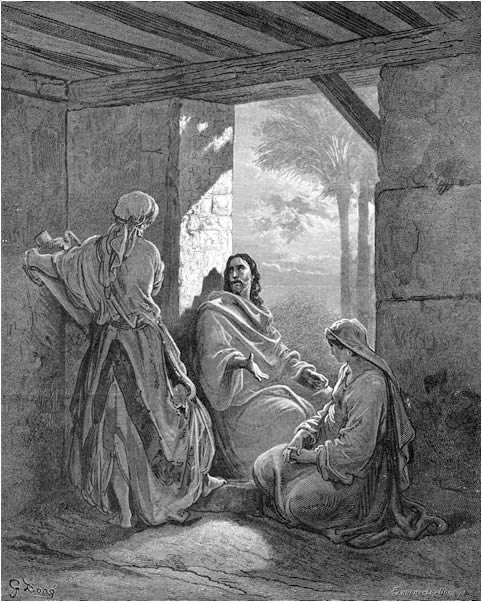
in Luke 10As they traveled along, Jesus entered a village where a woman named Martha welcomed Him into her home.
BSB
The same verse in ASV and KJV ▾
ASV
Now as they went on their way, he entered into a certain village: and a certain woman named Martha received him into her house.
KJV
Now it came to pass, as they went, that he entered into a certain village: and a certain woman named Martha received him into her house.
⋯
This verse in Luke 10
Commentary
19 notes on this verseNow it came to pass as they went,.... As Christ and his disciples went from Jerusalem, having been at the feast of tabernacles, Joh 7:2 or at the feast of dedication, Joh 10:22 to some other parts of Judea: that he entered into a certain village; called Bethany, which was about fifteen furlongs, or two miles from Jerusalem, Joh 11:1 and a certain woman named Martha.
This site's exposition
a woman named Martha welcomed Him into her home
on Luke 10:38-39
A woman named Martha welcomed Him into her home, the household John places at Bethany. Her sister Mary sat at the Lord’s feet, the posture of a disciple before a rabbi, a place then held by men.
The record, by era
The Church Fathers5 voices
(Ser. 103.) But the Lord, who came to his own, and his own received him not, (John 1:12.) was received as a guest, for it follows, And a certain woman named Martha received him into her house, &c. as strangers are accustomed to be received. But still a servant received her Lord, the sick her Saviour, the creature her Creator. But if any should say, "O blessed are they who have been thought worthy to receive Christ into their houses," grieve not thou, for He says, For inasmuch as ye have done it to the least of my brethren, ye have done it unto me. (Matt. 25:40.) But taking the form of a servant, He wished therein to be fed by servants, by reason of His condescension, not His condition. He had a body in which He was hungry and thirsty, but when He was hungry in the desert, Angels ministered to Him. (Matt. 4:11.) In wishing therefore to be fed, He came Himself to the feeder.
The Lord had a body. And just as he deigned to assume a physical body for our sake, so also did he deign to be hungry and thirsty. As a result of the fact that he deigned to be hungry and thirsty, he condescended to be fed by those he himself enriched. He condescended to be received as a guest, not from need but from favor.Martha was busy satisfying the needs of those who were hungry and thirsty. With deep concern, she prepared what the Holy of Holies and his saints would eat and drink in her house. It was an important but transitory work. It will not always be necessary to eat and drink, will it? When we cling to the most pure and perfect Goodness, serving will not be a necessity.
The name of which village Luke indeed here omits, but John mentions, calling it Bethany. (John 11.)
To cling always to God and to the things of God—this must be our major effort, this must be the road that the heart follows unswervingly. Any diversion, however impressive, must be regarded as secondary, low-grade and certainly dangerous. Martha and Mary provide a most beautiful scriptural paradigm of this outlook and of this mode of activity. In looking after the Lord and his disciples, Martha did a very holy service. Mary, however, was intent on the spiritual teaching of Jesus, and she stayed by his feet, which she kissed and anointed with the oil of her good faith.… In saying "Mary chose the good portion," he was saying nothing about Martha, and in no way was he giving the appearance of criticizing her. Still, by praising Mary he was saying that the other was a step below her. Again, by saying "it will not be taken away from her," he was showing that Martha's role could be taken away from her, since the service of the body can only last as long as the human being is there, whereas the zeal of Mary can never end.
(Const. Mon. c. 1.) Now every work and word of our Saviour is a rule of piety and virtue. For to this end did He put on our body, that as much as we can we might imitate His conversation. (in reg. fus. int. 19.) It is foolish also to take food for the support of the body, and thereby in return to hurt the body, and to hinder it in the performance of the divine command.
12 more voices on this verse
The Church Fathers1 voice
By His own example then He teaches His disciples how they ought to behave in the houses of those who receive them, namely, when they come to a house, they should not remain idle, but rather fill the minds of those who receive them with sacred and divine teaching. But let those who make ready the house, go to meet their guests gladly and earnestly, for two reasons. First, indeed, they will be edified by the teaching of those whom they receive; next also they will receive the reward of charity.
The Medieval Church4 voices
It happened, as they were going, that he entered a certain village, and a certain woman named Martha welcomed him into her house. And she had a sister named Mary. This reading is beautifully connected to the preceding one. For as that one designates love …
The love of God and our neighbour, which was contained above in words and parables, is here set forth in very deed and reality; for it is said, Now it came to pass, as they went, that he entered into a certain village.
Great is the good that comes from hospitality, as Martha showed, and it should not be neglected; but an even greater good is to attend to spiritual discourse. For by the former the body is nourished, but by the latter the soul is given life.
For the instruction of the disciples, a human example is subjoined, set forth in a twofold manner. Now it came to pass, as they went, etc. After he handed down a form of living through the divine precept, here secondly he hands it down through …
The Puritans and the Awakening1 voice
They were seventy elders of the Jews that were employed by Ptolemy king of Egypt in turning the Old Testament into Greek, whose translation is thence called the Septuagint. The great sanhedrim consisted of this number. We are glad to find that Christ had so many followers fit to be sent forth; his labour was not altogether in vain, though he met with much opposition.
The Nineteenth Century6 voices
A certain village - If this village was Bethany, where Martha and Mary lived, at less than two miles’ distance from Jerusalem, see Joh 11:1, Joh 11:18; Joh 12:2, then this must have happened later than Luke places it; because, in Luk 19:29, he represents Jesus as having arrived after this at Bethany; and what is said in Luk 13:22, and Luk 17:11, seems to confirm that this visit of Jesus to Martha and Mary ought to be placed later. Bishop Pearce.
IT is not an easy thing to maintain the balance of our spiritual life. No man can be spiritually healthy who does not meditate and commune. No man, on the other hand, is as he should be unless he is active and diligent in holy service. David sweetly sang, "He makes me to lie down in green pastures." There was the contemplative. "He leads me beside the still waters." There was the active and progressive. The difficulty is to maintain the two—and to keep each in its relative proportion to the other.
A commentator
J.C. Ryle1816–1900
Expository Thoughts on the Gospels: Luke (lightly modernized text, Grace Gems edition) (1858)
proposed
The little history which these verses contain, is only recorded in the Gospel of Luke. So long as the world stands, the story of Mary and Martha will furnish the Church with lessons of wisdom which ought never to be forgotten. Taken together with the eleventh chapter of John's Gospel, it throws a most instructive light on the inner life of the family which Jesus loved. Let us observe, for one thing — how different the characters and personalities of true Christians may be. The two sisters of whom we read in this passage were faithful disciples. Both had believed.
A commentator
J.C. Ryle1816–1900
Expository Thoughts on the Gospels: Luke (lightly modernized text, Grace Gems edition) (1858)
proposed
The little history which these verses contain, is only recorded in the Gospel of Luke. So long as the world stands, the story of Mary and Martha will furnish the Church with lessons of wisdom which ought never to be forgotten. Taken together with the eleventh chapter of John's Gospel, it throws a most instructive light on the inner life of the family which Jesus loved. Let us observe, for one thing — how different the characters and personalities of true Christians may be. The two sisters of whom we read in this passage were faithful disciples. Both had believed. Both had been converted. Both had honored Christ when few gave Him honor. Both loved Jesus — and Jesus loved both of them. Yet they were evidently women of very different turn of mind. Martha was active, stirring, and impulsive, feeling strongly — and speaking out all she felt. Mary was quiet, still, and contemplative, feeling deeply — but saying less than she felt. Martha, when Jesus came to her house, rejoiced to see Him — and busied herself with preparing a suitable refreshment. Mary, also, rejoiced to see Him — but her first thought was to sit at His feet and hear His Word. Grace reigned in both hearts — but each showed the effects of grace at different times, and in different ways. We shall find it very useful to ourselves to remember this lesson. We must not expect all believers in Christ to be exactly like one another. We must not set down others as having no grace — because their experience does not entirely tally with our own. The sheep in the Lord's flock have each their own peculiarities. The trees in the Lord's garden are not all precisely alike. All true servants of God agree in the principal things of religion. All are led by one Spirit. All feel their sins — and all trust in Christ. All repent, all believe — and all are holy.
IT is not an easy thing to maintain the balance of our spiritual life. No man can be spiritually healthy who does not meditate and commune. No man, on the other hand, is as he should be unless he is active and diligent in holy service. David sweetly sang, "He makes me to lie down in green pastures." There was the contemplative. "He leads me beside the still waters." There was the active and progressive. The difficulty is to maintain the two—and to keep each in its relative proportion to the other. We must not be so active as to neglect communion, nor so contemplative as to become unpractical. In the chapter from which our text is taken we have several lessons on this subject. The seventy disciples returned from their preaching tour flushed with the joy of success. And our Savior, to refine that joy and prevent its degenerating into pride, bids them rather rejoice that their names were written in Heaven. He conducted their contemplations to the glorious doctrine of election, that grateful thoughts might sober them after successful work. He bids them consider themselves as debtors to Divine Grace, which reveals unto babes the mysteries of God—for He would not allow their new position as workers to make them forget that they were the chosen of God—and therefore debtors. Our wise Master next returns to the subject of service, and instructs them by the memorable parable of the good Samaritan and the wounded man. And then as if they might vainly imagine philanthropy, as it is the service of Christ, to be the only service of Christ, and to be the only thing worth living for, He brings in the two sisters of Bethany. The Holy Spirit meant thereby to teach us that while we ought to abound in service, and to do good abundantly to our fellow men, yet we must not fail in worship, in spiritual reverence, in meek discipleship, and quiet contemplation.
A commentator
Albert Barnes1798–1870
Notes, Explanatory and Practical, on the Old and New Testaments (1832-1869)
proposed
A certain village - Bethany. See Joh 11:1. It was on the eastern declivity of the Mount of Olives. See the notes at Mat 21:1. Received him - Received him kindly and hospitably. From this it would seem that “Martha” was properly the mistress of the house. Possibly she was a widow, and her brother Lazarus and younger sister Mary lived with her; and as “she” had the care of the household, this will also show why she was so diligently employed about domestic affairs.
The words behind it
17 Greek wordsEvery Greek word of this verse in the order it stands, with what it means and the door to its own study. The last column counts the times a word stands in the whole Bible: the rarer the word, the more the places it appears belong together.
| Greek | Sound | Meaning | Word study | In the Bible |
|---|---|---|---|---|
| ἐν | en | In | G1722 → | 2738 times |
| δὲ | de | now | G1161 → | 2765 times |
| τῷ | to | the | G3588 → | 19766 times |
| πορεύεσθαι | poreuesthai | proceeding | G4198 → | 147 times |
| αὐτοὺς | autous | of them | G846 → | 5565 times |
| αὐτὸς | autos | He himself | G846 → | 5565 times |
| εἰσῆλθεν | eiselthen | entered | G1525 → | 194 times |
| εἰς | eis | into | G1519 → | 1755 times |
| κώμην | komen | a village | G2968 → | 27 times |
| τινά. | tina | certain. | G5100 → | 528 times |
| γυνὴ | gune | a woman | G1135 → | 211 times |
| δέ | de | now | G1161 → | 2765 times |
| τις | tis | certain | G5100 → | 528 times |
| ὀνόματι | onomati | named | G3686 → | 227 times |
| Μάρθα | martha | Martha | G3136 → | 13 times |
| ὑπεδέξατο | hupedexato | received | G5264 → | |
| αὐτόν | auton | Him | G846 → | 5565 times |
ἐνIn
enG1722 →2738 times
δὲnow
deG1161 →2765 times
τῷthe
toG3588 →19766 times
πορεύεσθαιproceeding
poreuesthaiG4198 →147 times
αὐτοὺςof them
autousG846 →5565 times
αὐτὸςHe himself
autosG846 →5565 times
εἰσῆλθενentered
eiselthenG1525 →194 times
εἰςinto
eisG1519 →1755 times
κώμηνa village
komenG2968 →27 times
τινά.certain.
tinaG5100 →528 times
γυνὴa woman
guneG1135 →211 times
δέnow
deG1161 →2765 times
τιςcertain
tisG5100 →528 times
ὀνόματιnamed
onomatiG3686 →227 times
ΜάρθαMartha
marthaG3136 →13 times
ὑπεδέξατοreceived
hupedexatoG5264 →
αὐτόνHim
autonG846 →5565 times
A shaded row is a word that stands 400 times or fewer in the Bible.
The walk
5 stopsEach card is a verse this one points to, and under it the verses that one points to in turn. Where several paths arrive at the same place, that place is listed first: the text keeps returning to it.
Through
Acts 16:15And when she and her household had been baptized, she urged us, “If you consider me a believer in the Lord, come and stay at my house.” And she persuaded us.
it leads to
- Acts 11:14
He will convey to you a message by which you and all your household will be saved.’
- Hebrews 13:2
Do not neglect to show hospitality to strangers, for by so doing some people have entertained angels without knowing it.
- Acts 16:33
At that hour of the night, the jailer took them and washed their wounds. And without delay, he and all his household were baptized.
- Luke 24:29
But they pleaded with Him, “Stay with us, for it is nearly evening and the day is almost over.” So He went in to stay with them.
- Genesis 19:3
But Lot insisted so strongly that they followed him into his house. He prepared a feast for them and baked unleavened bread, and they ate.
- Acts 11:14
Where this verse is studied
On this page
Studies13
On this verse
About Luke
Who and where
1 name in this verse with a page on the site.
This page draws on 16 works. Open the list of works
This page draws on Adam Clarke, Commentary on the Bible; Albert Barnes, Notes, Explanatory and Practical, on the Old and New Testaments (1832-1869); Augustine of Hippo, Catena Aurea by Aquinas; Augustine of Hippo, SERMONS 255.2; Basil of Caesarea, Catena Aurea by Aquinas; Bede, On the Gospel of Luke; Bede, Catena Aurea by Aquinas; Bonaventure, Commentary on Luke, Chapter 10; Charles Spurgeon, The Metropolitan Tabernacle Pulpit, Sermon No. 927: “Martha And Mary” (lightly modernized text, CCEL edition); Cyril of Alexandria, Catena Aurea by Aquinas; J.C. Ryle, Expository Thoughts on the Gospels: Luke (lightly modernized text, Grace Gems edition); John Cassian, CONFERENCE 1.8; John Gill, Exposition of the New Testament (1746-1748); Matthew Henry, Commentary on the Whole Bible; Origen of Alexandria, Catena Aurea by Aquinas and Theophylact of Ohrid, Commentary on Luke.