
Luke 10:33
in Luke 10But when a Samaritan on a journey came upon him, he looked at him and had compassion.
BSB
The same verse in ASV and KJV ▾
ASV
But a certain Samaritan, as he journeyed, came where he was: and when he saw him, he was moved with compassion,
KJV
But a certain Samaritan, as he journeyed, came where he was: and when he saw him, he had compassion on him,
⋯
This verse in Luke 10
Commentary
25 notes on this verseThat extraordinary Samaritan did not himself shun him whom the priest and the Levite had shunned. In the name of a sect, you may not shun him whom you will admire by interpretation of the word. Indeed, "guard" is signified by the name Samaritan. The interpretation means this. Who is the Guard, if not, "The Lord preserves the infants"? Thus, as there is one Jew in the letter and another in the spirit, so there is one Samaritan in public, another in secret. Here the Samaritan is going down.
This site's exposition
a Samaritan on a journey came upon him
on Luke 10:33-35
When a Samaritan came upon him, he had compassion, splanchnizomai, the verb of 7:13 at Nain, now given to the one figure the lawyer's culture despised. He bandaged his wounds, pouring on oil and wine, brought him to an inn, and paid for any additional expense until the man recovered.
The record, by era
The Church Fathers4 voices
Now this Samaritan was also coming down. For who is he that ascended upon into heaven, but he who came down from heaven, even the Son of Man who is in heaven (John 3:13.).
Now when He came He was made very near to us by His taking upon Himself our infirmities, He became a neighbour by bestowing compassion. Hence it follows, And when he saw him he was moved with compassion.
(ubi sup.) A Samaritan coming by, far removed by birth, very near in compassion, acted as follows, But a certain Samaritan as he journeyed came where he was, &c. In whom our Lord Jesus Christ would have Himself typified. For Samaritan is interpreted to be keeper, and it is said of him, He shall not slumber nor sleep who keeps Israel; (Ps. 128:4.) since being raised from the dead he dieth no more. (Rom. 6:9.) Lastly, when it was said to him, Thou art a Samaritan, and hast a devil, (John 8:48.) He said He had not a devil, for He knew Himself to be the caster out of devils, He did not deny that He was the keeper of the weak. He came in the likeness of sinful flesh, therefore 1 near to him, as it were, in likeness. (Serm. 171.) For what so distant, what so far removed, as God from man, the immortal from the mortal, the just from sinners, not in distance of place, but of likeness. Since then He had in Him two good things, righteousness and immortality, and we two evils, that is unrighteousness, and mortality, if He had taken upon Him both our evils He would have been our equal, and with us have had need of a deliverer. That He might be then not what we are, but near us, He was made not a sinner, as thou art, but mortal like unto thee. By taking upon Himself punishment, not taking upon Himself guilt, He destroyed both the punishment and the guilt.
A commentator
Origen of AlexandriaHOMILIES ON THE GOSPEL OF LUKE 34.3, 9 · Written before 253.
proposed
One of the elders wanted to interpret the parable as follows. The man who was going down is Adam. Jerusalem is paradise, and Jericho is the world. The robbers are hostile powers. The priest is the law, the Levite is the prophets, and the Samaritan is Christ. The wounds are disobedience. The beast is the Lord's body. The pandochium (that is, the stable), which accepts all who wish to enter, is the church. The two denarii mean the Father and the Son. The manager of the stable is the head of the church, to whom its care has been entrusted. The fact that the Samaritan promises he will return represents the Savior's second coming.…The Samaritan, "who took pity on the man who had fallen among thieves," is truly a "guardian," and a closer neighbor than the Law and the Prophets. He showed that he was the man's neighbor more by deed than by word. According to the passage that says, "Be imitators of me, as I too am of Christ," it is possible for us to imitate Christ and to pity those who "have fallen among thieves." We can go to them, bind their wounds, pour in oil and wine, put them on our own animals, and bear their burdens. The Son of God encourages us to do things like this. He is speaking not so much to the teacher of the law as to us and to everyone when he says, "Go and do likewise." If we do, we will receive eternal life in Christ Jesus, to whom is glory and power for ages of ages. Amen.
The Medieval Church1 voice
But He says, journeying, as though He purposely determined this in order to cure us.
18 more voices on this verse
The Medieval Church6 voices
But a certain Samaritan, etc. Here in the third place is added the person who comes to aid out of clemency. Concerning whom a twofold effect of mercy is shown, namely the support of infirmity and the relief of destitution. First, therefore, as regards the …
The person moreover coming to aid out of mercy is rightly understood as Christ the Lord, because Samaritan is interpreted as "guardian"; and he himself is the one of whom it is said in the Psalm: "Unless the Lord guard the city," etc.; and in …
Look: the phrase "by chance" has a certain meaning. For the Law was indeed given not for some particular reason, but because of the weakness of humanity (Gal. 3:19), which was unable at first to receive the mystery of Christ. Therefore it is said that …
However, a certain Samaritan, as he was traveling, came near him, and seeing him, was moved with compassion. The Samaritan, which means "guardian," signifies the Lord, about whom the prophet most rightly prays, so that he may not fall upon these robbers. He says, "Guard …
(ubi sup.) Seeing him lying down weak and motionless. And therefore was He moved with compassion, because He saw in him nothing to merit a cure, but He Himself for sin condemned sin in the flesh. (Rom. 8:3.) Hence it follows, And went to him, and bound up his wounds, pouring in oil and wine.
(Severus.) Now Christ here fully calls Himself a Samaritan. For in addressing the lawyer who was glorying in the Law, He wished to express that neither Priest nor Levite, nor all they who were conversant with the Law, fulfilled the requirements of the Law, but He came to accomplish the ordinances of the Law. Or He came by the way. For He was a true traveller, not a wanderer; and came down to the earth for our sakes.
The Puritans and the Awakening3 voices
That such great love should be found in a Samaritan was perhaps thought as wonderful as that great faith which Christ admired in a Roman, and in a woman of Canaan; but really it was not so, for pity is the work of a man, but faith is the work of divine grace.
But a certain Samaritan,....
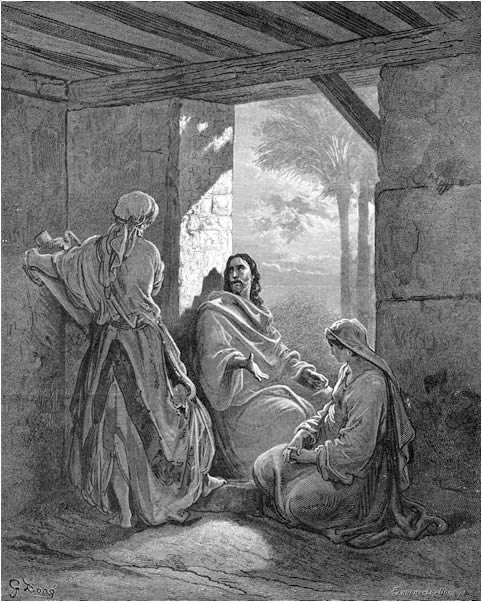
Christ's entertainment at Martha's house, the reproof he gave to her for her care about the world, and his commendation of Mary for her care about her soul,
The Nineteenth Century9 voices
Oh, no, he came "where he was," and finding that the man could do nothing whatever for his own assistance, the good Samaritan began with him, then and there, upon the spot, putting no impossible conditions to him, proposing no stipulations which the man could not perform—but doing everything for the man, and doing it for him as he was, and where he was. Beloved, we are all quite aware that a charity of which a man cannot avail himself, is no charity at all.
A commentator
Jamieson, Fausset & Brown1802–1910
Commentary Critical and Explanatory on the Whole Bible (1871)
Samaritan--one excommunicated by the Jews, a byword among them, synonymous with heretic and devil (Joh 8:48; see on Lu 17:18). had compassion--His best is mentioned first; for "He who gives outward things gives something external to himself, but he who imparts compassion and tears gives him something from his very self" [GREGORY THE GREAT, in TRENCH].
A commentator
J.C. Ryle1816–1900
Expository Thoughts on the Gospels: Luke (lightly modernized text, Grace Gems edition) (1858)
proposed
These words contain the well-known parable of the good Samaritan. In order to understand the drift of this parable, we must carefully remember the occasion on which it was spoken. It was spoken in reply to the question of a certain lawyer, who asked, "who is my neighbor?" Our Lord Jesus Christ answers that question by telling the story we have just read — and winds up the narrative by an appeal to the lawyer's conscience. Let these things not be forgotten. The object of the parable is to show the nature of true charity and brotherly love.
OUR text is the whole story of the Samaritan, but as that is very long, let us, for our memories' sake, consider the exhortation in the 37th verse to be our text. "Go, and do you likewise." There are certain persons in the world who will not allow the preacher to speak upon anything but those doctrinal statements concerning the way of salvation which are known as "the Gospel."
A commentator
J.C. Ryle1816–1900
Expository Thoughts on the Gospels: Luke (lightly modernized text, Grace Gems edition) (1858)
proposed
These words contain the well-known parable of the good Samaritan. In order to understand the drift of this parable, we must carefully remember the occasion on which it was spoken. It was spoken in reply to the question of a certain lawyer, who asked, "who is my neighbor?" Our Lord Jesus Christ answers that question by telling the story we have just read — and winds up the narrative by an appeal to the lawyer's conscience. Let these things not be forgotten. The object of the parable is to show the nature of true charity and brotherly love. To lose sight of this object, and search for deep allegories in the parable — is to trifle with Scripture, and deprive our souls of most valuable lessons. We are taught, first, in this parable — how rare and uncommon true brotherly love is. This is a lesson which stands out prominently on the face of the narrative before our eyes. Our Lord tells us of a traveler who fell among thieves, and was left naked, wounded, and half dead on the road. He then tells us of a priest and a Levite , who, one after the other, came traveling that way, and saw the poor wounded man — but gave him no help. Both were men, who from their religious office and profession, ought to have been ready and willing to do good to one in distress. But both, in succession, were too selfish, or too unfeeling to offer the slightest assistance. They doubtless reasoned with themselves — that they knew nothing of the wounded traveler — that he had perhaps got into trouble by his own misconduct — that they had no time to stop to help him — and that they had enough to do to mind their own business, without troubling themselves with strangers. And the result was, that one after the other — they both "passed by on the other side." We have in this striking description, an exact picture of what is continually going on in the world.
Oh, no, he came "where he was," and finding that the man could do nothing whatever for his own assistance, the good Samaritan began with him, then and there, upon the spot, putting no impossible conditions to him, proposing no stipulations which the man could not perform—but doing everything for the man, and doing it for him as he was, and where he was. Beloved, we are all quite aware that a charity of which a man cannot avail himself, is no charity at all. Go among the operatives of Lancashire and tell them that there is no necessity for any of them to starve, for on the top of Mount St. Bernard, there are hospitable monks who keep a refectory, where they relieve all passers-by. Tell them they have nothing to do but to journey to the top of the Alps and there they will find food enough. Poor souls! They feel that you mock them, for the distance is too great. Penetrate one of our back streets, climb up three pair of stairs into a wretched room, so dilapidated that the stars look between the tiles. See a poor young girl dying of consumption and poverty. Tell her, if you dare, "If you could get to the seaside, and if you could eat so much beef steak, you would no doubt recover." You are shamefully laughing at her—she cannot get these things. They are beyond her reach—she cannot journey to the seaside—she would die before she reached it. Like the wicked, your tender mercies are cruel. I have noticed this unavailing charity in hard winters. People give away bread and soup tickets to poor people who are to give sixpence and then receive soup and bread. And often I have had persons come to me—"Sir, I have a ticket. It would be worth a great deal to me, if I had sixpence to go with it to get the relief. But I have not a farthing in all the world, and I cannot make out the good of giving me this ticket at all." This is hardly charity.
OUR text is the whole story of the Samaritan, but as that is very long, let us, for our memories' sake, consider the exhortation in the 37th verse to be our text. "Go, and do you likewise." There are certain persons in the world who will not allow the preacher to speak upon anything but those doctrinal statements concerning the way of salvation which are known as "the Gospel." If the preacher shall insist upon some virtue or practical Grace, they straightway say that he is not preaching the Gospel, that he has become legal and is a mere moral teacher. We do not stand in any awe of such criticism, for we clearly perceive that our Lord Jesus Christ, Himself, would very frequently have come under it. Read the Sermon on the Mount and judge whether certain people would be content to hear the likes of it preached to them on the Sabbath. They would condemn it as containing very little Gospel and too much about good works. Our Lord was a great practical Preacher. He frequently delivered addresses in which He made answer to questioners, or gave direction to seekers, or upbraided offenders—and He gave a prominence to practical truth such as some of His ministers dare not imitate! Jesus tells us over and over again the manner in which we are to live towards our fellow men and He lays great stress upon the love which should shine throughout the Christian character. The story of the good Samaritan, which is now before us, is a case in point, for our Lord is explaining, there, a point which arose out of the question, "What shall I do to inherit eternal life?" The question is legal and the answer is to the point. But let it never be forgotten that what the Law demands of us, the Gospel produces in us. The Law tells us what we ought to be and it is one objective of the Gospel to raise us to that condition.
Samaritan is mentioned merely to show that he was a person from whom a Jew had no right to expect any help or relief, because of the enmity which subsisted between the two nations.
A commentator
Albert Barnes1798–1870
Notes, Explanatory and Practical, on the Old and New Testaments (1832-1869)
proposed
A certain Samaritan - The Samaritans were the most inveterate foes of the Jews. They had no dealings with each other. See the notes at Mat 10:
The words behind it
10 Greek wordsEvery Greek word of this verse in the order it stands, with what it means and the door to its own study. The last column counts the times a word stands in the whole Bible: the rarer the word, the more the places it appears belong together.
| Greek | Sound | Meaning | Word study | In the Bible |
|---|---|---|---|---|
| Σαμαρίτης | samarites | A Samaritan | G4541 → | 9 times |
| δέ | de | however | G1161 → | 2765 times |
| τις | tis | one | G5100 → | 528 times |
| ὁδεύων | hodeuon | journeying | G3593 → | |
| ἦλθεν | elthen | came | G2064 → | 628 times |
| κατ᾽ | kat᾽ | to | G2596 → | 468 times |
| αὐτόν, | auton | him, | G846 → | 5565 times |
| καὶ | kai | and | G2532 → | 9120 times |
| ἰδὼν | idon | having seen | G1492 → | 374 times |
| ἐσπλαγχνίσθη, | esplagchnisthe | was moved with compassion, | G4697 → | 12 times |
ΣαμαρίτηςA Samaritan
samaritesG4541 →9 times
δέhowever
deG1161 →2765 times
τιςone
tisG5100 →528 times
ὁδεύωνjourneying
hodeuonG3593 →
ἦλθενcame
elthenG2064 →628 times
κατ᾽to
kat᾽G2596 →468 times
αὐτόν,him,
autonG846 →5565 times
καὶand
kaiG2532 →9120 times
ἰδὼνhaving seen
idonG1492 →374 times
ἐσπλαγχνίσθη,was moved with compassion,
esplagchnistheG4697 →12 times
A shaded row is a word that stands 400 times or fewer in the Bible.
The walk
8 stopsEach card is a verse this one points to, and under it the verses that one points to in turn. Where several paths arrive at the same place, that place is listed first: the text keeps returning to it.
Through
Luke 7:13When the Lord saw her, He had compassion on her and said, “Do not weep.”
it leads to
- Isaiah 63:9
In all their distress, He too was afflicted, and the Angel of His Presence saved them. In His love and compassion He redeemed them; He lifted them up and carried them all the days…
- Psalms 103:13
As a father has compassion on his children, so the LORD has compassion on those who fear Him.
- Hebrews 4:15
For we do not have a high priest who is unable to sympathize with our weaknesses, but we have one who was tempted in every way that we are, yet was without sin.
- Lamentations 3:32–33
Even if He causes grief, He will show compassion according to His abundant loving devotion.
- Psalms 86:15
But You, O Lord, are a compassionate and gracious God, slow to anger, abounding in loving devotion and faithfulness.
- Isaiah 63:9
Through
Proverbs 27:10Do not forsake your friend or your father’s friend, and do not go to your brother’s house in the day of your calamity; better a neighbor nearby than a brother far away.
it leads to
- Proverbs 18:24
A man of many companions may come to ruin, but there is a friend who stays closer than a brother.
- Proverbs 18:24
Through
Matthew 18:33Shouldn’t you have had mercy on your fellow servant, just as I had on you?’
it leads to
- Colossians 3:13
Bear with one another and forgive any complaint you may have against someone else. Forgive as the Lord forgave you.
- Ephesians 4:32
Be kind and tenderhearted to one another, forgiving each other just as in Christ God forgave you.
- Colossians 3:13
Where this verse is studied
On this page
Studies11
About Luke
This page draws on 19 works. Open the list of works
This page draws on Adam Clarke, Commentary on the Bible; Albert Barnes, Notes, Explanatory and Practical, on the Old and New Testaments (1832-1869); Alexander Maclaren, Expositions of Holy Scripture, Luke; Ambrose of Milan, Commentary on Luke; Ambrose of Milan, Catena Aurea by Aquinas; Ancient Greek Expositor, Catena Aurea by Aquinas; Augustine of Hippo, Catena Aurea by Aquinas; Bede, On the Gospel of Luke; Bonaventure, Commentary on Luke, Chapter 10; Charles Spurgeon, The Metropolitan Tabernacle Pulpit, Sermon No. 473: “Good News For You” (lightly modernized text, CCEL edition); Charles Spurgeon, The Metropolitan Tabernacle Pulpit, Sermon No. 1360: “The Good Samaritan” (lightly modernized text, CCEL edition); J.C. Ryle, Expository Thoughts on the Gospels: Luke (lightly modernized text, Grace Gems edition); Jamieson, Fausset & Brown, Commentary Critical and Explanatory on the Whole Bible; John Gill, Exposition of the New Testament (1746-1748); Matthew Henry, Commentary on the Whole Bible; Origen of Alexandria, HOMILIES ON THE GOSPEL OF LUKE 34.3, 9; Pseudo-Augustine, Catena Aurea by Aquinas; Theophylact of Ohrid, Catena Aurea by Aquinas and Theophylact of Ohrid, Commentary on Luke.