
Luke 10:35
in Luke 10The next day he took out two denarii and gave them to the innkeeper. ‘Take care of him,’ he said, ‘and on my return I will repay you for any additional expense.’
BSB
The same verse in ASV and KJV ▾
ASV
And on the morrow he took out two shillings, and gave them to the host, and said, Take care of him; and whatsoever thou spendest more, I, when I come back again, will repay thee.
KJV
And on the morrow when he departed, he took out two pence, and gave them to the host, and said unto him, Take care of him; and whatsoever thou spendest more, when I come again, I will repay thee.
⋯
This verse in Luke 10
Commentary
25 notes on this verseBlessed is that innkeeper who can care for another's wounds. Blessed is he to whom Jesus says, "Whatever you shall spend over and above, I will repay you." A good steward is one who also spends over and above. Paul is a good steward, whose sermons and epistles overflow with the knowledge that he received. He followed the moderate command of the Lord with almost immoderate effort of mind and body, so that he raised many from deep sorrow by the stewardship of spiritual exhortation.
This site's exposition
a Samaritan on a journey came upon him
on Luke 10:33-35
When a Samaritan came upon him, he had compassion, splanchnizomai, the verb of 7:13 at Nain. The verb is now given to the one figure the lawyer's culture despised.
This site's exposition
two denarii
Augustine reads the two coins as the two commands of love. Theophylact notes the order: the wounds bound first, then care at the inn. The Samaritan pays in advance and promises more.
The record, by era
The Church Fathers5 voices
"The next day," what is this next day, if not that day of the Lord's resurrection, of which it was said, "This is the day which the Lord has made"? "He took out two coins, and gave them to the host, and said, 'Take care of him.' "
What are those two coins, unless perhaps the two Testaments that contain revealed within them the image of the eternal King, at the price of whose wounds we are healed? Precious blood redeemed us, that we may avoid the sores of final death.
But as the Samaritan had not time to stay longer on the earth, he must needs return to the place whence he descended, as it follows, And on the morrow he took out two pence, &c. (Ps. 118:24.) What is that morrow, but perchance the day of our Lord's resurrection? of which it was said, This is the day the Lord hath made. But the two pence are the two covenants, which bear stamped on them the image of the eternal King, by the price of which our wounds are healed.
Blessed then is that inn-keeper who is able to cure the wounds of another; blessed is he to whom Jesus says, Whatsoever thou hast spent more, when I come again I will repay thee. But when wilt thou return, O Lord, save on the Judgment day? For though Thou art ever every where, and though standing in the midst of us, art not perceived by us, yet the time will be in which all flesh shall behold Thee coming again. Thou wilt then restore what Thou owest to the blessed, whose debtor Thou art. Would that we were confident debtors, that we could pay what we had received!
Robbers left you half-dead on the road, but you have been found lying there by the passing and kindly Samaritan. Wine and oil have been poured on you. You have received the sacrament of the only-begotten Son. You have been lifted onto his mule. You have believed that Christ became flesh. You have been brought to the inn, and you are being cured in the church.That is where and why I am speaking. This is what I too, what all of us are doing. We are performing the duties of the innkeeper. He was told, "If you spend any more, I will pay you when I return." If only we spent at least as much as we have received! However much we spend, brothers and sisters, it is the Lord's money.
17 more voices on this verse
The Church Fathers4 voices
Wherefore we have need of the dew of God, that we be not consumed by fire, nor be rendered unfruitful, and that where we have an accuser there we may have also an Advocate, the Lord commending to the Holy Spirit His own man, who had fallen among thieves, whom He Himself compassionated, and bound up his wounds, giving two royal denaria; so that we, receiving by the Spirit the image and superscription of the Father and the Son, might cause the denarium entrusted to us to be fruitful, counting out the increase [thereof] to the Lord.
A commentator
Origen of AlexandriaHOMILIES ON THE GOSPEL OF LUKE 34.3, 9 · Written before 253.
proposed
One of the elders wanted to interpret the parable as follows. The man who was going down is Adam. Jerusalem is paradise, and Jericho is the world. The robbers are hostile powers. The priest is the law, the Levite is the prophets, and the Samaritan is Christ. The wounds are disobedience. The beast is the Lord's body. The pandochium (that is, the stable), which accepts all who wish to enter, is the church. The two denarii mean the Father and the Son. The manager of the stable is the head of the church, to whom its care has been entrusted. The fact that the Samaritan promises he will return represents the Savior's second coming.…The Samaritan, "who took pity on the man who had fallen among thieves," is truly a "guardian," and a closer neighbor than the Law and the Prophets. He showed that he was the man's neighbor more by deed than by word. According to the passage that says, "Be imitators of me, as I too am of Christ," it is possible for us to imitate Christ and to pity those who "have fallen among thieves." We can go to them, bind their wounds, pour in oil and wine, put them on our own animals, and bear their burdens. The Son of God encourages us to do things like this. He is speaking not so much to the teacher of the law as to us and to everyone when he says, "Go and do likewise." If we do, we will receive eternal life in Christ Jesus, to whom is glory and power for ages of ages. Amen.
Or the two pence seem to me to be the knowledge of the sacrament, in what manner the Father is in the Son, and the Son in the Father, which is given as a reward by the Angel to the Church that she may take more diligent care of the man entrusted to her whom in the shortness of the time He Himself had also cured. And it is promised that whatever she should spend on the cure of the half dead man, should be restored to her again, And whatsoever thou spendest more, when I come again I will repay thee.
(ubi sup.) Or the two pence are the two commandments of love, which the Apostles received from the Holy Spirit to preach to others; or the promise of the present life, and that which is to come. (ubi sup.) The inn-keeper was the Apostle, who spent more either in giving counsel, as he says, Now concerning virgins, I have no commandment of the Lord, yet I give my judgment; (1 Cor. 7:15.) or, in working even with his own hands, that he might not trouble any of the weak in the newness of the Gospel, (2 Thess. 3:8) though it was lawful for him to be fed from the Gospel. (1 Cor. 9:14.) Much more also did the Apostles spend, but those teachers also in their time have spent more who have interpreted both the Old and New Testament, for which they shall receive their reward.
The Medieval Church5 voices
Secondly, as regards mercy relieving destitution, he adds: And the next day he brought out two denarii and gave them to the innkeeper. He brought out a small sum of money, because perhaps he had but little, according to that passage of Tobit four: "As …
Christ applied nourishment, which is done through the teaching of the two testaments, which is understood in the offering of the two denarii that he gave to the innkeeper, that is, to the prelate, whose task it is to minister the teaching of Christ and …
And the next day he took out two denarii and gave them to the innkeeper, and said: Take care of him. The next day is after the Lord's resurrection. For even before, through the grace of his Gospel, he had enlightened those who sat in …
And whatever more you spend, I will repay you when I return. The innkeeper spends more than he received in the two denarii, when the Apostle says: Concerning virgins I have no commandment of the Lord, but I give my advice (1 Corinthians 7). And …
Note the precision with which it is said that he brought him to the inn and took care of him. Before he brought him to it, he only bound up his wounds. What does this mean? That when the Church was established and the inn …
The Puritans and the Awakening2 voices
And on the morrow when he departed,....
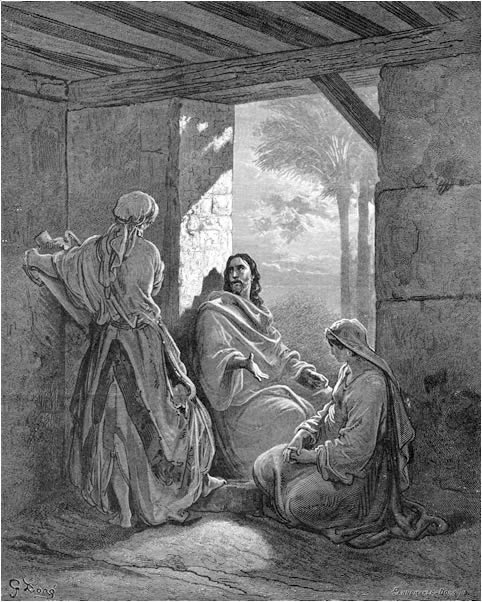
Christ's entertainment at Martha's house, the reproof he gave to her for her care about the world, and his commendation of Mary for her care about her soul,
The Nineteenth Century6 voices
A commentator
Albert Barnes1798–1870
Notes, Explanatory and Practical, on the Old and New Testaments (1832-1869)
Two pence - About 27 cents, or 1 shilling, 2d. This may seem a small sum, but we are to remember that that sum was probably ten times as valuable then as now - that is, that it would purchase ten times as much food and the common necessaries of life as the same sum would now. Besides, it is probable that all the man wanted was “attention” and kindness, and for all these it was the purpose of the Samaritan to pay when he returned. The host - The innkeeper.
A commentator
J.C. Ryle1816–1900
Expository Thoughts on the Gospels: Luke (lightly modernized text, Grace Gems edition) (1858)
proposed
These words contain the well-known parable of the good Samaritan. In order to understand the drift of this parable, we must carefully remember the occasion on which it was spoken. It was spoken in reply to the question of a certain lawyer, who asked, "who is my neighbor?" Our Lord Jesus Christ answers that question by telling the story we have just read — and winds up the narrative by an appeal to the lawyer's conscience. Let these things not be forgotten. The object of the parable is to show the nature of true charity and brotherly love.
OUR text is the whole story of the Samaritan, but as that is very long, let us, for our memories' sake, consider the exhortation in the 37th verse to be our text. "Go, and do you likewise." There are certain persons in the world who will not allow the preacher to speak upon anything but those doctrinal statements concerning the way of salvation which are known as "the Gospel."
A commentator
J.C. Ryle1816–1900
Expository Thoughts on the Gospels: Luke (lightly modernized text, Grace Gems edition) (1858)
proposed
These words contain the well-known parable of the good Samaritan. In order to understand the drift of this parable, we must carefully remember the occasion on which it was spoken. It was spoken in reply to the question of a certain lawyer, who asked, "who is my neighbor?" Our Lord Jesus Christ answers that question by telling the story we have just read — and winds up the narrative by an appeal to the lawyer's conscience. Let these things not be forgotten. The object of the parable is to show the nature of true charity and brotherly love. To lose sight of this object, and search for deep allegories in the parable — is to trifle with Scripture, and deprive our souls of most valuable lessons. We are taught, first, in this parable — how rare and uncommon true brotherly love is. This is a lesson which stands out prominently on the face of the narrative before our eyes. Our Lord tells us of a traveler who fell among thieves, and was left naked, wounded, and half dead on the road. He then tells us of a priest and a Levite , who, one after the other, came traveling that way, and saw the poor wounded man — but gave him no help. Both were men, who from their religious office and profession, ought to have been ready and willing to do good to one in distress. But both, in succession, were too selfish, or too unfeeling to offer the slightest assistance. They doubtless reasoned with themselves — that they knew nothing of the wounded traveler — that he had perhaps got into trouble by his own misconduct — that they had no time to stop to help him — and that they had enough to do to mind their own business, without troubling themselves with strangers. And the result was, that one after the other — they both "passed by on the other side." We have in this striking description, an exact picture of what is continually going on in the world.
OUR text is the whole story of the Samaritan, but as that is very long, let us, for our memories' sake, consider the exhortation in the 37th verse to be our text. "Go, and do you likewise." There are certain persons in the world who will not allow the preacher to speak upon anything but those doctrinal statements concerning the way of salvation which are known as "the Gospel." If the preacher shall insist upon some virtue or practical Grace, they straightway say that he is not preaching the Gospel, that he has become legal and is a mere moral teacher. We do not stand in any awe of such criticism, for we clearly perceive that our Lord Jesus Christ, Himself, would very frequently have come under it. Read the Sermon on the Mount and judge whether certain people would be content to hear the likes of it preached to them on the Sabbath. They would condemn it as containing very little Gospel and too much about good works. Our Lord was a great practical Preacher. He frequently delivered addresses in which He made answer to questioners, or gave direction to seekers, or upbraided offenders—and He gave a prominence to practical truth such as some of His ministers dare not imitate! Jesus tells us over and over again the manner in which we are to live towards our fellow men and He lays great stress upon the love which should shine throughout the Christian character. The story of the good Samaritan, which is now before us, is a case in point, for our Lord is explaining, there, a point which arose out of the question, "What shall I do to inherit eternal life?" The question is legal and the answer is to the point. But let it never be forgotten that what the Law demands of us, the Gospel produces in us. The Law tells us what we ought to be and it is one objective of the Gospel to raise us to that condition.
Two pence - Two denarii, about fifteen pence, English; and which, probably, were at that time of ten times more value there than so much is with us now.
The words behind it
26 Greek wordsEvery Greek word of this verse in the order it stands, with what it means and the door to its own study. The last column counts the times a word stands in the whole Bible: the rarer the word, the more the places it appears belong together.
| Greek | Sound | Meaning | Word study | In the Bible |
|---|---|---|---|---|
| καὶ | kai | And | G2532 → | 9120 times |
| ἐπὶ | epi | on | G1909 → | 883 times |
| τὴν | ten | the | G3588 → | 19766 times |
| αὔριον | aurion | next day | G839 → | 14 times |
| ἐκβαλὼν | ekbalon | having taken out | G1544 → | 79 times |
| ἔδωκεν | edoken | he gave [them] | G1325 → | 412 times |
| δύο | duo | two | G1417 → | 133 times |
| δηνάρια | denaria | denarii | G1220 → | 16 times |
| τῷ | to | to the | G3588 → | 19766 times |
| πανδοχεῖ | pandochei | innkeeper | G3830 → | |
| καὶ | kai | and | G2532 → | 9120 times |
| εἶπεν | eipen | said | G2036 → | 925 times |
| ἐπιμελήθητι | epimeletheti | do take care | G1959 → | |
| αὐτοῦ, | autou | of him, | G846 → | 5565 times |
| καὶ | kai | and | G2532 → | 9120 times |
| ὅ | ho | whatever | G3739 → | 1405 times |
| τι | ti | more | G5100 → | 528 times |
| ἂν | an | maybe | G302 → | 165 times |
| προσδαπανήσῃς, | prosdapaneses | you may expend, | G4325 → | |
| ἐγὼ | ego | I myself | G1473 → | 839 times |
| ἐν | en | on | G1722 → | 2738 times |
| τῷ | to | the | G3588 → | 19766 times |
| ἐπανέρχεσθαί | epanerchesthai | returning | G1880 → | |
| με | me | of me | G3165 → | 1936 times |
| ἀποδώσω | apodoso | will repay | G591 → | 48 times |
| σοι. | soi | you. | G4771 → | 2973 times |
καὶAnd
kaiG2532 →9120 times
ἐπὶon
epiG1909 →883 times
τὴνthe
tenG3588 →19766 times
αὔριονnext day
aurionG839 →14 times
ἐκβαλὼνhaving taken out
ekbalonG1544 →79 times
ἔδωκενhe gave [them]
edokenG1325 →412 times
δύοtwo
duoG1417 →133 times
δηνάριαdenarii
denariaG1220 →16 times
τῷto the
toG3588 →19766 times
πανδοχεῖinnkeeper
pandocheiG3830 →
καὶand
kaiG2532 →9120 times
εἶπενsaid
eipenG2036 →925 times
ἐπιμελήθητιdo take care
epimelethetiG1959 →
αὐτοῦ,of him,
autouG846 →5565 times
καὶand
kaiG2532 →9120 times
ὅwhatever
hoG3739 →1405 times
τιmore
tiG5100 →528 times
ἂνmaybe
anG302 →165 times
προσδαπανήσῃς,you may expend,
prosdapanesesG4325 →
ἐγὼI myself
egoG1473 →839 times
ἐνon
enG1722 →2738 times
τῷthe
toG3588 →19766 times
ἐπανέρχεσθαίreturning
epanerchesthaiG1880 →
μεof me
meG3165 →1936 times
ἀποδώσωwill repay
apodosoG591 →48 times
σοι.you.
soiG4771 →2973 times
A shaded row is a word that stands 400 times or fewer in the Bible.
The walk
8 stopsEach card is a verse this one points to, and under it the verses that one points to in turn. Where several paths arrive at the same place, that place is listed first: the text keeps returning to it.
Through
Proverbs 19:17Kindness to the poor is a loan to the LORD, and He will repay the lender.
it leads to
- Proverbs 28:27
Whoever gives to the poor will not be in need, but he who hides his eyes will receive many curses.
- Hebrews 6:10
For God is not unjust. He will not forget your work and the love you have shown for His name as you have ministered to the saints and continue to do so.
- Luke 6:38
Give, and it will be given to you. A good measure, pressed down, shaken together, and running over will be poured into your lap. For with the measure you use, it will be measured…
- 2 Corinthians 9:6–8
Remember this: Whoever sows sparingly will also reap sparingly, and whoever sows generously will also reap generously.
- Matthew 25:40
And the King will reply, ‘Truly I tell you, whatever you did for one of the least of these brothers of Mine, you did for Me.’
- Proverbs 28:27
Through
Luke 14:13But when you host a banquet, invite the poor, the crippled, the lame, and the blind,
it leads to
- Luke 14:21
The servant returned and reported all this to his master. Then the owner of the house became angry and said to his servant, ‘Go out quickly into the streets and alleys of the city,…
- Isaiah 58:10
and if you give yourself to the hungry and satisfy the afflicted soul, then your light will go forth in the darkness, and your night will be like noonday.
- Proverbs 14:31
Whoever oppresses the poor taunts their Maker, but whoever is kind to the needy honors Him.
- Luke 14:21
Where this verse is studied
On this page
Studies20
On this verse
On this chapter
About Luke
This page draws on 17 works. Open the list of works
This page draws on Adam Clarke, Commentary on the Bible; Albert Barnes, Notes, Explanatory and Practical, on the Old and New Testaments (1832-1869); Alexander Maclaren, Expositions of Holy Scripture, Luke; Ambrose of Milan, Commentary on Luke; Ambrose of Milan, Catena Aurea by Aquinas; Augustine of Hippo, Catena Aurea by Aquinas; Augustine of Hippo, SERMON 179A.7-8; Bede, On the Gospel of Luke; Bonaventure, Commentary on Luke, Chapter 10; Charles Spurgeon, The Metropolitan Tabernacle Pulpit, Sermon No. 1360: “The Good Samaritan” (lightly modernized text, CCEL edition); Irenaeus, Against Heresies Book III; J.C. Ryle, Expository Thoughts on the Gospels: Luke (lightly modernized text, Grace Gems edition); John Gill, Exposition of the New Testament (1746-1748); Matthew Henry, Commentary on the Whole Bible; Origen of Alexandria, HOMILIES ON THE GOSPEL OF LUKE 34.3, 9; Origen of Alexandria, Catena Aurea by Aquinas and Theophylact of Ohrid, Commentary on Luke.