
Luke 10:32
in Luke 10So too, when a Levite came to that spot and saw him, he passed by on the other side.
BSB
The same verse in ASV and KJV ▾
ASV
And in like manner a Levite also, when he came to the place, and saw him, passed by on the other side.
KJV
And likewise a Levite, when he was at the place, came and looked on him, and passed by on the other side.
⋯
This verse in Luke 10
Commentary
17 notes on this verseA commentator
Albert Barnes1798–1870
Notes, Explanatory and Practical, on the Old and New Testaments (1832-1869)
A Levite - The Levites, as well as the priests, were of the tribe of Levi, and were set apart to the duties of religion. The special duty of the priest was “to offer sacrifice” at the temple; to present incense; to conduct the morning and evening services of the temple, etc. The office or duty of the “Levites” was to render assistance to the priests in their services. In the journey of the Israelites through the wilderness, it was their duty to transport the various parts of the tabernacle and the sacred utensils.
This site's exposition
A man was going down from Jerusalem to Jericho
on Luke 10:30-32
A man going down from Jerusalem to Jericho fell into the hands of robbers on the dangerous desert road. A priest and a Levite, bound by the law just summarized, each passed by on the other side. Corpse defilement barred a priest from temple service, yet the man still lived.
This site's exposition
a Levite came to that spot
Augustine reads the priest and the Levite as the times of the Law and the Prophets. Theophylact says both wished to set people right and were unable. The Levite sees and passes as the priest did.
The record, by era
The Church Fathers3 voices
A commentator
Origen of AlexandriaHOMILIES ON THE GOSPEL OF LUKE 34.3, 9 · Written before 253.
proposed
One of the elders wanted to interpret the parable as follows. The man who was going down is Adam. Jerusalem is paradise, and Jericho is the world. The robbers are hostile powers. The priest is the law, the Levite is the prophets, and the Samaritan is Christ. The wounds are disobedience. The beast is the Lord's body. The pandochium (that is, the stable), which accepts all who wish to enter, is the church. The two denarii mean the Father and the Son. The manager of the stable is the head of the church, to whom its care has been entrusted. The fact that the Samaritan promises he will return represents the Savior's second coming.…The Samaritan, "who took pity on the man who had fallen among thieves," is truly a "guardian," and a closer neighbor than the Law and the Prophets. He showed that he was the man's neighbor more by deed than by word. According to the passage that says, "Be imitators of me, as I too am of Christ," it is possible for us to imitate Christ and to pity those who "have fallen among thieves." We can go to them, bind their wounds, pour in oil and wine, put them on our own animals, and bear their burdens. The Son of God encourages us to do things like this. He is speaking not so much to the teacher of the law as to us and to everyone when he says, "Go and do likewise." If we do, we will receive eternal life in Christ Jesus, to whom is glory and power for ages of ages. Amen.
(ubi sup.) Here then was man (that is, Adam) lying destitute of the aid of salvation, pierced with the wounds of his sins, whom neither Aaron the high priest passing by could advantage by his sacrifice; for it follows, And by chance there came down a certain priest that way, and when he saw him, he passed by on the other side. Nor again could his brother Moses the Levite assist him by the Law, as it follows, And likewise a Levite, when he was at the place, came and looked on him, and passed by on the other side.
(de q. Ev. l. ii. q. 19.) Or by the Priest and the Levite, two times are represented, namely, of the Law and the Prophets. By the Priest the Law is signified, by which the priesthood and sacrifices were appointed; by the Levites the prophecies of the Prophets, in whose times the law of mankind could not heal, because by the Law came the knowledge not the doing away of sin. (Serm. 171.) Or it is said, passed by, because the man who came down from Jerusalem to Jericho is believed to have been an Israelite, and the priest who came down, certainly his neighbour by birth, passed him by lying on the ground. And a Levite also came by, likewise his neighbour by birth; and he also despised him as he lay.
The Medieval Church2 voices
But He says, passed by, (Rom. 3:20; 8:3.) because the Law came and stood till its time foreordained, then, not being able to cure, departed. Mark also that the Law was not given with this previous intention that it should cure man, for man could not from the beginning receive the mystery of Christ. And therefore it is said, And by chance there came a certain priest, which expression we use with respect to those things which happen without forethought. They pitied him, I say, when they thought about him, but afterwards, overcome by selfishness, they went away again. For this is signified by the word, passed him by.
The person moreover passing by with hardness was legal justice, which bestowed neither mercy nor medicine. This was well signified in Exodus 17, where it is said that "the hands of Moses were heavy"; whence in the Gloss of Bede: "The priest announces the law …
9 more voices on this verse
The Medieval Church2 voices
Second, as regards the inferior person, he adds: Likewise also a Levite, when he was near the place and saw him, passed by: and this one was not heeding that passage of Ecclesiasticus 7: "Do not fail those who weep in consolation, and walk with …
By the priest and the Levite, understand, perhaps, the Law and the prophets. For they desired to justify man, but could not. "It is impossible," says the Apostle Paul, "that the blood of bulls and goats should take away sins" (Heb. 10:4). They took pity …
The Puritans and the Awakening3 voices
It is sad when those who should be examples of charity are prodigies of cruelty, and when those who should by displaying the mercies of God, open the bowels of compassion in others, shut up their own. [3.] How he was succoured and relieved by a stranger, a certain Samaritan, of that nation which of all others the Jews most despised and detested and would have no dealings with.
And likewise a Levite, when he was at the place,....
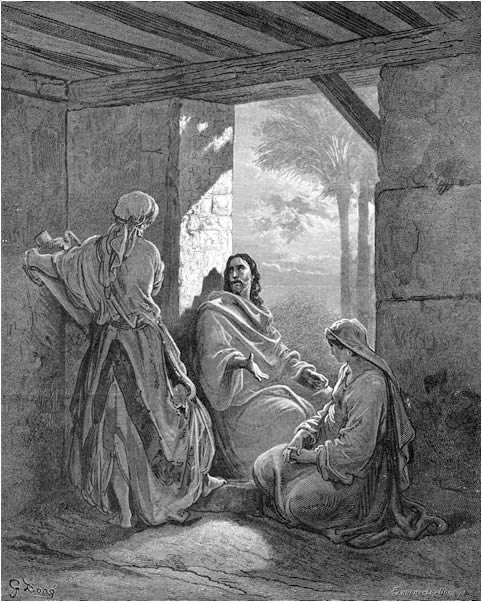
Christ's entertainment at Martha's house, the reproof he gave to her for her care about the world, and his commendation of Mary for her care about her soul,
The Nineteenth Century4 voices
A commentator
J.C. Ryle1816–1900
Expository Thoughts on the Gospels: Luke (lightly modernized text, Grace Gems edition) (1858)
proposed
These words contain the well-known parable of the good Samaritan. In order to understand the drift of this parable, we must carefully remember the occasion on which it was spoken. It was spoken in reply to the question of a certain lawyer, who asked, "who is my neighbor?" Our Lord Jesus Christ answers that question by telling the story we have just read — and winds up the narrative by an appeal to the lawyer's conscience. Let these things not be forgotten. The object of the parable is to show the nature of true charity and brotherly love.
OUR text is the whole story of the Samaritan, but as that is very long, let us, for our memories' sake, consider the exhortation in the 37th verse to be our text. "Go, and do you likewise." There are certain persons in the world who will not allow the preacher to speak upon anything but those doctrinal statements concerning the way of salvation which are known as "the Gospel."
A commentator
J.C. Ryle1816–1900
Expository Thoughts on the Gospels: Luke (lightly modernized text, Grace Gems edition) (1858)
proposed
These words contain the well-known parable of the good Samaritan. In order to understand the drift of this parable, we must carefully remember the occasion on which it was spoken. It was spoken in reply to the question of a certain lawyer, who asked, "who is my neighbor?" Our Lord Jesus Christ answers that question by telling the story we have just read — and winds up the narrative by an appeal to the lawyer's conscience. Let these things not be forgotten. The object of the parable is to show the nature of true charity and brotherly love. To lose sight of this object, and search for deep allegories in the parable — is to trifle with Scripture, and deprive our souls of most valuable lessons. We are taught, first, in this parable — how rare and uncommon true brotherly love is. This is a lesson which stands out prominently on the face of the narrative before our eyes. Our Lord tells us of a traveler who fell among thieves, and was left naked, wounded, and half dead on the road. He then tells us of a priest and a Levite , who, one after the other, came traveling that way, and saw the poor wounded man — but gave him no help. Both were men, who from their religious office and profession, ought to have been ready and willing to do good to one in distress. But both, in succession, were too selfish, or too unfeeling to offer the slightest assistance. They doubtless reasoned with themselves — that they knew nothing of the wounded traveler — that he had perhaps got into trouble by his own misconduct — that they had no time to stop to help him — and that they had enough to do to mind their own business, without troubling themselves with strangers. And the result was, that one after the other — they both "passed by on the other side." We have in this striking description, an exact picture of what is continually going on in the world.
OUR text is the whole story of the Samaritan, but as that is very long, let us, for our memories' sake, consider the exhortation in the 37th verse to be our text. "Go, and do you likewise." There are certain persons in the world who will not allow the preacher to speak upon anything but those doctrinal statements concerning the way of salvation which are known as "the Gospel." If the preacher shall insist upon some virtue or practical Grace, they straightway say that he is not preaching the Gospel, that he has become legal and is a mere moral teacher. We do not stand in any awe of such criticism, for we clearly perceive that our Lord Jesus Christ, Himself, would very frequently have come under it. Read the Sermon on the Mount and judge whether certain people would be content to hear the likes of it preached to them on the Sabbath. They would condemn it as containing very little Gospel and too much about good works. Our Lord was a great practical Preacher. He frequently delivered addresses in which He made answer to questioners, or gave direction to seekers, or upbraided offenders—and He gave a prominence to practical truth such as some of His ministers dare not imitate! Jesus tells us over and over again the manner in which we are to live towards our fellow men and He lays great stress upon the love which should shine throughout the Christian character. The story of the good Samaritan, which is now before us, is a case in point, for our Lord is explaining, there, a point which arose out of the question, "What shall I do to inherit eternal life?" The question is legal and the answer is to the point. But let it never be forgotten that what the Law demands of us, the Gospel produces in us. The Law tells us what we ought to be and it is one objective of the Gospel to raise us to that condition.
The words behind it
12 Greek wordsEvery Greek word of this verse in the order it stands, with what it means and the door to its own study. The last column counts the times a word stands in the whole Bible: the rarer the word, the more the places it appears belong together.
| Greek | Sound | Meaning | Word study | In the Bible |
|---|---|---|---|---|
| ὁμοίως | homoios | Likewise | G3668 → | 30 times |
| δὲ | de | now | G1161 → | 2765 times |
| καὶ | kai | also | G2532 → | 9120 times |
| Λευίτης | leuites | a Levite | G3019 → | |
| γενόμενος | genomenos | having come | G1096 → | 667 times |
| κατὰ | kata | to | G2596 → | 468 times |
| τὸν | ton | the | G3588 → | 19766 times |
| τόπον | topon | spot | G5117 → | 94 times |
| ἐλθὼν | elthon | having come | G2064 → | 628 times |
| καὶ | kai | and | G2532 → | 9120 times |
| ἰδὼν | idon | having seen [him] | G1492 → | 374 times |
| ἀντιπαρῆλθεν. | antiparelthen | passed by opposite. | G492 → |
ὁμοίωςLikewise
homoiosG3668 →30 times
δὲnow
deG1161 →2765 times
καὶalso
kaiG2532 →9120 times
Λευίτηςa Levite
leuitesG3019 →
γενόμενοςhaving come
genomenosG1096 →667 times
κατὰto
kataG2596 →468 times
τὸνthe
tonG3588 →19766 times
τόπονspot
toponG5117 →94 times
ἐλθὼνhaving come
elthonG2064 →628 times
καὶand
kaiG2532 →9120 times
ἰδὼνhaving seen [him]
idonG1492 →374 times
ἀντιπαρῆλθεν.passed by opposite.
antiparelthenG492 →
A shaded row is a word that stands 400 times or fewer in the Bible.
The walk
8 stopsEach card is a verse this one points to, and under it the verses that one points to in turn. Where several paths arrive at the same place, that place is listed first: the text keeps returning to it.
Through
2 Timothy 3:2For men will be lovers of themselves, lovers of money, boastful, arrogant, abusive, disobedient to their parents, ungrateful, unholy,
it leads to
- Romans 1:29–31
They have become filled with every kind of wickedness, evil, greed, and depravity. They are full of envy, murder, strife, deceit, and malice. They are gossips,
- Philippians 2:21
For all the others look after their own interests, not those of Jesus Christ.
- Jude 1:16
These men are discontented grumblers, following after their own lusts; their mouths spew arrogance; they flatter others for their own advantage.
- Psalms 10:3
For the wicked man boasts in the cravings of his heart; he blesses the greedy and reviles the LORD.
- 2 Timothy 3:4
traitorous, reckless, conceited, lovers of pleasure rather than lovers of God,
- Romans 1:29–31
Through
Proverbs 27:10Do not forsake your friend or your father’s friend, and do not go to your brother’s house in the day of your calamity; better a neighbor nearby than a brother far away.
it leads to
- Proverbs 18:24
A man of many companions may come to ruin, but there is a friend who stays closer than a brother.
- Proverbs 17:17
A friend loves at all times, and a brother is born for adversity.
- Proverbs 18:24
Through
Psalms 109:25I am an object of scorn to my accusers; when they see me, they shake their heads.
it leads to
- Psalms 22:6–7
But I am a worm and not a man, scorned by men and despised by the people.
- Psalms 22:6–7
Where this verse is studied
On this page
Studies11
About Luke
This page draws on 12 works. Open the list of works
This page draws on Albert Barnes, Notes, Explanatory and Practical, on the Old and New Testaments (1832-1869); Augustine of Hippo, Catena Aurea by Aquinas; Bonaventure, Commentary on Luke, Chapter 10; Charles Spurgeon, The Metropolitan Tabernacle Pulpit, Sermon No. 1360: “The Good Samaritan” (lightly modernized text, CCEL edition); J.C. Ryle, Expository Thoughts on the Gospels: Luke (lightly modernized text, Grace Gems edition); Jamieson, Fausset & Brown, Commentary Critical and Explanatory on the Whole Bible; John Chrysostom, Catena Aurea by Aquinas; John Gill, Exposition of the New Testament (1746-1748); Matthew Henry, Commentary on the Whole Bible; Origen of Alexandria, HOMILIES ON THE GOSPEL OF LUKE 34.3, 9; Theophylact of Ohrid, Commentary on Luke and Theophylact of Ohrid, Catena Aurea by Aquinas.