
Luke 10:39
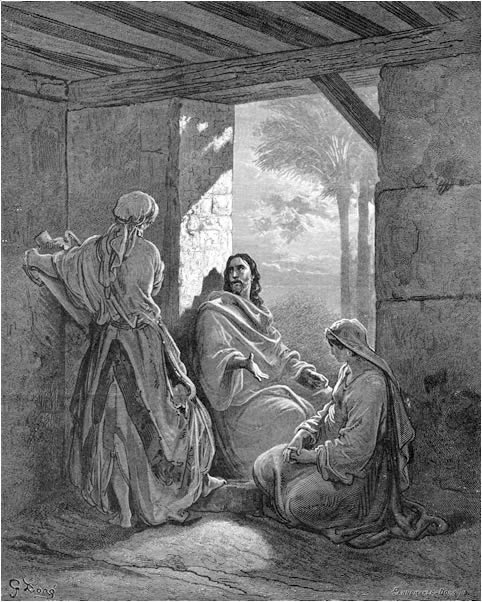
in Luke 10She had a sister named Mary, who sat at the Lord’s feet listening to His message.
BSB
The same verse in ASV and KJV ▾
ASV
And she had a sister called Mary, who also sat at the Lord’s feet, and heard his word.
KJV
And she had a sister called Mary, which also sat at Jesus’ feet, and heard his word.
⋯
This verse in Luke 10
Commentary
22 notes on this verse(6. Mor. c. 18.) Or by Mary who sat and heard our Lord's words, is signified the contemplative life; by Martha engaged in more outward services, the active life. Now Martha's care is not blamed, but Mary is praised, for great are the rewards of an active life, but those of a contemplative are far better. Hence Mary's part it is said will never be taken away from her, for the works of an active life pass away with the body, but the joys of the contemplative life the rather begin to increase from the end.
This site's exposition
a woman named Martha welcomed Him into her home
on Luke 10:38-39
A woman named Martha welcomed Him into her home, the household John places at Bethany. Her sister Mary sat at the Lord’s feet, the posture of a disciple before a rabbi, a place then held by men.
This site's exposition
sat at the Lord’s feet listening to His message
Augustine contrasts Martha preparing food for the Lord with Mary choosing to be fed by Him. Theophylact reads sitting at the feet as being firmly settled in active virtue. Mary listens.
The record, by era
The Church Fathers5 voices
Mary came and sat at his feet. This was as though she were sitting on firm ground at the feet of him who had forgiven the sinful woman her sins. She had put on a crown in order to enter into the kingdom of the …
To cling always to God and to the things of God—this must be our major effort, this must be the road that the heart follows unswervingly. Any diversion, however impressive, must be regarded as secondary, low-grade and certainly dangerous. Martha and Mary provide a most beautiful scriptural paradigm of this outlook and of this mode of activity. In looking after the Lord and his disciples, Martha did a very holy service. Mary, however, was intent on the spiritual teaching of Jesus, and she stayed by his feet, which she kissed and anointed with the oil of her good faith.… In saying "Mary chose the good portion," he was saying nothing about Martha, and in no way was he giving the appearance of criticizing her. Still, by praising Mary he was saying that the other was a step below her. Again, by saying "it will not be taken away from her," he was showing that Martha's role could be taken away from her, since the service of the body can only last as long as the human being is there, whereas the zeal of Mary can never end.
It is not said of Mary simply that she sat near Jesus, but at His feet, to show her diligence, stedfastness, and zeal, in hearing, and the great reverence which she had for our Lord.
Martha then, setting about and preparing to feed our Lord, was occupied in serving; but Mary her sister chose rather to be fed by the Lord, for it follows, And she had a sister called Mary, which also sat at Jesus' feet, and heard his word. (ubi sup.) Now as was her humility in sitting at His feet, so much the more did she receive from Him. For the waters pour down to the lowest part of the valley, but flow away from the rising of the hill.
What was Mary enjoying while she was listening? What was she eating? What was she drinking? Do you know? Let's ask the Lord, who keeps such a splendid table for his own people, let's ask him. "Blessed," he says, "are those who are hungry and thirsty for justice, because they shall be satisfied." It was from this wellspring, from this storehouse of justice, that Mary, seated at the Lord's feet, was in her hunger receiving some crumbs. You see, the Lord was giving her then as much as she was able to take. But as for the whole amount, which he was going to give at his table of the future, not even the disciples, not even the apostles themselves, were able to take in at the time when he said to them, "I still have many things to say to you, but you are unable to hear them now." ...What was Mary enjoying? What was she eating? I'm persistent on this point, because I'm enjoying it too. I will venture to say that she was eating the one she was listening to. I mean, if she was eating truth, didn't he say himself, "I am the truth"? What more can I say? He was being eaten, because he was the Bread. "I," he said, "am the bread who came down from heaven." This is the bread which nourishes and never diminishes.
14 more voices on this verse
The Medieval Church3 voices
"Sat at Jesus' feet and listened to His word." By the feet one can understand active virtue, for they signify movement and walking. And sitting is a sign of immobility. So whoever sits at the feet of Jesus, that is, whoever becomes firmly established in …
Second, with regard to the leisure of the contemplative life, he adds: And she had a sister, named Mary, who was perfect in the leisure of contemplation; whence it is added: Who also, sitting at the feet of the Lord, heard his word. This indeed …
And she also, sitting beside the feet of the Lord, listened to His word, but Martha was distracted by frequent ministering. No one doubts that these things suit both lives. And the uniform perfection of the contemplative life is indeed to have a mind stripped …
The Puritans and the Awakening2 voices
And she had a sister called Mary,....
They were seventy elders of the Jews that were employed by Ptolemy king of Egypt in turning the Old Testament into Greek, whose translation is thence called the Septuagint. The great sanhedrim consisted of this number. We are glad to find that Christ had so many followers fit to be sent forth; his labour was not altogether in vain, though he met with much opposition.
The Nineteenth Century8 voices
A commentator
Albert Barnes1798–1870
Notes, Explanatory and Practical, on the Old and New Testaments (1832-1869)
Sat at Jesus’ feet - This was the ancient posture of disciples or learners. They sat at the “feet” of their teachers - that is, beneath them, in a humble place. Hence, Paul is represented as having been brought up at the “feet” of Gamaliel, Act 22:3. When it is said that Mary sat at Jesus’ feet, it means that she was “a disciple” of his; that she listened attentively to his instructions, and was anxious to learn his doctrine.
IT is not an easy thing to maintain the balance of our spiritual life. No man can be spiritually healthy who does not meditate and commune. No man, on the other hand, is as he should be unless he is active and diligent in holy service. David sweetly sang, "He makes me to lie down in green pastures." There was the contemplative. "He leads me beside the still waters." There was the active and progressive. The difficulty is to maintain the two—and to keep each in its relative proportion to the other.
A commentator
Charles Spurgeon1834–1892
The Metropolitan Tabernacle Pulpit, Sermon No. 2927: “Love at Leisure” (lightly modernized text, CCEL edition) · Written before 1892.
MARY was full of a love to Christ which could be very active and self-sacrificing. I have read to you of her pouring the precious box of spikenard upon our Lord for His anointing. She was, therefore, one who not only waited and listened, but she served the Lord after her sort and fashion. If she had been simply contemplative and nothing more, we might, perhaps, have considered her somewhat of a one-sided character—and while pointing to that which was good in her as an example, we might have had to comment on her deficiencies.
A commentator
J.C. Ryle1816–1900
Expository Thoughts on the Gospels: Luke (lightly modernized text, Grace Gems edition) (1858)
proposed
The little history which these verses contain, is only recorded in the Gospel of Luke. So long as the world stands, the story of Mary and Martha will furnish the Church with lessons of wisdom which ought never to be forgotten. Taken together with the eleventh chapter of John's Gospel, it throws a most instructive light on the inner life of the family which Jesus loved. Let us observe, for one thing — how different the characters and personalities of true Christians may be. The two sisters of whom we read in this passage were faithful disciples. Both had believed.
A commentator
J.C. Ryle1816–1900
Expository Thoughts on the Gospels: Luke (lightly modernized text, Grace Gems edition) (1858)
proposed
The little history which these verses contain, is only recorded in the Gospel of Luke. So long as the world stands, the story of Mary and Martha will furnish the Church with lessons of wisdom which ought never to be forgotten. Taken together with the eleventh chapter of John's Gospel, it throws a most instructive light on the inner life of the family which Jesus loved. Let us observe, for one thing — how different the characters and personalities of true Christians may be. The two sisters of whom we read in this passage were faithful disciples. Both had believed. Both had been converted. Both had honored Christ when few gave Him honor. Both loved Jesus — and Jesus loved both of them. Yet they were evidently women of very different turn of mind. Martha was active, stirring, and impulsive, feeling strongly — and speaking out all she felt. Mary was quiet, still, and contemplative, feeling deeply — but saying less than she felt. Martha, when Jesus came to her house, rejoiced to see Him — and busied herself with preparing a suitable refreshment. Mary, also, rejoiced to see Him — but her first thought was to sit at His feet and hear His Word. Grace reigned in both hearts — but each showed the effects of grace at different times, and in different ways. We shall find it very useful to ourselves to remember this lesson. We must not expect all believers in Christ to be exactly like one another. We must not set down others as having no grace — because their experience does not entirely tally with our own. The sheep in the Lord's flock have each their own peculiarities. The trees in the Lord's garden are not all precisely alike. All true servants of God agree in the principal things of religion. All are led by one Spirit. All feel their sins — and all trust in Christ. All repent, all believe — and all are holy.
IT is not an easy thing to maintain the balance of our spiritual life. No man can be spiritually healthy who does not meditate and commune. No man, on the other hand, is as he should be unless he is active and diligent in holy service. David sweetly sang, "He makes me to lie down in green pastures." There was the contemplative. "He leads me beside the still waters." There was the active and progressive. The difficulty is to maintain the two—and to keep each in its relative proportion to the other. We must not be so active as to neglect communion, nor so contemplative as to become unpractical. In the chapter from which our text is taken we have several lessons on this subject. The seventy disciples returned from their preaching tour flushed with the joy of success. And our Savior, to refine that joy and prevent its degenerating into pride, bids them rather rejoice that their names were written in Heaven. He conducted their contemplations to the glorious doctrine of election, that grateful thoughts might sober them after successful work. He bids them consider themselves as debtors to Divine Grace, which reveals unto babes the mysteries of God—for He would not allow their new position as workers to make them forget that they were the chosen of God—and therefore debtors. Our wise Master next returns to the subject of service, and instructs them by the memorable parable of the good Samaritan and the wounded man. And then as if they might vainly imagine philanthropy, as it is the service of Christ, to be the only service of Christ, and to be the only thing worth living for, He brings in the two sisters of Bethany. The Holy Spirit meant thereby to teach us that while we ought to abound in service, and to do good abundantly to our fellow men, yet we must not fail in worship, in spiritual reverence, in meek discipleship, and quiet contemplation.
A commentator
Charles Spurgeon1834–1892
The Metropolitan Tabernacle Pulpit, Sermon No. 2927: “Love at Leisure” (lightly modernized text, CCEL edition) · Written before 1892.
proposed
MARY was full of a love to Christ which could be very active and self-sacrificing. I have read to you of her pouring the precious box of spikenard upon our Lord for His anointing. She was, therefore, one who not only waited and listened, but she served the Lord after her sort and fashion. If she had been simply contemplative and nothing more, we might, perhaps, have considered her somewhat of a one-sided character—and while pointing to that which was good in her as an example, we might have had to comment on her deficiencies. But she did more than sit at the Master's feet. Beloved, if we ever serve the Lord as Mary did, we shall do well. Now, since she was able thus to serve, she becomes a safe example for us in this other matter of restful faith. The portion of her life occupied in sitting at her Master's feet may instruct and help us. I feel I can safely hold her up to you as an example in all respects and the more so because of the particular incident just now before us where she received the Master's express commendation. He also praised her for bringing the box of ointment but, on this occasion, He praised her, too, saying that she had chosen the good part which should not be taken from her. He could not have more conspicuously set His seal of approval on her conduct than He did. I am not going to say much about her, but I want to speak to those of you who love the Lord as Mary did, to try if I cannot entice you for your own rest and for your own encouragement into following her example in this particular incident, namely, that of sitting at the feet of the Lord Jesus Christ. I have already said you can see that the example is only part of her life—one side of it. At another time I may take the other side and exhort you to also follow her in that, but for this next hour or so, I want you to leave out the other side of her character and stick only to this.
Sat at Jesus’ feet - This was the posture of the Jewish scholars, while listening to the instructions of the rabbins. It is in this sense that St. Paul says he was brought up at the Feet of Gamaliel, Act 22:3.
Modern Voices1 voice
A commentator
GK ChestertonThe Everlasting Man, Part 2 Ch. 2: The Riddles of the Gospel (1925) (1925)
proposed
Something of the same thing may be said about the incident of Martha and Mary; which has been interpreted in retrospect and from the inside by the mystics of the Christian contemplative life. But it was not at all an obvious view of it; and …
The words behind it
18 Greek wordsEvery Greek word of this verse in the order it stands, with what it means and the door to its own study. The last column counts the times a word stands in the whole Bible: the rarer the word, the more the places it appears belong together.
| Greek | Sound | Meaning | Word study | In the Bible |
|---|---|---|---|---|
| καὶ | kai | And | G2532 → | 9120 times |
| τῇδε | teade | she | G3592 → | |
| ἦν | en | was | G1510 → | 2333 times |
| ἀδελφὴ | adelphe | a sister | G79 → | 26 times |
| καλουμένη | kaloumene | being called | G2564 → | 147 times |
| Μαριάμ. | mariam | Mary. | G3137 → | 53 times |
| ἣ | he | She | G3739 → | 1405 times |
| καὶ | kai | also | G2532 → | 9120 times |
| παρακαθεσθεῖσα | parakathestheisa | having sat down | G3869 → | |
| πρὸς | pros | at | G4314 → | 700 times |
| τοὺς | tous | the | G3588 → | 19766 times |
| πόδας | podas | feet | G4228 → | 93 times |
| τοῦ | tou | of the | G3588 → | 19766 times |
| κυρίου | kuriou | Lord | G2962 → | 711 times |
| ἤκουεν | ekouen | was listening to | G191 → | 425 times |
| τὸν | ton | the | G3588 → | 19766 times |
| λόγον | logon | word | G3056 → | 329 times |
| αὐτοῦ. | autou | of Him. | G846 → | 5565 times |
καὶAnd
kaiG2532 →9120 times
τῇδεshe
teadeG3592 →
ἦνwas
enG1510 →2333 times
ἀδελφὴa sister
adelpheG79 →26 times
καλουμένηbeing called
kaloumeneG2564 →147 times
Μαριάμ.Mary.
mariamG3137 →53 times
ἣShe
heG3739 →1405 times
καὶalso
kaiG2532 →9120 times
παρακαθεσθεῖσαhaving sat down
parakathestheisaG3869 →
πρὸςat
prosG4314 →700 times
τοὺςthe
tousG3588 →19766 times
πόδαςfeet
podasG4228 →93 times
τοῦof the
touG3588 →19766 times
κυρίουLord
kuriouG2962 →711 times
ἤκουενwas listening to
ekouenG191 →425 times
τὸνthe
tonG3588 →19766 times
λόγονword
logonG3056 →329 times
αὐτοῦ.of Him.
autouG846 →5565 times
A shaded row is a word that stands 400 times or fewer in the Bible.
The walk
8 stopsEach card is a verse this one points to, and under it the verses that one points to in turn. Where several paths arrive at the same place, that place is listed first: the text keeps returning to it.
Through
Proverbs 8:34Blessed is the man who listens to me, watching daily at my doors, waiting at the posts of my doorway.
it leads to
- Luke 11:28
But He replied, “Blessed rather are those who hear the word of God and obey it.”
- Matthew 7:24
Therefore everyone who hears these words of Mine and acts on them is like a wise man who built his house on the rock.
- Proverbs 3:13
Blessed is the man who finds wisdom, the man who acquires understanding,
- Acts 2:42
They devoted themselves to the apostles’ teaching and to the fellowship, to the breaking of bread and to prayer.
- Psalms 27:4
One thing I have asked of the LORD; this is what I desire: to dwell in the house of the LORD all the days of my life, to gaze on the beauty of the…
- Luke 11:28
Through
John 12:3Then Mary took about a pint of expensive perfume, made of pure nard, and she anointed Jesus’ feet and wiped them with her hair. And the house was filled with the fragrance of the…
it leads to
- Mark 14:3–9
While Jesus was in Bethany reclining at the table in the home of Simon the Leper, a woman came with an alabaster jar of expensive perfume, made of pure nard. She broke open the…
- John 11:2
(Mary, whose brother Lazarus was sick, was to anoint the Lord with perfume and wipe His feet with her hair.)
- Luke 10:38–39
As they traveled along, Jesus entered a village where a woman named Martha welcomed Him into her home.
- Mark 14:3–9
Where this verse is studied
On this page
Studies20
On this verse
On this chapter
About Luke
This page draws on 17 works. Open the list of works
This page draws on Adam Clarke, Commentary on the Bible; Albert Barnes, Notes, Explanatory and Practical, on the Old and New Testaments (1832-1869); Augustine of Hippo, Catena Aurea by Aquinas; Augustine of Hippo, SERMON 179.5; Bede, On the Gospel of Luke; Bonaventure, Commentary on Luke, Chapter 10; Charles Spurgeon, The Metropolitan Tabernacle Pulpit, Sermon No. 927: “Martha And Mary” (lightly modernized text, CCEL edition); Charles Spurgeon, The Metropolitan Tabernacle Pulpit, Sermon No. 2927: “Love at Leisure” (lightly modernized text, CCEL edition); Ephrem the Syrian, COMMENTARY ON TATIAN'S DIATESSARON 8.15; GK Chesterton, The Everlasting Man, Part 2 Ch. 2: The Riddles of the Gospel (1925); Gregory the Dialogist, Catena Aurea by Aquinas; J.C. Ryle, Expository Thoughts on the Gospels: Luke (lightly modernized text, Grace Gems edition); John Cassian, CONFERENCE 1.8; John Chrysostom, Catena Aurea by Aquinas; John Gill, Exposition of the New Testament (1746-1748); Matthew Henry, Commentary on the Whole Bible and Theophylact of Ohrid, Commentary on Luke.