
Luke 10:28
in Luke 10“You have answered correctly,” Jesus said. “Do this and you will live.”
BSB
The same verse in ASV and KJV ▾
ASV
And he said unto him, Thou hast answered right: this do, and thou shalt live.
KJV
And he said unto him, Thou hast answered right: this do, and thou shalt live.
⋯
This verse in Luke 10
Commentary
17 notes on this verseHe says, "What is written in the law? How do you read?" The lawyer repeated what is in the law. As if to punish his wickedness and reprove his malicious purpose, Christ, knowing all things, says, "You have answered correctly; do this, and you will live." The lawyer missed his prey. He shot off the mark. His wickedness is unsuccessful. The sting of envy ceased. The net of deceit is torn. His sowing bears no fruit, and his toil gains no profit. As some ship overwhelmed by misfortune, he has suffered a bitter shipwreck.
This site's exposition
an expert in the law stood up to test Him
on Luke 10:25-28
Testing Him, an expert in the law asked about eternal life, a scholar probing a teacher without formal credentials. Sent back to his own text, he joined the Shema's love of God to the love of neighbor from Leviticus. Do this and you will live holds him to his answer.
This site's exposition
Do this and you will live
Theophylact says the answer was correct for a man still under the Law. Origen draws from it that the life preached by the Creator's Scriptures is eternal life. The command to do it leads to the lawyer's next question.
The record, by era
The Church Fathers3 voices
With these verses belongs the text that exposes those who seem to themselves to be experts on the law, who keep the letter of the law but disregard its spirit. He teaches that they are ignorant of the law from its very first chapter. He proves this immediately at the beginning of the law. Both the Father and the Son proclaimed and announced the sacrament of the divine incarnation, saying, "You shall love the Lord your God" and "You shall love your neighbor as yourself." The Lord said to the lawyer, "Do this, and you shall live."
From these words it is undoubtingly gathered, that the life which is preached according to God the Creator of the world, and the Scriptures given by Him, is life everlasting. For the Lord Himself bears testimony to the passage from Deuteronomy, Thou shalt love the Lord thy God; (Deut. 6:5.) and from Leviticus, Thou shalt love thy neighbour as thyself. (Lev. 19:18.) But these things were spoken against the followers of Valentinus, Basil, and Marcion. For what else did he wish us to do in seeking eternal life, but what is contained in the Law and the Prophets?
When the lawyer had answered the things contained in the law, Christ, to whom all things were known, cuts to pieces his crafty nets. For it follows, And he said to him, Thou hast answered right: this do, and thou shalt live.
The Medieval Church2 voices
So, to the lawyer He says: "you have answered correctly." Since you, He says, are still subject to the Law, then you answer correctly; for according to the Law you reason rightly.
You have answered correctly: Do this, and you will live. Then, after introducing a parable responding that the one who showed mercy to the wounded was the neighbor, He adds: Go, and do likewise, that is, remember to love and support your neighbor who needs …
9 more voices on this verse
The Medieval Church1 voice
Thirdly, with regard to the approbation of the truth discovered, it is added: And he said to him: You have answered rightly: because you brought forth a word of rectitude, which pertains to love, according to that of Song of Songs 1: "The righteous love …
The Puritans and the Awakening3 voices
And he said unto him, thou hast answered right,.... It is so written, and read; and this, as if he should say, is the sum and substance of the law, and what that requires men should do; wherefore, do this, and thou shalt live; for the bare reading of it was not sufficient; though these men placed great confidence in reading this passage, or in reciting their phylacteries, of which this was a part, morning and night.
We are concerned to know who is our neighbour, whom by the second great commandment we are obliged to love. This is another of this lawyer's queries, which he started only that he might drop the former, lest Christ should have forced him, in the prosecution of it, to condemn himself, when he was resolved to justify himself.
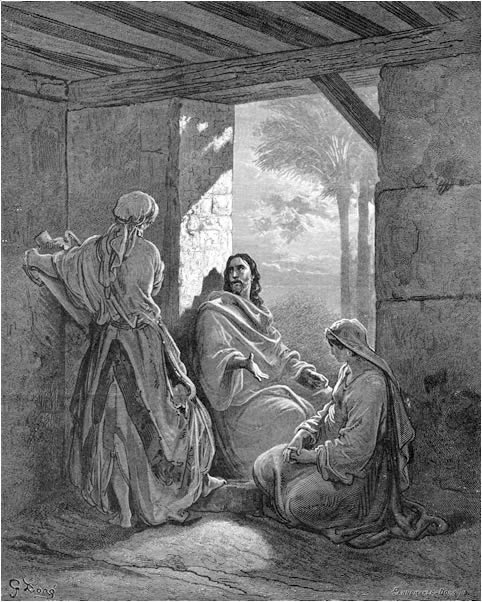
Christ's entertainment at Martha's house, the reproof he gave to her for her care about the world, and his commendation of Mary for her care about her soul,
The Nineteenth Century5 voices
A commentator
Jamieson, Fausset & Brown1802–1910
Commentary Critical and Explanatory on the Whole Bible (1871)
proposed
THIS do, and life is thine"--laying such emphasis on "this" as to indicate, without expressing it, where the real difficulty to a sinner lay, and thus nonplussing the questioner himself.
quarantine:debris (2026-07-29) — odd-straight-quotes
A commentator
J.C. Ryle1816–1900
Expository Thoughts on the Gospels: Luke (lightly modernized text, Grace Gems edition) (1858)
proposed
We should notice in this passage — the solemn question which was addressed to our Lord Jesus Christ. We are told that a certain lawyer asked Him, "What shall I do to inherit eternal life?" The motive of this man was evidently not right. He only asked this question to "test" our Lord, and to provoke Him to say something on which His enemies might lay hold of. Yet the question he propounded was undoubtedly one of the deepest importance. It is a question which deserves the principal attention of every man, woman, and child on earth.
A commentator
J.C. Ryle1816–1900
Expository Thoughts on the Gospels: Luke (lightly modernized text, Grace Gems edition) (1858)
proposed
We should notice in this passage — the solemn question which was addressed to our Lord Jesus Christ. We are told that a certain lawyer asked Him, "What shall I do to inherit eternal life?" The motive of this man was evidently not right. He only asked this question to "test" our Lord, and to provoke Him to say something on which His enemies might lay hold of. Yet the question he propounded was undoubtedly one of the deepest importance. It is a question which deserves the principal attention of every man, woman, and child on earth. We are all sinners — dying sinners, and sinners going to be judged after death. "How shall our sins be pardoned? With what shall we come before God? How shall we escape the damnation of Hell? Where shall we flee from the wrath to come? What must we do to be saved?" These are inquiries which people of every rank ought to put to themselves — and never rest until they find an answer. It is a question which unhappily few care to consider. Thousands are constantly inquiring, "What shall we eat? What shall we drink? With what shall we be clothed? How can we get money? How can we enjoy ourselves? How can we prosper in the world?" Few, very few — will ever give a moment's thought to the salvation of their souls. They hate the subject. It makes them uncomfortable. They turn from it and put it away. Faithful and true is that saying of our Lord's, "Wide is the gate and broad is the way that leads unto destruction — and many enter through it. But small is the gate and narrow the way that leads to life — and only a few find it." (Matthew 7:13-14.) Let us not be ashamed of putting the lawyer's question to our own souls. Let us rather ponder it, think about it — and never be content until it fills the first place in our minds.
OUR text is the whole story of the Samaritan, but as that is very long, let us, for our memories' sake, consider the exhortation in the 37th verse to be our text. "Go, and do you likewise." There are certain persons in the world who will not allow the preacher to speak upon anything but those doctrinal statements concerning the way of salvation which are known as "the Gospel." If the preacher shall insist upon some virtue or practical Grace, they straightway say that he is not preaching the Gospel, that he has become legal and is a mere moral teacher. We do not stand in any awe of such criticism, for we clearly perceive that our Lord Jesus Christ, Himself, would very frequently have come under it. Read the Sermon on the Mount and judge whether certain people would be content to hear the likes of it preached to them on the Sabbath. They would condemn it as containing very little Gospel and too much about good works. Our Lord was a great practical Preacher. He frequently delivered addresses in which He made answer to questioners, or gave direction to seekers, or upbraided offenders—and He gave a prominence to practical truth such as some of His ministers dare not imitate! Jesus tells us over and over again the manner in which we are to live towards our fellow men and He lays great stress upon the love which should shine throughout the Christian character. The story of the good Samaritan, which is now before us, is a case in point, for our Lord is explaining, there, a point which arose out of the question, "What shall I do to inherit eternal life?" The question is legal and the answer is to the point. But let it never be forgotten that what the Law demands of us, the Gospel produces in us. The Law tells us what we ought to be and it is one objective of the Gospel to raise us to that condition.
OUR text is the whole story of the Samaritan, but as that is very long, let us, for our memories' sake, consider the exhortation in the 37th verse to be our text. "Go, and do you likewise." There are certain persons in the world who will not allow the preacher to speak upon anything but those doctrinal statements concerning the way of salvation which are known as "the Gospel."
The words behind it
9 Greek wordsEvery Greek word of this verse in the order it stands, with what it means and the door to its own study. The last column counts the times a word stands in the whole Bible: the rarer the word, the more the places it appears belong together.
| Greek | Sound | Meaning | Word study | In the Bible |
|---|---|---|---|---|
| Εἶπεν | eipen | He said | G2036 → | 925 times |
| δὲ | de | then | G1161 → | 2765 times |
| αὐτῷ· | auto | to him; | G846 → | 5565 times |
| ὀρθῶς | orthos | Correctly | G3723 → | 4 times |
| ἀπεκρίθης· | apekrithes | you have answered; | G611 → | 231 times |
| τοῦτο | touto | This | G3778 → | 1381 times |
| ποίει | poiei | do perform | G4160 → | 569 times |
| καὶ | kai | and | G2532 → | 9120 times |
| ζήσῃ.¶ | zese | you will live. | G2198 → | 139 times |
ΕἶπενHe said
eipenG2036 →925 times
δὲthen
deG1161 →2765 times
αὐτῷ·to him;
autoG846 →5565 times
ὀρθῶςCorrectly
orthosG3723 →4 times
ἀπεκρίθης·you have answered;
apekrithesG611 →231 times
τοῦτοThis
toutoG3778 →1381 times
ποίειdo perform
poieiG4160 →569 times
καὶand
kaiG2532 →9120 times
ζήσῃ.¶you will live.
zeseG2198 →139 times
A shaded row is a word that stands 400 times or fewer in the Bible.
The walk
8 stopsEach card is a verse this one points to, and under it the verses that one points to in turn. Where several paths arrive at the same place, that place is listed first: the text keeps returning to it.
Through
Matthew 19:17“Why do you ask Me about what is good?” Jesus replied. “There is only One who is good. If you want to enter life, keep the commandments.”
it leads to
- Leviticus 18:5
Keep My statutes and My judgments, for the man who does these things will live by them. I am the LORD.
Reached by 3 separate paths from here.
- Leviticus 18:5
Through
Leviticus 18:5Keep My statutes and My judgments, for the man who does these things will live by them. I am the LORD.
it leads to
- Romans 10:5
For concerning the righteousness that is by the law, Moses writes: “The man who does these things will live by them.”
Reached by 3 separate paths from here.
- Galatians 3:12
The law, however, is not based on faith; on the contrary, “The man who does these things will live by them.”
Reached by 2 separate paths from here.
- Ezekiel 20:13
Yet the house of Israel rebelled against Me in the wilderness. They did not follow My statutes and they rejected My ordinances—though the man who does these things will live by them—and they utterly…
Reached by 2 separate paths from here.
- Ezekiel 20:11
And I gave them My statutes and made known to them My ordinances—for the man who does these things will live by them.
- Ezekiel 20:21
But the children rebelled against Me. They did not walk in My statutes or carefully observe My ordinances—though the man who does these things will live by them—and they profaned My Sabbaths. So I…
- Romans 10:5
Through
Nehemiah 9:29You admonished them to turn back to Your law, but they were arrogant and disobeyed Your commandments. They sinned against Your ordinances, by which a man will live if he practices them. They stubbornly…
it leads to
- Nehemiah 9:16
But they and our fathers became arrogant and stiff-necked and did not obey Your commandments.
- Nehemiah 9:26
But they were disobedient and rebelled against You; they flung Your law behind their backs. They killed Your prophets, who had admonished them to return to You. They committed terrible blasphemies.
- Nehemiah 9:16
Where this verse is studied
On this page
Studies20
On this verse
On this chapter
About Luke
This page draws on 14 works. Open the list of works
This page draws on Adam Clarke, Commentary on the Bible; Ambrose of Milan, Commentary on Luke; Bede, On the Gospel of Luke; Bonaventure, Commentary on Luke, Chapter 10; Charles Spurgeon, The Metropolitan Tabernacle Pulpit, Sermon No. 1360: “The Good Samaritan” (lightly modernized text, CCEL edition); Cyril of Alexandria, COMMENTARY ON LUKE, HOMILY 69; Cyril of Alexandria, Catena Aurea by Aquinas; J.C. Ryle, Expository Thoughts on the Gospels: Luke (lightly modernized text, Grace Gems edition); Jamieson, Fausset & Brown, Commentary Critical and Explanatory on the Whole Bible; John Gill, Exposition of the New Testament; John Gill, Exposition of the New Testament (1746-1748); Matthew Henry, Commentary on the Whole Bible; Origen of Alexandria, Catena Aurea by Aquinas and Theophylact of Ohrid, Commentary on Luke.